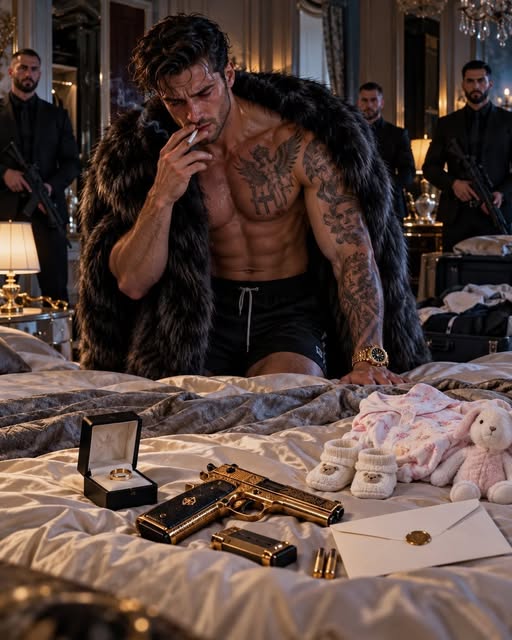
Our daughter was born at dawn, in the little clinic above the pharmacy where this whole story had hidden its hinge, and she arrived furious and perfect and six pounds nine ounces, with her mother's mouth and a head of black hair and a cry that Ruth the midwife described, professionally, as "having no respect for the hour." Emily held her first. Then Emily looked at me standing at the foot of the bed with my hands hanging useless and my heart somewhere outside my body entirely, and said, "Well. Come and meet her, Ethan. She's been considering it for months. I think the review is in."
Hope. We named her Hope Carter, which the town considered on-the-nose and Emily considered accurate, and her brother's name went on the same page of the same book, because in our family we say both names or we say nothing: Jonah, who we lost, and Hope, who we didn't. I held my daughter in the crook of one arm — I, who have held my nerve through things I will never describe — and I was terrified in a way no enemy ever managed, and she opened her eyes, and they were mine. Nadia had been right, and wrong. In the end there were two people in that room with my face, and both of them were allowed to me, and neither of them had to be.
I will not pretend the road home was short. We stayed in Greyhook through the winter, in the cottage with the paper stars, and I ran what was left of my empire by telephone in the inn's back room like a man liquidating a former life — because I was. The casinos I sold down to a minority and a signature. The docks I put into a trust with men whose names meant something cleaner than mine attached, and rules written down, and a lawyer — an actual lawyer, Emily enjoyed that detail for weeks — to read them aloud to me monthly in case I forgot I no longer owned the weather. The war with the Blakes cooled into the kind of armed truce our world calls peace; Victor Blake sent, through three intermediaries, a christening gift of obscene value and no card, which Emily had me return with a photograph of the harbor and four words in her own hand: "She is not weather." He never wrote again. Empires understand each other, in the end, through exactly one language, and my wife, it turned out, was fluent.
Madison married a shipping heir from Savannah in the spring, beautifully and publicly, and I wish her the specific mercy of being understood by whoever shares her house. That sentence took me a year to be able to write. It's true now.
In April, Emily said the thing I had stopped rehearsing hearing. We were on the shore path, the three of us, Hope asleep against my chest in a carrier with her fist in her mouth, and Emily stopped at the turn of the point and said, "I want to go home for a while. Not forever — I reserve the cottage and the point and Tomaszek's rye bread in perpetuity. But I want her to know the house. I want to watch you be her father in the place where you weren't mine." She said it plainly, the way she had said everything since the day she became the author of this family, and I said the only two words that mattered, which were "Yes, Emily," in the tone a man uses for vows.
The house had kept her shape the way a shore keeps a tide line. Mrs. Doyle came back — at double wages and with conditions, which I signed like a treaty, because they were just. Marcus took up his post again, though his post now included, by Hope's decree and his complete surrender, being a horse. And on the first night home I came up the stairs at some small hour with a warmed bottle, and I stopped in the doorway of the nursery we had built out of the room that used to hold my guns — the guns are gone, all but one, and that one sits in a case at the bottom of the garden wall beside a small stone with my son's name on it, where Emily put it, saying a thing can be a grave marker or a weapon and she had decided which — and in the doorway I stopped, because Emily was there ahead of me, in the rocking chair, with Hope asleep on her shoulder, and on Emily's left hand, catching the low light, was the ring.
She had found it herself. I had kept it three years in a drawer of my desk, on no chain and under no stone, because I had understood that it was not mine to offer again — only mine to keep safe in case she ever asked where it was. She had asked that morning, while I was making her tea wrong, and I had told her — drawer, left side, under the deed to the Greyhook cottage, which is in her name — and she had nodded and gone quiet, and I had gone about my day being terrified in the new, domestic way, and now here it was on her hand, where it had been made to be, and she looked up at me in the doorway with our daughter asleep against her heart and she said:
"Ask me properly this time, Ethan."
Thirteen years after the first time, in a nursery doorway, with a bottle going cold in my hand, I went down on one knee — the same knees that had buckled beside our bed at 2:47 in the morning of the worst day of my life — and I asked my wife to marry me, properly, with nothing arranged and nothing assumed, like a man asking a question whose answer he has not purchased. And Emily Carter, who had left me in the night with fourteen pages and a sentence for a headstone, smiled the smile from the photograph — the one from before she taught herself not to — and said, "I already did, once. This time, keep up."
Leaving Greyhook took a full day of goodbyes, which Emily conducted like a head of state and I conducted like a man being read out of a religion. Cap came down from the harbor wall with a parcel of smoked fish wrapped in paper and a handshake that lasted one beat longer than business. Tomaszek closed the bakery for an hour — closed it, in April, on a Saturday — and stood in his doorway with his arms folded and his whole Gdansk childhood in his face, and said to me, in front of Emily, "You were terrible at the counter. Come back in the summer and be terrible again. The grandmothers ask for you. I have told them you are a reformed pirate. It is good for business." Mrs. Abernathy charged me for an extra night I hadn't stayed, "for the roof," and then refused the money, "for the girl," and the whole transaction entered town legend before our car reached the harbor road. Emily kept the cottage — the deed in her name, the paper stars still turning above the crib we'd brought with us and would bring back, the tomatoes staked for a summer we intended to spend half in exile and half at home, a border between two countries that had finally signed their treaty. On the point, she stopped the car. We stood in the wind with Hope asleep in the back, and Emily looked at the water the way she had looked at it alone all those evenings, hand low, holding everything down. "I used to stand here and practice not missing you," she said. "I got very good at it. World's best. Standing here telling you that is the strangest part of my whole life." Then she got back in the car, and I drove us home at five miles under the limit the entire way, with my daughter asleep and my wife awake beside me reading road signs aloud for no reason, and it remains the finest journey of my life.
Last autumn, the arithmetic got its final examination. A coalition of crews moved on the Bayonne docks during a dispute the trust was handling too slowly, and two men I had known for twenty years appeared at our gate on a Sunday — at the house, on a Sunday, which tells you the size of their emergency — asking me to take back the chair for ninety days. Just ninety days. Just until the water calmed. They stood in my hall making their case to the man I used to be, and Hope was asleep upstairs, and Emily was in the kitchen doorway with a dish towel over her shoulder, saying nothing, doing the arithmetic of her own. And I felt it — I won't lie in this record — I felt the old chair fit itself to me like a hand remembering a glove. Ninety days. The phone already warm. The whole machine idling at the curb of my life, washed and fueled, exactly where I'd left it.
I looked at Emily. She did not shake her head. She had set her terms a year and a half before, on a porch, in another life — you get credit for Tuesdays — and she was not going to spend it now rescuing me from a decision. It was mine. That was the last test, and we both knew it was the last test, and it was administered in a hallway by men who thought they were offering me a crown.
"Vince has the trust's authority," I said. "The rules are written. If the rules are too slow, the answer is better rules, not me." I walked them to the gate myself, because courtesy costs nothing and I had learned to pay in that currency. "I'm not the chair anymore, gentlemen. I'm a father with a sleeping daughter and a wife who numbers the days by what they hold. Come back when it's about either of them. It won't be. That's rather the point."
When I came back into the kitchen, Emily was writing in the notebook. The notebook lives on our counter now — the school notebook's successor, bought by her, kept by both of us, in the open, where anyone in the house can read it, which is the entire design. We number the days differently now. That evening she had written, in her steady hand, the hand of the fourteen pages: "Day 212: He was offered the world back today, at the gate, for ninety days. He said no in the hallway so the baby wouldn't wake. Progress, of a kind." She turned it toward me without ceremony. "Your turn, Ethan. You always did need the last word. It's your one remaining vice. I've decided to keep it."
So I wrote under it, in mine: "Day 212: She laughed at breakfast. The baby has two teeth and her father's temper about porridge. Jonah's stone has moss on it now, which Emily says is him settling in. I answered the phone on the first ring all day. It was only the baker. It counts. It all counts."
So this is the end of it, and it is also 2:47 a.m. It is always, in our house, eventually 2:47 a.m. — the hour I used to come home smelling of other people's rooms, the hour she left, the hour her letter waited for me under her ring. Tonight it is the hour our daughter wakes, in the blue dark, with her one clear complaint, and I am already sitting up before the second cry, already reaching, already answering on the first ring of her, because my phone is never off now and neither am I, not to them, not ever again. Emily watches from her pillow, half asleep, entirely awake in the way of mothers, and as I lift Hope into the crook of my arm and the house settles around the three of us like water closing over a stone, my wife says, into the dark, the sentence I spent an empire and a war and eleven weeks in a town named after nothing to earn the hearing of:
"There you are," she says. "You came home."
I did. I do. I will keep doing it, at 2:47 and at every other hour, for as long as there is a home with her name on the deed and her hand in the dark finding mine. That is the whole of the law now.
The rest is just the days, and we number them differently these days. We number them by what they hold, not by what they cost.