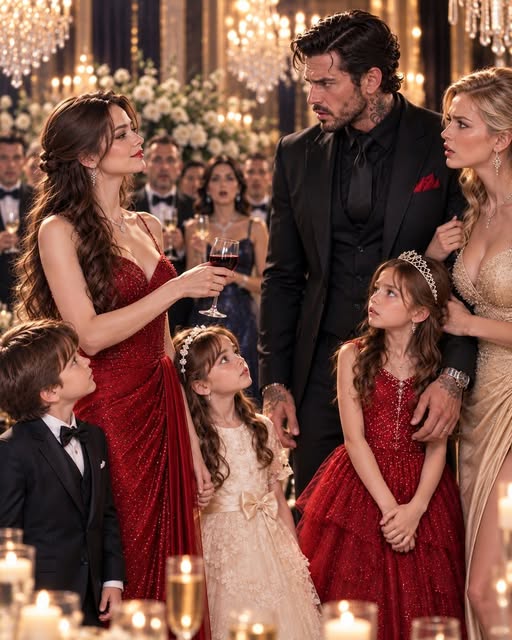
For three years, I was married to the most powerful man in Chicago, and almost no one on earth knew it.
My name is Claire Bennett. Before I was a secret, I was an event planner — a good one. I worked for a boutique firm that produced charity galas and foundation dinners for the kind of people who bid on silent auctions the way the rest of us buy groceries. That is how I met Alexander Moretti. His family's foundation hired my firm for its autumn gala, and for six weeks I rebuilt that event from a sleepy obligation into the night everyone in Chicago wanted an invitation to. Alexander noticed. Alexander noticed everything; it was the talent that had carried a shipping empire's heir into the head of a family whose real business nobody discussed at dinner.
He courted me the way he did everything — quietly, completely, and with terrifying focus. Flowers with no card. A driver appearing in the rain. Conversations that lasted until the sky went gray, in which this guarded, dangerous man told me things I later understood he had never told anyone: that he was tired of being feared, that he wanted one room in his life where nobody wanted anything from him.
I was twenty-four the day I married him in a courthouse ceremony so small that the only witnesses were his lawyer, his driver, and a clerk who never looked up from her screen. There were no flowers. There was no music. His own mother was not told. Alexander held my hands in that gray little room and promised me the secrecy was temporary — his world was in the middle of a war I didn't fully understand, a rival family was watching everyone he loved, and a public wife would be a target painted on my back.
"Just trust me," he said. "When the time is right, everyone will know."
I believed him. God help me, I believed him for three years.
I lived in his penthouse, but I entered through the service garage. I planned other women's galas by day and cooked his dinners by night, eating half of them alone, because his evenings belonged to the family. I wore my wedding ring on a chain beneath my clothes, pressed against my heart like a secret too dangerous to say out loud. On the rare nights he came home before midnight, he would find that ring with his fingers in the dark and hold it like it meant something. And I would let myself believe that it did.
There were tests along the way, and he failed every one. A cousin of his, visiting from Palermo, found me making coffee in the penthouse kitchen one morning and asked, pleasantly, who I was. Alexander, standing in the doorway, answered before I could: "A friend of the house." I smiled and poured the coffee. That night he apologized with a weekend in Paris booked under a false name, and I forgave him, because underneath everything I understood his fear.
The second year, on his birthday, the family held a dinner for forty people in the penthouse I had decorated myself. I chose the flowers. I wrote the menu with the chef. I hung the lights on the terrace with my own hands. And when the guests arrived, I ate in the kitchen with the staff, because Sophia had drawn up the seating and there was, somehow, no chair for me. Alexander found me there at midnight, after everyone had gone, sitting among the cooling dishes. He looked stricken. He said my name like an apology. He said, "Next year." I nodded, because I loved him, and because a woman in love can turn "next year" into a life raft and float on it for a very long time. What I never understood — not until the end — was that a secret kept long enough stops being protection. It becomes a habit. And Alexander had grown very comfortable with a wife the world couldn't see.
The banquet was the Moretti Foundation's spring gala, the biggest night of the family's year. Every powerful name in Chicago would be there: judges, aldermen, shipping magnates, old families with old money and older sins. Three days before it, a photograph began circulating among the city's gossip pages — a grainy shot of me climbing out of Alexander's car outside the Drake, his hand at the small of my back. It was nothing. It was everything.
I had seen the photograph before he ever mentioned it. It arrived on my phone at dawn, sent by an old colleague with three question marks. Underneath it, strangers were already busy in the comments: Who is she? Nobody. Some girl. One man wrote that Moretti would never be caught dead with a nobody, and four hundred people liked it. I read that sentence twice in my own kitchen, wearing my husband's ring.
Alexander's voice was flat when he called me into his study. "You'll arrive separately tonight. Wait ten minutes after me before you come in, and enter through the east doors. No photographs."
I stared at him. "We're married, Alexander. What exactly are you afraid people will misunderstand?"
"Claire, don't make this complicated." He didn't look up from the cufflinks he was fastening. "Sophia has the evening arranged down to the minute. Just follow the plan."
Sophia. His secretary. Sophia Reynolds, who scheduled his days, managed his correspondence, stood at his right hand at every public event, and looked at me — on the rare occasions our paths crossed — the way you look at a stain on a carpet.
Still, that night, dressing in the empty penthouse, I let myself hope. It was three years to the week since the courthouse. Three years of patience, of garages and back stairs and a ring against my skin. Surely, I told myself as I fastened the chain beneath the neckline of my dress, surely the time was finally right.
I entered the ballroom alone, ten minutes behind him, through the east doors exactly as instructed.
The room was a sea of black ties and diamonds. A string quartet played near the marble staircase. Waiters moved through the crowd with silver trays, and the chandeliers threw gold light over everything. Near the entrance, on an easel, stood the evening's seating chart, and before I could stop myself I searched it for my name. I wasn't on it — of course I wasn't on it. The head table read like a roll call of power: Alexander, his mother Francesca, two judges, a senator's widow. And at Alexander's right hand, in elegant calligraphy: S. Reynolds.
Across the room, Alexander stood at the center of a circle of powerful men, laughing at something, a glass in his hand — and Sophia stood beside him in a red dress, close enough that her shoulder brushed his arm, in the exact place a wife should have been standing.
I was moving along the edge of the room, looking for a quiet corner to disappear into, when a voice stopped me.
"You planned our autumn gala, three years ago. The one with the white roses."
Francesca Moretti stood in front of me — Alexander's mother, seventy-four years old, small and straight as a blade, with her son's gray eyes and none of his caution about using them. I had met her exactly twice, both times as hired help.
"I never forget a face that does good work," she said. "And tonight you are — a guest?" She asked it the way other people lay down a card they intend to win with.
"Something like that, Mrs. Moretti."
She studied me for a moment longer than was comfortable, and something in her expression shifted — not softness, exactly. Recognition of a puzzle. "Enjoy your evening, Miss Bennett," she said, and moved on into the crowd.
I took a glass of water from a tray and told myself to breathe.
It took less than five minutes for Sophia to find me.
She glided over with two women from a shipping family in tow, smiling the sweet, poisonous smile I had seen her practice in mirrors. As she passed, before the performance began, she murmured just for me: "You're embarrassing yourself, darling. You always do."
Then, louder, for the audience she had brought with her: "Miss Bennett, I didn't realize you were invited." Her eyes traveled down my dress and back up. "Or did you come hoping Mr. Moretti would finally notice you?"
Someone laughed. Then someone else did.
A man I vaguely recognized — a banker, a friend of the family — leaned in with a grin. "Getting out of his car doesn't make you his woman, sweetheart."
More laughter. Heads were turning now. Glasses paused halfway to mouths. The quartet played on, oblivious, and I stood in the middle of that golden room with my face burning, waiting for the one thing I had waited three years to hear.
I looked at Alexander.
He had heard. Of course he had heard — the whole room had heard. He was watching me across fifteen feet of marble floor, his expression carved from ice.
One sentence. That was all I needed. One sentence and three years of hiding would have been worth it.
She's my wife.
He never said it.
Instead he set down his glass, and in a voice cold enough to silence the laughter around us, he said, "Claire, there are important people here tonight. Don't cause a scene."
Don't cause a scene.
The woman beside Sophia actually gasped, then covered it with a smile. The banker turned away, satisfied, the matter settled: I was exactly what they said I was. Nobody. A delusion with a pretty dress.
And then Sophia — slowly, deliberately, while I watched — slipped her arm through Alexander's.
And Alexander let her.
I want to be honest about that moment, because I have turned it over in my mind ten thousand times in ten years. The laughter didn't break me. The stranger's cruelty didn't break me. What broke me was his arm, hanging at his side, not moving. Accepting hers. In front of everyone.
I set my untouched water glass down on a passing tray with a hand that did not shake. I was proud of that hand. I walked the length of that ballroom with my spine straight and my head high, past the tables of people already turning back to their dinners and their drinks and their small amusements, and nobody — not one person — tried to stop me.
My car was still warm when I got home. I don't remember the drive. I remember standing in the dark penthouse with my coat still on, the chain at my throat suddenly unbearably heavy, listening to the silence of a home that had never once, in three years, been allowed to call me its mistress in public.
I didn't cry. That surprised me. I made tea I didn't drink. I took off the dress and hung it carefully in the closet, the way you handle something that belongs to a life you're about to stop living. I opened the drawer where I kept the only photograph of us that existed — the two of us laughing in a vineyard in Napa, taken by a stranger who thought we were just a couple in love — and I turned it face-down. I sat on the edge of the bed I shared with a man the world believed was single, and I waited for him to come home and explain to me what I was to him.
While I waited, I rehearsed one question, the only one that mattered, the one I had swallowed a hundred times at dinners and doorways and in the back seats of cars. Tonight I would ask it out loud. Tonight, whatever he answered — or didn't — I would finally believe him. I took the chain from beneath my dress and held the ring in my palm, warm from my skin, and I thought about a gray little room and a man holding my hands, promising me the whole world just as soon as the world was safe. The world was never going to be safe. That was the thing I had never let myself know.
I didn't wait long.
At half past midnight, headlights swept across the penthouse windows. A car door slammed in the garage below. The elevator rose. And when the front door of our home finally opened, Alexander Moretti came through it like a storm coming off the lake — furious, jaw clenched, eyes black with rage.
At me.