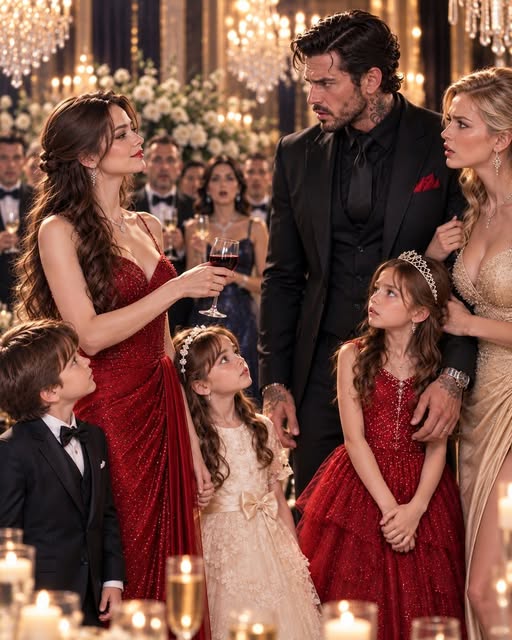
The twins were born on the coldest night of February, in a county hospital in Wisconsin, while a storm took the power out twice and Maggie Doyle held my hand in the dark and did the breathing with me like we were back at one of her weddings and the bride was hyperventilating in a corridor.
Leo came first — furious, red-faced, all lungs. Luna came four minutes later, calm as a duchess, and looked around the room as if she were reviewing it. The nurse turned Leo to clean him and went quiet, and then she smiled at me. "Look at that," she said. "Born with a little moon." Behind my son's left ear there was a birthmark, small and perfect: a dark crescent, curved like the edge of an eclipse. I didn't know then that it was an old Moretti mark, carried down the male line of that family for five generations. I only knew that it was his, and he was mine, and for the first time in almost a year I cried from something other than grief.
I will not pretend the years that followed were a montage. They were a siege. There were nights in the cottage behind Maggie's inn when both babies cried in shifts like they had planned it, and I cried with them, silently, so as not to waste the noise. There were weddings I planned with a baby strapped to my chest under a blazer, timelines in one hand and a bottle warming in my suit pocket. There was the winter the inn's pipes burst and I paid the plumber with the last of the pawned-earrings money and ate staff meals for a month and told no one.
But here is the thing nobody tells you about being left with nothing: nothing is a very clean place to build from. Nobody was arranging my life anymore. Every piece of it was mine, including the failures, and I had been a woman whose own wedding had six guests and no flowers — I knew exactly how much of a life is decoration, and how much is frame.
The frame held. My weddings got written up. A bride's mother in Milwaukee recommended me to a hospital board; the hospital board recommended me to a bank; the bank's holiday gala won a regional award, and suddenly Bennett Events had a waiting list and a staff of four and an office with my name — my name, Bennett, the only one I'd ever earned — in brushed steel on the door. When the twins were five, I bought us a house with a yard and a mortgage that terrified me. When they were seven, I bought out Maggie's events book when she retired, and she cried and called me her best investment. When they were nine, Leo was serious and stubborn and kept a list of rules he'd written for the protection of the household, in which Rule One was "Nobody makes Mom cry," and Luna was fearless and funny and had inherited, God help me, her father's way of going very quiet and very still when she was deciding whether to forgive you.
They asked about their father the way children do — in pieces, over years. I never lied to them, and I never poisoned the well, though some nights the poison was right there in my mouth, asking to be poured. I told them his name was Alexander. I told them he lived in Chicago, in a world with rules that hadn't had room for us. I told them being left was about grown-ups failing, not about two children being unlovable — that they were the most loved people on the planet, and that if he had known them, really known them, everything would have been different. I believed that last part on my good days. On my bad days I remembered a marble counter and a plain gold ring lying on it, and I believed nothing at all.
What I never told them was his surname. Moretti was a word that opened doors and graves all over Chicago, and I would not have my children carrying it like a key they might be tempted to use — or like a target, the way their father once claimed a wife would be. On that much, at least, Alexander and I had always agreed: his world ate the people it loved in public.
When they started kindergarten, the teacher, Mrs. Alvarez — who had taught half the town and buried two husbands and feared nothing on earth — called me in after the first week. On the classroom wall, among thirty crayon families, hung Leo's: a woman with yellow hair, two children holding her hands, and next to them a tall figure drawn entirely in outline, left uncolored, its face blank. "He says that's his dad," Mrs. Alvarez told me. "He says his dad is a question mark. I thought you should know he isn't sad about it, exactly. He's just — waiting to color it in."
I drove home with the drawing in a folder on the passenger seat like it was made of glass. That night, after the twins were asleep, I sat at the kitchen table and did the arithmetic I had been refusing to do for six years: every year I protected them from his world, I was also the wall standing between them and the truth, and walls don't get to choose how long they stand. One day they would be old enough to go looking. One day the outline would get colored in whether I held the crayon or not. I put the drawing in the drawer of my desk, under the contracts, and I told myself the day was far away and the man was farther.
I almost believed me.
So Leo and Luna Bennett grew up in clean lake air, with a mother who worked too much and laughed a lot and checked their homework at midnight, in a town where nobody had ever heard of the Moretti family. And if, some evenings, I stood at the cottage window with the old habit of listening for an elevator that didn't exist — well. A woman is allowed her ghosts. Mine had never once come looking for me, and I had made my peace with being unlooked-for.
I was wrong about that, in almost every particular. But I wouldn't learn it for ten years — and by the strangest road. Not through a detective, or a deathbed, or a chance encounter.
Through a contract.
In Chicago, in the penthouse I had left, Alexander Moretti did something in the first months after I vanished that he would rather have died than admit: he waited.
He told himself I would come back when the money ran out — that was the story that fit, the story in which he was not the villain of a ballroom. When four months passed and then six, pride curdled into something he couldn't name, and he did the thing powerful men do instead of apologizing. He sent an investigator to find me, not to bring me home — that is what he told himself, and the investigator, and the walls — only to confirm I was alive and as comfortable as he'd paid for me to be.
This is what the investigator brought him, delivered in a folder by Sophia's own hand, because by then Sophia had arranged to be the door through which everything reached him: a wire confirmation. Five million dollars, disbursed from the settlement account three days after the divorce was final, into an offshore account in my name. And beneath it, a letter, on plain paper, in handwriting that looked exactly like mine — because Sophia had three years of my notes and lists and place cards to practice from, and a signature she had watched me make across a conference table while my hand shook.
The letter said I had taken the settlement and chosen to disappear. It said I had never loved the life and, reading between its neat lines, that I had never quite loved him. It wished him well. It was, Alexander told me years later, the cruelest document he had ever read, because it was written to be believed by exactly one man: the one who had let his wife be laughed out of a ballroom and had been waiting for a reason to make that her fault instead of his.
He found his reason. He stopped looking. He told his mother the matter was closed — he used Sophia's own phrase, though he didn't know it — and when Francesca, who missed nothing and believed less, asked how a woman disappears with five million dollars and buys no house, hires no lawyer, leaves no footprint anywhere on earth, Alexander said the words that ended the subject for a decade: "Money spends quietly when a woman wants to be forgotten."
Two years after I left, he married Sophia Reynolds, in the cathedral, in front of six hundred people, with his mother sitting in the front pew wearing black that everyone politely agreed was navy. It was a good merger. Sophia's father's shipping contracts doubled the family's legitimate tonnage; Sophia herself was flawless in public, a hostess of terrifying competence, and if the marriage was a well-run company rather than a love story, Alexander had convinced himself that companies were what survived. A daughter came a year later — Isabella, bright and imperious and adored — and Alexander was, in his distant, dutiful way, a decent father to her. He built her a childhood with no service elevators in it. He was proud of that. He did not examine why.
Once, at a gala very much like the one where he'd lost me, he saw a woman across a ballroom with my walk, and his heart stopped so hard he had to set down his glass. It wasn't me. It was never me. He stood there among the gold light and the quartet music and felt the old, familiar shame rise up — and then, right on schedule, the saving anger: she took the money, she wrote the letter, she chose this. The shame went down under it like a stone in the lake.
He never once asked himself who had handed him that folder. That was the genius of it. The best lies are not the ones we're told. They're the ones we're handed at the exact moment we're desperate to stop hurting.
And so ten years turned, in Chicago as in Wisconsin, and the Moretti Foundation prepared to celebrate its sixtieth anniversary with the largest gala in its history — three hundred guests, two former governors, a sitting senator — and put the production contract out to a blind bid, because the board's new chair was a stickler for clean process.
Forty-one firms bid. The committee scored the portfolios without names attached.
My operations director, Dana, put the signed acceptance packet on my desk on a Tuesday morning in April, while Leo and Luna were doing long division at the conference table because the school had a pipe problem and my office had better snacks. "We got it," Dana said, grinning. "The big one. Chicago. It's going to put us on the national map, Claire."
I turned the pages of the client packet — venue, headcount, security requirements, the usual language — and at the top of the second page, in sober foundation type, I found the words I had spent a decade not reading.
THE MORETTI FOUNDATION — SIXTIETH ANNIVERSARY GALA.
The room went very quiet around me. Somewhere far away, Dana was still talking about deposits. Leo looked up from his long division and said, "Mom? You look like you saw a ghost."
"Chicago, right?" Luna said, swinging her legs. "Is Chicago far?"
I looked at my children — my son with his serious eyes and the small dark moon behind his ear that I suddenly, sickeningly, could imagine on another man's childhood photographs; my daughter with her still, deciding stare that I had been pretending for nine years came from me — and then I looked down at the contract, and at the signature line waiting at the bottom of the last page, and I picked up my pen.
"No, baby," I said. "Chicago isn't far at all."
I signed.