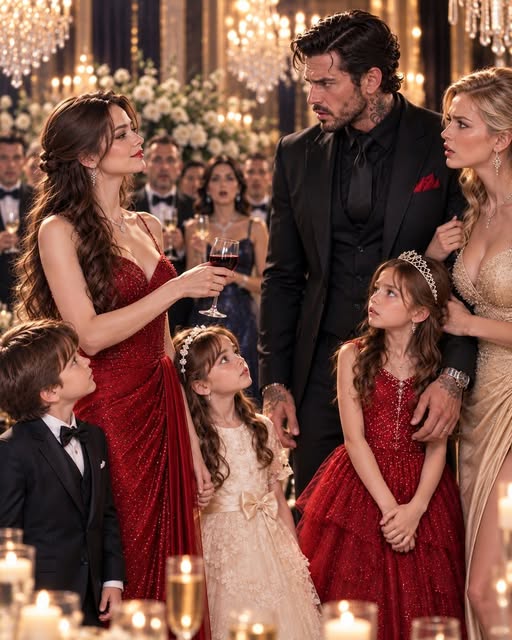
The Astor Grand had kept the ballroom exactly as I remembered it, the way rich places keep everything: as if time were a rumor that happened to other people.
Same marble staircase. Same chandeliers, throwing the same gold light. Same quartet corner by the windows, where a new set of musicians would play on Saturday night while three hundred people ate off the Moretti Foundation's china. I stood in the middle of that room on Friday morning in work boots, with a clipboard under my arm and a tape measure on my belt, and I waited to feel something large. What I felt was mostly professional: the dance floor wanted two more meters, the step-and-repeat was crooked, and somebody's assistant had ordered the wrong lilies.
Ten years is a long time. A room can hold your worst memory and still, on a Friday morning with the work lights up, be mostly a room.
The twins were installed in our suite upstairs with Dana, a stack of room-service menus, and instructions that had been negotiated like a treaty: homework first, hotel pool second, no exploring, no elevators alone, no exceptions, Rule One applies in hotels too. They had been magnificent on the drive down — this was the biggest job of Mom's career and they treated it like a moon landing. Leo had packed a tie. He informed me he might need it "for the important dinner," and I had not had the heart to tell him there would be no important dinner for us. We were staff. We were, in the old language of that house, people who entered through the service doors.
I was checking sight lines from the stage when I heard, from the direction of the grand staircase, a small commotion of running feet and a child's laughter, cut off sharply — and then my daughter's voice, outraged and delighted at once: "Leo! You can't just—"
I came down the stairs at a speed that was not dignified.
They were at the bottom, in the corridor that led to the family lounge, and they were not alone. Leo stood at an angle in front of his sister, chin up, one hand slightly raised — nine years old and running an old, old program — because the woman who had stopped them, who had in fact caught Luna by the shoulders as she came around the corner at full tilt, was Francesca Moretti.
She was older. Smaller, if that was possible, and somehow more formidable, the way mountains get more formidable the closer you stand. She was looking down at Luna — at my daughter's face, at those gray Moretti eyes looking back up at her, entirely unafraid — and then Leo said, "Please let go of my sister," in a voice so polite and so immovable that his great-grandmother's head turned toward him slowly, like a compass finding north.
He turned his head as he spoke. The corridor light fell across the side of his face. And I watched Francesca Moretti see it: the small dark crescent behind his left ear, the mark her own husband had carried, and her father-in-law before him, and her son — her son, whose childhood photographs sat in silver frames all over her house with that same little moon behind his ear.
Her hands came off Luna's shoulders as if the child had turned to flame. She did not step back. She did something stranger: she steadied herself, very slightly, against the wall, with the fingertips of one hand, the way I had once steadied myself in a penthouse kitchen.
"Children," she said, and her voice was not steady either. "Whose children are you?"
"Auntie, they're with me." It was Marta who answered — Marta, the housekeeper, grayer and slower, who had been brought out of retirement for this gala because no one else alive knew where the foundation's old silver was kept. She came down the corridor at her best speed, and her eyes found me on the stairs, and I watched twenty recognitions cross her face in two seconds. "They're Ms. Bennett's children, ma'am. The producer's. Come on, my loves, there's cake in the kitchen with your names on it."
"Mom!" Luna spotted me and pointed up the stairs, delighted to have reinforcements. "We weren't exploring. The pool was closed for cleaning, that's different."
"We'll discuss the treaty downstairs," I said. My voice came out almost normal. I came down the rest of the stairs and took my children's hands, and I nodded at Francesca Moretti with all the professional courtesy I owned. "Mrs. Moretti. The room will be ready for your inspection at four."
She looked at me for a long time. The puzzle I had seen assembling itself in her face ten years ago — You have honest eyes, Miss Bennett — finished assembling itself now, in a corridor, with my son's birthmark still bright in the light.
"Claire," she said quietly. Not Miss Bennett. "You've been gone a long time."
"Yes, ma'am," I said. "Excuse us."
I walked my children to the kitchen for their cake, and I did not look back, and my hands were shaking so hard that Luna, matter-of-factly, held mine tighter to help.
At four o'clock I gave Francesca Moretti her inspection, as contracted.
She walked the room slowly, touching nothing, missing less than nothing: the seating, the light levels, the height of the centerpieces — "A Moretti table should let people see each other's faces. Power that can't see faces is just noise" — and at the end she stood with me by the stage and looked out over three hundred gold chairs.
"You built a company," she said. "From nothing, I gather."
"From a cottage and a waiting list, ma'am."
"And the children. A boy and a girl." She said it the way she had asked about my being a guest, laying down a card. "No husband, I am told."
"No husband, Mrs. Moretti."
"Mm." She was quiet a moment. "My son collects enemies the way other men collect wine, Miss Bennett, and he has outlived most of both. But in seventy-four years I have learned there is exactly one opponent a Moretti man has never once defeated." She turned those gray eyes on me, and they were not unkind. "The truth, arriving late. It always wins on points."
She walked away up the marble staircase, one hand on the rail, leaving me standing at the edge of my own stage with a clipboard and a pulse I could hear.
Sophia found me an hour later, in the service corridor, where I was arguing with the florist about the lilies.
She had aged the way women with money and vigilance age: expensively, and not one visible day. The red dress from ten years ago had become a cream suit; the secretary had become the wife; the arm that had slipped through Alexander's in triumph was now weighted with his diamonds. She stopped three feet from me and looked me up and down — the clipboard, the tape measure, the work boots — and her whole face arranged itself into an expression I remembered from a ballroom.
"Well," she said. "Claire Bennett. I heard a rumor the help had been promoted."
"Hello, Sophia. The lilies for your table are the white ones. I remembered you prefer them."
It wasn't a taunt — I did remember; it's my job to remember what everyone at the head table prefers. But I watched her decide to take it as a taunt, because war was the language she was fluent in, and she stepped closer and lowered her voice to the register of the service corridor, where the staff could pretend not to hear.
"I don't know what you think you're doing, crawling back here after ten years—"
"Working," I said. "The foundation's board hired my firm. Blind bid, committee scoring — your husband's chairwoman was very particular about clean process. The contract's signed, Sophia. Forty-eight hours before the gala, you can't replace the producer without explaining to that board, in writing, why their anniversary just lost its production team, its vendors, and its deposit. I'm very good at my job. It's unfortunate for both of us that I'm the best bid they got."
She stared at me. I could see her running the arithmetic — scandal versus inconvenience, the woman she had buried versus the woman standing in front of her in work boots, unhurried and unhidden.
"He doesn't know you're here," she said at last.
"No," I said. "He doesn't know a great many things. That's never been my department." I picked up my clipboard. "Excuse me. I have your gala to produce."
I walked away from her — down the same service corridor I had once entered my own marriage through — and I did not hurry, and my hand did shake that time, but only a little, and only where no one could see.
Alexander arrived at five for the final walkthrough.
I heard his voice before I saw him — that level, carrying baritone that a ballroom could be built around — and my body reacted the way it used to react to weather coming off the lake: all at once, and without asking me. I stepped behind the half-built floral wall at the stage's edge with my heart going like a fist on a door, close enough to hear him discuss sight lines and security and the order of speakers, close enough that when the walkthrough ended and the others drifted toward the bar he stayed a moment, alone, looking out over the empty room with its round tables and its gold chairs — and frowned, slightly, at nothing, the way a man frowns at a sound only he can hear.
I have wondered since what he sensed. The florist swears nobody can smell white lilies from that distance. Francesca, who was watching him from the staircase — watching him, I realized later, the way you watch a fuse burn — said afterward that he looked like a man in a photograph of his own life, discovering someone had been cropped out of it.
Then Saturday came, and the Astor Grand filled up with three hundred people and ten years' worth of Chicago power, and I stood in the control booth above the ballroom with a headset on and a run sheet in my hand, and I produced the Moretti Foundation's sixtieth anniversary gala the way I had produced a hundred other nights: perfectly, invisibly, from the dark.
The quartet played. The awards were given. The senator's widow cried in the right places. And then Alexander Moretti took the stage for the anniversary address, in a black suit with his wife in cream in the front row and his daughter beside her in a dress the color of champagne, and the room rose for him the way rooms had risen for him all his life.
"Sixty years ago my grandfather built this foundation on a single conviction," he said. "That everything a man builds is worthless unless it outlives him — in the hands of his family." He paused, and smiled down at the front row, and I knew the run sheet by heart, I had typed the cue myself, and I knew what came next, and still it went through me like a blade through paper.
"Everything I have built," Alexander said, "will someday belong to my daughter. My only daughter, Isabella."
In the control booth, the run sheet slid off my lap onto the floor.
Down the corridor, in the family lounge, two nine-year-olds were watching their mother produce a gala on a monitor, eating cake that had their names on it. And in the booth, their mother stood up, took off her headset with hands that had finally, after ten years, gone completely steady, and set it down beside the lighting board.
"Dana," I said quietly. "Take the booth."
"Claire? We're mid-show—"
"I know," I said. "There's something I have to do. And I have to do it in exactly this room."