In April, Salvatore Cavallo pled guilty to nineteen federal counts rather than face a jury with Marco DeLuca in the witness chair and his own voice on the pier cameras, and a judge sentenced him to thirty years — which, for a man of sixty-eight, was the rest of the world. Vincent did not attend. He sent no message. But on the day the sentence came down, he drove alone to a cemetery in Queens and stood for a while in front of a modest, well-kept stone — Thomas Crawford, Harbormaster, Beloved Father — and he read the dates aloud, and then he said, to the stone and to the spring wind, "It's finished. The record says what you said it would. She did it, mostly. I just carried the heavy pieces."
By spring, Pier 81 looked like a place waking from a long illness. The old harbormaster's office — where a ledger had slept under a floor for twenty years — had been restored board by board, on Vincent's order and at ruinous expense, exactly as it had stood in 2004, except for one addition: beside the door hung a brass plaque, and on the plaque, a name and a title and three words the port authority had resisted and then, confronted with a vacated conviction and a framed front page, had approved in full.
THOMAS CRAWFORD, HARBORMASTER. HE KEPT THE BOOKS HONEST.
Arabella unveiled it herself, on a bright morning with the gulls screaming over the Hudson, standing a little stiffly still — her collarbone had healed crooked by two degrees and always would — with her hand in the crook of Vincent's arm. The dockworkers had come in their hundreds, and their fathers, and some of their grandfathers, men who had crossed the street in 2005 to avoid the harbormaster's widow. Marco spoke. Then Arabella spoke, briefly, the way she did everything. "My father used to say the pier runs on two things," she said. "Cranes, and the truth. You can lose a crane and keep working. You can't lose the truth." She looked up at Vincent, sideways, the private look, the office look, six years of mornings in it. "This family lost the truth for twenty years. It has it back now. Keep it."
After the unveiling, when the speeches were done and the men were drifting back to the berths with their paper cups of coffee, an old woman in a black coat came up to the plaque and stood a long time with her palm flat against the brass, reading the name with her fingers as much as her eyes. Her name was Rosa DeLuca — no relation to Marco; the pier was full of DeLucas — and her husband had loaded ships beside Thomas Crawford for eleven years and had gone to his grave in 2011 still lowering his voice when he said the harbormaster's name, because in those years you lowered it. "He lent us the money for our daughter's christening," she told Arabella, without preamble, the way the very old tell you the important things. "Forty dollars. He wrote it in that book of his, in the back, so he wouldn't forget to refuse it back." She took Arabella's hand in both of hers, hard. "Twenty years they made us whisper him. You made them put him on the wall in brass, in the sun, where the ships come in." She nodded once, fiercely, at the plaque, at Arabella, at the whole bright morning. "Now nobody whispers."
The Foundation's first letter arrived in May, hand-delivered to the pier office by a social worker who looked profoundly uncertain about the address. It was written in careful schoolgirl English on lined paper, translated underneath in Russian, and it was from the youngest of the eleven — Ana, sixteen, from the town whose name the translator had to spell. She was in a safe house upstate. She was in school. She had written, among other things: The man who answered me in Russian said never, and it was the first true thing anyone said to me in that country, so I am going to learn English and also accounting, because the lady who visited us said books that are honest can kill bad men better than guns. Arabella read it twice at her desk, in the office that used to be a storage room for Sal's port authority files and was now hers, and then she pinned it to the corkboard beside a certain framed front page she had been given in March, and she doubled the scholarship fund's first-year intake with a stroke of her pen and a phone call Vincent pretended, wisely, not to have overheard.
She ran the rest of her life — and a good portion of his — from the office beside his, where she was no longer anyone's secretary. The Cavallo Foundation, funded with the seized Volkov-route money and a percentage of the legitimate terminals in perpetuity, paid for dockworkers' widows and prisoners' children and, in time, eleven scholarships a year for the daughters of the Port of New York. People found it very confusing, for a while, that the most feared man in New York now signed whatever the Crawford woman put in front of him. People who had met her stopped being confused.
Reynolds came to dinner once — at Arabella's insistence, at a restaurant, on neutral ground, and arrived with his hat in his hand and the expression of a man defusing something. Halfway through the meal he said, "You know I'm still going to be watching your family until I retire, Vincent."
"I'd be offended if you stopped, Ray," Vincent said. "She'd make my life hell. She keeps the books honest now."
"Eleven dockings," Reynolds said. "Eleven girls in a container and eleven years she gave that family." He shook his head. "Worst secretary you ever had, I guess."
"Best thing that ever happened to this family," Vincent said. "She just took the long way in."
In February, old Frankie Bonnano had come to the office — alone, in his good coat, hat in hand — and stood in front of Vincent's desk like a man at a confessional. "I carried your father's coffin," he said. "I sat at that table in November and I listened to that old snake lay his plans on you like a tablecloth, and I said my one sentence, and I'm here to tell you it should have been ten." He set his hat down. "Your girl there—" he jerked his chin toward the office where Arabella's voice could be heard dismantling a shipping schedule — "your girl there did with a notebook what none of us old men did with forty years of guns. The pier knows it. I came so you'd know the pier knows it." And Vincent, who had been rehearsing magnanimity and found he didn't need it, stood up and poured the old man a coffee with his own hands and sat with him until the light changed. The family, minus one chair at the head of one table in Dyker Heights, was knitting itself back together around the hole where the rot had been — slower, leaner, and watched now by two sets of honest books.
The fourteenth of March came around again — the day she had decided, three years before, was the anniversary of his collapse, the day of the soup. Vincent, who had been warned by eleven drafts of a letter and one brass plaque to pay attention to what mattered, was ready. At six in the evening he came back from the pier to find the bowl on his desk exactly where it had always been, with the steam rising and the note in her handwriting: Eat. That's an order. — A.
This time, beside the bowl, he set down two things.
The first was the framed front page — the apology, the vacated conviction, her father's name in print as an innocent man's — which he had kept in a drawer for two months, waiting until he could give it to her standing up, in spring, with no hospital anywhere in the story.
The second was smaller. It had belonged to his mother. It had waited even longer.
She read the front page first, standing in the doorway of his office with her hand pressed flat over her mouth, the way she had once pressed it over a bleeding she could not stop, and for once in six years Arabella Crawford had nothing organized to say. Then she saw the ring box, and she looked up at him, and her eyes were bright and absolutely furious with joy, in the precise expression he had once seen her turn on a caterer who had double-booked his mother's birthday.
"You are impossible, Mr. Cavallo," she said. "You ambushed me. In writing. With soup."
"And yet you're still here, Arabella."
"I am still here." She crossed the office — slowly, carefully, like a woman who has learned the price of every step and decided this one is worth it — and took his face in both her hands, and kissed him in the office where she had spent six years leaving dinners and telling truths. "Someone has to keep this place functioning."
"Marry it, then," he said. "Marry me. Keep it functioning forever. Be the family I choose, since the family I was given—" He stopped. Started again, simpler, the way she had taught him without ever teaching him. "I have been the loneliest man in New York at the head of a very long table, Arabella. You are the only person who ever sat down without being afraid of me. Don't ever sit anywhere else."
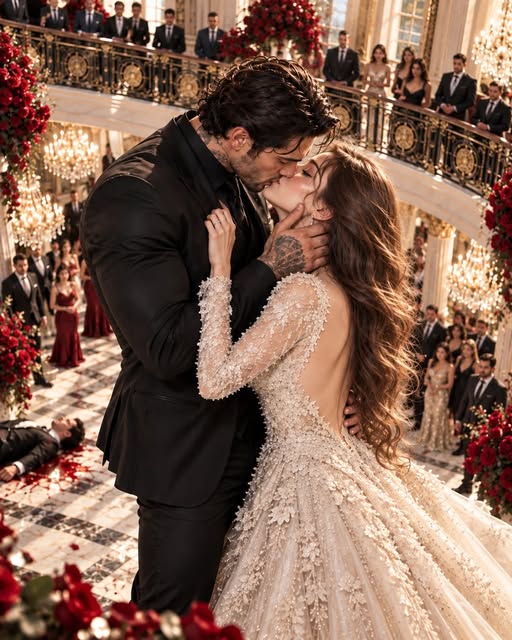
They were married in June, at dawn, on Pier 81, because Arabella said the pier had seen the worst of the story and deserved to see the end of it. Paulie drove them, and cried, and denied it. Marco came out of protection for one morning, under a sky the color of the first page of something, and stood with his hat over his heart. Delgado stood guard out of habit and then, at Arabella's direct order, sat down and ate cake like a guest. Reynolds sent a card. It said: No surveillance. One day only. — R.
There were no rings exchanged that anyone hadn't seen before — hers was his mother's, resized; his was a plain band she had chosen with the terrifying efficiency she brought to all procurement — but there were vows, because Arabella insisted on vows, on the record. Hers were short. "I spent six years keeping your books honest," she said, in front of forty dockworkers and one detective's empty chair with a card on it, "and I intend to spend the rest of my life doing the same thing, in every room, whether you like it or not. Especially when you don't like it. That's the whole vow. That's always been the whole arrangement." His took longer, mostly because he had to stop once. "I was raised at a table where love and loyalty were the same word, and the word was a lie," he said. "You taught me the difference at the cost of nearly everything. Whatever I have that's worth keeping, you kept it. It stays yours. I stay yours. When I forget to eat—" and here the whole pier laughed, and the bride, in a white dress with her scar showing like a medal, said "You won't," and he said, "—when I forget to eat, I trust the management."
And late that night, back in the penthouse above a city that feared her husband considerably less than it had in November and respected him considerably more, Arabella set a bowl of soup on the desk of a man who had worked, predictably, through his own wedding dinner.
"You're impossible, Mrs. Cavallo," he said.
"And yet," she said, "you're still here."
And for the first time in twenty years, the head of the Cavallo family laughed out loud, at his own table, with his wife beside him and nothing hidden under any floor anywhere — and the whole long night of the story, the alley and the rain and the envelope and the note, closed over them like water over a stone, and was done.