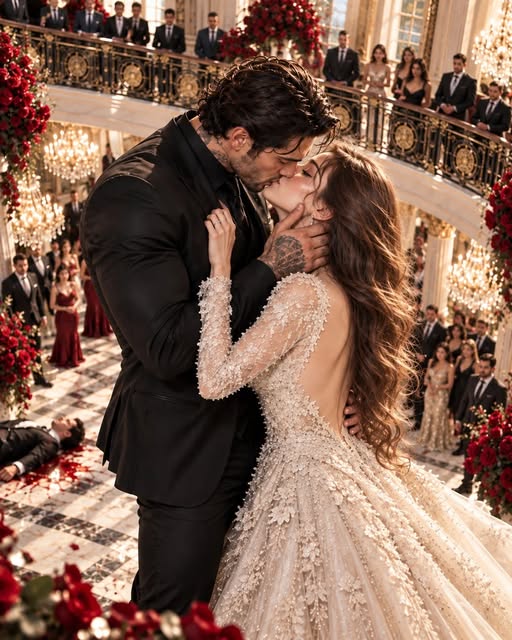
He asked me on a Tuesday, in his office, at 2 a.m., over cold coffee and the quarterly lake shipping settlements — which is to say, he asked me in the exact place and manner of our real life together, and I have never heard of a better proposal.
There was no audience. There was no gunfire. There was Cosimo Ferraro with his sleeves rolled once, precise as ever, sliding a reconciliation report across the conference table and saying, without preamble, "The month is up, Francesca. The books balance. I'm asking."
I said yes before he'd finished the sentence, which ruined his composure entirely and remains one of my favorite memories.
We were married three months later, in the grand ballroom of The Drake Hotel.
It was my idea. It scandalized everyone — my mother-in-law-to-be wept about omens, my sisters wept about romance, my father simply looked at me for a long moment and said, "You always did insist on balancing the ledger in the same book where the debt was made." The Drake it was. I wanted to stand in the exact center of the room where four hundred people had watched me be weighed and found worthless, and I wanted to be weighed there again — accurately, this time, in front of all of them.
I wore emerald. Of course I wore emerald — a new gown, cut like the first one, because the dress was never the problem. The problem had only ever been the arithmetic of the people looking at it.
Bianca was my maid of honor. She had spent the spring learning to read a balance sheet at my kitchen table, twice a week, with the fierce concentration of a woman retraining for a war she intended to win, and she had turned out to have a real gift for forensic accounting — a jeweler's eye for the one stone in the setting that's paste. "It's the same as men," she told me, the night before the wedding, over wine. "You just look for the one whose numbers don't match his story." Sofia sang at the ceremony — actually sang, the sweet voice put to its true use at last — and half the Syndicate wept into their programs and will deny it until they die.
The morning of the wedding, my sisters came to my room at the Lombardi house with coffee, chaos, and a garment bag, and for two hours the three of us were simply what we had never been allowed to be when it might have saved us trouble: sisters, in a sunlit room, preparing for a wedding.
Sofia did my hair — the same careful pins as the night of my engagement, and we both noticed, and neither of us pretended not to. "Last time I pinned you up," she said quietly, working, "I cried in the corridor afterward because I knew what Dominic was, and I didn't say anything, because Father had decided and I didn't know how to be the one who speaks." Her hands stilled. "Say it now, then," I told her. "Whatever it is. For the rest of our lives, in this family, we say it now." She nodded, fierce and tearful, and pinned the last pin like a soldier planting a flag.
Bianca brought the something-borrowed: our grandmother's rosary, which she had taken from the family chapel that morning without asking anyone, on the grounds that Nonna had kept the Lombardi books through two wars and would have wanted representation. "She ran the money for thirty years and grandfather got the statue in the cemetery," Bianca said, fastening it around my wrist. "The women in this family have always been the treasury, Franny. You're just the first one whose name is on the door." Then she checked my gown's train with a tactician's eye and delivered her final report as my deputy and my maid of honor: "The cathedral length is a liability in a firefight. Otherwise — acceptable losses. You look like a hostile takeover in a dress."
I laughed until I cried, which cost Sofia twenty minutes of repairs, and I did not mind at all. A year before, I had gotten ready for my engagement in that same room, alone, in silence, like a document being prepared for signing. This time the room was loud with women who had learned to speak — and I understood that this, more than the ballroom downstairs or the man waiting at the end of the aisle, was the actual restitution. The empire could have survived without me marrying Cosimo Ferraro. My family could not have survived without learning how to love its daughters out loud. We managed both, in the end, but only just, and only because the arithmetic finally shamed us into it.
My father walked me down the aisle.
Halfway down, in the precise spot where Dominic had stood to raise his glass, the old Don stopped — stopped the whole procession, stopped the music — and turned to the assembled families of Chicago, and he said, in a voice built to carry ballrooms: "One year ago, in this room, I stood by while my daughter was called worthless. I will not make the walk twice in the same silence. This is Francesca Lombardi. She holds this family's books, its future, and its honor — she has held them since she was nineteen years old. Any house that marries into ours today marries up." Then he looked at me, and his eyes were wet, and he finished the walk.
Cosimo was waiting at the end of it, healed and straight and smiling the real smile, the brief warm one I'd first seen through gunsmoke. When the officiant asked who gave this woman, my father said, "No one gives her. She was never ours to give. She comes as she chooses" — and the ballroom made a sound I will hear on my deathbed, half gasp and half roar.
We said our vows where the ice sculpture had stood.
I will not pretend I wasn't afraid walking the last steps — not of him, never of him, but of the room itself, of the ghost of a year ago that stood in this ballroom with her hands empty and her chin up while everyone waited for her to cry. Grief like that doesn't evaporate because a story ends well; it takes its seat among the guests and watches. So I looked for her deliberately, that girl, as I crossed the marble where Dominic's blood had dried under the polish — and I made her a promise, there in front of two families and God: that no daughter of mine, no niece, no quiet girl in any house our money touches, would ever again have to learn her own worth from a whispered confession in the middle of a war. She would be taught the books. She would be told, early and often and in public, exactly what she was.
Then I reached Cosimo, and put my hand in the hand he offered — palm up, still waiting, still a choice — and the ghost took her seat, and quieted, and stayed only as a witness.
I remember the light through the tall windows, gold as poured honey. I remember my sisters' faces, and the captains standing at the walls in their black suits like a punctuation of old wars, and Dominic — invited, at my insistence, with his healed shoulder and his strange new dignity — raising his glass to me from the back of the room in a toast that this time cost him nothing and meant everything: to the bride. I remember the emerald on my hand catching the light.
And I remember that at the reception, when the quartet was playing and the champagne had loosened even the Moretti patriarch into something resembling warmth, Cosimo drew me out onto the terrace above Michigan Avenue, into the cold clean Chicago night, and held me the way a man holds the thing he has chosen every day since the day he first offered his hand and waited.
"They think you're the daughter nobody wanted," he murmured, an echo, a quotation, a debt being closed in the same book where it was made.
"I remember," I said.
He turned me gently in his arms so I could see the ballroom through the glass — my father laughing, actually laughing, with his arm around Bianca; Sofia dancing with a blushing Vitale captain; the whole glittering machinery of our world turning, for once, in the light. "What do they know now?"
I thought about being nineteen, invisible, in an office above a restaurant on Taylor Street, reading ledgers nobody else could untangle, building an empire in the dark for people who called me a disappointment at dinner. I thought about a retired key in a sealed envelope, and a fountain pen from a false uncle, and a whisper in a ballroom full of blood and broken glass. I thought about the rule — my choice, always my choice — and about all the years it had taken the world to learn arithmetic.
"They know now," I said, "that the daughter nobody wanted was the one holding up the house."
Cosimo kissed me then — gently, deliberately, the way he had the first time, with the whole of Chicago as witness and not one person in it left who doubted what I was worth.
Behind us, the music rose. The Lombardi books were balanced. The Ferraro books were balanced. And for the first time in my life, standing in the light in my emerald dress, with my hand in the hand of the man who had seen me first as a mind — I was not invisible at all.
I was the headline.
Six months later, on a bright morning in early spring, I opened the new joint office of Lombardi–Ferraro Financial Oversight on Wacker Drive — forty-first floor, windows over the river, my name in brushed steel on the door, and Bianca's on the door beside mine. The Syndicate's quarterly settlements now run through a table where nine captains can read their own routes in clean columns, and at the first quarterly review, the eighty-one-year-old Vitale patriarch studied the report I'd prepared for a long time before announcing to the room, "The girl keeps books like her grandmother's God is auditing." It remains the highest compliment our world possesses, and I have had it framed.
Salvatore writes me a letter every month from Arizona. They are checked, of course. They are also — this is the strange part, the part no ledger predicted — almost entirely about the weather, and about a garden he has been permitted to keep, and about the tomatoes failing in the desert soil. He has never apologized. I have never asked him to. I send him, each Christmas, a packet of seeds suited to dry climates, and my father pretends not to know, and some accounts, I have learned, are never meant to balance. They are simply closed, and the loss is carried forward, quietly, by everyone.
My father comes to the office on Thursdays. He sits in the visitor's chair — the Don of the Lombardis, in the visitor's chair, by his own insistence — and Bianca walks him through the quarterlies while I pretend not to listen, and afterward he takes his three daughters to lunch and pays court to us one by one like a man making up a debt in installments he fully intends to complete. He is not a good man, my father. He is becoming, late and at cost, an honest one, and I have made my peace with the difference.
And Cosimo — Cosimo keeps the rule. In the office, in the marriage, in every ledger there is, my choice stands first, and he has made a kind of religion of it, so that now the captains of two families ask my consent before they ask my opinion, and mean both. At night he sometimes finds me at the desk long after the building empties, the way I have worked since I was nineteen, and he sets down coffee he poured himself, and reads over my shoulder, and says nothing he doesn't need to say.
On the wall behind my desk there hangs a framed photograph: the Drake ballroom, one year ago, a ring on a table and a girl in an emerald dress standing alone in a circle of space while four hundred people waited for her to cry. I keep it where I can see it from my chair. Underneath it, in my own hand, I have written the only caption a photograph like that will ever need:
She wasn't worthless. She was unaudited.
Now the whole city has read the audit.
THE END