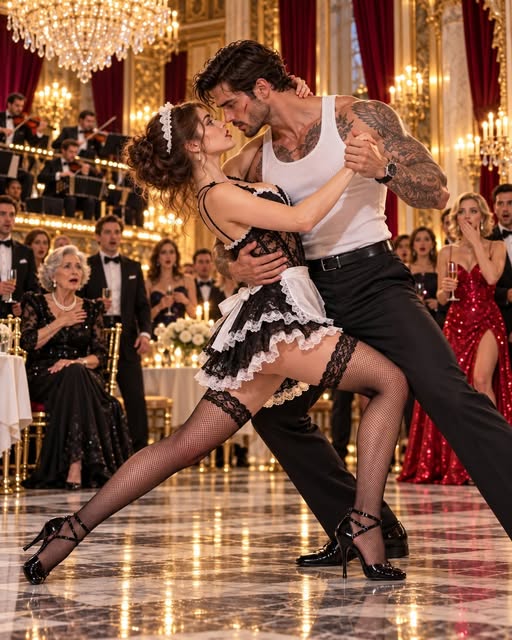
We were married in June, in the ballroom where it started, at a sensible hour, in front of a guest list that Eleanor had edited with a red pen and a complete absence of mercy.
Gone were the senators-for-show and the families-by-obligation. Present were the captains who had stayed, the dock families Grant had stood by in the autumn, Marta from the kitchens as an honored guest in a hat like a wedding cake, Rachel as my maid of honor in deep-water blue, and Ethan and Noah as ring bearers — Ethan with a solemnity that suggested he believed the rings powered the building, Noah with the bandoneon's smallest cousin, a toy accordion, which he had been forbidden to play during the ceremony by a coalition of everyone.
That morning, Rachel dressed me in the guest suite with the lake view — the same room where I had once sat with a packed bag and a necklace's worth of trouble — while Noah, barred from the proceedings on grounds of accordion, reported on events from the doorway at intervals, like a small town crier. Ethan supervised the shoes. Ethan has always understood ceremony.
Rachel's hands were steady on the fastenings, the way they'd been steady on everything since we were girls. "Dad's probably unbearable right now," she said to my reflection. "Wherever he is. Telling everyone. That's my Emily. She out-negotiated the mafia, she out-danced the mafia, and then she married the mafia for the catering."
"For the floor," I corrected. "The floor is excellent."
"The floor is excellent," she agreed, and then her eyes filled, traitorously, and she pressed her forehead briefly to my shoulder blade, among the buttons. "He'd have walked you, Em. In the white shirt. Sleeves rolled. He'd have cried the whole way and pretended it was the music."
"I know," I said. "That's why Eleanor's doing it. Somebody has to represent the family's interest in embarrassing me in public."
It was Eleanor who had solved the final detail, as she had solved so many. At breakfast that morning she had presented me with a small flat box, and inside it, pressed and folded, was a linen napkin — the napkin, the one she had put into my hand over a wine stain half a year and several lifetimes ago, only now it had been embroidered along one edge in silver thread, in a hand too old for such fine work and too stubborn to delegate it: 11:17 P.M. — and below it, a tiny stitched pair of dancing shoes.
"For your bouquet," she said. "Something old. Something borrowed is the ring, something blue is Rachel's dress, and something stolen — " her eyes gleamed with the purest mischief I have ever seen on a woman of eighty-four " — is my grandson. I recommend you keep him. This family has a policy about returns."
Eleanor walked me down the aisle.
It had been her idea — announced, not proposed, at breakfast three weeks earlier, in the tone of a woman reading a verdict: "Your father cannot. Your sister should stand beside you, not deliver you. And I have owed Daniel Brooks an escort for sixty years, and I am eighty-four, and I do not intend to die with the account open." She took my arm in both her hands at the ballroom doors, in her silver silk, upright as a flagpole, and as the doors opened on two hundred people — the same room, the same chandeliers, an entirely different universe — she whispered, "Head up, Emily. Whatever happens," and we walked my father's floor together at a pace she set and nobody hurried.
Grant waited at the far end in a suit with no sawdust on it, and the look on his face when the doors opened is not something I will describe in detail, because some things a woman keeps. I will say only that Marcus, standing beside him as best man, had to clear his throat twice, and that the most feared man in Chicago cried in front of his entire organization without a flicker of shame, and that if a single soul present thought less of him for it, they kept it to themselves forever, which in that world is the same as it not happening.
We wrote our own vows. His are his. Mine were short, because I had said the long version at a microphone at the Drake Hotel in front of six hundred people, and everyone who needed them had already heard them.
"I spent two years in this house learning to be invisible," I said. "You found me by accident, in a joke, at 11:17 on a Saturday night. I am not going to thank the joke. I am going to thank the music — and the woman who remembered it — and the man who, when it stopped being funny, stood still long enough to hear it." I took his hands. "Grant Whitmore. I will keep your balance. You keep mine. That's the whole contract. That's the whole marriage. Dance with me for the rest of our lives and don't you dare dance three seconds in the future."
"Now," he said, for both of us, so quietly that the front rows leaned in. "Always now."
There was, of course, a first dance.
The orchestra — the same orchestra; I had insisted, and the conductor had wept when the booking came, and sent a note saying it was the honor of his career — lifted the opening of my father's arrangement, the bandoneon breathing out across the ballroom where it all began. And this time there was no joke and no crowd holding its breath for a fall: just a husband and wife in the middle of a marble floor, dancing the tango the way Daniel Brooks taught Chicago to dance it, as a conversation — question, answer, trust, risk — while two hundred people who had once laughed at a housekeeper applauded a love story they had all, in one way or another, been extras in.
Halfway through, Grant leaned close, in the pause. The pause where the trust lives. Perfectly still. Perfectly present.
"I'll spend my whole life making sure you never lose your balance," he murmured.
"I know," I said. "You're very well taught."
Later, when the cake had been cut and the toasts survived — Marcus's was four sentences long and made Rachel cry; Rachel's was eleven minutes long and made everyone cry, including, at one point, both senators' replacements — the orchestra played a slower set, and my husband crossed the ballroom to his grandmother's chair with the air of a man about to do something he had been rehearsing in secret. Which, I learned afterward, he had. For six weeks. At dawn. With Marta's cousin, who had sworn an oath of silence on pain of Eleanor.
"Nonna," he said, holding out his hand. "One dance. Half a song. The doctors said — "
"The doctors," Eleanor announced, rising with the majestic slowness of a battleship leaving harbor, "have been wrong about me since 1979, and I see no reason to break their streak." She took his hand. "Half a song, Grant Thomas Whitmore. And if you dance three seconds in the future, I will tell this entire room about the winter you were nine and afraid of the lake ice."
They danced — if dancing is the word for a stately, careful, devastating progress around six feet of marble, an eighty-four-year-old woman in silver silk in the arms of the grandson she had rescued twice: once from his enemies, and once, at considerably greater length, from himself. Halfway through, the orchestra — may they be blessed in this life and the next — let the arrangement open into the same figure, the same breathing pause, that my father's bandoneon had asked as a question in that very room, and Grant stood in the pause with his grandmother the way I had taught him: perfectly still, perfectly present, holding her balance like it was the only cargo he had ever carried that mattered.
Over his shoulder, Eleanor found my eyes, and she smiled — the private smile, the Halsted Street smile, sixty years deep — and mouthed two words at me across the music.
He learned.
And I stood in my wedding dress in the middle of the Whitmore ballroom with tears ruining Marta's cousin's work on my face for the second time in a year, and I thought about debts and how they actually get paid: not in ledgers, not in deeds, not even in gold leaf on a wall. In this. In a man's hands, careful at last, around the people who taught him what hands were for.
The Brooks Dance Studio reopened on Ashland Avenue on the first Saturday of September, exactly twenty-five years after the fire, in a building with a sprung floor, a wall of mirrors, and a ghost sign we did not restore and did not remove — we lit it. It stands there still, lit, every night, over the door: BROOKS DANCE STUDIO, in letters that waited a quarter of a century in the soot for somebody to come back and plug them in.
Rachel runs the office and the books, with a salary, a title, and a ferocity about late payments that has made her locally feared in a way I find deeply satisfying. The Whitmore Foundation funds thirty scholarships a year for children from the dock neighborhoods and the service corridors of great houses — housekeepers' kids, porters' kids, the children of invisible people, who arrive on Saturday mornings with their shoes held together with hope, exactly as their teacher's teacher once arrived. The classes are free. The coffee is terrible. The floor is perfect.
Eleanor teaches one class a month, seated, imperious, eighty-four years old, correcting posture with a silver-handled cane and a memory like a steel trap, and the children call her La Reina and are terrified of her and adore her in the proportions she has always demanded from life. On the studio wall hangs a photograph: a young man in a white shirt with rolled sleeves, laughing, mid-lesson, in a room above a bar on Halsted Street in 1964, with a girl in a wasp-waisted dress in his arms who is looking at him the way the whole world should be looked at at least once.
Below it hangs a second photograph, newer: the same room's inheritors. My wedding. The dip. The chandeliers. It was taken by a photographer named Marta's cousin, at the exact moment the music stopped, and in it my husband is looking at me the way a man looks at a locked door in his own house that turned out, on the other side, to have been a garden all along.
My father's bandoneon sits in a glass case by the studio door, retired, honored, its work done. Noah plays the toy accordion at it sometimes, in the belief, which I have not corrected, that it is listening.
And on Saturday mornings, when the light comes through the tall windows the way it came through the old ones, and the bandoneon recording — my father's own, digitized from a reel Eleanor kept for sixty years in a hatbox, because some women keep everything — breathes out over a floor full of children learning that grace is something ordinary people are allowed to have, I teach the first lesson the way I was taught it, by a man in a white shirt who believed that strength and gentleness were the same thing wearing different clothes.
Heel. Toe. Pause.
"A good tango," I tell them, "isn't about controlling someone."
Out in the hall, most Saturdays, my husband is standing in the doorway with coffee he made himself and an expression he no longer bothers to hide, learning the last and hardest lesson of all — that a man can simply watch happiness happen in a room he helped to build, and not own it, and not guard it, and not weigh it.
"It's about making sure they never lose their balance."
Heel. Toe. Pause.
We never have. Not once. Not since 11:17 P.M., in a ballroom in Lake Forest, when a mafia boss made a joke in front of two hundred people — and a housekeeper, in a wine-stained uniform, with sore feet and a steady heart, decided to dance.