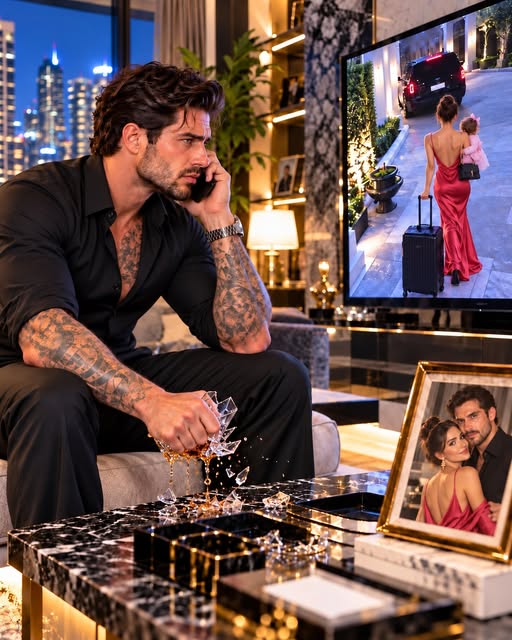
The photographs arrived on a Tuesday, while Adrian was behind my counter at the pharmacy learning the difference between two blood-pressure cuffs, to the visible astonishment of Mr. Alvarez.
Rocco came through the door with an envelope and a face like a held breath.
"Boss. It's moving on the family channels. You need to see it before the council does."
The photographs showed me outside St. Mary's, three weeks earlier, in the clinic doorway — in the arms of a tall man in a coat.
I remembered the moment instantly. Daniel Okafor, a nurse on the maternity ward, an old friend from my residency years, who had held the door for me and hugged me — sideways, briefly, the way you hug a woman who has just heard her baby's heartbeat for the first time — while his husband waited in the car with the engine running and their adopted son asleep in the back.
The photographs had been cropped the way lies are cropped: husband out, car out, context out. Only the hug remained, and a caption doing the rounds of Romano cousins and DeLuca friends alike:
THE ROMANO HEIR. ALLEGEDLY.
"Enzo DeLuca has called a council," Rocco said. "Thursday. The villa. He says the families must 'resolve the succession question before it resolves itself.' He's bringing Bianca as a witness." He hesitated. "She's prepared to testify that she saw you with this man in February. At the clinic. Repeatedly."
I sat down slowly among the vitamin shelves.
So that was the shape of it. The alliance between the families had been negotiated for two years — ports, percentages, a marriage to seal it. My pregnancy had detonated the marriage. A paternity scandal would detonate the pregnancy. And Bianca, who had known my clinic schedule since February, who had known about the baby before my husband did, had been keeping her knowledge the way her family keeps everything: as inventory, to be sold at the highest moment.
"Elena." Adrian had gone very quiet, the dangerous quiet his men feared. "Tell me about the man."
"Daniel Okafor. Nurse. Friend. Married to a pediatrician named Sam, who was in the car." I handed him my phone, open, the way he now left his for me. "Here is his number. Here is Sam's. Here is the ward's number. Call everyone. That is the rule now, isn't it? Verify, don't imagine."
He looked at the phone in my open hand for a long moment.
Then he closed my fingers gently around it.
"I believe you," he said. "That is also new. Do not let it go to waste." He turned to Rocco. "Get me the clinic's full security footage for that day. Not the door camera — all of them. And find out who paid the photographer. There is always a payment. There is always a thread."
There was.
It took his people thirty hours. The footage showed everything the photographs had hidden: Daniel, the door, the sideways hug, the waiting car, Sam waving through the windshield, a small boy asleep against the window. And the money: the photographer had been paid through a shell consultancy that dissolved, on paper, into the DeLuca family office — authorized, in a memo Rocco read to me twice in disbelief, by Bianca DeLuca herself, in February.
In February. When I was eleven weeks pregnant and still hoping to tell my husband on our anniversary.
Adrian asked me whether I wanted to attend the council.
He asked. I want that recorded. A year earlier he would have simply forbidden it, or simply commanded it, and the difference between those two tells you everything about what had been happening to my husband in the small bright apartment and the pharmacy on Taylor Street.
"Yes," I said. "I'm attending. She has been telling my story for months. I'd like to be present for the correction."
The council met in Giulia's long dining room — the same room, the same table, where I had been asked whose child I carried. Twenty-two chairs. The DeLucas on one side, Enzo at their head with his cufflinks and his calm; Bianca beside him in white, dressed like a bride at someone else's wedding. The Romanos on the other. And at the head, Giulia, who had called this council into her house and therefore owned it.
Enzo presented the photographs with the grief of a family friend. Bianca, hand trembling becomingly, testified to the clinic, the man, the repeated meetings. She did not look at me. She looked at Adrian, the way you watch a door you expect to open.
Adrian let her finish. Then he stood, and did something no Romano had done in that room in fifty years.
He asked his wife to speak.
"Elena," he said. "The floor is yours. It should have been yours months ago."
I am not a public woman. I measure my life in compartments and quiet counters. But a pharmacist knows how to read a label aloud, and that is what I did — the full footage, frame by frame, on the screen Rocco wheeled in: the husband, the car, the sleeping child, the timestamps. Daniel Okafor's marriage certificate, which he had sent with his blessing and a note that read: Take them apart, Elena. Sam's statement. And finally the payment memo, with Bianca's authorization enlarged until her signature filled the screen.
"You knew about my baby in February," I said to her, in front of both families. "You sat in my kitchen's doorway — in my marriage — asking my husband to feel needed, while you paid a man to follow his pregnant wife to her clinic. You didn't want him, Bianca. You wanted the ports, and an heir was bad for business."
Bianca's face changed. The trembling stopped. Something colder and more honest came up in her, the family resemblance to Enzo finally visible.
"You were nothing in that house," she said. "A servant with a ring. I gave him a life—"
"You gave him an audience," I said. "There's a difference. I know. I was the one doing the work."
Giulia rose. When the matriarch rises, the room is over. "The DeLuca alliance is dissolved," she said, "for fraud against this family's blood. The ports question will be settled by attorneys. Enzo, your niece will not be received in any house that flies our name. And you will leave my table by the service door, because the front of my house is for family."
It was then — as the guards stepped forward and the chairs scraped — that Enzo's driver, a young man with a nephew's debts and a gambler's desperation, made the decision that ended the evening in blood. I saw the knife only as light moving. He wasn't aiming at Adrian. He was aiming at the succession. At me.
Adrian stepped into it the way other men step through doorways — without pausing to consider the architecture.
The blade opened his forearm to the bone as he turned me behind him, and then Rocco and the guards had the young man on the floor, and the room was shouting, and my husband's blood was coming through my fingers where I pressed them, hard, pharmacist's hands, to the wound.
"Pressure," I said, to him, to myself. "Adrian. Look at me. Pressure, and you'll keep the arm, and if you faint I will be extremely angry."
"Noted," he said, gray-faced, and then, absurdly, he smiled. "You're very good at this."
"I had a good teacher's worth of practice. Eight years of keeping a Romano alive."
They ruled it a clean cut, twenty stitches, no tendon gone. Enzo DeLuca left Chicago within the week, under terms the attorneys described as "structured," and Bianca left with him, exiled from two families' tables at once — a woman who had wanted to be needed discovering what it is to be needed by no one.
At midnight I cleaned and re-dressed Adrian's arm at my own kitchen counter, the small bright one, with his sleeve rolled and his good hand flat on the surface to keep it still for me.
The pill organizer sat beside the gauze. His — he managed his own now, labeled in his own hand.
"You never hesitated," I said quietly. "Today. You just — moved."
"I hesitated for eight years," he said. "That was the hesitation. It's spent." He watched my hands work, the way he had been learning to watch everything. "Teach me," he said. "All of it. The baby things. The pressure. The Thursdays. I don't want to be protected from my own life anymore, Elena. I want to be trained for it."
I tied off the bandage.
"All right," I said. "Lesson one. When someone you love is bleeding, you don't ask whose fault it is first."
His eyes filled — the second time in our marriage I had seen it, the first being a heartbeat on a screen.
"Lesson one," he repeated. "Received."
There was a price for the council, and I made him pay it where it counted.
Three days later, in the apartment, with his arm in a sling and twenty stitches itching under the bandage, I told him my remaining condition — the one that had never made it into Dana's document, because it was not a legal instrument. It was a mother's.
"Our daughter will not grow up flinching at doors," I said. "She will not learn the sound of a room going quiet when her father enters it. She will not watch men check the street before she crosses it, and she will not—" my voice held, which surprised me, "—she will not be handed a knife's worth of fear as an inheritance and told it's protection. I married the heir of an empire of locked doors, Adrian. I am asking the father of my child to build her a different one."
He was quiet for a long time. What I was asking was not a promise about a night or a woman. It was the dismantling of fifty years of family architecture, the whole dark machinery by which Romanos stayed Romanos — and I watched him understand that, and watched him not look away from it.
"The legitimate side can carry the name inside five years," he said finally. "Shipping, warehousing, the union contracts — it's already three-fifths of the revenue; my grandfather built the rest in a different century's weather. I've had the accountants mapping it since March." I stared at him. He almost smiled. "You think the notebook only has your vitamins in it? Elena — a daughter who waves at ultrasound screens. I am not handing her the other kind of meeting. I started before you asked. I'm telling you because the rule is reports, and because—" the smile went, and the plain sentence arrived, "—because you are the only person alive whose belief I can't simply arrange. I have to earn it in installments. This is an installment."
As for the young man with the knife: he was Bianca's cousin, twenty-three, with gambling debts Enzo had been quietly holding like a leash. The old Romano way would have made an example of him that other families would discuss in low voices for a decade.
Adrian paid the debts, broke the leash, and put him on a plane to an uncle's ranch in Montana with a letter of introduction and a warning that was almost gentle: "Come back to Chicago when you're a man your mother recognizes."
"He tried to kill you," I said, when Rocco reported it, disbelieving.
"He tried to kill what Enzo told him I was protecting," Adrian corrected. "There's a difference. You taught the household that, somewhere around the second pharmacy shift. Care is a list you keep for somebody else. His mother had a list once. Nobody kept one for him."
I put my hand over my daughter, who kicked once, approving or objecting.
"Installments," I said.
"Installments," he agreed. "I'm good for them. Ask my pharmacist."