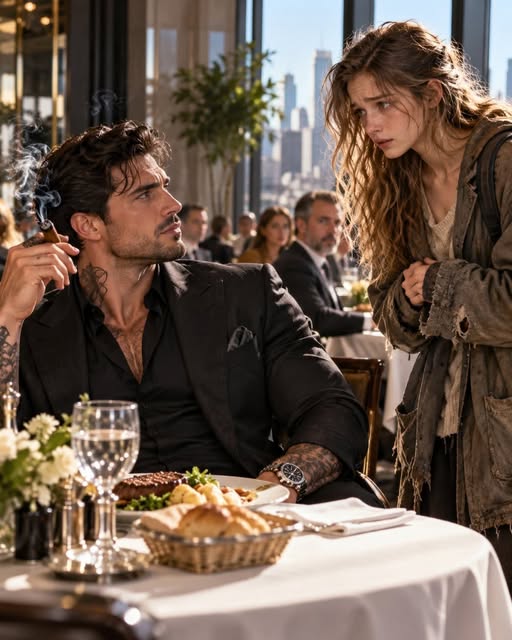
I did not sleep that night.
Before Emma left the restaurant — wrapped, over her protests, in a coat from the hotel's lost property that I had sent for and lied about, telling her it was unclaimed when it had in fact been purchased by my driver, Aldo, at the boutique across the street twenty minutes earlier — I had done two things that would have been unthinkable to me a week before.
I had given her a room. "One night," I said, because she would not have accepted more, and because I needed her somewhere I could see her while I decided what she was. "Room 412. Breakfast comes whether you order it or not. That's the rule of the house."
And I had put Marco Reyes on her.
Marco has been my right hand for eleven years. He is a quiet man with a scar through his left eyebrow and the instincts of a tax auditor crossed with a wolf. When I showed him the photograph security had taken at the restaurant door — standard practice, everyone who approaches my table is photographed — he studied it the way he studies everything, without expression.
"Who is she?" he asked.
"That's what you're going to tell me," I said. "Everything. Where she was born, where she's been, who she talks to, who she owes, who owes her. And Marco—" I turned the photograph face down on my desk, and even I heard what that cost me. "Find out about St. Brigid's Home. Outside Milwaukee. Everything there too. Especially who else came out of that place."
He looked at me then, just once, because Marco knows the name Daniel Krell, and Marco was there eight years ago, and Marco has the scar to prove what that name means.
"You think she's his?" he said.
"I think," I said, "that in our life there are no coincidences shaped exactly like keys. Run it."
He reported back in forty-eight hours, in my office above the hotel, with a folder thin enough to be an insult.
"Emma Carter," he said. "Twenty-seven. Born in Kenosha, mother dead of an overdose when she was four, father unknown. Taken into care at five, placed at St. Brigid's Home outside Milwaukee at six, stayed until she aged out at eighteen. Clean record — not a parking ticket, boss, not one. Scholarship money and a café job got her to Chicago and into the education program at the university, and everything she told you about losing it is true to the dollar. Café cut her hours in March, closed in June. Eviction in July. She sold her car in August. Since then: shelters, the vent on Fulton, a church basement on the nights the shelter's full. She volunteers at the public library reading to kids on Saturdays — unpaid, obviously — and the librarian cried describing her, which has never happened to me in an interview before."
He let that sit.
"She's exactly what she looks like," he said. "A good person having the worst year of her life."
I should have been relieved. Some part of me — the part that had laughed at my own table for the first time in staff memory — was relieved.
Then Marco opened the second folder.
"St. Brigid's," he said. "The home was run by a charity board. The Whitmore Family Foundation was a quiet donor for years — your father's money, before you were born into any of it. The kids who aged out the same era as Emma include teachers, two nurses, a cop." He paused. "And Daniel Krell."
The room went very still.
"Krell was placed there at nine," Marco said. "Aged out at eighteen, same as her. He was twelve years older than Emma — they wouldn't have overlapped by much, she'd have been a little kid when he left. But it's the same house, boss. Same hill. Same library."
Eight years ago, Daniel Krell came within one night of ending everything my family had built in forty years.
I had loved him. That is the part nobody outside this room understands, and it is the only part that matters. Krell hadn't been an employee; he'd been a brother — not by blood, but by the older and more dangerous covenant of boys who survive the same place. He'd risen with me. He'd held my father's dying hand with me in a hospital corridor. And then, in one winter, for money I would have given him outright if he'd asked, he sold our shipment schedules to the Vardanyan family — sold the routes, the times, the drivers' names.
The ambush on Route 12 killed four of my men and my father.
My father — who had built his empire with one hand and given money to a children's home with the other, who taught me that debts belong only to the guilty — died on a frozen shoulder of the interstate with his head in Daniel Krell's arms, because Krell had arranged to be the one who "found" him, the hero of the night he himself had authored.
It took me a year to prove it. It took one night to answer it. Krell ran before we reached him, and he has been a ghost for eight years — a rumor in Detroit, a face on a camera in Cleveland, nothing. A ghost I've spent eight years watching every door for.
And now the ghost's childhood home had produced a woman who asked me for bread.
"You see it," I said.
"I see it," Marco agreed. "It's either nothing, or it's the most patient thing he's ever done. He'd know you'd find the connection. He'd know it would sit in your head like a splinter. Making you look inward for a month is worth more to him than a bomb."
"Or she's his sister," I said. "His blood. Placed to get close."
"Krell had a sister," Marco said, and turned a page. "Mara. Younger. Also St. Brigid's. She died at twenty-two — six years ago, overdose, Milwaukee. It's documented. Emma is not her." He closed the folder. "Emma Carter is nobody, boss. That's what makes her perfect — for him, or by accident. There's no way to know except to keep her close and watch."
So I kept her close, and I watched, and I hated myself with a precision I usually reserve for other people's failures.
I could not give her charity — she had made that plain the first night, accepting the room only as a loan, insisting on writing me an IOU on a napkin in a waiter's borrowed pen, as serious as a treaty. So I gave her work instead, real work, which she could accept with her chin intact. The hotel runs a weekend reading program in the staff nursery — employees' children, a bright room nobody had ever cared much about, supervised by whoever could be spared. I put Emma in it at a fair wage, and within two weeks the room was full and there was a waiting list and the head of housekeeping informed me, with some emotion, that if I moved "Miss Emma" anywhere else there would be a strike.
I told myself I visited the fourth floor because the program was a business asset.
I visited the fourth floor because at 9:47 on a Tuesday night a woman had looked at my bread instead of my watch, and some structural element of my life had quietly failed, and I was spending my days walking past the crack to see if it would widen.
On the ninth day, I went down to hear story time, because a man should inspect his own suspicions at close range, and because I am a liar about my reasons even in the privacy of my own head.
The nursery at three in the afternoon is a country I have never held citizenship in. Twelve children on a rug. The radiator ticking. Emma in the middle of it with a picture book spread across her knees and every face turned toward her like flowers in a newsreel about the sun. She read the way her Mrs. Abernathy must have read — all the voices, no shame about any of them, the giant basso, the mouse in falsetto. A dockworker's son named Felix, five years old and built like a fireplug, was conducting the page turns with a wooden spoon, on her instructions, as though it were a knighthood.
Then she came to a page — this was an old donated book, not a picture book from the program's new shelf — where the paper had been torn away in some earlier catastrophe, and half the story simply stopped existing mid-sentence, the way conversations do in my world.
Felix was scandalized. "It's broke," he announced. "Miss Emma, the book's broke."
"The book is injured," she corrected, with total seriousness. "There's a difference. Injured things get help." She looked around the rug, and her eyes found me in the doorway, and something in her face — some private amusement, some test — did not look away. "When a story is missing its pages, we don't throw it out. We fix the endings. Everybody helps. Felix — what should the bear do next?"
Twelve children authored twelve endings simultaneously at the tops of their voices. The bear went to the moon. The bear apologized. The bear, in Felix's definitive version, opened a restaurant.
I stood in the doorway of my own nursery with my hands in my pockets and felt something move in my chest that I did not have a filing category for. It was not suspicion. Suspicion I know intimately; suspicion has kept me alive. This was worse. This was the suspicion turning, like a key in a lock it had been cut for, and showing me the room behind it — a room in which I had taken the first genuinely kind thing that had happened to me in twenty years and responded to it by hiring a wolf to go through its pockets.
I told myself this proved nothing. A voice can be trained. A performance can be sustained for two weeks by a professional.
I told myself this while she was reading the moon ending aloud in the giant's voice, because it had won the vote.
She noticed, of course. She noticed everything.
"You're two people," she told me one afternoon, shelving picture books while a dozen of my employees' children napped on mats around her like a small, defeated army. "There's the one who ordered the cake, and there's the one who watches me like I'm a weather system. I keep waiting to find out which one is renting me the room."
"Both of them are," I said.
"That," she said, "is the first honest thing you've said to me since the restaurant."
I should have walked away from her then, for her sake. Instead I said, "Dinner. Friday. Not the restaurant — there's a place I know, no one knows me there. I owe you an explanation I'm probably not going to give you, and it seems rude to withhold it over room service."
She laughed, and said yes, and I spent three days as a forty-one-year-old man who has faced down federal indictments with less dread than a Friday dinner.
On Friday morning, Marco came to my office without knocking, which he has done perhaps six times in eleven years, and put his tablet on my desk.
A surveillance still. A pawnshop on Archer Avenue, three days ago — Tuesday, mid-afternoon, while Emma was supposedly shelving books in the nursery. A thin man with a limp was pressing a thick envelope into her hands. Emma was looking down at it with an expression I could not read at this resolution, which was the worst possible thing about it.
"I know the limp," Marco said. "So do you. That's Silas Dorn. He drove for Krell for six years. He was Krell's hands, boss, before he was Krell's ghost."
I looked at the photograph for a long time. The cake. The book with the missing pages. Mrs. Abernathy's flashlight. "I'm trying to," she'd said.
"Bring her," I said, "to me."