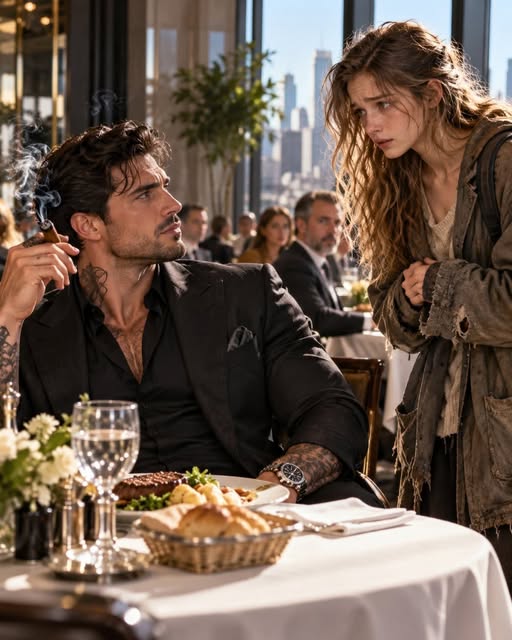
I have interrogated men in rooms designed for it — rooms where I controlled the light, the heat, the exits, and the size of the silence. I brought Emma Carter into my office at the top of the Whitmore Grand, a room with forty feet of glass and a view of the lake doing its best impression of the sea, and I put the photograph on the desk between us like an indictment.
She looked at it. Her face, which I had watched learn to unguard itself over two weeks, did something I will remember when I am old: it closed, floor by floor, like a building going dark.
"Where did you get that?" she said.
"Archer Avenue. Tuesday. The thin man with the limp is named Silas Dorn." I kept my voice level, the voice I use for men whose accounts don't balance. "He was Daniel Krell's driver for six years. Krell sold my family's routes to our enemies. Four men died. My father died. And three days ago, his driver put an envelope in your hands outside a pawnshop. So I'll ask you the question I should have asked you at that table, Emma, and I want you to answer it the way you've answered everything — like it's the truth. Who are you working for?"
"I'm not—" She stopped. Breathed. Began again, and her steadiness in that moment shamed every man who had ever sat in that chair and begged. "His name isn't— he told me his name was Sam. He said he was from the St. Brigid's alumni circle. There isn't an alumni circle, Vincent. I know there isn't. I knew it while he was saying it." She gave a small, wrecked laugh. "Do you know what I did? I took the envelope anyway. Because he said the words 'St. Brigid's,' and home is the only password I have left, and I wanted — I wanted someone in the world to have remembered I existed."
"What's in the envelope?"
"Two hundred dollars. And a note." She was looking at the photograph, not at me. "The note said: 'From someone who remembers the hill.' I bought food. I bought a pair of boots from the thrift store on Cermak because mine had a hole you could see my sock through. And I gave forty dollars to a girl at the shelter named Dee who's pregnant and seventeen, because she hadn't eaten since—" Her voice broke, finally, once. "Since Tuesday. Sound familiar?"
"Why didn't you tell me?"
"Tell you what? When?" Now there was fire in it, and it was righteous, and I knew it, and knowing it didn't save me. "That a stranger gave me money? You're not my— you gave me a job and a room, Vincent, and I wrote you an IOU for both on a napkin like a child, and I have been waiting since the first morning for the other shoe, for the price tag on all of it. Well." She stood up, and gathered her bag — the same shapeless bag, the book inside it, everything she owned on earth in one shoulder. "Here it is. Here's the price tag. I'm not a weather system. I'm not a key, or a splinter, or a trap. I'm the woman who asked you for bread because I was hungry, and you are the man who decided that was suspicious."
"Emma." I stood too. "If Krell is using you—"
"Then I'm sorry for him," she said, "because I'm not worth anything to anyone. That's what eight months teaches you, Vincent. That's the curriculum. Nobody plants a woman like me. Nobody would bother. I cost two hundred dollars and a lie about a home that doesn't have an alumni circle, and even that, apparently, was more than I deserved, because the one man who looked at me like a person has a photograph of it on his desk."
She took off the coat. The good coat, Aldo's coat, the one I had lied about. She folded it — actually folded it, with care, like it had feelings — and laid it over the back of the chair, and beneath it she was wearing her own coat, the thin faded one with the torn sleeve, which she must have kept all this time, the way you keep the truth under the story.
"Thank you for the soup," she said. "It was the best meal of my life. I mean that even now, so write it in your file."
Then Emma Carter walked out of my office, past Marco, past the elevators she didn't take because I suppose the stairs felt more honest, and out into a Chicago January that was, at that exact hour, deciding to become a blizzard.
I stood at the glass and watched the snow come down like the end of the world, and I did the thing I have done for twenty years whenever my heart attempted to file a report.
I buried it in work.
It took four hours for the city to inform me that this was a luxury it did not intend to allow me.
At 9:47 in the evening — I would learn to hate that number; the universe has a clerk's sense of humor — Aldo was driving me back from a meeting in Bridgeport along the service road below the hotel, because the main entrance was jammed with a wedding party, when the world went white and loud.
A plow truck. That was the genius of it — in a blizzard, a plow truck is invisible, it's weather, it's the city itself. It came down the ramp with its blade up and its lights off and it did not slow down. Aldo saw it a half second before I did. He threw the car sideways, took the impact on his own side like a man catching a door for someone, and the truck's blade sheared through the driver's door and spun us across three lanes of ice into a concrete pillar.
I remember the silence afterward, and the snow coming in through the broken glass, absurdly gentle, settling on the dashboard. I remember Aldo's blood on the airbag and Aldo, conscious, gripping my wrist with a hand like a vise and saying, with great annoyance, "Don't— get out— on the street side, boss. Do not get out on the street side."
In the interval — and an interval is what it was, a held breath with snow in it — I got my hands under Aldo's shoulders and hauled him, swearing in two languages, across the console into the lee of the passenger side, and put my palm flat over the worst of the blood, which was coming from a gash along his ribs where the sheared door had kissed him.
"Boss," Aldo said, through his teeth, in the tone of a man reviewing a disappointing film. "The girl. The teacher. She still eating in the restaurant?"
"She left, Aldo."
"Then you find her after," he said, with the absolute authority of the wounded, who are permitted to reorder other men's priorities. "A man gets one— one person who looks at the bread instead of the watch. My father drove trucks thirty years, he—" He had to stop and breathe, and it frightened me how much of him the breathing took. "He said you don't let that person walk out into weather, boss. Not over pride. Pride's a coat with no lining."
"I know," I said. "Hold on. That's an order."
"Copy," said Aldo, and closed his eyes, and stayed.
The second vehicle came thirty seconds later, headlights first this time, and found Marco's follow car already across the road with its doors open and its men out in the snow with their coats flaring, and it decided, professionally, to be somewhere else.
They took Aldo to Northwestern with a broken collarbone, six broken ribs, and a concussion, and he was complaining about the food before the anesthesia had fully worn off, which the surgeon told me was a good sign. Marco stood in the corridor with snow still melting in his hair and gave me the summary in the voice he uses for arithmetic.
"That was not a robbery and it was not a warning," he said. "That was a removal. Professional. Timed to the storm so the cameras would be blind. They knew the car, they knew the route change, they knew the service road. Boss — they knew everything except Aldo."
I looked at him.
"For eight years Krell has been a ghost," Marco said. "Ghosts don't buy plow trucks. Somebody has been paying to keep him. And tonight he stopped haunting and started hunting. The question is why now." He let a beat pass. "I'll tell you my answer, and you won't like it. Because for two weeks, the whole city has watched the great Vincent Whitmore eat lunch on the fourth floor with a woman from St. Brigid's. Krell put her in your path to make you look inward. The photograph, the envelope — breadcrumbs, timed. While you were reading her file, he was reading your habits. She wasn't the weapon, boss. She was the blindfold."
"There's more," Marco said, and took out his phone, and showed me the stills our security had pulled from the one camera on the service road that the storm hadn't blinded. The plow truck at the top of the ramp, lights off, patient as a held breath. And this: across the street, under the hotel's own awning, a man in a transit worker's coat watching my car the way a man watches a train he intends to board. The photograph was grainy, the face half-turned, the snow coming down through the lamplight like static.
I knew the posture before I knew the face. I knew it in my spine.
"He stood like that outside the church at my mother's funeral," I said. "At the back. He didn't come in."
"Boss." Marco's voice had the care in it that men use for loaded things. "The transit coat, the ramp, the timing — this was staged over weeks. And the watcher wanted to be seen, or he didn't care about being seen, and I don't know which one frightens me more, so I've decided to be frightened of both."
Through the ward doors they wheeled a man I didn't know, and a woman I didn't know walked beside the gurney holding his hand and talking to him in a low, steady voice, the voice of someone reading a story to keep the dark at a distance. I watched them pass. I thought about my father, who had died in a corridor not unlike this one in every way except the ending, with Daniel Krell's arms under his head and Daniel Krell's voice in his ear saying stay with me, stay with me — a performance so perfect that for a year I had thanked the man who murdered him, weekly, by name, in my prayers and out of them.
Grief does not make men wise. It makes them archivists. We keep everything, and we file it under the wrong names, and years later we take it out and read it wrong at exactly the moment it matters most.
The corridor was very quiet. Somewhere a machine counted someone's heart out loud.
"She's out there," I said. "In this. She walked out six hours ago with a torn coat and forty dollars' worth of groceries in her bag, and if Krell's people are moving tonight, she is a loose end with a name they gave her. He doesn't leave loose ends. That's the one thing about him I know for certain, because I taught it to him."
"Boss—"
"Find her." I was already walking, and my shoulder was screaming where the pillar had introduced itself, and I did not care, and Marco — who has talked me out of wars — looked at my face and simply fell into step and started making calls. "Every shelter. The library. The church basement. The Fulton Street laundromat first. She said there's a vent. She said if you get there before ten you get the good spot by the wall."
We got there at eleven.
The vent was blowing its warm, greasy breath out into the storm, faithful as a dog. The good spot by the wall was empty. The cardboard was gone. Everything was gone except, half-buried in the snow where the wind had worried it loose from under the laundromat's dumpster, one water-swollen paperback book with a broken spine and half a cover, open face-down in the slush like something that had been dropped by someone in a hurry — or taken by someone who had not, in the end, been in a hurry at all.