The Vale house in River Forest was not a house. It was a statement — eleven thousand square feet of limestone and black glass behind a gate that opened only after a man in a booth had looked at my driver's license, my face, and some list that apparently contained both. Walt drove me in Caleb's car, a plain dark sedan, and on the way he gave me the only briefing anyone offered.
"Rules," he said, eyes on the road. "You translate. You don't react. You don't answer questions about the kid — any question, from anybody, you smile and say you'll have to ask Mr. Vale. And whatever happens in that room, you keep your hands where people can see them and your face like a church window. Got it?"
"Got it."
"You scared?"
"Terrified," I said.
"Good." He turned in at the gate. "Scared people pay attention."
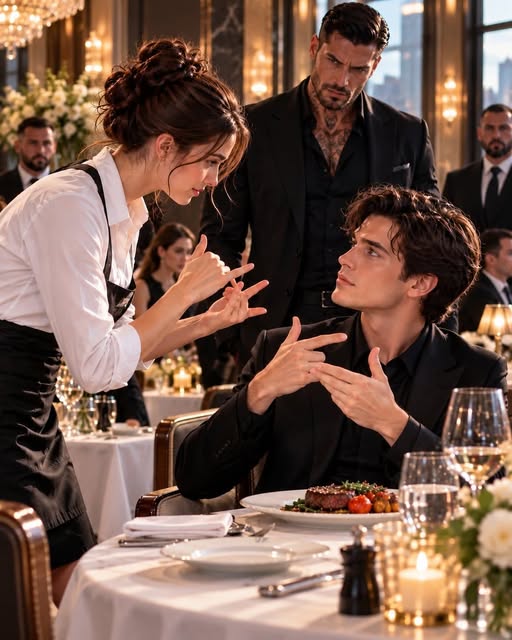
The dining room seated twenty-four and was full. I have waited on senators and a sitting governor at Bellamy's and I have never been in a room that quiet with that many people in it. Captains in dark suits. Two lawyers with the stillness of paid furniture. A silver-haired woman introduced as the head of the Brennan family's Chicago interests — Mrs. Agnes Brennan, seventy if she was a day, with eyes like an audit. And at Dominic's right hand, in the seat of honor, Marco Vale.
Marco was Dominic with the edges rearranged — younger by six years, softer in the face, warmer in the voice, and the only person in the room who smiled at me like a friend.
"The miracle worker," he said, rising to shake my hand. "Dominic told me about the restaurant. Ribeye, wasn't it? And coffee." His grip was warm and dry. "We've had such rotten luck with interpreters for my nephew. They never seem to — translate well. I do hope you'll break the streak, Miss Mercer."
"So do I," I said.
Caleb sat at his father's left, in the heir's seat, performing the role he'd performed for fourteen years: eyes down, face empty, hands still in his lap. He didn't look at me. We'd agreed on that — agreed on all of it, in the bookshop, in the car. I stood behind and to the side of his chair, where he could see me without turning his head, and I understood that my job was to be invisible until the moment I wasn't.
For two hours, I was. The dinner was a ballet of courses and coded language — tonnage and timetables, unions and inspectors, a judge's retirement discussed like a weather system. I translated the small talk that drifted Caleb's way, and there was almost none. These men had spent fourteen years not talking to the empty chair, and habit is stronger than courtesy. Marco, I noticed, talked across Caleb twice to reach Dominic, the way you talk across a centerpiece.
An hour in, Marco tested me. I didn't recognize it as a test until later, which I suppose was the point of it.
Someone — a captain named Doyle, halfway down the table — got expansive on the second bottle and raised his glass in Caleb's general direction. "To the heir," he said, too loudly, the way hearing people always talk too loudly around the deaf, as if volume were a ramp. "Health."
The table drank. Caleb, who had read it off Doyle's face, raised his glass a careful half-second behind everyone else, and I watched twenty-three people relax at how well he still performed being less than he was.
Then Marco leaned into his nephew's sightline, caught his eye, and signed at him. Slowly. Clumsily. The way a tourist speaks a language from a phrasebook — big blocky movements, the grammar of a greeting card. Family. Food. Good. It was, I realized with a drop in my stomach, the entire vocabulary most of Caleb's family had ever bothered to learn: a dozen signs, learned once, probably for a photograph, and worn ever since as proof of effort.
"Tell him—" Marco turned to me, still smiling "—tell him his uncle says the kitchen has outdone itself. And that we're all very proud of how well he's doing tonight."
He hadn't signed any of that. He'd signed family, food, good.
Caleb was watching me. The whole point of the exercise — Marco's point — suddenly assembled itself in front of me like a trap springing in reverse: if I translated what Marco said he'd said, I was Marco's creature, and Caleb would know it, and whatever fragile thing had been built in a bookshop in Pilsen would be finished. If I translated what he'd actually signed, Marco would know I couldn't be handled, and the evening would change in some way I couldn't predict.
I translated what Marco had signed. Word for word. Sign for sign.
"'Family. Food. Good,'" I said to Caleb, and let my face do nothing at all.
Something moved in Caleb's expression — relief so sharp it was almost anger. He nodded slowly. And his hands, low, below the level of the table where only I could see, signed: Now he knows. Good. Let him know.
Marco was still smiling. But he'd stopped eating, I noticed. He'd put his fork down very carefully, the way a man sets down something he suddenly suspects is loaded.
Then the port contract came up, and the room changed temperature.
Agnes Brennan walked the table through the agreement in a voice like a gavel — two Vale docks, Brennan crews, five years, numbers that were read aloud slowly so everyone could pretend to do the math. Dominic listened with his chin in his hand. Marco smiled the smile of a man watching his own signature dry.
And Caleb's hands moved.
It was small at first — small enough that for a second I thought he was adjusting his cuff. Then it sharpened into sign, angled across his body toward me, fast and precise and absolutely unmistakable.
Ask my uncle a question for me, he signed. Ask him what the Brennans are paying for the second dock. The price in that contract — or the price in the letter he signed in December?
My mouth went dry. Twenty-three people. Two families. A deal six months in the making, and the "broken" heir had just handed me a lit match.
I thought about Evan — about interpreters who edit being liars, and interpreters who leak being thieves, and what you call an interpreter who stands in a room full of wolves and decides, for the comfort of everyone present, to translate a man into someone smaller than he is.
You call her an accomplice.
"Mr. Vale," I said, and my voice came out steadier than I felt, "Caleb has a question for his uncle."
The room stopped. Forks stopped. Agnes Brennan's eyebrows went up a full centimeter. Dominic turned his head toward his son with the slow care of a man who has just heard a sound in a house he thought was empty.
Caleb nodded at me once. Go on.
"He asks," I said, "what the Brennans are paying for the second dock. The price in this contract — or the price in the letter he signed in December?"
You could have heard the snow land outside.
Marco laughed — he was good, I'll give him that, he laughed like a man delighted by a child's nonsense — but he laughed a half-second too late, and Agnes Brennan wasn't laughing at all. She was looking at Marco the way she'd been looking at the numbers.
"Well," Marco said. "The miracle worker has a sense of theater." He spread his hands at the table. "There's no letter, Dominic. There's a confused young man and a waitress who's discovered that drama pays better than—"
"She translates what she's given," Caleb signed, and I said it aloud as his hands moved, word for word, no softening, the way we'd agreed. "Nothing more. Nothing less. If my uncle says there is no letter, let him say it to my face. He knows I can read his lips. Everyone at this table should know it. I have always been able to read your lips."
Fourteen years of silence, detonated over the fish course.
I won't pretend the room erupted — rooms like that don't erupt; they go very, very quiet and rearrange themselves around the new fact. Dominic was staring at his son as if Caleb had stood up out of a coffin. Marco's smile had not moved, but something behind it had — the warmth was gone, and what was left was arithmetic.
Dinner ended twenty minutes later in a fog of unfinished business. The Brennan party left early, Agnes pausing at the door to look at Caleb for a long moment with an expression I couldn't read. Dominic withdrew with Marco into his study — a closed door, voices too low and too turned-away for Caleb to read, a fact I registered and filed.
I was collecting my coat in the foyer when Marco found me.
He didn't raise his voice. He didn't need to. He stood close enough that it was almost courteous and he said, conversationally, "You have a gift, Miss Mercer. It would be a shame for it to be wasted on a fantasy. My nephew is unwell. The accident — you know about the accident. Sometimes he invents. He'll invent more, now that someone's listening. It's cruel, actually, encouraging him."
"I'm an interpreter, Mr. Vale. I don't encourage. I translate."
"Of course." He smiled. "Then translate this. Fifty thousand dollars, for a simple kindness: you tell me what he says when the family isn't in the room. What he plans. What he believes. Think of it as—" he searched for the word, enjoying himself "—context. Interpreters provide context, don't they?"
"No," I said. "We don't."
His smile thinned. "Bellamy's pays you what, thirty an hour? And your brother's funeral — that went on a credit card, I believe. Six years ago and still not cleared. That's a long time to carry a dead boy, Miss Mercer."
The foyer was very cold. He'd done homework. Of course he'd done homework. Men like Marco always know the price of the furniture before they sit on it.
"Drive carefully tonight," he said, pleasantly, and went back to the party.
I drove home with my hands at ten and two, checking the mirrors the way Walt had taught me without teaching me, and twice on the expressway a black SUV with no front plate paced me in the next lane — not passing, not falling back, just there, a car's length off my shoulder, until I took an exit I didn't need and watched it continue past.
I told myself I'd imagined the menace in it. I told myself that all the way up the stairs to my apartment, and through three locks, and into bed.
In the morning, my car was sitting in the lot below my window with every window smashed in.
Nothing was stolen. My cheap stereo was untouched. The glove compartment hung open and empty. And on the driver's seat, placed neatly in the center of the broken glass like a garnish on a plate, was a brand-new box of crayons.
Sixty-four colors. Unopened.
I stood in the frozen lot in my bathrobe and slippers, with my phone in my hand and glass glittering all over the seats of a car I still owed eleven payments on, and I want to tell you that I was brave. I wasn't. My hands were shaking so hard I had to take the photographs three times before one of them was in focus.
I didn't call the police. Even then, six days into the Vale family's gravity, I'd already learned that much: there are events you report, and there are events that are messages, and a message you report to the police is a message you've answered wrong.
I called Walt.
He didn't ask questions. He said, "Don't touch anything. Don't go back inside alone. I'm twenty minutes out," and then, after a pause that had something almost gentle in it, "He knows about the crayons thing, doesn't he? The restaurant. It was the first thing the kid told me about that night — what his father said. Marco knew it would—" He stopped. "Twenty minutes. Stay where people can see you."
I stayed. I stood in the cold with my smashed car and my unopened box of sixty-four crayons, and I understood, all the way down to my bones, the thing Caleb had been trying to tell me in the bookshop.
This was how Marco Vale had kept a bright, furious, fully competent man silent for fourteen years. Not with locks. Not with threats you could point to.
With reminders. One small, deniable, perfectly aimed reminder at a time.