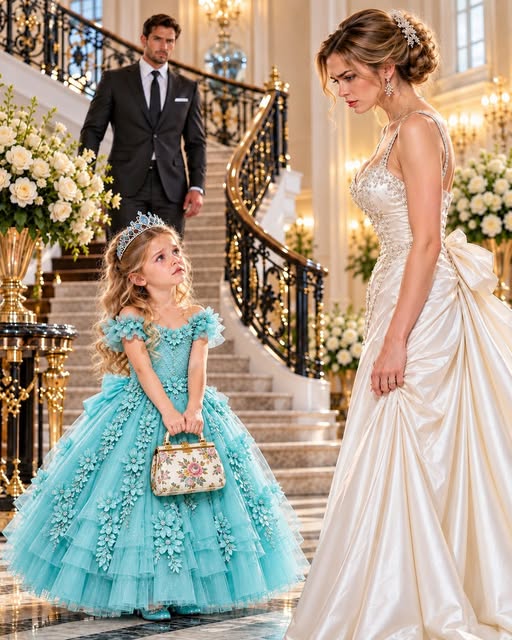
Three days after the canceled wedding, the mansion finally began to feel like a home again.
The white roses were gone.
The tables had been removed from the ballroom.
The enormous ivory ribbons tied around the staircase had disappeared.
Without the wedding decorations, the foyer looked familiar.
But I couldn't walk across that marble floor without remembering Lily's scream.
I had spent years believing that money could solve almost anything.
When Hannah died, I hired the best grief counselor I could find. I enrolled Lily in an excellent preschool. I paid for private tutors, expensive vacations, and birthday parties with entertainers flown in from other states.
I told myself these things proved I was taking care of her.
But I had forgotten something Hannah understood instinctively.
Children don't measure love by the size of a house.
They measure it by who comes when they cry.
And on my wedding morning, my daughter had cried so desperately that her voice echoed through a mansion filled with two hundred thousand dollars' worth of flowers.
I had almost missed what was happening.
Not that morning.
That morning I had finally listened.
But in the months before it, I had missed almost everything.
On Wednesday, I took Lily to see a child therapist named Dr. Rebecca Collins.
I had asked our family pediatrician for a recommendation because I wanted Lily to have someone she could talk to without feeling responsible for protecting my feelings.
Dr. Collins had a small office filled with comfortable chairs, children's books, and shelves of toys.
She didn't wear a white coat.
She didn't ask Lily to explain the wedding.
Instead, she offered her a box of crayons.
Lily chose turquoise.
Of course she did.
After a while, Dr. Collins asked me to sit with her privately while Lily played nearby with an assistant.
“Mr. Mercer,” she said, “your daughter has experienced significant stress.”
I nodded.
“Can she recover from it?”
“Children can be remarkably resilient when they have consistent, trustworthy support. But we shouldn't expect her anxiety to disappear simply because the immediate threat has ended.”
“What should I do?”
“Be predictable. Follow through on promises. Allow her to talk without pressuring her for details. Don't ask her to choose sides or carry adult secrets.”
I thought of the envelope in the handbag.
“She found documents that helped me understand what was happening.”
“That doesn't make her responsible for what happens next.”
I looked up.
Dr. Collins continued.
“Adults should handle the investigation. Lily's job is to be five years old.”
I nodded slowly.
“She keeps asking whether Victoria will come back.”
“Then keep giving her an honest, simple answer. Children often need to hear reassurance many times before they begin to believe it.”
I hesitated.
“What if she's angry with me for not listening sooner?”
“Then let her be angry.”
That answer surprised me.
Dr. Collins smiled gently.
“She doesn't need you to defend yourself. She needs you to recognize how she felt.”
I sat quietly.
Then I asked the question that had been troubling me since Saturday.
“Is there a way to make her understand that I never wanted to send her away?”
“Yes,” Dr. Collins said. “Show her. Over time.”
That afternoon, I found Lily sitting on the floor of her bedroom.
The room had changed.
Not because I had bought anything new.
Because Mrs. Alvarez had restored the things Victoria removed.
Hannah's photographs stood on the dresser again.
Oliver the rabbit sat beside Lily's pillow.
Her favorite old storybooks filled the small white shelf near the window.
And above the bed hung a framed picture of Hannah and me holding Lily on the day we brought her home.
I stood in the doorway.
Lily was drawing.
“May I come in?”
She nodded.
I sat beside her.
“What are you making?”
“A family.”
I looked at the paper.
Three stick figures stood in front of a blue house.
One was tall.
One was small.
The third wore a yellow dress and had enormous curly hair.
“Who's that?” I asked, pointing to the yellow figure.
“Mommy.”
My throat tightened.
“And that's you?”
She nodded.
“And me?”
“Yes.”
I waited.
Then Lily added a fourth figure.
This one was gray.
It stood far away from the house.
“Who's that?”
She stared at the drawing.
“Victoria.”
I didn't respond.
Lily drew a thick black line between Victoria and the house.
Then she looked up.
“Daddy, can I tell you a secret?”
“Always.”
She hesitated.
“Sometimes I wanted you to be sad again.”
The words startled me.
“Why, sweetheart?”
She began picking at the corner of the paper.
“Because when you were sad about Mommy, you used to hold me.”
I felt my chest tighten.
“Then Victoria came, and you were happy. But you were busy.”
I stared at my daughter.
She looked frightened by her own confession.
“I know it's bad to want you sad.”
I reached for her hand.
“No, Lily.”
Her eyes filled with tears.
“You were nicer when you missed Mommy.”
I couldn't speak for several seconds.
The truth in those words hurt more than any accusation could have.
I had mistaken appearing happy for becoming whole again.
And in my determination to move forward, I had stopped noticing that my daughter was being left behind.
I pulled her gently into my lap.
“Sweetheart, I'm sorry.”
She looked at me.
“Why?”
“Because I wasn't listening when you needed me.”
She lowered her head.
“I tried.”
“I know.”
“I told you Victoria didn't like my pictures.”
“I remember.”
“You said I should be nice to her.”
I closed my eyes.
She was right.
I had said that.
Not because I wanted Hannah's memory removed.
Because I thought Lily was resisting change.
Because Victoria had told me that was what was happening.
Because listening closely would have required me to question a relationship I had desperately wanted to work.
I looked into my daughter's eyes.
“I made a mistake.”
Lily frowned.
“Grown-ups make mistakes?”
“All the time.”
“Even daddies?”
“Especially daddies.”
She considered that.
Then she wrapped her arms around my neck.
“It's okay.”
I held her tightly.
But I knew something important.
Her forgiveness didn't erase what had happened.
It gave me a chance to do better.
And I intended to earn that chance every single day.
The financial investigation continued.
By Thursday morning, Evelyn Brooks had identified a pattern that made the situation much more serious.
Several of the questionable vendor companies had received funds through layered invoices approved by Graham's department.
Some payments were connected to actual renovation work but had been inflated.
Others appeared to have no corresponding services at all.
The largest pending payment had been stopped before it was released.
Evelyn called me into a conference with Michael and the company's independent counsel.
“We've found evidence that some of the vendor documentation was altered after approval,” she explained.
“By whom?” I asked.
“Administrative credentials assigned to Graham's finance team were used. We're still establishing which individuals operated those accounts.”
Michael looked at her.
“What about Victoria?”
Evelyn opened another file.
“Several transfers from one of the consulting companies eventually reached an account associated with a business in which Victoria held a beneficial interest.”
I leaned forward.
“How much?”
“Approximately $230,000 in identifiable transfers so far.”
I stared at the screen.
Victoria had told me she was financially independent.
She organized charity events, consulted for luxury brands, and managed a successful social network of wealthy clients.
I had never questioned her finances.
Now I wondered how much of that polished lifestyle had been supported by money taken from my company.
“Is that enough to prove she participated in fraud?” I asked.
“No,” Evelyn replied. “It establishes a financial connection that investigators need to examine. The purpose and authorization of those payments still matter.”
I appreciated her caution.
After everything Victoria had done, it would have been easy to assume every suspicious fact proved the worst possible conclusion.
But I wanted the truth.
Not a convenient version of it.
Michael spoke next.
“We're preparing the materials for the relevant law enforcement authorities and cooperating with the company's insurer and auditors. We also need to preserve the original records properly.”
I nodded.
Then Evelyn displayed another document.
“This one concerns Lily.”
I felt my stomach tighten.
It was a letter supposedly written by Dr. Teresa Kim, our family pediatrician.
The letter claimed that Lily had shown persistent behavioral problems and might benefit from an extended period outside her primary residence.
I read it twice.
Then I shook my head.
“Dr. Kim never recommended that.”
“How do you know?”
“Because I spoke to her after the wedding. She was surprised by the entire arrangement.”
Michael frowned.
“Then we need formal confirmation.”
I called Dr. Kim.
She answered between appointments.
I sent her the document through a secure channel.
Ten minutes later, she called back.
“Daniel, I didn't write this.”
My pulse quickened.
“Are you certain?”
“Absolutely. That isn't my letterhead, and the statements attributed to me are not based on any clinical assessment I made.”
I thanked her.
Then I asked whether she would provide a written statement confirming the document wasn't authentic.
She agreed.
When I ended the call, I felt cold.
Someone hadn't merely forged my signature.
They had apparently created medical-looking evidence to justify removing my daughter.
I looked at Michael.
“Why would someone go this far?”
He took off his glasses.
“Because a convincing paper trail can cause ordinary people to follow instructions they would otherwise question.”
I thought of the driver who arrived on Saturday.
Of the housekeeping staff ordered to pack Lily's belongings.
Of Celia's supposed consent.
Every individual piece had been designed to make the arrangement look legitimate.
No single employee was expected to know the whole story.
They were simply expected to perform their assigned task.
The only person who had interrupted the process was a frightened child with a tiny handbag.
That evening, Victoria's attorney sent a letter.
It accused me of breaching our wedding agreements, damaging Victoria's reputation, and refusing to return certain personal belongings.
It also suggested that I had behaved aggressively during our confrontation.
I felt anger rise as I read it.
Victoria had slapped me.
Victoria had shoved me.
And now she was attempting to portray herself as the victim.
Michael reviewed the letter carefully.
“Don't respond directly,” he said.
“I want to tell her exactly what happened.”
“Then tell me. We'll respond through proper channels.”
I walked toward the window.
“She has lied about Lily. She has lied about our wedding. Now she's lying about me.”
Michael waited.
I turned around.
“There's a camera in the foyer.”
He looked up.
“What?”
“The security system. We installed cameras after a burglary attempt two years ago.”
“Does it cover the staircase?”
“Yes.”
“Have you preserved the recording?”
I shook my head.
“Not yet.”
Michael stood.
“Then let's do that immediately.”
We contacted Thomas.
The footage was still available.
He preserved the original recording through the security vendor and arranged for a copy to be securely retained.
When we reviewed it, I felt sick.
There was Lily.
Standing in her turquoise dress.
Victoria leaning toward her.
My daughter recoiling.
Then me descending the staircase.
The camera had no usable audio, but the physical sequence was unmistakable.
Victoria reached for the handbag.
I stepped between them.
She slapped me.
Later, she shoved me backward into the marble column.
The tray fell.
Lily flinched.
I watched my daughter's frightened movements and felt tears sting my eyes.
I hadn't realized how small she looked from a distance.
How vulnerable.
How completely alone she had appeared before I reached her.
Michael watched the video once.
Then he closed the laptop.
“We'll preserve this and provide it to the appropriate people if necessary. It doesn't need to be released publicly.”
I nodded.
I didn't want millions of strangers watching my little girl beg for protection.
I wanted her to be able to forget that moment someday.
On Friday afternoon, Victoria called me.
I almost ignored the number.
Then I decided to answer with Michael present on the line, after making sure everyone understood who was participating.
“Daniel,” she said softly.
For one terrible moment, she sounded like the woman I thought I knew.
“Hello, Victoria.”
“I miss you.”
I said nothing.
“I know you're angry.”
“I'm concerned about what you've done.”
She sighed.
“Can we stop speaking like enemies?”
“You arranged to send Lily away without telling me.”
“I was trying to save our marriage before it even began.”
“We weren't married.”
“And apparently we never will be.”
I heard her swallow.
“Daniel, I love you.”
Once, those words would have mattered.
Now they sounded like a question I had already answered.
“Love doesn't involve frightening a child into silence.”
Her voice sharpened.
“You've always treated Lily like she can do no wrong.”
“She's five.”
“And I'm supposed to spend the rest of my life living in Hannah's shadow?”
There it was.
The resentment I should have recognized months earlier.
I took a slow breath.
“Victoria, Hannah is dead. She isn't competing with you.”
“She was everywhere in that house.”
“Because she lived there. Because she was Lily's mother.”
“You never made room for me.”
“I gave you more trust than you deserved.”
Silence.
Then she said something that made my stomach tighten.
“If you keep investigating those financial records, you're going to hurt a lot of people.”
I glanced at Michael.
He remained silent.
“What does that mean?”
“It means Graham isn't the only person who could be damaged.”
“Are you threatening me?”
“No. I'm trying to protect you.”
“From what?”
She hesitated.
“From the consequences of destroying everything we've built.”
I looked toward the photograph of Hannah on my desk.
“Whatever was built on forged documents and hidden payments deserves to be examined.”
Victoria's breathing changed.
“Daniel, you don't understand how complicated this is.”
“Then cooperate with the investigation.”
“That's not possible.”
“Why?”
She was silent for several seconds.
Then she whispered, “Because Graham has records that could ruin you too.”
My body went rigid.
“What records?”
She didn't answer.
“Victoria?”
“Just stop.”
“Stop what?”
“The investigation. The lawyers. All of it.”
I stared at the phone.
“And what happens to Lily?”
“She can stay with you.”
I felt a surge of anger.
“She was always going to stay with me.”
“Fine. Then let it go.”
“That's not a bargain you get to offer.”
Her voice cracked.
“Daniel, please. We can walk away from this without destroying each other.”
I looked at Michael.
He shook his head slightly.
I knew what he meant.
No private deal.
No secret arrangement.
No promise made under pressure.
I turned back to the call.
“If you have information about Graham or the documents, give it to your attorney. Mine will receive it through the appropriate channels.”
Victoria went quiet.
Then she spoke in a voice I barely recognized.
“You think you're protecting Lily.”
“I am.”
“You have no idea how dangerous the truth could become.”
The call ended.
I lowered the phone.
Michael looked at me.
“We need to treat that statement seriously, but we shouldn't assume it's true.”
I nodded.
Yet I couldn't ignore what Victoria had said.
Graham has records that could ruin you too.
I had not knowingly participated in their scheme.
But I had signed budgets.
Approved expansions.
Trusted financial summaries.
What if someone had used those decisions to create documents that made me appear responsible?
For the first time, I realized the investigation might threaten more than my company.
It could threaten my reputation, my ability to provide for Lily, and perhaps even my freedom if false evidence were convincing enough.
I looked toward the family photographs.
Then I made a decision.
I would tell the investigators everything.
Every delegated authority.
Every financial approval.
Every careless decision.
If I had made mistakes, I would acknowledge them.
But I would not protect a lie simply because the truth might embarrass me.
That night, I sat beside Lily's bed until she fell asleep.
Just before closing her eyes, she whispered, “Daddy, did I do something brave?”
I looked at her.
“Yes, sweetheart.”
She smiled.
“Like a princess?”
I brushed a curl away from her forehead.
“Braver than any princess I've ever heard of.”
Her eyes grew sleepy.
“Then why was I so scared?”
My throat tightened.
“Because brave people can be scared too.”
She thought about that.
Then she reached for my hand.
“Will you stay until I sleep?”
I settled into the chair beside her.
“As long as you need.”
Minutes later, her breathing became soft and even.
I stayed anyway.
Downstairs, my phone displayed another message from Michael.
The investigators had found an unusual document among the recovered financial files.
It appeared to authorize a major transfer on behalf of Mercer Hospitality.
And it bore my signature.
A signature I had never written.