The associates came to the house that afternoon, one at a time, the way suspects do in novels — though both of them arrived looking like what they were: tired young lawyers in good suits, blinking in the sun of a scandal far above their salaries.
The first was Laura Kim, twenty-nine, meticulous, frightened in the controlled way of a woman who keeps lists. Yes, she had opened the intake log on Tuesday. Yes, she had seen the Lake House entry. No, she had told no one; the entry had struck her as odd, she admitted, because she administered the Blackwood files and had never heard of a Lake House trust, but odd instructions from wealthy clients were the firm's daily bread. She had flagged it, in fact. There was a note. Rachel read the note over her shoulder and her jaw tightened — the flag existed, time-stamped, exactly as claimed.
The second was Peter Voss.
Voss was thirty-four, handsome in the forgettable way that opens doors, with a wedding ring he turned around his finger while he talked. He had been Rachel's senior associate for three years. He had carried her leather case into the dining room on the morning of the pool; he had stood behind her chair while the transfer papers lay fanned across the table like a losing hand of cards.
Yes, he had opened the log. No, he had told no one. His answers arrived half a beat too fast, the way answers do when they have been rehearsed in a car.
"You administered the Cole Meridian escrow correspondence in March," Rachel said. It was not a question, and Daniel, watching from the window with his hands clasped behind him, saw Voss understand that the shape of the room had changed. "The buyer's counsel sent the escrow instructions to our office. You logged them."
"That's routine work, Rachel."
"It is. Who is Ethan Cole to you, Peter?"
"A name on a file."
"Then you won't mind telling me why your office phone called his office phone eleven times in the two weeks before my client's signature was forged onto a transfer he never saw."
The silence in the study acquired a texture. Voss's ring stopped turning. He smiled then — a thin, professional smile, the last one in the box.
"I want a lawyer," he said.
"You are a lawyer," Rachel said. "Get a better one." She stood up. "You're suspended as of this minute. Your access is revoked. If you speak to Ethan Cole, to Clara Blackwood, or to any member of the press before my investigators reach you, I will personally see to it that the only law you ever practice again is from the inside of a cell with your name on the door."
But suspension was not proof, and proof was what Friday required. The audit would take days. Voss walked out of the house with his career in ruins and his secrets intact, and Daniel stood at the window watching him cross the drive, and understood with cold clarity that the other side would not wait politely for the audit. They had a completion date. They had momentum. And that night — that night was the gala.
The Blackwood Foundation gala was the largest night of the house's year: two hundred guests, a string quartet, a silent auction, and a ballroom that had been built by Daniel's grandfather for exactly the purpose of making other rich people feel small. For eight months the planning had proceeded around Daniel's blindness like water around a stone. Clara had chaired the committee. Clara's name was on the invitations, in gold.
Daniel had decided, over Rachel's flat objection and Shaw's grunt of approval, that he would attend. Sighted. In the open. Let them all see him see.
"She'll be there," Rachel had warned. "With her own counsel. In front of every camera in the county."
"Good," Daniel said. "Let her perform for witnesses. It's the one thing she's never practiced."
Anna was not on the guest list. She was something more dangerous to the other side than a guest: she was a retained witness with a signed statement, and Rachel had insisted she attend in that capacity — present, observable, and impossible to quietly disappear from the story. The firm provided a dress from a stylist's rail, navy and severe and beautiful, and Anna looked at herself in the staff-wing mirror for a long time before she came down the stairs, feeling, as she later told him, like a weapon somebody else had loaded.
"You look—" Daniel began, at the foot of the stairs.
"Like evidence," Anna said. "Don't make it anything else tonight."
"Tonight," he agreed. "Tomorrow I'll lie about it properly."
The ballroom did what ballrooms do. The quartet played. The auction prices climbed. And at nine o'clock, Daniel Blackwood walked the length of the room unassisted, reading the lot numbers off the catalogue in his hand, and shook the mayor's hand while looking him in the eye, and the sound that went through two hundred guests was the sound of a story changing direction at speed.
Clara arrived at nine-twenty, in silver, on the arm of her attorney.
She played the first act beautifully. She embraced two board members' wives. She laughed in the right places. She let her eyes fill, once, at exactly the moment a photographer from the county paper raised his camera. And then, as the quartet rested between sets and the room's noise thinned to a murmur, she crossed the ballroom floor with her attorney at her shoulder and a thin, furious smile, and pitched her voice to carry precisely as far as betrayal requires.
"Darling. How wonderful that you're feeling so much better." She took his hand in both of hers, the way she had a thousand times for cameras, and her grip was a small, cold warning. "The doctors will be so relieved. They were terribly worried when you began insisting you'd recovered. Dr. Fenn has explained to me how common it is, after injuries like yours. The mind gives the patient what he begs for." She turned her shining face to the circle that had formed, as circles do, around money and disaster. "My husband has filed court papers based on these… episodes. I've had no choice, for his own protection, but to petition for an emergency guardianship. Someone has to keep him safe from the people exploiting his condition."
She did not look at Anna when she said it. She didn't have to. The circle looked for her.
Daniel set his glass down on a waiter's tray with great care.
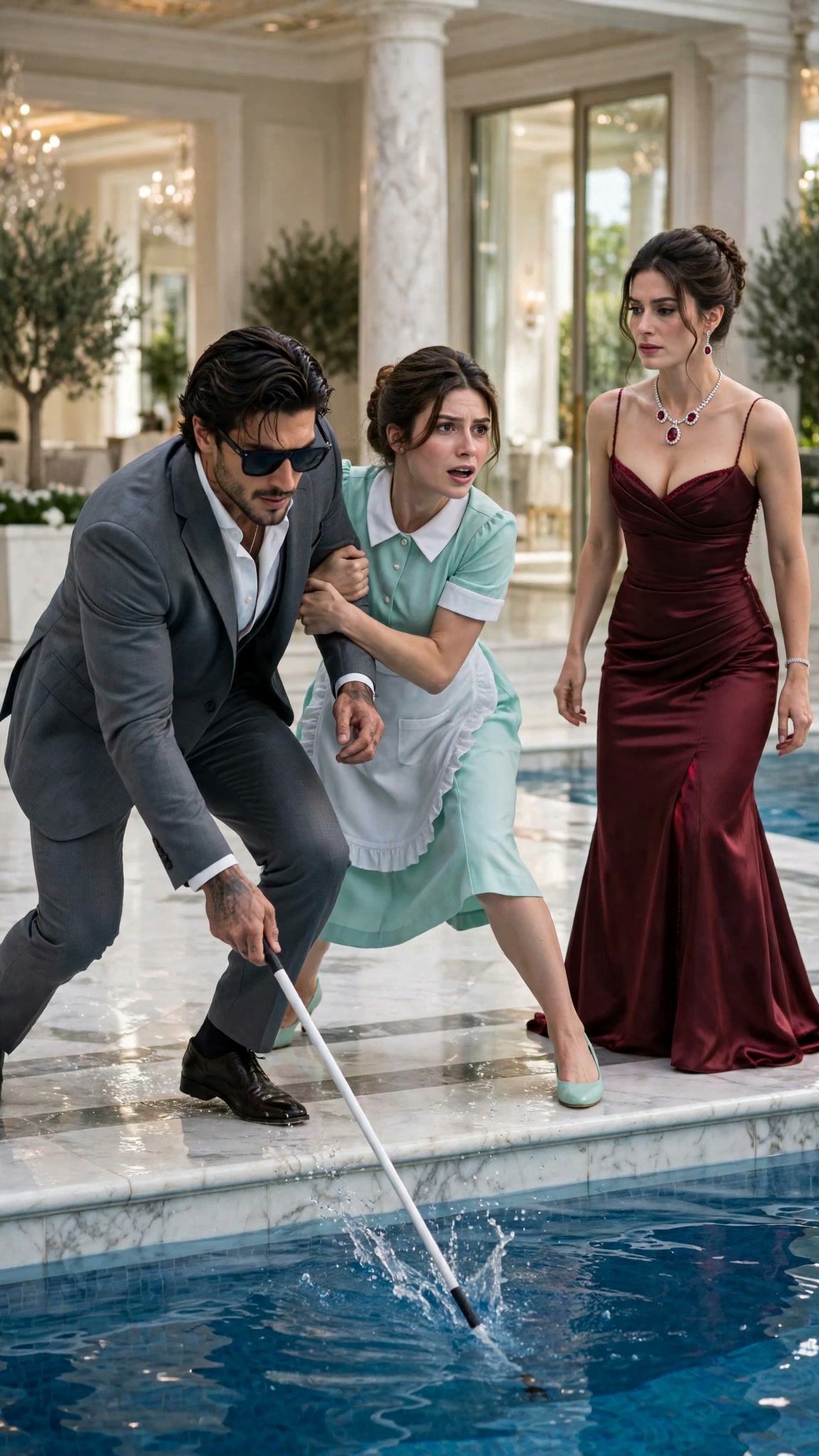
"My wife," he said, pleasantly, at carrying volume, "is concerned for my health. She has been concerned for some time. She was concerned in the west corridor in March, with Ethan Cole. She was concerned eleven days ago, when my signature appeared on the sale of this house — a sale I never made, to a company Mr. Cole controls, for a completion scheduled this Friday." His voice never rose. It did something worse: it clarified. "She was so concerned this morning, in fact, that someone removed the railing from my pool, wet the tiles, and cut the tip of my cane. If my maid had been one second slower, the guardianship question would be moot. I would simply be dead, and my signature would be worth a great deal more."
Two hundred people forgot how to breathe in unison.
Clara's smile held for exactly two seconds after it should have died. "You see?" she said to the circle, gently, terribly. "You see what he's become? Paranoid. Grandiose. He accuses his own wife of murder at a charity gala. Dr. Fenn warned me it would get worse before—"
"What did you do with the sapphire, Clara?"
She stopped.
"The ring I gave you had a blue sapphire set beneath the diamond. I had it made that way so I would always know the real one. The ring on your hand tonight is a copy." He let the pause do its work. "When a woman sells her wedding ring and wears a copy to deceive her blind husband, the word for her condition is not concern."
Her attorney touched her elbow. She shook him off with a violence that cracked the performance wide open, and for one naked instant the whole ballroom saw what Anna had seen from the doorway of a pool terrace: the fury, the calculation, the contempt — and underneath it, rising like water in a hull, the fear.
And it was at that moment, with two hundred witnesses holding their glasses like punctuation, that Gregory Shaw came through the ballroom doors with two police detectives behind him and his face carved out of stone.
The detectives did not come for Clara.
They crossed the floor — past the quartet, past the auction tables, past the mayor — and stopped in front of Anna Reed, and the taller one said, in the flat voice of a man reading weather, "Miss Reed, we need you to come with us." Behind them, a hotel of silence: two hundred people, a string quartet with its bows frozen, and Clara Blackwood beginning — too late — to hide her smile.
"A security review of the staff wing was conducted an hour ago," the detective said. "Acting on information received. A cloned financial authentication device — the kind used to authorize high-value transfers — was found in your locker, Miss Reed. Wrapped in your spare uniform."
Anna did not move. She looked at Daniel across six feet of ballroom floor, and what he saw in her face was not fear. It was the terrible steadiness of a woman who had lost everything once before to exactly this kind of lie, recognizing its smell.
"I never touched any device," she said, clearly, for the witnesses. "I don't know what that is. I cleaned that locker myself on Monday and it was empty."
"Miss Reed—"
"The woman you're taking," Daniel said, and his voice went through the ballroom like a blade through silk, "is the only person in this room who hasn't lied to me tonight."
"Sir, you'll have to let us do our jobs."
He let them. That was the worst of it, and he would remember it on worse nights than this one: he let them, because Rachel's hand was on his sleeve with an attorney's iron in it, because two hundred witnesses had just heard his wife call him insane, and because a screaming scene would hand Clara the guardianship by morning. He stood in his own ballroom, sighted and rich and utterly powerless, and watched them walk Anna Reed out between the silent-auction tables with her chin up and the navy dress moving like dark water.
The quartet did not resume. The gala ended the way ships sink, in a rush and a murmur and a great many small, cowardly courtesies. Rachel got him into the study with Shaw and shut the door on the wreckage.
"First thing in the morning," Rachel said, already dialing, "I file for her release and I put the device into evidence with our own examiner before their lab has finished its coffee. A clone planted in a locker is not a case, Daniel, it's a confession — theirs. Whoever put it there touched it, carried it, and chose her locker because her locker was the one place in this house that a maid's word could never defend." She stopped dialing and looked at him. "She was framed because her statement matters. Do you understand? They didn't attack your money tonight. They attacked your witness. That means the statement she wrote at your dining table is the thing they're most afraid of in the world."
"The tip," Shaw said, before Daniel could speak. "I asked the detective where it came from. Anonymous call, logged at eight-forty." He looked up, and his gray face was grayer. "Sir — it came in on the house's own internal line. The study extension. This extension." He nodded at the phone on Daniel's desk, three feet away, where all evening, through every toast and every dance, it had sat in the dark among the ledgers.
"Someone stood in this room tonight," Shaw said, "picked up your phone, and framed her. While the ballroom was full."
Daniel looked at the phone for a long time.
"Then the traitor," he said at last, "danced with us tonight."