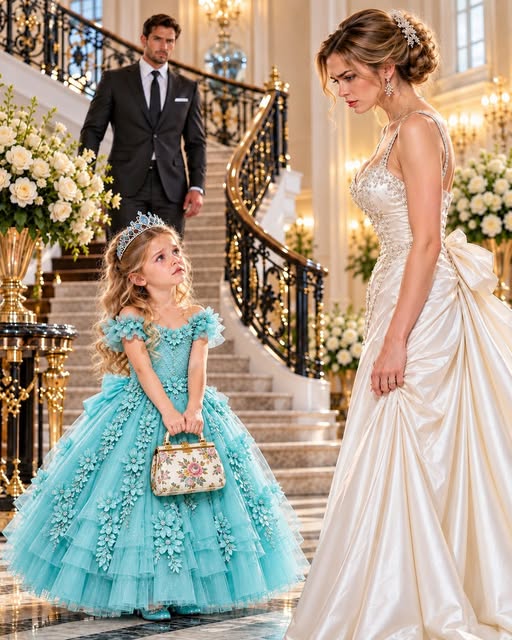
Eleven months after my canceled wedding, I stood at the foot of the same grand staircase where my daughter had once begged me not to let her be thrown out.
The mansion looked different.
Not because we had renovated it.
Not because I had purchased new furniture or hired a famous interior designer.
It looked different because Lily was laughing.
Her laughter floated down from the second floor, followed by the sound of quick footsteps and Mrs. Alvarez reminding her not to run near the stairs.
Then my daughter appeared.
She was wearing a yellow sundress and carrying Oliver the rabbit beneath one arm.
Her blonde curls bounced as she hurried toward me.
“Daddy!”
I opened my arms.
She leaped into them.
I caught her and spun her around until she squealed.
“Good morning, princess.”
She wrapped her arms around my neck.
“Guess what?”
“What?”
“I lost another tooth!”
She opened her mouth proudly.
I examined the little gap.
“That's incredible.”
“The tooth fairy has to come tonight.”
“I'll make sure she knows.”
Lily narrowed her eyes.
“Daddy, do you know the tooth fairy?”
I tried to look mysterious.
“We've met.”
She gasped.
“Really?”
“Very important business relationship.”
She giggled.
And as I carried her toward the kitchen, I thought about how far we had come.
A year earlier, Lily had been afraid to speak when Victoria entered a room.
She had hidden her favorite toys.
She had stopped asking for bedtime stories because she believed I was too busy.
Now she laughed freely.
She asked endless questions.
She argued passionately about whether peanut butter belonged on pancakes.
And when something frightened her, she came to me.
Not because she believed I was perfect.
Because she had learned that I would listen.
That change was worth everything.
The legal proceedings had been long and exhausting.
Victoria eventually entered a guilty plea to offenses arising from the forged documents and financial scheme.
Graham also faced criminal consequences for his role in the fraudulent transactions.
The court records established that unauthorized payments had been routed through companies connected to the scheme and that false documentation had been used to support both the business transactions and Lily's proposed relocation.
Victoria had known far more than she admitted when I first confronted her.
She had helped organize the arrangements for Lily to leave the mansion.
She had participated in discussions about the timing.
And she had expected the wedding to give her enough influence over me that I wouldn't challenge what she had done.
Some of the missing money was recovered through legal proceedings, insurance claims, and settlements.
Some wasn't.
The financial damage was significant.
But Mercer Hospitality survived.
We introduced stronger internal controls, hired independent compliance personnel, and changed the way major payments were authorized.
For the first time in my career, I learned that trusting good people and verifying important decisions were not contradictory ideas.
A healthy organization needed both.
So did a healthy family.
The court proceedings attracted media attention, but Michael helped me keep Lily's private experiences from becoming the center of public discussion.
I refused interviews that wanted photographs of her handbag.
I rejected offers to appear on television and describe her tears.
I didn't want my daughter's worst day turned into entertainment.
What happened in that foyer belonged to her.
And although the evidence had helped expose serious wrongdoing, she had no obligation to spend the rest of her childhood explaining it to strangers.
The most surprising change in my life had nothing to do with the courts.
It involved my calendar.
I used to schedule family time around business.
Now I scheduled business around the responsibilities that mattered most.
I still ran Mercer Hospitality.
I still attended meetings, negotiated contracts, and made difficult decisions.
But I no longer treated being constantly unavailable as proof of dedication.
Every Tuesday afternoon, I picked Lily up from school.
Every Thursday evening, we cooked dinner together.
On Sundays, we visited a park, a museum, or the lakefront.
Sometimes we did nothing more exciting than sit on the living room floor and build elaborate castles from wooden blocks.
At first, Lily seemed suspicious of the new routine.
She would ask whether I had to leave.
Whether my phone would ring.
Whether someone more important needed me.
I never punished her for asking.
I simply kept showing up.
And slowly, she stopped needing to check.
One evening, I returned home to find a large cardboard box waiting in the library.
Mrs. Alvarez stood beside it.
“Mr. Mercer, I found these while organizing the storage rooms.”
I looked inside.
The box contained Hannah's old cookbooks, several framed photographs, a collection of greeting cards, and a small blue notebook.
I recognized the notebook immediately.
Hannah used to carry it everywhere.
She wrote down recipes, birthday gift ideas, and little observations about people she loved.
Sometimes she made lists of places she wanted us to visit.
Sometimes she wrote reminders to herself.
Call Mom.
Buy more strawberries.
Ask Daniel whether he can take Friday off.
I smiled sadly at that last one.
Hannah had spent years trying to convince me that success didn't require missing every important family moment.
I hadn't listened well enough then either.
I sat in the leather armchair and opened the notebook.
The first few pages were ordinary.
Shopping lists.
Travel plans.
Ideas for Lily's nursery.
Then I found a page titled:
Things I Hope Lily Always Knows.
My breath caught.
Beneath the heading, Hannah had written several sentences.
She hoped Lily would know that kindness was strength.
That being frightened didn't make someone weak.
That she never needed to become smaller to make another person comfortable.
And that love was supposed to make home feel safe.
I stared at the page.
The last sentence blurred.
For a moment, grief returned with the same sharp intensity I remembered from Hannah's funeral.
I lowered my head.
Eleven months earlier, Lily had stood in the foyer fighting for the very things Hannah wanted her to have.
Kindness.
Safety.
The right to belong.
I closed the notebook carefully.
Then I did something I hadn't done in years.
I cried.
Not because I was hopeless.
Not because I wanted to go back.
But because I finally understood how much of Hannah's love was still alive in the daughter we had created together.
I had spent so long mourning the life we lost that I almost failed to protect the life she left in my care.
I promised myself I would never forget that again.
Lily turned six on a beautiful Saturday in early autumn.
She asked for a birthday party in the garden.
Nothing fancy.
No elaborate entertainment.
No enormous guest list.
She wanted balloons, cupcakes, a treasure hunt, and a small group of friends from school.
She also wanted me to wear a crown.
“Absolutely not,” I said when she informed me.
She put her hands on her hips.
“It's my birthday.”
“That's a powerful argument.”
“You have to.”
I sighed dramatically.
“What color?”
“Gold.”
“Of course.”
So at three o'clock that afternoon, I stood in my own backyard wearing a cardboard gold crown while six children chased each other across the grass.
Michael arrived carrying a gift bag.
He took one look at me and burst out laughing.
“Daniel Mercer. CEO. Hotel owner. Fearless negotiator.”
I adjusted the crooked crown.
“Watch yourself.”
Michael laughed harder.
“You look magnificent.”
“There's a spare crown inside.”
His expression changed.
“Don't you dare.”
Ten minutes later, he was wearing a purple one.
Lily thought it was the funniest thing she had ever seen.
And I realized something as I watched her laugh.
I had spent much of my adult life being afraid of looking foolish.
Afraid of losing control.
Afraid of making mistakes in public.
But standing in the garden with a cardboard crown slipping over my forehead, I felt more successful than I had ever felt in a boardroom.
My daughter was happy.
She felt safe.
She knew she was loved.
That was enough.
Later, after the other children left, Lily asked me to come upstairs.
She was holding the little floral handbag.
The same one she had clutched on my wedding day.
The same one Victoria had tried to take.
For months, I had wondered whether Lily would want to keep it.
I never suggested throwing it away.
It had belonged to her before the terrible events.
It had been a gift from her mother.
And she deserved to decide what it meant.
“Daddy,” she said, “can we put something new inside?”
I smiled.
“Of course.”
She placed the bag on her bed.
The cream-colored fabric was slightly faded now, and one of the tiny pink roses had begun to fray at the edge.
But the silver clasp still worked.
Lily opened it.
Inside were her usual treasures.
A purple hair ribbon.
A small shell from our summer trip to Lake Michigan.
A miniature plastic horse.
A drawing of Oliver the rabbit.
And the photograph of Hannah holding her as a baby.
Lily took out the photograph.
“Daddy, look.”
She turned it over.
On the back, in Hannah's familiar handwriting, were a few words.
For our beautiful Lily. Wherever life takes you, remember that you are loved.
I had seen that photograph hundreds of times.
But somehow, I had never noticed the message.
I read it again.
Then I looked at my daughter.
“Mommy wrote that,” Lily said proudly.
“Yes, she did.”
“Do you think she knew I would keep it?”
I smiled.
“I think she hoped you would.”
Lily carefully returned the picture to the handbag.
Then she reached beneath her pillow and pulled out a folded piece of paper.
“Can this go inside too?”
“What is it?”
“A new treasure.”
She unfolded the paper.
It was a drawing.
Two figures stood in front of a large house.
A little girl in a turquoise dress.
And a tall man in a dark suit.
Above them was a bright yellow star.
Beneath the picture, in careful six-year-old handwriting, were four words.
DADDY ALWAYS COMES BACK.
My eyes filled with tears.
“Lily,” I whispered.
She looked worried.
“Do you not like it?”
I pulled her into my arms.
“I love it.”
“Then why are you crying?”
I laughed softly through my tears.
“Because sometimes people cry when something makes them very happy.”
She considered that.
Then she kissed my cheek.
“That's okay, Daddy. I cry when I'm happy too.”
We placed the drawing inside the handbag.
I helped her close the silver clasp.
Then she put the purse on her nightstand beside Oliver.
For the first time, I realized that the little bag no longer reminded me primarily of the wedding.
It reminded me of courage.
Of truth.
Of a child who had refused to surrender the things that mattered to her.
And of a father who had finally learned to listen.
That winter, I made a decision about Hannah's legacy.
Before she died, she had volunteered with several organizations supporting families in difficult circumstances.
She believed that children deserved safe homes, access to education, and adults who took their concerns seriously.
I decided to expand that work through a charitable program called the North Star Family Initiative.
The name came from the song Hannah used to sing to Lily.
The program partnered with established local organizations to support families experiencing instability, help caregivers access appropriate services, and fund practical resources for children.
I insisted on independent oversight.
Transparent accounting.
Clear safeguards.
And qualified professionals handling sensitive cases.
After what had happened with Victoria and Graham, I understood that good intentions were not a substitute for responsible management.
I also understood that children needed more than speeches about love.
They needed safe places.
Reliable adults.
And systems that didn't ignore their voices simply because they were young.
At the opening of our first community partnership, I gave a short speech.
I didn't mention Victoria.
I didn't discuss the criminal proceedings.
I spoke about Hannah.
About her kindness.
About the importance of paying attention to children who are frightened.
And about the responsibility adults have to make sure a child's safety never depends on whether someone happens to hear one desperate cry for help.
Afterward, a grandmother approached me.
She held my hand and said, “Your wife would have been proud.”
For a moment, I couldn't answer.
Then I smiled.
“I hope so.”
As time passed, the mansion developed new routines.
Lily began inviting friends over.
Mrs. Alvarez taught her how to make cinnamon rolls.
Michael became an honorary uncle who spoiled her shamelessly.
Thomas occasionally helped her practice riding her bicycle on the long driveway.
And I learned to be present in ways that once seemed impossible.
I attended school concerts.
I remembered which stuffed animal needed to travel with us.
I learned that Lily preferred the crusts cut off her sandwiches but insisted on eating pizza crust.
I discovered that she disliked thunderstorms unless someone sat beside her and counted the seconds between lightning and thunder.
Small things.
Ordinary things.
The kinds of details Hannah would have known without thinking.
For years, I had treated such details as insignificant compared with major business decisions.
Now I understood that they were the substance of family life.
I also learned not to expect perfect healing.
There were still occasional nightmares.
There were mornings when Lily became anxious about unfamiliar adults.
Sometimes she wanted reassurance that I would pick her up exactly when I promised.
I never told her she was being silly.
I never demanded that she forget.
Dr. Collins continued working with her when needed, and I participated in sessions about rebuilding trust.
Healing wasn't a straight line.
But it was happening.
One ordinary day at a time.
The following spring, almost a year after the wedding, Lily asked me a question while we walked beside Lake Michigan.
The wind moved through her blonde curls.
She held my hand tightly as waves broke against the shore.
“Daddy?”
“Yes?”
“Are you ever going to get married again?”
I looked down at her.
It was the first time she had asked.
“I don't know, sweetheart.”
She considered that.
“Would you want to?”
“Maybe someday. If I met someone kind.”
She was quiet for a moment.
Then she asked, “Would she have to like me?”
I stopped walking.
I knelt so we were eye to eye.
“Lily, anyone who wants to share my life would have to treat you with love and respect.”
Her forehead wrinkled.
“Even if I spill juice?”
I smiled.
“Even if you spill juice.”
“Even if I make mistakes?”
“Especially then.”
She looked relieved.
Then she asked, “What if she doesn't?”
I took her hands.
“Then she wouldn't be the right person for our family.”
Lily thought about that for several seconds.
Then she nodded.
“Okay.”
I stood, and we continued walking.
After a while, she said, “Daddy, I think you should wait.”
I glanced down.
“Why?”
“Because we have lots of things to do.”
I laughed.
“Such as?”
“We have to go to the zoo. And I need a new bike. And you promised we'd learn to make pizza.”
She began counting on her fingers.
“And next year I want to see the mountains.”
I squeezed her hand.
“Sounds like a very busy schedule.”
She nodded seriously.
“Very busy.”
I smiled.
“Then I suppose I'd better keep my calendar clear.”
She grinned.
And we walked along the lake, planning a future that belonged to us.
On the anniversary of the canceled wedding, I woke earlier than usual.
For a few moments, I lay in bed, remembering that other morning.
The dark suit.
The black tie.
The grand staircase.
The white roses.
The beautiful bride who stood above a frightened child.
I remembered the sharp sound of Victoria's slap.
The silver tray crashing against marble.
The tiny metallic click of Lily's handbag.
And then her voice.
Daddy, don't let her throw me out.
A year had passed.
Yet I could still hear every word.
I got dressed and went downstairs.
Sunlight streamed through the tall windows.
The marble floor reflected the chandeliers.
The staircase stood exactly as it had that morning.
But now a child's voice drifted from the kitchen.
“Daddy! Hurry up!”
I smiled.
I followed the sound.
Lily was standing beside Mrs. Alvarez, wearing an apron that was much too large for her.
On the counter sat a bowl of pancake batter.
“Good morning,” I said.
Lily looked at me.
“We're making breakfast.”
“I can see that.”
“You have to help.”
I rolled up my sleeves.
“What's my job?”
She handed me a wooden spoon.
“Stir.”
I laughed.
“Always stir.”
“Because you're not good at the other parts.”
Mrs. Alvarez hid a smile.
I accepted my assignment.
For the next twenty minutes, we made a glorious mess.
Flour covered the counter.
A little batter landed on the floor.
One pancake came out shaped like something between a cloud and a shoe.
Lily declared it perfect.
We ate breakfast by the windows.
For once, there were no urgent calls.
No reporters.
No attorneys.
No financial documents waiting for signatures.
Just a father, his daughter, and a woman who had helped keep our family together when we needed her most.
After breakfast, Lily ran upstairs.
She returned carrying her floral handbag.
“Daddy,” she said, “I want to show you something.”
I knelt.
“What is it?”
She opened the clasp.
Inside was a new photograph.
It showed the two of us standing in the garden on her sixth birthday.
I was wearing the ridiculous cardboard crown.
Lily was laughing so hard that her eyes were nearly closed.
She held up the photograph.
“Mrs. Alvarez printed it for me.”
I smiled.
“It's a very good picture.”
Lily nodded.
“Because we're happy.”
My throat tightened.
“Yes, sweetheart.”
She looked around the beautiful foyer.
Then she asked, “Daddy, do you remember when I cried right here?”
The question surprised me.
I glanced toward the staircase.
“Yes.”
She walked to the spot where she had stood in her turquoise princess gown.
The same spot where Victoria had threatened to send her away.
For a moment, Lily grew quiet.
I watched her carefully.
Then she looked at me.
“I was very scared that day.”
I walked closer.
“I know.”
“I thought you would let her take me.”
The words still hurt.
I knelt in front of her.
“I'm sorry you ever had to feel that way.”
She looked into my eyes.
Then she did something I hadn't expected.
She smiled.
“But you didn't.”
I swallowed.
“No.”
“You came down the stairs.”
“Yes.”
“And you told her this was my home.”
I felt tears gather.
“I did.”
Lily looked around the foyer again.
Then she opened her arms wide.
“And it still is.”
I laughed through my tears.
“It always will be.”
She stepped forward and hugged me.
I held her tightly.
Above us, sunlight spilled across the black-and-gold railings.
The chandeliers glimmered.
The mansion was quiet except for the distant sound of Mrs. Alvarez singing in the kitchen.
Lily pressed her cheek against mine.
“Daddy?”
“Yes, princess?”
“Can I tell you something?”
“Anything.”
She whispered, “I don't think my handbag is a secret bag anymore.”
I smiled.
“What kind of bag is it now?”
She thought for a moment.
Then she said, “It's my happy bag.”
I closed my eyes.
My daughter had taken an object associated with the most frightening day of her life and filled it with things she loved.
A photograph of her mother.
A drawing of our family.
A little shell from the lake.
A picture of her father wearing a ridiculous crown.
Memories of people who made her feel safe.
I kissed her forehead.
“That's a perfect name.”
She leaned back.
“Daddy?”
“Yes?”
“I love you bigger than this whole house.”
I smiled.
“I love you bigger than every house in the world.”
She giggled.
“Even your hotels?”
“Even my hotels.”
“All of them?”
“Every single one.”
Lily laughed and threw her arms around me again.
And as I held her, I finally understood something that had taken me far too long to learn.
The greatest gift I could give my daughter wasn't a mansion.
It wasn't money.
It wasn't a perfect wedding or a beautiful new family portrait.
It was the certainty that she belonged.
That she would be heard.
That she would be protected.
That no adult could make her earn the right to be loved.
A year earlier, my five-year-old daughter had stood in the middle of that same foyer, terrified that her father was about to choose someone else over her.
Now she stood in my arms, smiling, with the little floral handbag hanging from her wrist.
She didn't need to scream anymore.
She didn't need to hide.
She didn't need to wonder whether she would be sent away.
She knew the answer.
And so did I.
I had nearly married a woman who wanted my daughter removed from her own home.
Instead, that little girl had saved us both.
I would never celebrate the pain she endured.
But I would spend the rest of my life honoring the courage it took for her to speak.
Because when Lily cried, “Daddy, don't let her throw me out,” she wasn't merely trying to stop a wedding.
She was asking whether her father would finally see her.
And from that moment forward, I promised myself that he always would.
THE END