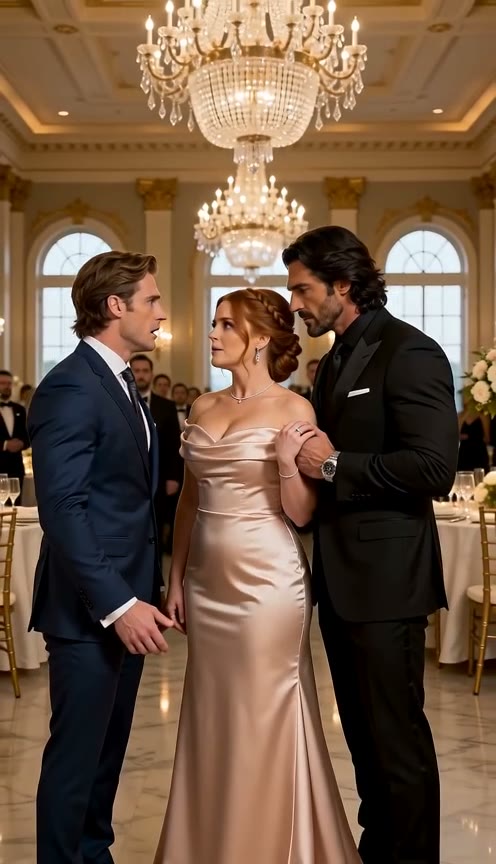
The ballroom of the St. Regis had been built for moments that felt like history, and on that night, beneath three tiers of blazing crystal chandeliers, Penelope Russo stood very still in the center of it and tried not to let two hundred people watch her bleed.
"Where's your husband, Penny?"
Bradley Farnsworth said it the way he said everything — with a smile that had been polished since childhood, pitched just loud enough for the nearest tables to hear. He leaned toward her across the edge of the dance floor, navy suit immaculate, and pointed one manicured finger directly at the diamond wedding ring on her left hand, as if it were evidence in a trial he had already won.
Penelope's fingers tightened around her glittering evening clutch. Her champagne-blush gown caught the golden light; her chestnut hair, braided up in soft romantic coils, did not move. Only her eyes moved — widening once, briefly — before she lifted her chin and held his gaze.
"He's on his way," she said.
It came out quiet. It came out steady. She was proud of that, in some distant corner of her mind, even as her heart slammed against her ribs hard enough to hurt.
Bradley laughed — a short, contemptuous sound — and glanced sideways at the guests, inviting them in. A woman in emerald silk hid a smile behind her champagne flute. A man Penelope had once tutored in economics looked down at his shoes.
"On his way," Bradley repeated, savoring it. He stepped closer, and his smile widened into something colder, something that had been waiting eight years to be said in exactly the right room. His eyes traveled over her — slowly, deliberately, the way you appraise something you have already decided is worthless. "Who would marry you?"
The words landed the way he meant them to. Penelope felt them in her teeth. Around them the gala's music went on — strings, laughter, the bright clink of glass — but inside the small circle of Bradley's cruelty, everything had gone very quiet.
She did not step back. That was the thing she would remember later, long after everything else: she did not step back.
And then the great doors at the far end of the ballroom opened.
There was no announcement. There did not need to be. Conversation thinned out along the edges of the room like a tide going back, table by table, guest by guest, as a tall figure in an immaculate black three-piece suit came through the doorway and stopped, framed for one held breath in the golden light.
Damian Russo did not scan the room. He did not need to. His dark eyes found his wife the way a compass finds north, and the whole ballroom felt it happen.
Guests stepped aside. Not dramatically — nothing so crude — just a subtle, instinctive clearing of the path, the way a crowd parts around deep water.
Bradley, mid-smirk, registered the shift in the room before he understood it. He turned his head.
Penelope watched the exact moment the blood left his face.
Damian crossed the marble floor with unhurried, deliberate steps and stopped beside her, and his large hand settled on her shoulder — warm, certain, possessive in the way of a man closing a door against a storm. His thumb moved once, slightly, against the silk of her gown. A reassurance no one else in the room was meant to see.
Penelope turned toward him, and the relief that broke across her face was not performance. It was eight years of being unchosen, answered in a single touch.
Damian looked at her for one brief moment — long enough for her breathing to slow — and then he raised his eyes to Bradley Farnsworth, and the temperature of the entire ballroom seemed to drop.
Bradley had gone the color of old paper. His pointing hand had drifted down to his side, forgotten. His lips parted.
"Damian Russo…" he whispered.
Damian's voice, when it came, was deep and perfectly controlled, quieter than the music, and somehow every guest within twenty feet heard it.
"You insulted my wife?"
Penelope placed her hand gently over her husband's, where it rested on her shoulder, and looked at the man who had once taught her what it cost to be loved by the wrong person. Her eyes were wet. Her voice was not.
"Bradley," she said softly, "meet my husband."
What happened in the ballroom that night would be retold at dinner tables across Manhattan for a year. But to understand how Penelope Russo came to be standing there — in a champagne-pink gown, between the boy who had discarded her and the most dangerous man in New York — you have to go back eight years, to a girl who had nothing, and a golden boy who had everything, and the night he showed her exactly what that meant.
* * *
Eight years earlier, Penelope Hart was twenty-two years old, graduating from Wexford University with honors, a scholarship transcript, forty-one dollars in her checking account, and a heart so full of Bradley Farnsworth that she could not imagine a world in which it wasn't returned.
She had met him in the library her sophomore year, reaching for the same copy of a Keats anthology neither of them needed. He had laughed — that same laugh, back when it had sounded like sunlight — and let her take the book, and written his number inside the back cover while she pretended not to watch. For two years, she had been the great romantic story of his college career: the golden heir of Farnsworth Capital, dating the scholarship girl from Ohio who worked weekends in the campus café. His friends called it charming. His parents, in the beginning, called it a phase — politely, at a distance, the way you speak of weather that will pass.
Penelope had known about the word phase. She had heard it exactly once, through a door she was never meant to be standing behind, and she had done what girls who have clawed their way out of nothing learn to do: she buried it, and she loved him harder, and she became fluent in making herself easy to love. She laughed at his friends' jokes that were not jokes. She did not mention the skipped dinners with his family, the photographs cropped just so. She told herself that graduation would fix it — that once she had the degree, the job offers, the standing, she would become a woman the Farnsworths could not call weather.
She was wrong in the way only the very young and very hopeful can be wrong.
And she had so much to be hopeful about — that was the tragedy of it, later. Because Bradley in private was not the Bradley of the fountain. Bradley in private had read her term paper on Keats at 2 a.m. and argued about it until dawn, badly, happily, losing. Bradley in private had driven four hours in February to sit in a hospital waiting room in Columbus because her mother had fallen, and had charmed the nurses and bullied the cafeteria into producing edible soup. Bradley in private had found her crying over a failed statistics midterm in the library stacks — convinced the scholarship was gone, convinced she was a fraud the university would eventually invoice — and had sat down on the floor between the shelves in his good coat and said, "Listen to me. You are the smartest person at this school. The rest of us are just better dressed," until she laughed through the tears and believed him enough to stand back up.
She stored those moments the way she stored everything precious: carefully, in order, where she could keep them safe. She did not notice — because she did not yet know how to look — that every one of them had happened where no one from his world could see. The hospital, the library floor, the 2 a.m. kitchen of her dorm. Never the club. Never the family box at the stadium. Never, in two years, a single photograph on the Farnsworths' holiday card, which arrived each December addressed to him alone, with a girl cropped out of the summer-house picture so neatly that only the edge of her sleeve remained, blue against the white railing, like a rumor of a person.
She noticed the sleeve. She wants it known, in the record of her own heart, that she noticed the sleeve. She simply filed it under things graduation would fix.
The graduation party was held at the Farnsworth family's country club, all white roses and string quartets, and Penelope wore a blue dress she had saved four months to buy. In her purse, wrapped in silver paper, was a first-edition Keats — the same anthology, two years later — into which she had written, in her careful hand: For the boy who let me keep the book. Everything starts here.
She never gave it to him.
The party itself had warned her, in a hundred small courteous cuts, all afternoon. Mrs. Farnsworth had greeted her at the door with a smile that stopped at the eyes and said, "Penelope. How brave of you to come all this way," as if the country club were a war zone and she a tourist. There was no place card for her at the family table — an oversight, the coordinator murmured, blushing, while a waiter materialized a folding chair at the far end, near the kitchen doors, where the scholarship girl could watch Bradley's toast through the steam of other people's dinners. The photographer doing the class portraits had posed the golden couples on the terrace steps — Bradley and Vanessa among them, Vanessa's hand bright on his arm, an arrangement nobody corrected — and Penelope, watching from below with a glass of lemonade she didn't remember taking, had told herself it was protocol. Family friends. Optics. The things graduation would fix.
She had even rehearsed generosity. In the mirror that morning, zipping the blue dress with hands that shook, she had practiced being gracious about London if it came — because some rumor of London had reached even her, wrapped in the plausible deniability of his friends' jokes — practiced saying we'll write, we'll visit, we'll be the story that survives the distance. She had practiced everything except the truth, because the truth had no manners and she had been raised by a mother who believed manners were a form of armor.
She was coming down the terrace steps with two glasses of lemonade when she heard her name in the knot of Bradley's friends by the fountain — and heard, in Bradley's own voice, easy and amused above the others: "Come on. You don't marry the scholarship girl. You date her in college so you have something interesting to remember."
The lemonade glasses did not fall. She was always, even then, a woman who did not drop things. She set them down on the stone balustrade with great care, and she stood in the shadow of the terrace column, and she listened to the man she loved explain her to his friends — a phase, a story, a kindness, really, he was doing her a kindness, she'd land on her feet, girls like that always did — and then she heard Vanessa Cole's laugh, bright as a struck bell, and Bradley saying, fond and final, "Vanessa and I leave for London on Tuesday. That's real. That's the plan. It was always the plan."
Penelope walked back into the ballroom on legs she could not feel. She took the silver-wrapped book out of her purse and set it down on the marble gift table between a Tiffany box and a vase of white roses, exactly where he would find it. She did not write a note. The inscription was already inside, and by the time he read it — if he ever read it — it would be a relic of a girl who no longer existed.
Then Penelope Hart walked out of the country club, down the long gravel drive, in her four-months-saved-for blue dress, into a rain that had come up off the lake without asking anyone's permission — and she made herself a promise, quietly, the way she did everything that mattered.
She did not know it yet, but she had just walked out of the wrong man's story — and straight toward her own.