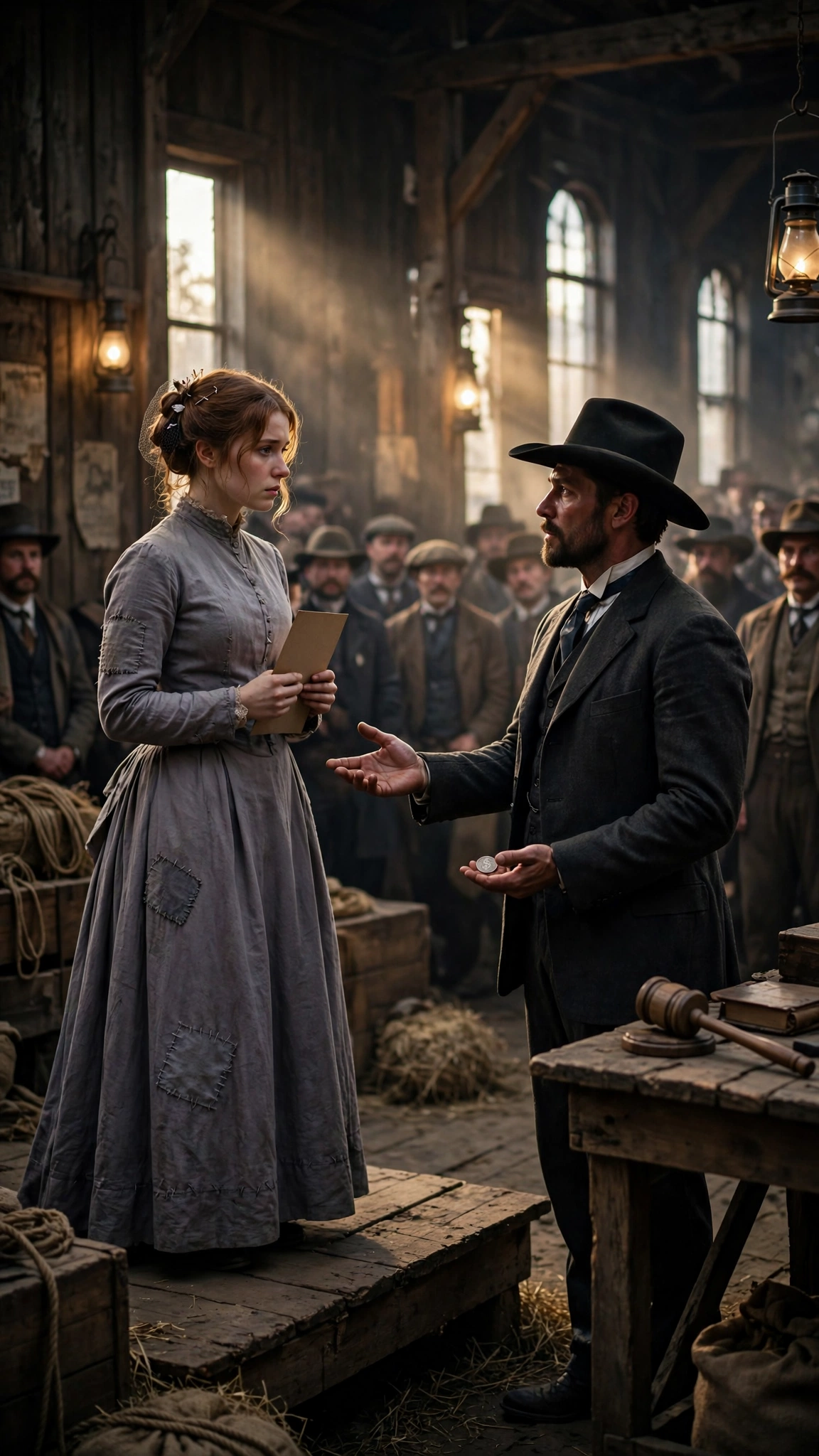
The trouble began in April, at the church in Council Bluffs, on the first Sunday Evelyn went to service as Mrs. Redmond.
She wore her best dress — the lavender-grey, washed and pressed, with a new collar she had sewn herself — and she sat beside Silas in the pew near the front, and she folded her hands, and she listened to the sermon about Ruth and Naomi, about loyalty and belonging. She had chosen the pew near the front deliberately. She had told herself that morning, while she pinned her hair, that she would not hide at the back like a woman with something to be ashamed of. She was Mrs. Silas Redmond now. She had a husband, and a house, and a name. She would sit where she belonged.
But the town had not forgotten the warehouse. The town had not forgotten the doctor.
She felt it the moment she walked down the aisle: the heads turning, the whispers moving through the pews like wind through dry grass. The women looked at her and then looked away. The men stared at Silas with a mixture of envy and contempt. And when the service ended and the congregation spilled out onto the churchyard steps, no one came to greet her. No one offered a hand. No one said, "Welcome to Council Bluffs, Mrs. Redmond."
Except one man.
Amos Grady was a cattle baron like Silas, but where Silas was quiet, Grady was loud, and where Silas was respected, Grady was merely rich. He owned nine thousand acres to Silas's eighteen, and it galled him every day of his life. He had a red face and a loud laugh and a son named Caleb who had inherited both, and he had wanted Silas's north range for ten years, and he had never forgiven Silas for refusing to sell it.
He came across the churchyard with his hands in his pockets and his hat tipped back, and he stopped in front of Evelyn and Silas, and he smiled the smile of a man who has been waiting all week for this moment.
"Well, Silas," he said. "I hear congratulations are in order. Bought yourself a wife at the auction, I hear. One dollar, was it?"
The churchyard went quiet. The women stopped talking. The men turned to watch.
Silas looked at Grady the way he looked at a rattlesnake on the trail — calmly, and without fear, and with his hand nowhere near his gun, because a man who reaches for his gun has already lost.
"My wife's name is Evelyn," Silas said.
"Oh, I'm sure it is," Grady said. "And I'm sure she's a fine woman. But a dollar, Silas? For a woman the doctor himself said couldn't bear? Seems to me you paid a dollar for an empty field."
Evelyn felt the words go through her like a cold draught, the same cold she had felt in the back bedroom when Dr. Harlan had washed his hands and not looked at her. She felt her hands go cold inside her gloves. She felt the humiliation rising in her throat like something she might choke on.
But she had practised her posture. Straight back. Chin level. Eyes forward. She lifted her chin and looked at Amos Grady, and her voice was quiet, and it carried.
"Mr. Grady," she said, "I do not know what the doctor told you. But I know what my husband told me. He told me I was not livestock. And he told me to hold my head up. So I am holding it up."
Grady's smile faltered. He had expected tears. He had expected her to run. He had not expected a quiet woman in a mended dress to answer him in front of the whole churchyard.
Silas put his hand on Evelyn's arm — not to hold her back, but to stand beside her — and he looked at Grady, and his voice was as calm as still water.
"Amos," he said, "you have nine thousand acres and a son who drinks. I have eighteen thousand acres and a wife who can read. I think I got the better of the bargain."
And he took Evelyn's hand, and they walked to the wagon, and they drove home in silence, with the churchyard behind them and the grasslands opening up ahead, and Evelyn sat beside him with her hands folded in her lap, and she did not cry, and she did not speak, until they were halfway home, and then she said, in a voice so small he almost did not hear it, "Thank you."
"For what?" Silas asked.
"For standing beside me," she said. "Thomas always stood beside me. I had forgotten what it felt like."
Silas looked at the road ahead, and at the grass moving in waves under the wind, and he said, "Evelyn. I didn't marry you to stand in front of you. I married you to stand beside you. There's a difference, and I mean to remember it."
That night, after supper, Evelyn sat in the library with a book she was not reading, and she thought about the doctor's word, and about how it followed her wherever she went. It had followed her from Omaha to Council Bluffs. It had followed her into the churchyard. It would follow her into every room she ever entered, for the rest of her life, unless something changed.
She had begun to understand something that frightened her: that the doctor's word was not just a fact about her body. It was a story the town told about her. And stories, once told, are hard to untell. The only way to untell a story is to live a different one, loudly enough that people hear it.
She did not yet know what that story would be. But she knew it would not be written in a churchyard, by a man like Amos Grady.
It would be written at home.
The diphtheria came to the county in May.
It came the way sickness always comes to the plains — quietly, at first, a cough in one house, a fever in another, and then all at once, like a fire catching in dry grass. It took the Miller family first, out on the east range: a mother and a father, both dead within a week of each other, leaving two children behind — a boy of eight named Thomas, and a girl of six named Ruth — alone in a sod house with a dead stove and a pantry full of nothing.
Dutch found them. He had ridden out to the Miller place to check on the cattle, and he had found the house silent, and the children sitting on the doorstep with their arms around each other, waiting for someone to come. He brought them back to the ranch wrapped in his coat, and he carried them into the kitchen, and he set them down by the stove, and he looked at Silas, and he said, "Well, boss. What do we do with them?"
Silas looked at the two children — thin, dirty, frightened, their eyes too big for their faces — and he looked at Evelyn, who was already kneeling beside them with a basin of warm water and a cloth, washing the boy's face with the gentle, practised hands of a woman who had once dreamed of children of her own.
"We keep them," Evelyn said, without looking up. "We feed them. We give them a bed. We see what happens next."
"They're not ours," Silas said, and his voice was careful, the way a man's voice is careful when he is afraid of hoping.
"They're here," Evelyn said. "That's enough for now."
She washed them, and she fed them — bread and milk and stew, small portions at first, because their stomachs had shrunk — and she put them to bed in the room next to hers, in a bed that had stood empty for twelve years, and she sat with them until they fell asleep, and she listened to their breathing in the dark, and she thought about the list of names on the back of the primer.
Thomas. Ruth.
The names were not on her list. But they were names, and they were children, and they were here, in her house, breathing in the dark, and she understood, with a sudden clarity that made her hands shake, that the doctor had been wrong about one thing at least: he had said she would never be a mother. But motherhood, she was beginning to understand, was not only a matter of blood. It was a matter of showing up. Of washing a face. Of sitting in the dark until a frightened child fell asleep.
In the morning, the boy woke first. He came into the kitchen in his bare feet, and he stood in the doorway, and he looked at Evelyn, and he said, in a small, careful voice, "Are we staying?"
Evelyn looked at Silas, who was standing by the stove with his coffee, watching her. Silas looked at the boy. He set his cup down. He crouched, so that his eyes were level with the boy's, and he said, "You're staying as long as you want to stay. This is your home now, if you want it."
The boy looked at him for a long time. Then he nodded, once, the way a man nods, and he went to the table, and he sat down, and he ate his breakfast like a boy who had not eaten properly in a week.
That was the day the Redmond ranch stopped being a house with eighteen thousand acres of silence, and started being a home.
But the town had not finished with them. A week after the children arrived, Dr. Harlan himself rode out to the ranch. He came in his buggy, with his black bag, and his cold hands, and his careful voice, and he asked to see Mrs. Redmond, and Evelyn received him in the parlour, because that was what one did, and she sat with her hands folded, and she waited.
"I hear you have taken in the Miller children," Dr. Harlan said.
"We have," Evelyn said.
"A kind act," the doctor said. "But I felt I should warn you, Mrs. Redmond. A woman in your condition — a woman who cannot bear children of her own — should be careful about raising hopes. The children will leave, in time. They always do. And then you will be alone again, and the disappointment will be worse than the loneliness."
Evelyn looked at him for a long moment. She looked at his cold hands and his careful voice, and she thought about the back bedroom in Omaha, and about the words he had spoken there, and about how those words had followed her for two years, from town to town, like a shadow.
Then she stood up, and she walked to the door, and she opened it, and she said, in a voice as steady as the day she had stood on the auction stage, "Doctor Harlan. You told me I would not bear children. You did not tell me I could not love them. There is a difference, and I mean to remember it. Good day."
And she closed the door behind him, and she went to the kitchen, where Ruth was helping Mrs. O'Leary knead bread, with flour on her nose and her sleeves rolled to the elbow, and where Thomas was sitting at the table doing his lessons, sounding out the words in the primer, and Evelyn stood in the doorway and watched them, and she felt something in her chest loosen, like a knot coming undone.
That night, Silas found her in the library, and he sat beside her, and he did not ask about the doctor, because Dutch had told him. He only said, "Are you all right?"
"I am," Evelyn said. "I think I am. For the first time since Thomas died, I think I am."
And she took his hand, and they sat together in the lamplight, and the house was quiet around them, but it was a different quiet now. It was the quiet of a house with children asleep upstairs, and bread rising in the kitchen, and a future taking shape, one small day at a time.