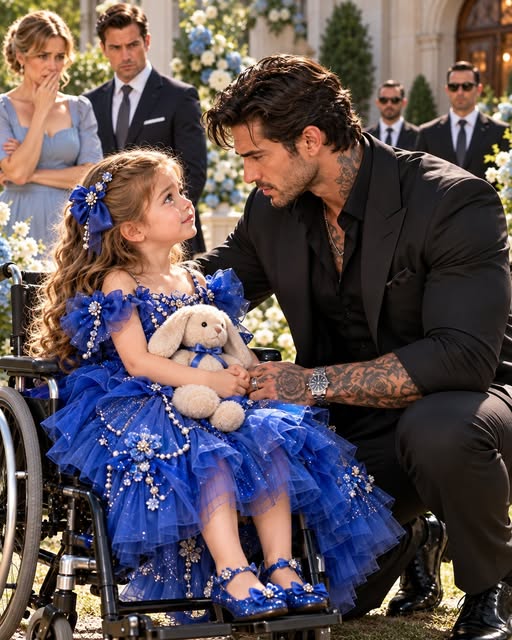
My name is Lily, and I am six years old. I live at St. Clare's Home for Children, which is a big white house with a courtyard, an old oak tree, and white flowers that Mrs. Bell plants every spring. I have long curly brown hair that tangles if I do not brush it, a large blue bow that Mrs. Bell ties for me every morning, and a dress that I love more than anything else in the world. It is royal blue and sparkles when I move, and it has pearl buttons down the front that I count when I am nervous. One, two, three, four, five, six, seven. I have blue shoes that match the dress. I have a wheelchair with wheels that squeak a little when I turn too fast. And I have Mr. Bear.
Mr. Bear is not a real bear. He is a cream-colored teddy bear with a blue ribbon around his neck, and he is soft in the places where I have hugged him the most. His left ear is a little bit bent because I fell asleep on him once during story time and Mrs. Bell had to rescue him from under my pillow. I take him everywhere. When people ask me why I carry a teddy bear, I say, "Because he is my best friend, and best friends do not get left in a bedroom." Mrs. Bell says that is a very good rule. She says it in the voice she uses when she is trying not to cry, which is a soft voice, like a blanket voice.
Mrs. Bell is the caretaker here. She is not my mother, and she would never pretend to be, but she is the person who knows that I like my toast cut into triangles, that I hate it when my socks slide down inside my shoes, and that I am scared of thunderstorms even though I pretend I am not. She braids my hair when it gets too wild, and she tells me stories about brave girls who were small and still did big things. She never tells me that being small means being unimportant. She never tells me that my wheelchair makes me less. She says, "Lily, your wheels are just how you get around. Your heart is how you get through." I have remembered that sentence since I was four. I keep it in my pocket like a lucky coin.
St. Clare's is a home, but it is also a waiting place. Children come here, and families come here, and sometimes a child leaves with a new family and we all stand on the porch and wave and clap. We make a banner out of paper and we write "Good luck!" in big letters, and Mrs. Bell bakes a cake that is too sweet and we all eat it anyway. I have waved at a lot of banners. I have clapped until my hands hurt. I have smiled so hard my cheeks ached. And then I have gone back to my room, put Mr. Bear on my lap, and whispered, "Maybe next time, it will be us."
I have been chosen three times. I need to tell you about that, because if I do not, you will not understand why the day the black cars came mattered so much. Being chosen sounds like a happy thing. It sounds like someone points at you and says, "You. We want you." But sometimes being chosen is only the first part of the story, and the second part is being sent back.
The first family was a couple with a big house and a dog named Biscuit. They came on a Saturday, and the woman wore a yellow dress and the man carried a camera. They asked me what my favorite color was, and I said blue, and the woman laughed and said, "Of course it is, sweetheart. You look like a little blueberry." I liked that. I liked being a blueberry. They took me to the park for an afternoon, and they pushed my wheelchair very carefully over the grass, and they bought me ice cream with sprinkles. I told them about Mr. Bear, and they listened, and the man said Mr. Bear could have his own seat in the car if I wanted. I went to sleep that night thinking about Biscuit and the yellow dress and the seat for Mr. Bear.
They did not come back. Mrs. Bell told me, very gently, that they had decided they were not ready for a child with extra needs. She did not use the word "extra" like it was a bad word. She said it like it was a fact, like saying someone needs glasses. But I heard the part she did not say. I heard, "They were not ready for you." I sat under the oak tree with Mr. Bear for a long time that day, and I counted the pearl buttons on my dress. One, two, three, four, five, six, seven. I did not cry in front of the other children. I cried later, into Mr. Bear's soft fur, where no one could hear except him.
The second family was a single mother with kind eyes and a little boy who was already hers. She wanted a sister for her son. She read to me, and she taught me how to make paper stars, and she said my laugh was her favorite sound in the whole house. For two weeks, I thought I might be going home with her. I practiced saying "good morning" in the way she said it, slow and warm. I imagined a bedroom with a window that looked out on a garden, and a place for Mr. Bear on the bed, and a brother who would teach me how to skip rocks, even if I could only watch from the shore.
Then the boy got sick, and the mother had to spend all her time at the hospital, and she wrote a letter to Mrs. Bell saying she could not take on another child right now, not because of me, but because life had become too hard all at once. Mrs. Bell read me the kind parts of the letter, and she said, "Lily, this one was not about you." I believed her, mostly. But a small voice in my head said, "If I were easier, maybe she could have managed." I told that voice to be quiet. I told Mr. Bear, "We are not a problem to be managed. We are a person." He did not answer, because he is a teddy bear, but his ribbon felt like a nod.
The third family is the one I do not like to remember, but I have to, because it is the reason I stopped believing that being pretty and polite and brave would be enough. They came in a shiny car, and the woman wore perfume that smelled like flowers that had been left in the sun too long. The man talked about his business and his house and his boat, and he talked about children like they were things you could order from a catalog. They took me to a restaurant with white tablecloths, and I was very careful not to spill anything, and I smiled, and I answered all their questions, and I held Mr. Bear on my lap where he could not be seen too much, because I thought maybe they would think a six-year-old with a teddy bear was too babyish.
On the way home, in the car, I heard the woman say it. She did not whisper. She said, "She is sweet, but she is a burden. We wanted a normal child." The word "burden" landed in my chest like a stone. The word "normal" landed right beside it. I did not know what to say. I looked down at my blue dress, at the pearl buttons, at my shoes, at my hands holding Mr. Bear so tight his ribbon wrinkled. I thought, "I am not a burden. I am Lily." But I did not say it out loud, because my throat had closed up, and because I was six, and because grown-ups who say things like that in cars do not usually listen to six-year-olds.
When we got back to St. Clare's, Mrs. Bell was waiting on the porch. She saw my face, and she did not ask what happened right away. She just knelt down, which is a hard thing to do in a skirt, and she put her hands on my wheelchair, and she said, "Lily, you are not a burden. Do you hear me? You are not a burden, and you are not less than normal. You are Lily, and that is a wonderful thing to be."
I nodded, because I wanted to believe her. I nodded so hard my blue bow bounced. But that night, I sat on my bed and I whispered to Mr. Bear, "What if she is right? What if nobody wants a girl who cannot walk to the park by herself, who needs help getting into a car, who has wheels instead of running feet?" Mr. Bear looked at me with his button eyes, and I imagined him saying, "Then they do not deserve you." I liked that answer. I kept it.
After that, I stopped running to the door every time a car pulled into the courtyard. I stopped practicing my smile in the mirror. I still wore my blue dress on visiting days, because it made me feel brave, but I did not wear it with the same hope. I wore it like armor. Sparkles can be armor, if you believe in them hard enough. Mrs. Bell noticed, of course. Mrs. Bell notices everything. She started sitting with me under the oak tree after lunch, and she brought lemonade, and she did not try to fix my feelings with a speech. She just sat there, and she let me talk, and sometimes she let me not talk, and she taught me how to make daisy chains out of the white flowers. "See, Lily," she said one afternoon, holding up a chain, "these flowers are small, and they are not roses, and they are still beautiful. Nobody calls a daisy a burden for not being a rose."
I liked the daisy chain. I wore it on my wrist for the rest of the day, until it wilted, and then I pressed one flower in a book, so I could remember.
My days at St. Clare's were not all sad. I want to be honest about that, because a sad story that is only sad is not true. I had friends. I had a boy named Tommy who could make a paper airplane fly all the way across the courtyard, and a girl named Rosa who taught me how to draw a cat that actually looked like a cat. I had school lessons in a room with big windows, and I was very good at reading, and I was even better at making up stories. My favorite stories were about girls who went on adventures in wheelchairs that could fly, or turn into boats, or climb mountains with special wheels. Mrs. Bell said I had an imagination that could fill a whole house. I liked that. Imagination is free, and it does not ask if you can walk.
I also had chores, which is a normal thing for a child, even if some people think a child in a wheelchair should not have chores. I helped fold napkins. I helped sort books. I helped Mrs. Bell water the white flowers, because the watering can was light and I could hold it with one hand and steer with the other, if I was careful. I was proud of the flowers. They were mine, in the way that things you take care of become yours, even if you do not own them.
But at night, when the house got quiet and the hallway lights went dim, I would lie in bed and listen to the other children breathing, and I would think about families. I would think about a kitchen where someone knew I liked my toast in triangles. I would think about a lap that was not a chair, but a person, and a hand that held mine not because I needed help, but because they wanted to. I would think about a father, because I had never had one, and I did not know what that word felt like in real life. I had seen fathers in books, and in movies, and in the park, pushing swings and catching children who jumped off the slide. I wondered what it would be like to have someone who was not paid to take care of me, who chose me on purpose, and stayed.
I was afraid to hope for that, after the third family. Hope had started to feel like a bruise. You press it, and it hurts, and you learn not to press it. But I could not stop hoping entirely, because hope is stubborn, like a weed in the courtyard that keeps growing back between the stones. Mrs. Bell said hope was a good stubbornness. She said, "Lily, do not let one unkind family steal the whole idea of family from you." I wrote that down in my notebook, in my best handwriting, with a blue star next to it.
The morning it happened, it was golden hour, which is the time when the light turns honey-colored and everything looks like it is in a photograph. I was in the courtyard, under the oak tree, in my blue dress, with Mr. Bear on my lap. I had not been waiting for anyone. I had been drawing, actually. I was drawing a picture of a girl in a wheelchair under a tree, with white flowers all around her, and a teddy bear wearing a blue ribbon. It was a picture of me, but braver. I was humming a song Mrs. Bell had taught me, a song about a little boat that sails home, and I was thinking about lemonade, and about whether Tommy's paper airplane would fly farther if we folded the wings differently.
Mrs. Bell came out of the house quickly, which was unusual, because Mrs. Bell does not hurry. She smoothed her apron, and she looked at the gate, and she said, "Lily, stay right here, sweetheart. Someone is coming to visit." She did not say who. She did not say a family was coming. She just said someone, and her voice was a little bit shaky, like she was excited and nervous at the same time.
I looked up. I put my pencil down. I held Mr. Bear a little tighter.
And then I heard them. Not one car, but three. Three black SUVs, big and shiny and quiet in the way expensive cars are quiet, pulling into the courtyard one after another, like a parade that did not know it was a parade. The other children stopped playing. Rosa stopped drawing. Tommy's paper airplane fell to the ground, forgotten. Even the birds seemed to pause.
I did not know who was in those cars. I did not know if it was another family, or a visitor, or someone important. I only knew that my heart was beating very fast, and that my blue dress suddenly felt like armor again, and that Mr. Bear's ribbon was wrinkled in my hands.
I sat up straight in my wheelchair, under the oak tree, among the white flowers, in the golden light, and I waited to see who would get out of the first car. I told myself, "Do not hope too much, Lily. Do not hope too much." But my heart did not listen. My heart was already hoping, stubborn as a weed, brave as a daisy, and ready for whatever came next.
TITLE: A Feared Mafia Boss Knelt Before My Wheelchair, But My Five-Word Question Broke His Heart