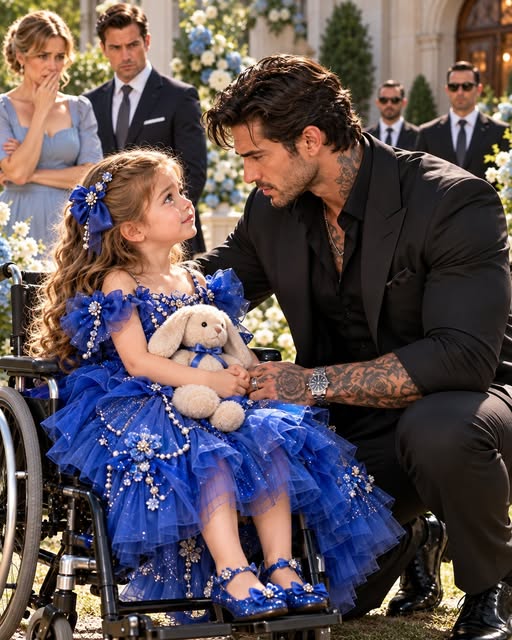
Dominic Moretti came back the next morning, and that was the first surprise. Grown-ups in my life did not usually come back. They came once, with a smile that was too wide and a list of questions, and then they went away and someone else explained, kindly and carefully, that it had not worked out. Dominic came back before breakfast, in the same black suit, with Marco and Enzo walking a little behind him, and he carried nothing in his hands except a plain brown folder. He did not try to look cheerful. He looked tired, the way people look when they have stayed awake thinking about something important.
Mrs. Bell met him at the door. She had her arms folded, which was how she looked when she was being polite and also being a wall.
"Mr. Moretti," she said. "The children are eating. If you have come to talk, you will talk to me first."
"Of course," Dominic said. He did not argue, and he did not try to walk past her. That surprised me too. Men who were used to being obeyed did not usually wait in a hallway. He waited.
I was supposed to be eating my toast, but I wheeled myself to the doorway of the dining room, with Mr. Bear tucked against my side, and I listened. I was very good at listening. When you are six and you sit lower than everybody else, people forget you are there, and then they say the true things.
Mrs. Bell did not waste time. "Yesterday you made a little girl a promise with your eyes," she said. "Today I want to hear it with words. What do you want from Lily?"
Dominic opened the folder. Inside were the papers he had pulled from his pocket in the courtyard, and beside them a letter, folded once, with the edges soft from being held too many times. He did not hand them to Mrs. Bell right away. He looked at them as if they were heavier than paper should be.
"I want to be her guardian," he said. "I want to ask the court to let me take care of her, properly and legally, and to let her stay with me while that is decided. I am not asking to take her away today. I am asking to be allowed to try, in the open, with everyone watching."
Mrs. Bell's eyebrows went up. "You are a busy man, Mr. Moretti. People write whole newspapers about you, and not the kind kind. Why a little girl in a wheelchair? Why now?"
Dominic was quiet for a long moment. Then he said, "Because I had a daughter once."
The hallway went very still. Even the breakfast sounds from the dining room seemed to pause.
"She was small," he said. "She liked stories before bed, and she liked to be carried on my shoulders so she could see over a crowd. She is gone now. She has been gone for years. I do not tell you this so you will feel sorry for me. I tell you because when I lost her, I stopped being a father, and I never learned how to start again. I built a life out of work and walls and men who call me sir, and none of it ever asked me how I was. Then yesterday, in your courtyard, a little girl in a blue dress asked me if I would leave her too, and I understood that I had been leaving everyone, in a way, for a very long time."
Mrs. Bell did not soften all at once. She was not the kind of person who softened all at once. But her arms unfolded, just a little.
"Grief is not a qualification, Mr. Moretti," she said. "It is a reason to be careful."
"I know," he said. "That is why I brought papers instead of promises. A promise I say in a courtyard can fade. A paper has to be read by a judge. It has to be checked. If I am not fit, the paper will not save me. If I am fit, the paper means I cannot simply walk away when it gets hard."
He handed her the papers. Mrs. Bell read them slowly, her lips moving a little, the way she did when she was reading something important and did not want to miss a word. The letter he kept in his own hand.
"What is the letter?" I asked, because I could not stay quiet any longer. I wheeled forward a little, and Mr. Bear's blue ribbon slipped, and I fixed it without thinking.
Dominic knelt down again, right there in the hallway, so his eyes were level with mine. He did not put his jacket on the floor this time. The floor was clean, and I think he had learned that kneeling was not about the jacket. It was about not making me look up at him like he was a mountain.
"The letter is one I wrote to my daughter," he said. "After she was gone, I wrote down everything I wished I had said better. That I was proud of her. That I would have stayed, no matter what. That being her father was the best part of my life, even the hard parts. I kept it because I needed to remember who I wanted to be. When I met you, I realized the letter was not only for her anymore. It was for the next little girl I might get to take care of, if she would let me."
I thought about that. Grown-ups often told me stories that made them sound good. This story did not make Dominic sound good. It made him sound sad, and a little bit lost, and honest in a way that was uncomfortable. I liked uncomfortable honesty better than comfortable lies. Comfortable lies were what the third family had told me, right before they called me a burden.
"Did you write the letter in pen or pencil?" I asked.
Dominic blinked. "Pen," he said.
"Then you cannot erase it," I said. "That is good. Promises should be in pen."
A sound came out of him then that was almost a laugh. It was rusty, like a door that had not been opened in a long time, but it was real. Mrs. Bell looked at him, and then at me, and I could see her thinking. She was thinking about all the families who had come with perfect smiles, and about this man who had come with a folder and a sad letter and no perfect smile at all.
"You may stay for lunch," she said at last. "You may eat with Lily, here, where I can see you. You may not take her out alone yet. You may not make her any more promises until you have kept the small ones. Do you understand?"
"I understand," Dominic said. "Small promises first."
Lunch was vegetable soup and bread, and Dominic ate it as if it were a meal at a fine restaurant. He asked me questions, but not the questions grown-ups usually asked, like whether I was happy all the time, or whether I needed anything. He asked me what Mr. Bear liked to eat, and whether the oak tree in the courtyard had a name, and what I did when I was angry.
"Mr. Bear likes pretend soup," I said. "The oak tree is called Mr. Oak, because he is old and he listens. When I am angry, I go very quiet, and Mrs. Bell knows that is worse than shouting."
Dominic nodded seriously, as if he were taking notes in his head. "When I am angry, I go very quiet too," he said. "My men think it means I am planning something. Mostly it means I do not know what to say yet."
"Then we are the same," I said. "Except I am smaller, and I have better hair."
That made him laugh again, a real laugh this time, and Marco, who was standing by the door pretending not to listen, smiled into his hand. Enzo looked at the ceiling, as if the ceiling were very interesting, but his shoulders were shaking.
After lunch, Dominic asked if he could push my wheelchair to the courtyard, but Mrs. Bell said no, not yet, because I could wheel myself, and because I liked to do it myself. He walked beside me instead, slowing his long steps to match my wheels, and he did not try to hurry me. Under the oak tree, with the white flowers nodding in the breeze, he sat on the low stone wall and talked to me like I was a person, not a problem to be solved.
He told me about his house, in a careful way, without bragging. It had a garden, and a kitchen with a big table, and stairs that would be a problem, and he had already called someone to fix that. "A house should fit the person who lives in it," he said. "If it does not fit, you change the house, not the person."
That was the nicest thing anyone had ever said about my wheelchair without making it sound sad. Usually people said "poor thing" or "so brave" or they pretended the wheelchair was not there at all. Dominic saw it, and he saw me in it, and he talked about ramps as if they were as normal as doors. Because they are.
I decided to test him. Mrs. Bell had told me, once, that you can learn a lot about a person by asking a small, honest question and watching whether they tell a small, honest answer.
"Do you get scared?" I asked.
"Yes," Dominic said, without pausing. "I was scared yesterday, when you asked me if I would leave you. I was scared this morning, driving here, that you would not want to see me again."
"Do you like broccoli?" I asked.
"No," he said. "I eat it because it is good for me, and I complain about it in my head the whole time."
"Would you read me a story even if you were tired?"
"Yes," he said. "Especially if I were tired. Tired is when stories matter most."
"Would you stay if I was grumpy for a whole day?"
He thought about that one. "I would stay," he said. "I would give you space, and I would still be in the next room. Being grumpy does not make you unlovable, Lily. It makes you human. I have been grumpy for years, and people still bring me soup."
I laughed, and it surprised me, because I had not expected to laugh with a man who was supposed to be feared. Laughter felt like a small door opening. I had been careful with my laughter since the third family left, as if laughing too much would make someone think I was fine and did not need anything. With Dominic, laughter felt safe, because he had already seen me cry, in a way, and he had not run away.
Mrs. Bell watched us from the doorway, and her face was doing that complicated thing grown-up faces do when they are hopeful and worried at the same time. Later, when Dominic had gone to make a phone call, she sat beside me under the oak tree and brushed a curl out of my face.
"He is not what I expected," she admitted. "I expected a man who wanted to buy his way into feeling better. He seems to want to work his way into it, which is different. But Lily, listen to me. Wanting is not enough. The court will ask hard questions. His work will ask hard questions. People who do not like him will try to use you to hurt him. I have to protect you from that, even if it means saying no to a man who makes you laugh."
"I know," I said. "You always protect me. That is your job, and you are very good at it."
She hugged me, carefully, so she did not squash Mr. Bear. "And your job," she said, "is to tell the truth, even when it is not pretty. Can you do that?"
"I can," I said. "I am very good at truth. Sometimes too good, Mrs. Bell says."
She smiled, but her smile faded quickly, because just then a car pulled up outside that was not one of Dominic's black SUVs. It was a smaller, gray car, and out of it stepped a woman with a neat bag and a notebook, and a look on her face that said she had come to check.
Mrs. Bell stood up straight, and her voice went calm and professional, the way it did when she was getting ready for a test.
"Lily," she said quietly, "that is a social worker. She has come to look at our home, and to ask about Mr. Moretti. Be yourself. Tell the truth. And remember, no matter what she writes down, you are safe here with me tonight."
My stomach did a funny flip. A social worker meant papers and questions and decisions made by people who did not live in my room or know Mr. Bear's name. Dominic came back from his phone call, saw the woman, and went very still. He did not smile his big public smile. He looked at me, and I looked at him, and for a second I wondered if all the small promises we had made under the oak tree were about to be tested by someone with a notebook.
The social worker walked toward us, smiling politely, and Mrs. Bell stepped forward to meet her. Behind her, the white flowers kept nodding, as if nothing had changed at all, even though everything suddenly felt like it might.
TITLE: A Feared Mafia Boss Knelt Before My Wheelchair, But My Five-Word Question Broke His Heart