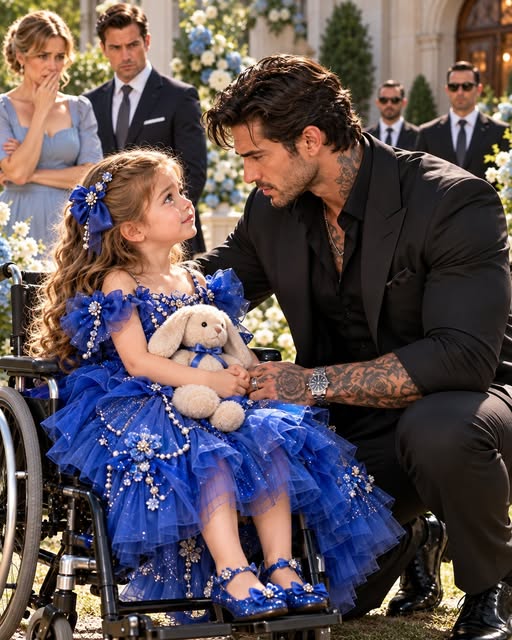
The trial weeks had taught Lily the small, ordinary sounds of a house that was learning to be a home. In the morning, the kettle clicked in the kitchen before anyone spoke. In the afternoon, Marco hummed while he polished the front steps, and Enzo argued with the television about soccer as if the players could hear him. At night, the house settled the way a tired person settles into a chair, with creaks and sighs and, from the room across the hall, the soft sound of Dominic checking the lock on her door twice, just to be sure.
Lily had a room with a window that looked out over the garden. Her wheelchair fit through the doorway without scraping. The bed was low enough that she could climb into it herself, with a little help from the step Marco had built and painted blue because, he said, everything in this house that belonged to Lily had to be blue. On her bedside table sat Mr. Bear, his blue ribbon new and neat, and a drawing she had made of the orphanage courtyard, with the oak tree in the middle and white flowers all around it. She had drawn three black cars too, because that was how the story had started, and a small figure in a black suit kneeling on the ground. She had not drawn his face very well. Dominic said it looked exactly like him, which made her laugh, because she knew it did not, and she knew he knew it too.
For the first time in her life, Lily stopped counting the days until someone changed their mind. She did not count the plates at dinner to see if there would still be one for her tomorrow. She did not fold her blue dress away at night as if she might need to leave in a hurry. She let herself believe, a little at a time, that this was not a visit. This was her life.
That was why the letter hurt so much when it arrived.
It came on a Tuesday, in a plain white envelope with no return address, and Dominic read it at the kitchen table while Lily was supposed to be doing her schoolwork in the next room. She was not supposed to hear him, but houses are not good at keeping secrets from children who are listening for them. She heard the paper rustle. She heard Marco say a word she was not allowed to repeat. She heard Enzo say, quietly, "We can handle this. We have handled worse."
Then she heard Dominic's voice, low and steady, the voice he used when he was trying not to frighten anyone. "Not in front of Lily," he said. "Not ever in front of Lily."
But Lily had already heard enough to be afraid. Later, when the adults thought she was asleep, she heard more. She had woken up thirsty and wheeled herself toward the kitchen, and the study door was open just a crack. Inside, Dominic and Marco and Enzo were talking, and Mrs. Bell was there too, because Dominic had called her. Mrs. Bell never raised her voice, but that night her voice was sharp with worry.
"They have filed another challenge," Mrs. Bell said. "They are saying the trial period should end. They are saying a man in your position cannot keep a child safe."
"It is not about safety," Marco said. "It is about the story in the papers. Someone is paying for those headlines. 'Boss Buys Himself a Family.' That is what they wrote today."
Lily pressed her hands over her mouth. She had seen that headline that morning, folded under Dominic's coffee cup. She had pretended not to read it, because the words had made her stomach hurt. Now she understood what it meant. People were saying Dominic only wanted her to look kind. People were saying she was a project, not a daughter.
"It is the rival," Enzo said. "He wants the deal you walked away from, Dominic. He thinks if he makes this messy enough, you will choose the business over the girl."
There was a long silence. Lily held her breath in the hallway, waiting for Dominic to say the words that would prove them all wrong. Waiting for him to say, "I will never choose the business. I will never choose anything over Lily."
Instead, Dominic said, very quietly, "If keeping her puts her in the middle of this, then I have to think about what is best for her. Even if it breaks my heart."
Lily did not wait to hear the rest. She did not wait for the part where Dominic surely meant that he would protect her, or fight for her, or change everything to keep her safe. She heard only the sentence that sounded like all the other sentences she had heard before, in other rooms, from other adults who had looked at her wheelchair and decided she was too much trouble.
The third family had called her a burden. They had wanted a normal child. Now, in her own head, the words rearranged themselves into a new, terrible logic: if she stayed, Dominic would lose his business, and his safety, and his peace. If she stayed, the bad men in the papers would keep coming. If she stayed, she would be the reason everything fell apart.
She wheeled herself back to her room in the dark, her hands shaking on the wheels. She did not cry, not at first. Crying felt like something that would make noise, and noise would bring Dominic, and Dominic would try to talk her out of it with kind words, and kind words were exactly what she was afraid to believe anymore. She sat in the dark and made a plan, the way a brave person makes a plan when they are scared and trying not to show it.
She would leave. Not forever, she told herself, and not because she did not love this house. She would leave to protect him. She would go back to the orphanage, where Mrs. Bell would understand, where the oak tree was, where she had been before and had survived. If she was not here, the headlines would stop. If she was not here, the rival would have nothing to use. If she was not here, Dominic could go back to being safe and strong and feared, the way he had been before she asked him that question.
She packed a small bag the way a six-year-old packs for a very serious journey. Mr. Bear went in first, because Mr. Bear had been with her for every hard night and could not be left behind. Then her blue ribbon, the spare one Mrs. Bell had sewn for her, and the drawing of the courtyard, folded carefully so the oak tree would not crease. Then a sandwich she had saved from dinner, wrapped in a napkin, because runaways in stories always needed food, and a bottle of water, and her favorite book, the one Dominic read to her when she could not sleep, with his finger following the words slowly, as if he were learning them for the first time too.
She waited until the house was quiet. She waited until Marco's humming stopped and Enzo's television went silent and Dominic's footsteps passed her door and paused, the way they always paused, as if he wanted to come in and say good night again. She held her breath until his footsteps moved on. Then she opened her door and wheeled herself down the hall, past the kitchen where the letter still sat on the table, past the study where the voices had been, and out through the side door that Marco always left unlocked for the garden.
The night air was cold. The garden smelled of wet grass and late flowers. The path to the gate was gravel, and her wheels crunched on it, loud in the quiet. She winced at every sound, but she kept going, because stopping would mean thinking, and thinking would mean crying, and crying would mean turning back.
She did not get to the gate. Halfway down the path, under the big tree Dominic had planted for her in the garden because she had said she missed the oak tree at the orphanage, she stopped. She was tired. Her arms ached from pushing. Her sandwich was squashed in her bag, and her book was heavy, and the night was much bigger and darker than it had looked from her window. She sat there under the tree and finally let herself cry, quietly, into Mr. Bear's soft ear.
"Lily?"
The voice was not loud. It was not angry. It was Dominic, standing a few steps behind her in his shirtsleeves, without his jacket, without his bodyguards, just a man in the dark who had clearly run out of the house without his shoes properly on. He did not rush at her. He did not grab her wheelchair. He did what he had done on the very first day, in the orphanage courtyard. He knelt down on the ground, so his eyes were level with hers, and he waited.
"Are you going somewhere, sweetheart?" he asked, very gently.
Lily wiped her face with her sleeve. She tried to sound grown up. She tried to sound sure. "I am going back," she said. "So they will leave you alone. So you will not have to think about what is best for me anymore. I heard you. I heard Marco. I heard about the letter and the papers and the headlines. I am the problem, Dominic. I was always the problem. The third family said so."
Dominic closed his eyes for a moment, as if her words had hit him somewhere he could not hide. When he opened them again, they were wet, and he did not try to hide that either.
"No," he said. "No, Lily. Listen to me, please. Really listen, because I am going to say this slowly, and I am going to say it true."
He took a breath. "The letter is from a man who is angry because I walked away from a deal that would have hurt people. The court challenge is from people who do not know me, and who think a man like me cannot change. The headlines are from people who sell papers by making kind things look small. None of that is because of you. None of that is your fault. Do you understand? The trouble was already there, long before you came. You did not bring it. You are the reason I finally wanted to leave it behind."
Lily shook her head, because she had practiced this argument in her head all the way down the hall, and she was not ready to give it up. "But if I go, it stops. If I go, you are safe."
"If you go, I am not safe," Dominic said. "If you go, I am alone again, in a big house with no kettle in the morning and no blue step by your bed and no one to draw me badly and tell me it looks exactly like me. That is not safe, Lily. That is empty. I have been feared, and I have been rich, and I have been powerful, and none of it ever felt like this house feels now, with you in it."
He reached out, slowly, so she could pull away if she wanted to, and took her small hand in his large, tattooed one. His hand was warm. Hers was cold from the night air.
"When I said I had to think about what is best for you," he said, "I meant I would give up the business. I meant I would walk away from all of it, from the deals and the headlines and the men who think a child will slow me down. I meant I would choose you, even if it costs me everything I built before you. I did not mean I would give you up. I will never give you up. Do you hear me? I will never leave you. I said it before, and I am saying it now as your father, not just as a man who knelt in a courtyard. I will never leave you."
Lily looked at him for a long time. She looked at his wet eyes and his kneeling knees, muddy now from the garden path, and his hand holding hers as if she were something precious and not something heavy. She thought about the third family, and the word burden, and how it had lived in her chest for so long that she had started to believe it was her name. She thought about Mrs. Bell, who had told her again and again that she was not too much. She thought about Marco painting a step blue, and Enzo learning to make her favorite soup, and Dominic reading slowly, finger on the words, because he wanted to get her story right.
Slowly, she nodded. Then she leaned forward, just a little, and rested her forehead against his, the way they did when she was tired and he was trying to make her laugh. "I do not want to go back," she whispered. "I want to stay. I just did not want to be the reason you lose everything."
"You are the reason I found everything," Dominic said, and his voice broke a little on the last word, but he smiled through it. "Come back inside, sweetheart. It is cold, and Mr. Bear looks cold too, and I think we both need hot chocolate and a proper talk with Mrs. Bell in the morning, where everyone says what they mean out loud, so no one has to guess in the hallway at night."
Lily laughed, a wet, hiccuping laugh, and let him push her wheelchair back up the path, slowly, while she held Mr. Bear and her squashed sandwich and her folded drawing. Behind them, the garden tree stood quiet in the dark, and the house lights were warm in the windows, and for the first time that night, the house did not feel like a place she might lose. It felt like a place she had chosen, and that had chosen her back.
The next morning, Dominic did something Lily had never seen him do before. He did not hide the letter, and he did not hide from the reporters, and he did not let Marco and Enzo answer for him. He stood on the front steps with Mrs. Bell beside him, and Lily beside him in her wheelchair, in her blue dress, with Mr. Bear on her lap, and he spoke plainly, in front of everyone who had come to watch.
"This is my daughter," he said. "Not a project. Not a headline. My daughter. I am asking the court to make our family permanent, and I am stepping back from the business that brought this trouble to our door. If anyone wants to challenge that, they can challenge me. They will not challenge her."
Mrs. Bell took Lily's hand. Marco and Enzo stood behind them like uncles at a wedding. Lily, who had almost left in the night to protect this man, looked up at him and smiled through her tears, because she finally understood what family meant. It was not about being easy. It was not about being normal, whatever that word meant. It was about two people, on a cold night under a tree, choosing each other, and then choosing each other again in the morning, in front of everyone.
That night, Lily did not pack a bag. She put Mr. Bear on her bed, smoothed her blue dress over the chair for tomorrow, and fell asleep to the sound of the house settling, and Dominic checking her door twice, just to be sure. She was not almost gone anymore. She was home, and she was staying.
TITLE: A Feared Mafia Boss Knelt Before My Wheelchair, But My Five-Word Question Broke His Heart