The first time Roman Bellini met Sophie Carter, he was standing in a grocery store with a declined credit card in his hand, wondering how a man who owned half of New York could feel so completely empty.
The second time he saw her, three weeks later, she was standing outside the iron gates of his mansion, clutching a white stuffed rabbit and carrying a letter that would change the course of his life.
But the story began with three crumpled dollar bills, seventeen cents, and a six-year-old girl who didn't understand that some men were supposed to be feared.
The payment terminal beeped.
A bright red message flashed across the screen.
PAYMENT DECLINED.
Roman stared at the words.
He was forty-one years old, the head of the Bellini organization, and a man whose name could silence conversations across Manhattan. Men with expensive attorneys and powerful political connections had spent years trying to earn his favor. Business owners carefully weighed their words before entering his office. Even wealthy executives who pretended not to fear anyone became unusually polite when Roman Bellini walked into a room.
And yet, on a quiet Tuesday afternoon, a grocery store computer had just informed him that he couldn't purchase a loaf of bread and a bottle of water.
He glanced at the terminal again.
"Run it one more time," he said.
The young cashier swallowed.
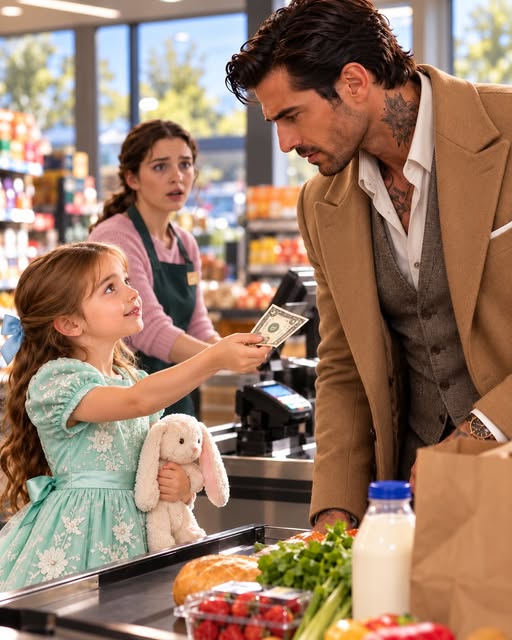
She was probably in her early twenties, with brown hair tied behind her head, a pink sweater beneath a dark green supermarket apron, and tired eyes that suggested she'd already worked too many hours.
"Sir, I already tried twice."
"Then try a third."
His voice wasn't raised. It didn't need to be.
The cashier reached for the card.
Roman hesitated before handing it over.
It was a black card with no visible spending limit, connected to accounts that ordinarily moved more money in a single morning than the entire grocery store earned in a year.
There was no reasonable explanation for it to fail.
Unless someone had deliberately made it fail.
The cashier inserted it into the terminal.
For a moment, the machine displayed PROCESSING.
Then came the same sharp beep.
PAYMENT DECLINED.
Behind Roman, someone sighed impatiently.
A middle-aged customer muttered something about rich people thinking the rules didn't apply to them.
Roman's jaw tightened.
He could have made a phone call and had a car arrive carrying enough cash to purchase the entire building. He could have summoned one of his employees to handle the situation. He could have walked away.
Instead, he stood motionless, suddenly exhausted by the absurdity of his own life.
He hadn't intended to visit this particular grocery store.
Earlier that afternoon, he'd attended a private meeting concerning the finances of Bellini Holdings. The meeting had ended badly, leaving him with questions about several suspicious transfers and a growing sense that someone inside his organization was hiding something.
Rather than return directly to his estate, he'd dismissed his driver for an hour and walked.
His feet had eventually carried him into a neighborhood that reminded him of his childhood, when his mother had sent him to the corner market for bread.
She used to make soup on rainy afternoons.
"Never come home without something warm for the table," she'd told him.
His mother had been gone for eleven years.
And for reasons he couldn't explain, Roman had walked into a grocery store and purchased the ingredients for a memory that no longer existed.
Except now even the bread seemed beyond his reach.
"Sir?" the cashier asked carefully. "Would you like to use another card?"
Roman reached toward the terminal.
Then something small moved beside him.
Three crumpled dollar bills slid across the checkout counter.
Several coins followed, scraping softly against the surface.
"I'll pay for you, mister."
Roman froze.
The voice was high, gentle, and completely without hesitation.
He turned.
A little girl stood beside the counter, looking up at him with bright, trusting eyes.
She couldn't have been older than six.
Her long, light auburn hair was tied back with a pale blue ribbon. She wore a mint-green dress covered in delicate white floral patterns, and tucked beneath her left arm was a small white stuffed rabbit with floppy ears.
Her right hand remained stretched toward the cashier.
In front of her lay three dollar bills, a dime, a nickel, and two pennies.
Roman looked at the money.
Then at the child.
For the first time in years, he couldn't think of a single thing to say.
The cashier glanced between them.
"Sweetheart, are you sure?"
The girl nodded solemnly.
"Yes, ma'am."
Roman recovered enough to speak.
"No."
The girl blinked.
He stepped slightly closer, careful not to crowd her.
"Keep your money."
She looked surprised by the objection.
"But you need the bread."
Roman stared at her.
He had been called ruthless, arrogant, dangerous, and worse. People had accused him of ruining businesses, controlling neighborhoods, and treating powerful institutions as if they were pieces on a chessboard.
Nobody had ever looked at him and decided his most urgent problem was needing a loaf of bread.
"I can pay for my own groceries," he said.
The girl glanced at the declined card in his hand.
Then she looked back at him.
"But your card didn't work."
The cashier quickly lowered her eyes.
Roman almost smiled.
Almost.
"That doesn't mean I don't have money."
The girl considered this explanation with the seriousness children reserve for things that don't make sense.
"Then why didn't the machine let you?"
Roman opened his mouth.
Closed it.
The girl gently pushed the bills farther across the counter.
"Please."
He extended a hand to stop her.
She simply moved the money around his fingers.
"Sweetheart," Roman said, softer now, "you don't know me."
"That's okay."
"People don't usually give money to strangers."
"My mommy says you should help people when you can."
"Does she?"
The girl nodded.
"Even when they look grumpy."
This time, the cashier couldn't hide her smile.
Roman looked down at the girl.
"Do I look grumpy?"
"A little."
"Then why are you helping me?"
Her expression changed.
The playful innocence faded, replaced by something unexpectedly thoughtful.
She studied his face for several seconds.
Then she said five words that Roman Bellini would remember for the rest of his life.
"You looked sad, mister."
Everything around him seemed to quiet.
The hum of the refrigerated cases, the distant conversation between customers, the electronic sounds of the registers—all of it became strangely remote.
Roman had spent nearly two decades training himself not to show weakness.
He had survived betrayals, funerals, police investigations, and nights when even people who claimed to love him were afraid to make eye contact.
He knew how to disguise anger.
He knew how to bury disappointment.
He knew how to smile when he wanted to scream.
But he had never learned how to defend himself against kindness.
Especially not kindness offered without expecting anything in return.
"You thought I was sad?" he asked.
The girl nodded.
"Your eyes looked like my mommy's when she thinks I'm sleeping."
Something tightened inside his chest.
He looked away.
Beyond the glass windows, the afternoon sun illuminated the sidewalk and a nearby bus stop. People hurried past carrying shopping bags. Cars moved through the intersection.
Ordinary lives continued, completely unaware that one of the most feared men in New York had just been undone by a child holding a stuffed rabbit.
"What's your name?" Roman asked.
"Sophie."
"Sophie," he repeated.
She smiled.
"That's me."
"Well, Sophie, I appreciate what you're trying to do, but—"
"Please don't say no."
The firmness in her voice startled him.
She looked down at the money.
"I saved it."
Roman's expression hardened with concern.
"Saved it for what?"
She hugged the stuffed rabbit a little tighter.
"For something special."
"Then you should keep it."
She shook her head.
"This is special."
Roman fell silent.
The cashier looked at him, waiting.
Something in his expression must have given her permission, because she carefully counted Sophie's money.
"Three dollars and seventeen cents," she announced.
The bread and bottled water cost two dollars and seventy-four cents.
She completed the transaction and placed forty-three cents in change on the counter.
Sophie gathered the coins and pushed them toward Roman.
"Here's your money back."
Roman looked at the coins.
Then Sophie picked up the loaf of bread with both hands.
It was nearly as long as her forearm.
She held it out to him.
For a moment, he didn't move.
"Take it," she encouraged.
Slowly, Roman accepted the bread.
His large, tattooed hand closed carefully around the packaging, avoiding her tiny fingers.
"Thank you," he whispered.
Sophie grinned.
"You're welcome."
Roman's throat felt unexpectedly tight.
He tried to think of something else to say.
Something appropriate.
Something meaningful.
Nothing came.
Sophie hugged her rabbit and glanced toward the windows.
"Oh! Mommy's waiting."
She waved toward the sidewalk.
Roman followed her gaze.
A woman in a thin navy coat stood near the bus stop, partially obscured by the reflections on the glass. Her posture suggested exhaustion, but when Sophie waved, the woman raised her hand.
Roman couldn't clearly see her face.
Sophie took two hurried steps toward the entrance.
Roman instinctively reached after her.
"Sophie—"
He stopped himself.
She turned.
"Yes, mister?"
He considered offering her money.
Hundreds of dollars. Thousands. Enough for a new bicycle, toys, or whatever a little girl might want.
But then he looked at her hopeful expression.
He understood that treating her gift like a transaction would somehow diminish it.
Instead, he lowered his hand.
"Don't ever lose that kind heart."
Sophie smiled.
"My mommy says it gets bigger when you share it."
Then she ran toward the doors.
Her ribbon bounced against her hair. The stuffed rabbit swung gently from her arm.
Outside, her mother bent to welcome her.
Roman watched as they joined hands and walked toward the bus stop.
He remained beside the checkout counter long after they disappeared from view.
"Sir?"
The cashier's voice finally reached him.
He turned.
"Are you all right?"
Roman looked at the bread in his hand.
It was an ordinary loaf of bread, purchased by a child with savings that probably represented weeks of careful counting.
"I don't know," he answered.
The cashier's expression softened.
"She's a sweet kid. She comes in here sometimes with her mom."
Roman looked toward the windows again.
"Does she?"
"Always polite. Sometimes she counts the change for people when they're short. Makes everybody smile."
He nodded slowly.
"What's your name?"
"Maya."
"Maya, I want you to remember something."
She straightened, suddenly nervous.
He placed his declined card in his wallet.
"That little girl didn't need to do what she did."
"No, sir."
"Don't let anyone make her feel foolish for it."
Maya nodded.
"I wouldn't."
Roman looked down at the forty-three cents Sophie had given him.
He picked up the coins one by one and slipped them into his coat pocket.
He would eventually place them inside a small wooden box in his study, beside the few possessions he still kept from his mother.
But that afternoon, he simply walked out carrying his bread.
He didn't know Sophie's last name.
He didn't know where she lived.
He didn't know that her mother had once occupied a place in his life that he had spent seven years pretending to forget.
And he certainly didn't know that someone inside his own family already considered Sophie Carter a problem that needed to be eliminated—not physically, but from every record that could establish who she really was.
All Roman knew was that an innocent child had seen something in him that everyone else overlooked.
A sadness so deeply buried he had almost forgotten its name.
At the Bellini estate, the gates opened before Roman's car.
The property sat behind high stone walls in a secluded section of Westchester County. Its sprawling lawns, ironwork balconies, and carefully maintained gardens looked more like the grounds of a European embassy than a private residence.
Roman had inherited the estate from his father.
He had spent millions improving it.
And he hated coming home to it.
The house was too large.
Too quiet.
Too full of rooms that had never heard children laughing.
His housekeeper, Mrs. Teresa Alvarez, met him near the entrance.
She had worked for the Bellini family for more than twenty years and was one of the few people who addressed Roman without fear.
"You're home early."
"Meeting finished."
She noticed the bread in his hand.
"Have you been grocery shopping?"
"Apparently."
Teresa raised an eyebrow.
"Should I alert the newspapers?"
Despite himself, Roman smiled.
"Not today."
He placed the bread on the kitchen island.
Teresa examined it.
"Would you like me to make you something?"
Roman hesitated.
"Do we have my mother's soup recipe?"
Teresa's expression changed.
She knew exactly which recipe he meant.
"Of course."
"Could you make it?"
"Certainly."
"And Teresa?"
"Yes?"
He removed the coins from his coat pocket.
He placed them carefully on the counter.
Three quarters would have been meaningless to a wealthy man.
But forty-three cents suddenly seemed more precious than any expensive watch in his collection.
"Do we have a small box?"
Teresa looked at the coins.
"Any particular kind?"
"Wooden. Something that closes."
"I'll find one."
She didn't ask why.
That was one of the reasons he trusted her.
As Roman turned toward his study, his phone vibrated.
His cousin Vincent Bellini was calling.
Vincent handled much of the financial administration for Bellini Holdings, the sprawling collection of real estate interests, logistics operations, investment partnerships, and charitable foundations that had grown around the family's older and darker business relationships.
Vincent was forty-five, impeccably dressed, and possessed of a polished charm Roman had never entirely trusted.
But blood was blood.
At least that was what Roman's father had taught him.
Roman answered.
"Tell me you figured out why my accounts are being flagged."
Vincent exhaled.
"There's been a banking issue."
"What kind?"
"An internal compliance review."
"Of what?"
"A few transfers. Nothing to concern yourself with."
Roman stopped walking.
"Then why did my card get declined at a supermarket?"
There was a brief pause.
"You went to a supermarket?"
"Answer the question."
"It's temporary. The bank identified some unusual activity associated with one of our subsidiary accounts. They're reviewing related spending credentials."
"How much unusual activity?"
Vincent hesitated.
"Roman—"
"How much?"
"Approximately forty-two million."
Silence.
Roman entered his study and closed the door.
"Forty-two million dollars moved without my authorization?"
"That's not precisely what I said."
"Then choose your next words carefully."
Vincent lowered his voice.
"There are some records I'd prefer to discuss in person."
"Tomorrow morning. Eight o'clock. Bring everything."
"Roman, there are people involved who—"
"Eight."
He ended the call.
For several seconds, he stared at the dark screen.
Forty-two million dollars.
A frozen credit card.
Missing records.
His cousin's careful evasions.
Something was wrong.
He knew it instinctively.
Yet as he sat behind his enormous mahogany desk, the most troubling thought in his mind wasn't the missing money.
It was a little girl who had voluntarily given away her savings to help someone who seemed sad.
His gaze drifted toward the photograph on his desk.
His mother stood in a sunlit kitchen, smiling beside a teenage Roman.
Underneath the picture was a small handwritten card.
We are remembered for what we give, not what we keep.
She had written it on his eighteenth birthday.
He hadn't thought about those words in years.
Roman leaned back in his chair.
And for the first time in a very long time, he wondered whether the life he'd built had been worth the person he'd become.
Across the city, Sophie Carter climbed the narrow staircase of an aging apartment building in Brooklyn.
Her mother walked behind her, carrying two small grocery bags.
The woman in the navy coat was thirty-five years old. Her dark auburn hair was loosely tied back, and the skin beneath her eyes showed the exhaustion of someone who had learned to survive on too little sleep.
Her name was Elena Carter.
And seven years earlier, she had been the only woman Roman Bellini had ever seriously considered marrying.
"Sophie, slow down," Elena called.
"But Mommy, I have to tell Mr. Buttons!"
Mr. Buttons was the stuffed rabbit.
Elena smiled faintly.
"You're holding him."
"I have to tell him properly."
They reached the third floor.
Elena unlocked the apartment door, and Sophie hurried inside.
The apartment was small but carefully maintained. Children's drawings decorated the refrigerator. A secondhand sofa sat beneath a window overlooking the street. The kitchen table doubled as Elena's workspace, and a vase of inexpensive yellow flowers stood in the center.
Sophie placed her rabbit on the sofa.
"Guess what, Mr. Buttons? I helped a giant today!"
Elena laughed quietly as she unpacked the groceries.
"A giant?"
"A really big man. He had a fancy coat and tattoos and looked like he was angry at the whole world."
Elena froze.
For a moment, her hands stopped moving.
"What kind of tattoos?"
Sophie tilted her head.
"Black ones. On his neck."
Elena slowly turned.
"Where did you see him?"
"At the store."
"What did he look like?"
Sophie described the dark hair, expensive watch, and brown coat.
Elena felt the blood drain from her face.
She set the groceries down.
"Sweetheart," she said carefully, "what did you do?"
Sophie smiled proudly.
"I bought him bread."
Elena gripped the edge of the table.
"With what money?"
"My three dollars and seventeen cents."
"The money you saved?"
Sophie nodded.
"His card didn't work, Mommy. Everybody was looking at him, and he looked really sad."
Elena closed her eyes.
She had spent six years ensuring her daughter never crossed paths with a particular man.
She had moved twice.
Changed jobs.
Avoided certain neighborhoods.
Stopped attending events where powerful families might appear.
She had done everything she could to keep Sophie Carter's world small, ordinary, and safe.
And now, by an unbelievable coincidence, her daughter had walked straight up to Roman Bellini and offered him her last three dollars and seventeen cents.
"Did he ask your name?"
"Just Sophie."
"Did he ask anything else?"
"No."
Elena released a shaky breath.
Sophie studied her face.
"Mommy? Are you sad?"
Elena knelt.
"No, baby."
"Did I do something wrong?"
The question broke her heart.
She gathered Sophie into her arms.
"No. You did something very kind."
"Then why are you shaking?"
Elena hugged her tighter.
Because the man you helped is your father, she thought.
Because he doesn't know you exist.
And because the people who kept us apart may have just lost the one secret they cannot afford to have discovered.
But she couldn't say any of those things.
Not yet.
Instead, she kissed Sophie's forehead.
"I'm just surprised, sweetheart."
Sophie smiled against her shoulder.
"I think he needed a friend."
Elena closed her eyes.
Seven years of carefully constructed distance suddenly felt as fragile as paper.
That evening, after Sophie fell asleep, Elena retrieved a small blue box from the back of her closet.
Inside were faded photographs, an unopened envelope, and a silver necklace she hadn't worn since the day she left Manhattan.
She removed a photograph.
Roman Bellini stood beside her on a pier at sunset, his arm around her waist, laughing at something she'd said.
He looked younger.
Less guarded.
Almost happy.
Elena touched the photograph with trembling fingers.
Then she turned it over.
On the back, written in Roman's unmistakable handwriting, were seven words.
Whatever happens, I will always find you.
Elena stared at the promise.
Once, she'd believed it.
Now she knew how dangerous believing it could be.
Her phone vibrated.
An unknown number had sent a message.
Your daughter made a very expensive mistake today.
Elena stopped breathing.
A second message appeared.
Keep her away from Roman Bellini.
Then a third.
Or the truth about seven years ago becomes your problem again.
Elena looked toward Sophie's bedroom.
The little girl slept peacefully, hugging her white rabbit.
Outside, rain began tapping against the windows.
Elena deleted nothing.
She photographed the messages with an old spare phone, saved copies, and put the blue box back in its hiding place.
For six years, she had believed silence was the price of keeping Sophie safe.
But somebody had just reminded her that silence had never guaranteed anything.
And somewhere beyond the city, Roman Bellini was eating his mother's soup, unaware that the little girl who bought his bread was the one person who could give him back the family he never knew he'd lost.