The first time Sophie Carter called Roman Bellini "Daddy," he almost dropped an entire tray of cupcakes.
It happened on a Thursday afternoon, eight weeks after the day she appeared at his gates.
Roman had spent the morning preparing for Sophie's school performance.
He'd cleared his schedule.
Ignored three nonurgent business calls.
Purchased flowers from a neighborhood shop.
And spent nearly an hour trying to find the perfect gift for a six-year-old who already seemed perfectly content with a stuffed rabbit and a collection of library books.
In the end, Elena had given him simple advice.
"Just show up."
Roman had frowned.
"That's it?"
"That's it."
"Shouldn't I bring something?"
"You can bring flowers."
"And?"
"Roman."
He looked at her.
"She doesn't need you to impress her."
Elena's expression softened.
"She needs to look into the audience and know you'll be there."
Those words stayed with him.
For most of his life, Roman had measured success through acquisitions, profits, influence, and the willingness of powerful people to answer his calls.
Now his most important appointment involved sitting in an elementary school auditorium and watching a group of children perform a play about the changing seasons.
He arrived thirty minutes early.
Naturally.
Elena was already there.
She wore a simple blue dress and had tied her hair into a loose braid.
When she saw him carrying flowers, her face brightened.
"You're early."
"So are you."
"I'm her mother."
"I'm learning."
She laughed.
They found seats near the middle of the auditorium.
Roman looked around.
Parents chatted.
Grandparents adjusted their glasses.
Children peeked through the curtains.
Somebody spilled juice near the entrance.
There were no security briefings.
No private dining arrangements.
No employees waiting for instructions.
Just ordinary families gathering to celebrate ordinary children.
Roman had never imagined such a room could feel so extraordinary.
When Sophie appeared onstage, she wore cardboard butterfly wings painted yellow and blue.
She searched the audience.
Her gaze moved across the rows.
Then she saw Elena.
Her face lit up.
A second later, she noticed Roman.
Her smile grew even wider.
She waved both hands.
Roman waved back.
Elena laughed.
"You're supposed to wave discreetly."
"I don't know how."
"Clearly."
The play began.
Children forgot lines.
A paper tree fell over.
One little boy announced the wrong season.
The audience laughed affectionately.
Then Sophie stepped forward.
Her voice trembled slightly at first.
But when she saw Roman watching, she straightened.
"Spring is when the world gets another chance to grow," she recited.
Roman felt his throat tighten.
Another chance.
He wondered whether her teacher understood how much those words would mean to him.
Sophie finished her lines perfectly.
Roman applauded so enthusiastically that Elena had to gently touch his wrist.
"She's not accepting an award for saving the planet."
"She should."
Elena shook her head, smiling.
After the performance, Sophie hurried toward them.
"Mommy!"
Elena knelt and hugged her.
"You were wonderful!"
Then Sophie turned.
"Daddy! Did you see me?"
Roman stopped.
For a fraction of a second, the entire hallway disappeared.
He heard only one word.
Daddy.
Sophie didn't seem to realize anything unusual had happened.
She simply raised her arms.
Roman carefully set the flowers aside and lifted her into a hug.
"I saw every second, sweetheart."
"Even when the tree fell?"
"Especially when the tree fell."
She giggled.
"That wasn't supposed to happen."
"I suspected."
"Did you like my wings?"
"They were beautiful."
Sophie leaned back and examined his face.
"Why are your eyes wet?"
Roman smiled through tears.
"Because I'm proud of you."
She looked pleased.
Then she kissed his cheek.
"Don't cry, Daddy. It was just a little play."
Roman laughed softly.
To her, perhaps it was.
To him, it was the first time his daughter had ever called him Daddy in a room full of people.
And no amount of money could have made that moment more valuable.
Over the following months, Roman learned that becoming a father required skills no boardroom had ever taught him.
He learned how to braid hair.
Badly at first.
Then reasonably well.
He learned that Sophie disliked mushrooms but loved carrots if they were cut into little stars.
He learned that Mr. Buttons needed to accompany her to the dentist.
He learned that bedtime stories required different voices for every character.
And he learned that promising to attend something meant arriving even when the rest of the world seemed determined to interfere.
There were difficult days.
One afternoon, Sophie became upset when Roman had to leave early for a meeting with investigators.
She crossed her arms.
"You said we'd finish the puzzle."
Roman knelt beside her.
"I know, sweetheart. I'm sorry."
"You're always busy."
The words struck harder than she intended.
For a moment, he saw Elena watching from the doorway.
Roman could have explained how important the meeting was.
He could have reminded Sophie that grown-ups had responsibilities.
He could have offered to buy her a new puzzle.
Instead, he sat on the carpet.
"You're right. I said we'd finish it, and I shouldn't have promised a time I couldn't keep."
Sophie looked down.
"Are you leaving forever?"
Roman's heart tightened.
"No."
"Really?"
He moved closer.
"I have to go to a meeting today. But I'm coming back."
She studied his face.
"How do I know?"
Roman swallowed.
Because promises had failed this child before.
Not promises she remembered hearing from him, but promises that had been stolen before she was old enough to understand them.
"You'll know because I'll keep showing you," he said.
He called Grace and arranged to join the meeting later.
Then he spent another twenty minutes completing the puzzle with Sophie.
It was a picture of a lighthouse beside the ocean.
When they finished, she smiled.
"See? We did it."
Roman looked at the completed picture.
"Yes, we did."
And he understood that being a good father wasn't about never making mistakes.
It was about refusing to let those mistakes become excuses for absence.
Elena did not immediately move permanently into the Bellini estate.
After her name was cleared in the employment matter, she found a bright apartment near Sophie's school.
It had three bedrooms, a little balcony, and enough space for a proper dining table.
Roman offered to purchase a house for them.
Elena declined.
She wanted the freedom to make decisions without feeling indebted to anyone.
Roman respected that.
Instead, they worked with their attorneys to establish a parenting arrangement centered on Sophie's needs.
Elena remained her primary day-to-day caregiver, and Roman became an increasingly involved father.
He attended school events.
Helped with homework.
Learned the names of Sophie's friends.
And discovered, much to his amusement, that being Roman Bellini impressed first graders considerably less than knowing how to make chocolate-chip cookies.
Their relationship grew through small moments.
A shared cup of coffee after dropping Sophie at school.
A conversation that lasted longer than planned.
An evening walk through the park.
A quiet apology when old habits surfaced.
There were arguments too.
Roman sometimes tried to solve problems by throwing resources at them.
Elena reminded him that not everything needed an expensive solution.
Elena sometimes assumed Roman would become impatient and disappear.
He reminded her, gently and consistently, that he was still there.
They began seeing a family counselor to help Sophie adjust and to work through the mistrust created by their separation.
It wasn't a magical cure.
Some sessions were uncomfortable.
Sometimes Elena cried.
Sometimes Roman admitted things he had spent years avoiding.
But gradually, their conversations became less about what had been taken from them and more about what they wanted to build.
One evening, after Sophie had fallen asleep, Elena sat beside Roman on the balcony.
The city glowed beyond the rooftops.
"I used to imagine what would happen if you ever found us," she said.
Roman looked at her.
"What did you imagine?"
"Usually the worst."
He nodded.
"I understand."
"I thought you'd be angry."
"I was angry."
"At me?"
"At everything. At Vincent. At myself. At all the years."
Elena stared into her tea.
"I was angry too."
Roman said nothing.
After a while, she continued.
"Sometimes I hated you for not coming."
His expression tightened.
"I know."
"And sometimes I hated myself for still wishing you would."
Roman turned toward her.
"Elena…"
She shook her head.
"Let me finish."
He waited.
"I don't want to spend the rest of my life punishing you for something neither of us understood completely."
Tears filled her eyes.
"But I also can't pretend I'm the same woman who loved you seven years ago."
Roman nodded.
"I'm not the same man."
"I know."
She looked at him.
"That's what scares me."
"Why?"
"Because I think I might be falling in love with who you are now."
Roman went still.
For several seconds, he couldn't speak.
Then he reached toward her hand, stopping just before touching it.
Elena looked at his fingers.
And placed her hand in his.
It was a small gesture.
No grand declaration.
No dramatic promise.
Just two people choosing to begin again.
The legal investigation continued for more than a year.
The fraudulent financial arrangements were gradually dismantled.
Vincent ultimately entered a guilty plea to several financial offenses under an agreement reviewed by the court.
His cooperation helped investigators recover additional records and trace money that had moved through shell companies.
He was sentenced according to the applicable legal process.
Roman did not attend the sentencing to celebrate his cousin's downfall.
He understood that Vincent's choices had harmed real people.
He also understood that the Bellini family's culture of secrecy had allowed those choices to continue.
He cooperated with investigators and accepted scrutiny of his own oversight failures.
Several companies were sold.
Others were placed under new management.
The family foundation was reorganized under independent leadership.
Recovered funds, settlements, and additional contributions supported a restitution and emergency assistance program for affected families.
Elena helped an independent nonprofit advisory group review the needs of applicants who had been overlooked or unfairly rejected.
She insisted that assistance be based on genuine need rather than public relations value.
Roman supported that principle.
The work was slow.
Some losses could not be reversed.
An apartment lost years earlier could not simply be returned.
A missed medical treatment could not be undone.
But families received help with housing, overdue bills, counseling, and rebuilding financial stability.
The process mattered.
And for Elena, it brought a form of peace she hadn't expected.
She was no longer simply the woman who had been falsely accused.
She was helping ensure that others wouldn't be treated the same way.
One afternoon, an older woman approached Elena outside a community center.
"Excuse me," the woman said.
Elena turned.
"Yes?"
"Are you Elena Carter?"
"I am."
The woman took her hand.
"My daughter and her children were approved for housing assistance last month. They'd been trying for years."
Elena smiled.
"I'm glad they finally received help."
The woman's eyes filled.
"My daughter told me you fought to have the old applications reviewed."
Elena hesitated.
"A lot of people worked on that."
"Maybe so."
The woman squeezed her hand.
"But she wanted me to tell you thank you."
Elena watched her walk away.
For years, the Bellini name had represented fear and heartbreak.
Now, slowly, something different was growing from the wreckage.
Not a perfect legacy.
Not a clean history.
But a deliberate effort to make things right.
One Saturday afternoon, Roman finally kept another promise.
He adopted a dog.
It was a golden retriever mix from a local rescue organization.
The puppy had oversized paws, soft honey-colored fur, and an unfortunate habit of stealing socks.
Sophie named him Biscuit.
Roman had suggested more dignified names.
Alexander.
Maximus.
Theodore.
Sophie rejected all three.
"Biscuit," she insisted.
Roman looked at Elena.
"Is there an appeals process?"
Elena smiled.
"No."
So Biscuit it was.
The puppy quickly became the undisputed ruler of the Bellini household.
He slept in expensive chairs.
Chewed a garden shoe.
Once stole a sandwich from Roman's plate.
And became inseparable from Sophie and Mr. Buttons.
Teresa announced that the estate had finally acquired some necessary chaos.
Roman agreed.
One evening, he found Sophie asleep on the living room carpet, her head resting against Biscuit's side.
Mr. Buttons lay beside them.
Roman stood quietly in the doorway.
Elena joined him.
"She's exhausted," she whispered.
"Long day."
They watched their daughter sleep.
After a while, Roman spoke.
"Do you remember what she said the first time she came here?"
Elena smiled.
"She said the house was too quiet."
Roman nodded.
"She was right."
Elena rested her head briefly against his shoulder.
"It's not quiet anymore."
He looked down at her.
"No."
For the first time in his adult life, Roman felt grateful for every sound filling his home.
A dog snoring.
A child breathing.
A woman laughing softly.
The ordinary sounds of a family.
The following spring, Sophie turned seven.
Her birthday party took place in the gardens of the Bellini estate.
Not because Elena wanted an extravagant celebration.
But because Sophie wanted a butterfly party with enough space for her school friends, Nora Walsh, Teresa, and Biscuit.
There were paper lanterns.
Pink and yellow balloons.
A homemade cake decorated with sugar butterflies.
And a small table where guests could paint flowerpots.
Roman had originally proposed hiring a professional event company.
Elena gently refused.
"She's seven, Roman."
"Seven is important."
"Every birthday is important."
"Exactly."
She smiled.
"Then help me make the cake."
He looked alarmed.
"Isn't there a safer option?"
"No."
So he spent the morning in the kitchen wearing an apron that read WORLD'S OKAYEST DAD.
Sophie had chosen it.
He wore it proudly.
When the guests arrived, Roman greeted the parents, carried extra chairs, and helped children find their missing shoes.
Several adults recognized him.
Some looked uncomfortable.
Others seemed surprised by how ordinary he behaved.
Roman noticed.
But he no longer felt the need to command their reactions.
He was there for Sophie.
Nothing else mattered.
After lunch, everyone gathered around the birthday cake.
Seven candles flickered.
Sophie climbed onto a small chair.
Elena stood beside her.
Roman held the cake steady.
"Make a wish," Nora called.
Sophie closed her eyes.
She remained silent for a surprisingly long time.
Then she blew out all seven candles.
Everyone applauded.
Roman leaned closer.
"What did you wish for?"
Sophie shook her head.
"Can't tell."
"Not even your dad?"
"Nope."
He smiled.
"Fair enough."
Later, while the other children played, Sophie found Roman sitting beneath the oak tree.
She climbed beside him.
"Daddy?"
"Yes, sweetheart?"
"Can I tell you my wish now?"
"I thought wishes were supposed to be secret."
"This one's different."
Roman turned toward her.
"What was it?"
She looked at him with enormous seriousness.
"I wished that nobody in our family ever has to be lonely again."
Roman felt his eyes sting.
Sophie leaned against him.
"Because Mommy used to be lonely."
He nodded.
"And you looked lonely in the store."
"Yes."
"And I was lonely sometimes too."
Roman wrapped an arm around her shoulders.
"I'm sorry, sweetheart."
She looked up.
"But we're not lonely now."
He smiled.
"No, we're not."
She rested her head against him.
"Then my wish already worked."
Roman kissed the top of her head.
For several minutes, they sat together beneath the tree.
No cameras.
No reporters.
No business associates.
Just a father and his daughter enjoying the quiet certainty that they belonged to each other.
That summer, Roman took Elena and Sophie back to the grocery store where everything began.
It was Sophie's idea.
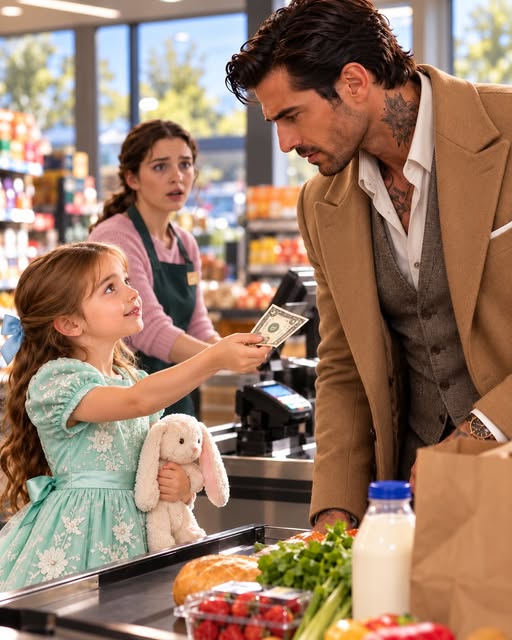
She wanted to see Maya, the cashier who had accepted her three dollars and seventeen cents.
The store looked almost exactly the same.
The refrigerated cases hummed.
Sunlight streamed through the windows.
The checkout counters stood beneath familiar fluorescent lights.
Maya was still working there while finishing her college degree.
When she saw Sophie, her face lit up.
"Well, look who's here!"
Sophie waved.
"Hi, Miss Maya!"
Maya noticed Roman.
Her eyes widened.
Then she looked at Elena.
And finally at the way Sophie's small hand rested confidently inside Roman's.
A smile spread across her face.
"Oh," she whispered.
Roman smiled.
"Hello, Maya."
She stared.
"You're the man with the bread."
Sophie giggled.
"That's my daddy."
Maya's mouth fell open.
"Your daddy?"
Sophie nodded enthusiastically.
"He didn't know before, but he knows now."
Maya looked between them.
Roman laughed softly.
"It's a long story."
Maya pressed a hand against her chest.
"Apparently."
Elena smiled.
Sophie placed a loaf of bread on the conveyor belt.
Then she added a bottle of water.
Roman looked down.
"Those seem familiar."
Sophie grinned.
"That's what you bought last time."
"I remember."
Maya scanned the items.
The price had increased slightly since their first meeting.
Roman inserted his card.
For one fleeting moment, all three adults watched the terminal.
Sophie leaned forward.
"Will it work this time?"
Roman smiled.
"I certainly hope so."
The machine beeped.
PAYMENT APPROVED.
Sophie cheered.
Maya laughed.
Roman retrieved the card.
Then Sophie reached into a small purse decorated with butterflies.
She removed three dollar bills and seventeen cents.
Roman stared.
"Sweetheart…"
She placed the money on the counter.
"I saved it again."
His expression softened.
"Why?"
Sophie shrugged.
"Just in case."
Maya looked away, blinking rapidly.
Elena placed a hand over her mouth.
Roman knelt in front of Sophie.
"Do you know something?"
"What?"
He took her small hand.
"The first time you gave me that money, I thought you were buying my groceries."
"I was."
He smiled.
"Yes. But you gave me something much bigger."
Sophie looked puzzled.
"Like a present?"
"Better."
"What?"
Roman swallowed.
"You helped me remember how to be a good person."
She considered this.
Then she shook her head.
"That's not something you buy."
Roman laughed softly.
"You're right."
She smiled.
"It's something you do."
Roman stared at her.
Then he nodded.
"Exactly."
He returned the money to her purse.
"Keep saving it, sweetheart."
Sophie looked uncertain.
"But what if somebody needs help?"
Roman glanced at Elena.
Then back at his daughter.
"We'll help them together."
Sophie smiled.
"Okay."
Maya handed Roman the receipt.
He accepted it.
And for a moment, he was back in that store one year earlier.
A man holding a declined credit card.
A little girl with a white stuffed rabbit.
A loaf of bread.
Three dollars and seventeen cents.
And five words that changed everything.
You looked sad, mister.
Roman folded the new receipt and placed it in his wallet.
He would keep it beside the old one.
Not because the purchases mattered.
But because the first had marked the day he discovered what he'd been missing.
And the second marked the day he understood what he'd found.
Eighteen months after Sophie's seventh birthday, Roman asked Elena to marry him.
Not at a glamorous restaurant.
Not during a public event.
Not in front of cameras.
He asked her in the same kitchen where he'd once burned pancakes.
Sophie was at Nora's apartment for the afternoon.
Biscuit slept beneath the table.
Elena stood at the counter preparing tea when Roman entered carrying a small wooden box.
She glanced at it.
"What's that?"
He smiled nervously.
"Something I've been meaning to show you."
She turned.
He opened the box.
Inside were three crumpled dollar bills, seventeen cents in carefully saved coins, forty-three cents in change, and the original grocery receipt.
Elena stared.
"You kept all of it?"
Roman nodded.
"Every cent."
Her eyes filled.
He removed a small velvet ring box from his pocket and placed it beside the wooden one.
"Elena, I spent most of my life thinking love was something I could protect by controlling everything around me."
She looked at him.
"I was wrong."
His voice trembled.
"I can't erase what happened to us. I can't give back the years we lost. But every day since Sophie walked into my life, you've helped me understand what it means to build something worth keeping."
He opened the ring box.
Inside was a simple diamond ring set in white gold.
Elegant.
Beautiful.
Not extravagant.
"I don't want to promise you a perfect life," he continued. "We've both learned that life doesn't work that way."
Elena was crying now.
"But I can promise to listen. To show up. To tell the truth. To keep learning how to be the man you and Sophie deserve."
He knelt.
"Elena Carter, would you marry me?"
For several seconds, she couldn't speak.
Then she laughed through her tears.
"Roman Bellini, you are the most stubborn man I've ever met."
He smiled.
"I've heard that."
"And your pancakes are terrible."
"Improving."
"And sometimes you still think you can solve everything with a phone call."
"Working on that too."
She knelt in front of him.
"But you're a good father."
Roman's eyes filled.
"And you've become a good man."
She kissed him.
"Yes."
He stared.
"Yes?"
"Yes, Roman. I'll marry you."
He laughed, pulling her into his arms.
From beneath the table, Biscuit barked.
Elena laughed against Roman's shoulder.
"Even the dog approves."
Roman smiled.
"He has excellent judgment."
They married six months later in a small garden ceremony.
Nora attended.
Teresa cried.
Grace gave a speech that made everyone laugh.
Maya, the cashier, was invited and came with flowers.
Sophie wore a pale mint-green dress with white embroidery, a blue ribbon in her hair, and carried a small bouquet.
Mr. Buttons attended too, dressed in a tiny bow tie.
When the officiant invited the couple to exchange vows, Sophie stood beside them holding both their hands.
Roman looked at Elena.
Then at his daughter.
Then at the family gathered around them.
He no longer saw the empty spaces.
He saw the people who had helped fill them.
The ceremony ended beneath a shower of flower petals.
Sophie ran into Roman's arms.
"Daddy!"
He lifted her.
"What is it, sweetheart?"
She kissed his cheek.
"Now we're a real family forever!"
Roman smiled.
"We were already a real family."
Sophie considered that.
"Then now we're a family with cake."
Roman laughed.
"Even better."
Years later, Roman would sometimes sit alone in his study after everyone had gone to bed.
The estate had changed.
There were children's photographs on the walls.
Books piled beside the sofas.
A dog bed near the fireplace.
A collection of family drawings taped proudly to the refrigerator.
The old portraits still hung in the hallway.
But now they shared space with something more important.
Evidence of a life being lived.
On Roman's desk sat the small wooden box.
He opened it occasionally.
Inside were the original three dollar bills, seventeen cents, forty-three cents in change, and two grocery receipts.
Beside the box stood a framed photograph.
Sophie, Elena, and Roman.
All three laughing.
No formal poses.
No expensive backdrop.
Just sunlight, happiness, and the imperfect beauty of an ordinary afternoon.
One evening, Sophie wandered into the study wearing pajamas.
She was older now, but she still carried Mr. Buttons when she was tired.
"Daddy?"
Roman looked up.
"You're supposed to be asleep."
"I know."
"Something wrong?"
She shook her head.
Then she climbed into the chair beside him.
"Can I ask you a question?"
"Anything."
"Are you still sad sometimes?"
Roman considered the question.
"Sometimes."
She frowned.
"Even now?"
He nodded.
"Everybody gets sad sometimes, sweetheart."
"Why?"
"Because life has hard days. And because we remember things we wish had happened differently."
Sophie studied him.
"Like when you didn't know about me?"
Roman felt the familiar ache.
"Yes."
She leaned against his shoulder.
"But you know me now."
He smiled.
"I do."
"And you come to my plays."
"Every one."
"And you make pancakes."
"Questionable pancakes."
She giggled.
"And you love Mommy."
"More than I can explain."
Sophie looked satisfied.
"Then I think you're doing okay."
Roman laughed softly.
"Thank you."
She rested her head against him.
After a moment, she whispered, "Do you remember when I bought you bread?"
"Every day."
"Did you really think I was being silly?"
Roman shook his head.
"No."
"What did you think?"
He looked at the wooden box.
Then at his daughter.
"I thought you were the bravest person I'd ever met."
Sophie smiled.
"But I was just little."
Roman kissed her forehead.
"Sometimes the smallest people teach us the biggest lessons."
She hugged him.
"Love you, Daddy."
His eyes filled.
"Love you too, sweetheart."
He carried her back to bed.
Elena was waiting in the hallway, smiling sleepily.
"Everything okay?"
Roman looked at his daughter.
Then at his wife.
Then toward the warm lights glowing throughout the home that had once felt like a monument to loneliness.
"Everything's okay," he answered.
And this time, he meant it.
Because the man who once believed he could purchase anything had discovered that the greatest things in life had no price.
Trust.
Forgiveness.
A second chance.
The love of a woman who had endured more than he understood.
And the heart of a little girl who had looked past his intimidating appearance and recognized someone who needed kindness.
Roman Bellini had once possessed enough influence to make powerful men tremble.
But he had never truly understood wealth until a six-year-old girl offered him her last three dollars and seventeen cents.
She thought she was buying him a loaf of bread.
Instead, she gave him back his family.
And for the rest of his life, Roman never forgot the little girl who saw sadness where everyone else saw danger.
THE END.