I had waited three years for the truth, and when the night finally came, it did not arrive with shouting or with guns. It arrived quietly, in my own study, with rain against the windows and a fire burning low in the grate. I had asked Salvatore to bring Vittorio to me alone, and I had asked the girl and her mother to stay in the east wing, where the doors were locked from the inside and where no man in my house would dare to enter without my word. That was the first decision of the night, and it was the most important one. Whatever happened between Vittorio and me, the child would not hear it. She would not be a witness, and she would not be a weapon. She was three years old, and she had already carried more of my family's history than any child should ever have to carry.
Salvatore stood by the door, his face pale but steady. He had served my father, and then me, for longer than I had been alive in this house as its head, and I trusted him in a way I had stopped trusting almost everyone else. On my desk lay the things that had brought us to this night, arranged in a straight line the way Matteo used to arrange his papers when he wanted me to listen. There was the ledger from the missing shipments, with Vittorio's handwriting in the margins, careful and neat, the handwriting of a man who believed no one would ever look closely enough. There was the letter Matteo had written to the maid, a letter I had not known existed until she gave it to me herself, folded and worn from being kept close. And there was a small photograph, taken years before, of Matteo and me standing in this same room, Matteo laughing, his arm around my shoulders, calling me Renzo as if it were the easiest word in the world.
Vittorio entered slowly. He was an old man now, and the years had not been kind to him, though he still carried himself as if the house owed him respect. His suit was dark, his hair silver, and his hands, which had once been so steady at a table, were shaking. I saw it at once, and I did not look away. For three years I had told myself that his shaking was grief, that we had all shaken after Matteo died, that an uncle who had lost a nephew might tremble for a long time. Now I knew better, and the knowledge sat heavy in my chest, not with triumph, but with a grief that felt fresh again.
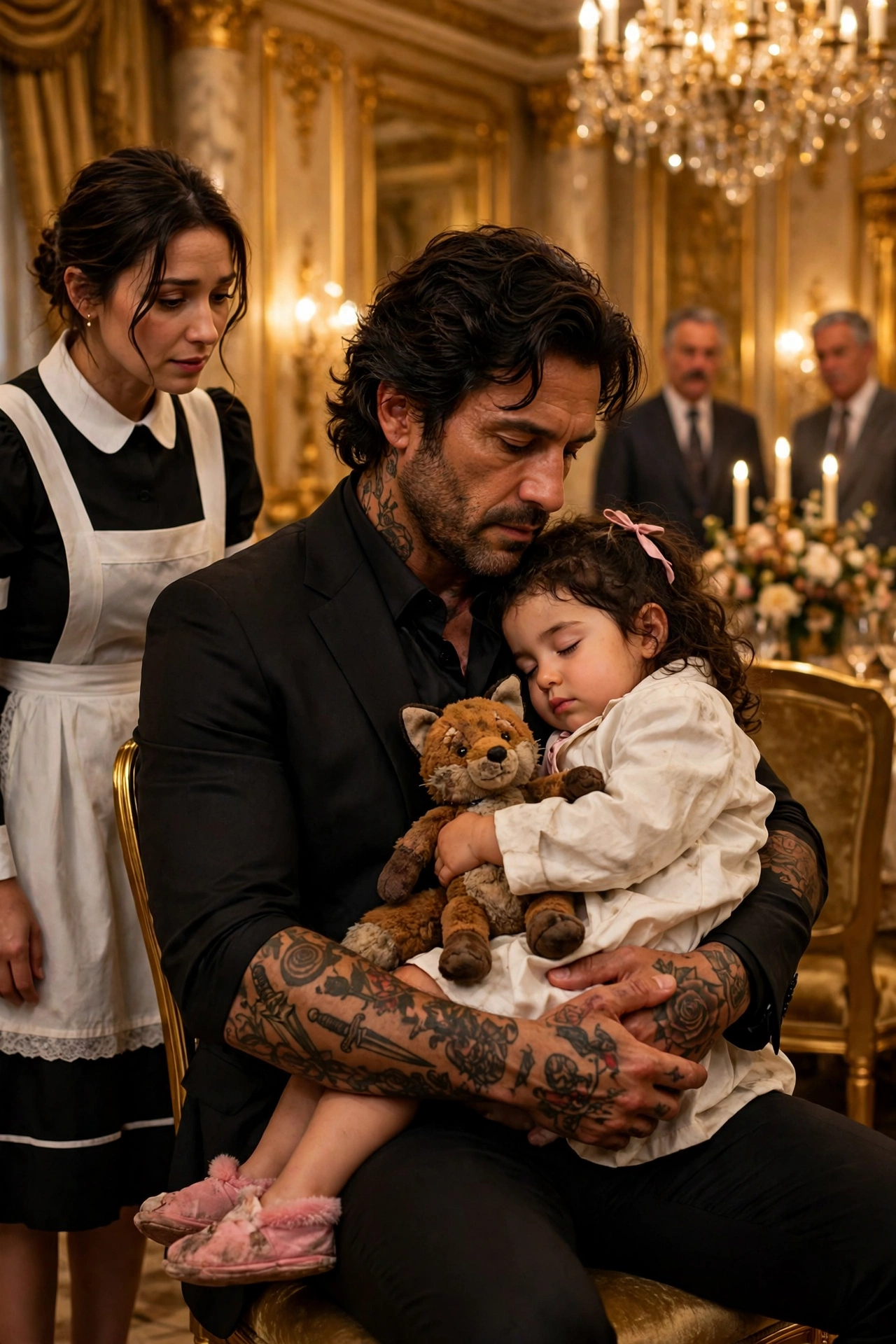
"Sit down, Uncle," I said. My voice was calm. I had practiced that calm all day, while the girl napped in the next room and her mother sang softly to her, because I did not want anger to do my thinking for me. Anger had ruled this house for too long. It had ruled me since the night Matteo died, and it had made me a man who could sit at a table with twelve dangerous men and feel nothing at all. The child had changed that. She had walked into my meeting and asked to sleep on me, and in doing so she had reminded me that there were still things in this world worth protecting without destroying everything around them.
Vittorio sat. He looked at the desk, at the ledger, at the letter, and then at me, and I saw the moment he understood that this was not a family dinner and not a negotiation. This was an accounting, and he had run out of excuses.
"You know why I called you here," I said.
He tried to smile, the way he always had when he wanted to make a difficult conversation go away. "Renzo, I am an old man. If this is about the shipments—"
"Do not call me Renzo," I said, and my voice did not rise, but something in it made him stop. "Only Matteo called me Renzo. And my mother. And my father, when we were alone. You have not earned that name, Vittorio. Not tonight."
He flinched. For a moment I thought he might stand and leave, and part of me almost wished he would, because then I could tell myself that I had been wrong, that the trembling was only age, that the dropped glass in the meeting room had only been an accident. But he did not leave. He stayed, and his hands folded together on his lap, and he looked down at them as if they belonged to someone else.
Salvatore closed the door quietly behind him and took his place by the wall. He did not speak. He did not need to. His presence was a reminder that this was not a private quarrel between two men in a house. This was a matter for the family, and the family would remember what was said here.
I picked up the ledger first. "Three years ago, the shipments began to go missing," I said. "Not all at once. A little at a time, so that no one would notice the pattern. Matteo noticed. He kept his own notes. He told me, the night before he died, that someone inside our own house was selling us to the Falcones, piece by piece, and that he was going to prove it."
Vittorio's eyes flickered to the ledger. "Matteo was young. He imagined things."
"He was not imagining the money," I said. "The money went somewhere. It went to accounts that were opened in your name, Uncle. Not in the family name. In yours. Salvatore found them. He found them because you taught him how to look, years ago, when you thought no one would ever look at you."
A silence followed that was longer than any silence I had known in that room. Outside, the rain grew heavier, and the fire crackled, and somewhere far away in the east wing, I imagined the girl was asleep, her fox tucked under her arm, safe from all of this. That thought steadied me more than anything else could have.
Then I set the ledger down and picked up Matteo's letter. I did not read it aloud at first. I held it, feeling the creases where the maid had folded it again and again, and I thought of what she had told me in private, in a voice that shook but did not break. Matteo had found her crying in the kitchen, years before, when she was new to the house and afraid and alone. He had not turned away. He had sat with her, he had listened, and he had promised her that no one in this house would hurt her or her daughter while he lived. When he died, she had believed that promise died with him. She had hidden the letter because she was afraid that whoever had killed Matteo would come for her next, and she had taught her daughter to be quiet, to be small, to be invisible. Until the day the little girl walked into my meeting, too tired and too trusting to be invisible anymore.
"Matteo wrote to her," I said, "because he knew she was afraid. He told her that if anything happened to him, she should find me, and she should tell me the truth. He told her that family was not only blood, Vittorio. Family was the people you protected, even when it cost you something."
Vittorio's face went white, the same white I had seen in the meeting room when the child whispered my name in her sleep. "I did not kill him," he said quickly. "I did not. You must believe me, Lorenzo. I was there that night, yes, but I did not—"
"You were there," I said. "That is the part you have never told me clearly. You told me you arrived after. You told me you found him. But the maid saw you leave with him that night, Vittorio. She saw you, and she remembered, because she was afraid, and afraid people remember everything."
He shook his head, but the shaking in his hands had grown worse. "I was trying to protect him. The Falcones—"
"The Falcones did not kill Matteo," I said. "Carmine Falcone told me himself, and for once I believe him, because he had nothing to gain by telling me the truth. He said you came to him. You offered him the shipments, and you offered him Matteo's silence, because Matteo was going to tell me what you had done. You did not pull a trigger with your own hand, Uncle. You do not need to. You arranged the meeting. You told Matteo it was safe. You left him there alone."
The words hung in the air, and for a long time Vittorio said nothing. Salvatore shifted slightly by the door, but he did not move toward us. This was not his confrontation to finish. It was mine, and I would finish it with words, because Matteo deserved a truth spoken aloud, not another secret buried in this house.
At last Vittorio spoke, and his voice was thin and tired, the voice of a man who had carried a lie for three years and could no longer carry it cleanly. "He was going to ruin us," he whispered. "He was going to tell you, and you would have cast me out, and I had given my life to this family. I panicked. I told the Falcones where he would be, and I told myself it would only frighten him, that they would only warn him. I did not think they would—" He stopped, and he put his face in his hands. "I did not think they would kill him. I swear it on my own life, Lorenzo. I did not think they would kill him."
I felt something break inside me then, not with rage, but with a terrible, quiet sorrow. For three years I had imagined a monster, a man who had planned my brother's murder coldly and without feeling. What I found instead was a frightened old man who had chosen himself over his nephew, and who had lived with that choice ever since, trembling every time the past came near him. It did not make what he had done forgivable. It made it human, and therefore more painful, because I could see how easily fear could turn a man who called himself family into a man who betrayed family.
"You called yourself family," I said softly. "Matteo warned me about that, the night before he died. He said, 'Renzo, if anything happens to me, don't trust the people who call themselves family.' I did not understand him then. I understand him now."
Vittorio looked up, tears in his eyes. "What will you do with me?" he asked. "Will you have me killed? Is that what this house has become?"
I shook my head. "No," I said. "That is what this house was, and it is why Matteo died. I will not answer his death with another death. You will confess what you did, in front of Salvatore and in front of Carmine Falcone, so that the war between our families can end. You will give back every cent you took. You will leave this estate, and you will never return. And you will live with what you did, Vittorio, in the open, where everyone can see it. That is your punishment. Not a grave. A life spent knowing the truth."
He stared at me as if he had not expected mercy, even a mercy as hard as this one. "And Carmine?" he asked. "Will he accept that? He has wanted war for years."
"He will accept it," I said, "because I will give him something better than war. I will give him the truth, and I will give him a promise that the shipments will stop disappearing, and that no child in either family will ever be used as a message again. Carmine is a father. He understands that, even if he has forgotten it at a table."
Salvatore stepped forward then, and for the first time that night he spoke. "I will witness it," he said. "And I will write it down, so that no one can change the story later."
Vittorio nodded slowly, and the fight went out of him all at once, like air leaving a room. He was not a dangerous man anymore. He was only an old man who had finally told the truth, and who would have to live with it.
I stood, and I walked to the window, looking out at the rain and at the dark gardens where Matteo and I had played as boys, where he had called me Renzo and I had called him Matty, and where nothing had seemed as complicated as it did now. Behind me, Vittorio wept quietly, and Salvatore waited, and the fire burned low. I thought of the little girl asleep in the east wing, of her mother sitting beside her, of the fox toy tucked under her arm, and I knew, for the first time in three years, what I was going to do next. I was not going to spend the rest of my life guarding a house full of secrets. I was going to make a home inside it, for the people who had been brave enough to tell the truth.
"Tomorrow," I said, turning back to them, "we will tell Carmine. Tonight, you will stay here, under guard, not as a prisoner to be hurt, but as a man who will answer for what he did in the morning. No one will touch you, Vittorio. That is my word. And my word, from tonight onward, will mean something different than it did before."
He nodded, and Salvatore led him out, gently, without force, without anger. I stayed in the study alone for a while, with Matteo's photograph in my hand, and I whispered the name he had given me, not in grief, but in promise. "Renzo," I said to the empty room, and for the first time since his funeral, the name did not feel like a wound. It felt like a beginning.
TITLE: A three-year-old maid's daughter walked into my private mafia meeting, climbed into my arms, and called me by a name nobody had dared speak since my brother's murder