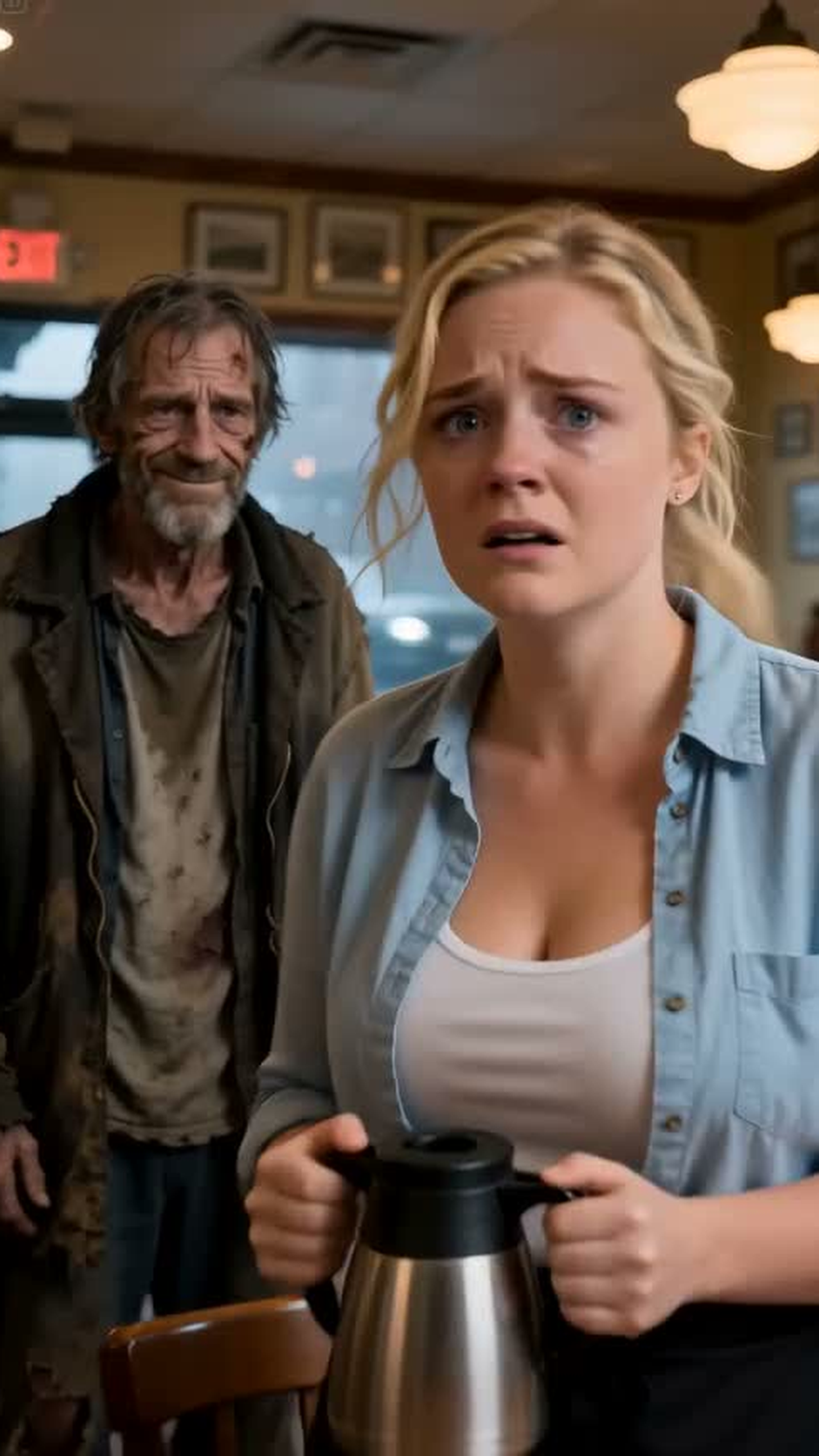
Thursday was coming down like the sky had a grudge, and Emma knew it the moment she stepped off the bus.
The forecast had said three days of it. The avenue was running in gutters. By nine the Kettle was full of damp coats and damp tempers, the windows fogged, the grill working overtime, and Emma's section had expanded the way it always expanded — by annexation, one abandoned table at a time, until Dana started calling her "the empire."
She did not see him arrive. She felt him, the way you feel a draft find the back of your neck — and looked up between the lunch rush and the lull to find the ledge occupied, the coat darker with rain at the shoulders, those clear eyes fixed on the windows, patient as a man waiting for a train he believes in.
"Don't," Dana said at the pass, not looking up from the tickets. "I can hear you thinking from here. Gus is doing the books in the closet and he's in a mood with a first and last name."
"I wasn't thinking anything."
"You were thinking it in Lawson."
Her staff plate came up at half past one — chicken, mash, beans, the roll — and the dining room did what it had been doing for three weeks, which was fail, spectacularly and in unison, to see the man outside. Walter the retired teacher shook the rain off his paper and folded it to the crossword. The couple at table four asked for their check without once glancing left. A man in a suit so dry it was practically a legal argument stepped around the ledge on his way in and said "excuse me" to the door.
Somewhere in Emma, very quietly, something that had been patient for twenty-seven years stopped being patient.
"He needs it more," she told Dana, and took her lunch out into the rain.
What happened next the whole avenue would later claim to have witnessed, though the video — shot by a seventeen-year-old at table nine who had come in for pie and stayed for history — showed only what it showed: a waitress crouching in the rain with a plate; an old man's face changing like the weather breaking; a napkin folded away like communion. Then headlights. Then the cars.
And then the man in the navy suit, standing in the middle of the Copper Kettle with wet eyes, saying "You fed my father," to a waitress holding a coffee pot, while his father — his father — stood in the doorway drying his hands on a dish towel Gus had handed him without a word, in the manner of a man resuming a throne.
"Your father," Emma said. She had meant it to be a question. It came out as an accusation of the entire universe.
"Salvatore Moretti," said the man in the suit. "Adrian Moretti." He did not offer a hand; he seemed to understand that hers were occupied and that shaking hands was a custom for people whose worlds made sense. "He's been missing nineteen days. Half this city has been looking for him. My men have checked every hospital—" His composure, which was clearly load-bearing, shifted. "He was three miles away. Eating staff meals. Under an awning."
"Half a staff meal," Emma said, because accuracy felt like the last solid ground. "The sandwich was half."
From the doorway, Salvatore Moretti — who had a name now, and a son, and a dry coat coming — laughed. It was not a loud laugh. It had the quality of a door opening in a house that had been shut for years. "She has always been exact," he said, to no one in particular. "Lawsons are exact. It's a defect. It's genetic."
Now it was Gus's turn to stare. Emma watched the arithmetic move across her boss's face — Rose Lawson, 1983, a skinny kid in a doorway two streets over whom his own father had complained about for a solid month — and land, forty years later, in his dining room, wearing a fortune.
"You," Gus said faintly. "You're little Sal."
"I'm nobody's little Sal anymore, Gus. But I was." The old man crossed the room — slowly, because the room was letting him, because the whole diner had become an amphitheater — and put his hand on the back of the chair at the counter, the third stool, which Emma realized with a small internal lurch was where he had sat every time in her grandmother's stories about the one who got fed. "My son would like to pay you now. Let him. It helps him. He's been raised to believe gratitude is a transaction, and unlearning it will take longer than lunch."
Adrian Moretti took a checkbook from his inside pocket — an actual checkbook, leather, which somehow made everything worse — and Gus, reviving, produced a pen from behind the register with the speed of a man who had been waiting sixty years for exactly one dramatic moment.
"Name the amount," Adrian said. "Any amount. It's a debt."
Emma looked at the checkbook. She looked at the man in the doorway, who was watching her the way he had watched her through the rain-streaked glass, with the patience of a man who has set an examination and is prepared to wait all day for the answer.
In the drawer of her mind marked RENT there was an envelope two hundred and sixty dollars light, nine days from empty. There was a pharmacy list. There was a credit card charging her monthly for a dead man's last winter. The checkbook sat open on the counter like a door out of all of it, and the whole diner held its breath, and table nine's phone held steady.
"It was a plate of food," Emma said. "Not a lottery ticket. Put that away before you embarrass us both."
She said it clearly, because some things should be said where the room can hold them for you later. She was not brave; she was specific. A debt named is a chain, and she had watched her father's hospital bills chain her mother to a kitchen table of lists for three years, and she had fed the man in the rain for exactly the reason she had said — because he was hungry — and she was not going to let a checkbook come along afterward and re-label the one clean thing she had done all year.
The silence that followed had a texture — like the moment after a glass breaks and hasn't yet been swept. Adrian Moretti closed the checkbook slowly, and something in his face rearranged itself into an expression she would spend weeks trying to name: not anger. Not even surprise. Something closer to a man hearing his native language spoken in a country where he'd stopped expecting it.
"You see?" said his father, with enormous satisfaction, to the room at large. "She is the one."
Before the room could demand the rest of it, Salvatore Moretti did something that rearranged the afternoon more quietly than the cars had: he sat down at the counter, on the third stool, and asked — in the tones of any regular, of any man — whether the kitchen was still serving the chicken, and whether it came the way it used to, with the skin in the mash.
"You've sat here before," Gus said. It was not a question. Gus was looking at the old man the way a man looks at a photograph of his own street taken before he was born. "Sixty-two years this place has stood. My father used to talk about a kid in the eighties. A doorway kid. Rose fed him till he got work at the docks and then he vanished — and one Christmas, years later, a case of wine showed up at the back door with no card, and my father said—" He stopped, because the old man was smiling into his coffee like a man at a wedding.
"Your father," said Salvatore, "was a terrible cook and a magnificent man, and he charged me for the wine. In installments. For six years." He raised the cup an inch. "Tell the kitchen the famine painting is back, Gus, and that he has notes."
The whole diner laughed — the release of it rolling booth to booth — and that was when Emma saw Adrian Moretti, still standing where she had refused his checkbook, do the strangest thing yet: he sat down. Not at the counter. At the end of it, in the bad seat by the register where the draft lives, a king in a three-piece suit on a cracked vinyl stool, and he watched his father eat lunch in a diner with the expression of a man who has been carrying a stone for nineteen days and has just been told he may, finally, put it down somewhere specific. When their eyes met over the pie case, Emma did something she would think about later with disbelief: she took him the pie menu, like he was anybody.
"He'll want the apple," she said. "He's had a month."
"How do you know that?" Adrian said.
"Waitress," she said, and went to get it.
The one what, the room did not get to learn, because that was the moment the day split in two — into the hour when the Copper Kettle was merely famous on Candler Street, and the hour when the video crossed two million views and the phones began.
By four o'clock there were three news vans double-parked in the rain. By five, a woman from a morning show was doing a stand-up under the awning — the awning — describing Emma as "the angel of Candler Street," a phrase that made Emma want to lie down on the railroad tracks of public opinion. Gus, who had declared at two o'clock that he would rather burn the diner down than talk to press, was discovered at five-thirty giving an interview in his good apron, using the words "family establishment" and "since nineteen sixty-two" in rotation, misty-eyed.
Adrian's people handled the street the way weather handles a beach — two quiet men, suddenly everywhere, moving the vans along, answering nothing. Adrian himself stayed until the dinner crowd, sitting at the counter with coffee he nursed for two hours, watching his father eat pie at the third stool like a king in a country he'd conquered by sitting still.
"He won't come home tonight," Adrian said at last, to Emma, low, as she refilled him. "He says the examination isn't finished. He says—" A muscle worked in his jaw. "He says there's rot in the foundation and he intends to stand in the rain until somebody around him turns out to be load-bearing. His words. He's been saying it for an hour. I believe it's a metaphor. With my father it's hard to tell — the metaphors have armed guards."
"He'll catch his death," Emma said.
"He's caught everything else for forty years. It bounced off." For the first time, the ghost of a smile. "Thank you, Miss Lawson. Not for the food." He searched for it, and found it, and it cost him something: "For seeing him. We've all been looking for nineteen days. You were the only one who actually—" He stopped. Set a hundred-dollar bill under the coffee cup for a two-dollar coffee, and was gone into the rain and the black cars before she could give it back.
She worked until close. The video hit four million. Someone had already printed the still of her crouching with the plate and taped it to the register, where Gus pretended not to see it and also pretended not to dust it.
That night, at the kitchen table, her tips totaled two hundred and twelve dollars — more than any night of her life, all of it from people who had come to eat where it happened, to be near the napkin story — and the RENT envelope, when she fed it, stood heavier and more honest than it had in months. Her mother watched the news segment twice and cried both times, holding Emma's hand hard enough to leave marks. "Your grandmother," June said, "is doing laps up there."
Emma was brushing her teeth when her phone lit up on the bathroom counter.
A photograph. Herself — taken that morning, through her own kitchen window from the alley behind the building: Emma in her work shirt, hair half up, reaching for the pill organizer, unaware, framed in the yellow light like something in a shop window.
Underneath it, a message from a number with no name:
Kindness is expensive, waitress. Ask the Morettis what it costs.
The toothbrush stopped. The apartment, the radiator, the not-quite-closed window — all of it suddenly had ears. Emma stood in her bathroom doorway in the dark of her own home, and understood with her whole body that the whole city had seen her feed a hungry man, and that somewhere out in it, someone had liked that least of all.