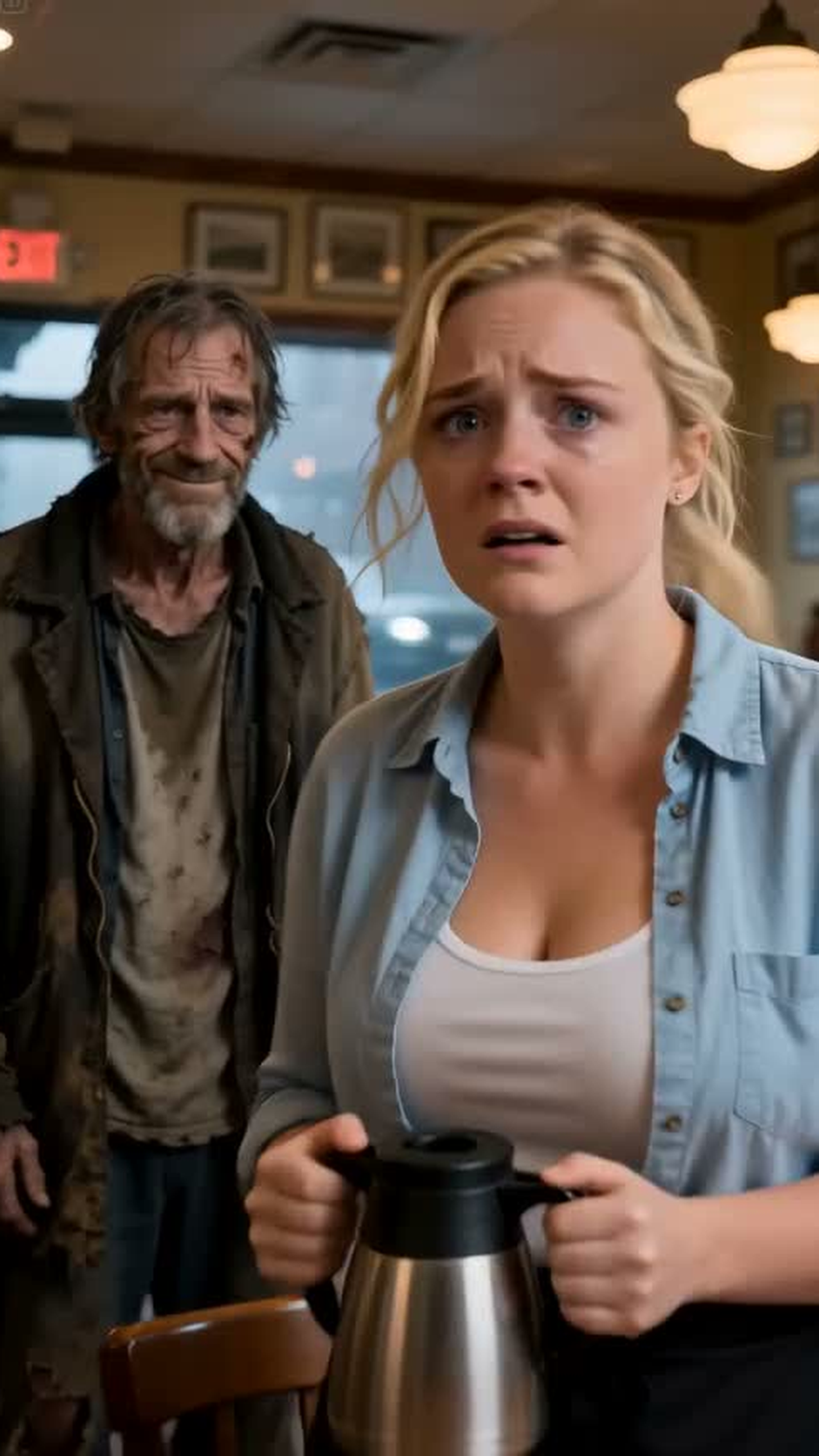
The flagship kitchen of the Moretti Family Foundation occupied a converted market hall on the harbor side, all glass and brushed steel and a mural of hands breaking bread that covered one wall in the style of a cathedral. Emma arrived Saturday at ten in her good cardigan, feeling like a spy in a novel where the spy has been cast wrong, and was received by Marcus Webb as if he had been expecting a spy and had rehearsed.
"Our angel," he said, shaking her hand with both of his. Cufflinks. A smile calibrated to the millimeter. "Salvatore hasn't stopped talking about you. Neither has the internet. Four million people, Miss Lawson. Do you know what four million people are worth to a foundation? You may be the most valuable thing that's walked through that door all year — and I include the mayor."
The tour took forty minutes and was, Emma would say later, the finest meal she never ate. The kitchens gleamed. The pantry was photographed more than it was stocked — that was her first thought, traitorous and immediate, waitress-trained: the shelves at the front were dressed like a shop window, full cans shoulder to shoulder, and behind them, in the working rows, gaps. Whole bays of gaps, labeled, dustless, excused by a printed sign — Deliveries Tuesday — on a day when the delivery dock, visible through the service window, stood empty as a stage after the show.
The serving line fed a hall of perhaps two hundred. Emma took a tray — Sal's instruction, be my eyes — and ate a lunch that she assessed with forty years of family professionalism: chicken in a sauce built to survive photographs; bread with a crust like upholstery; portions weighed to the gram by a cheerful supervisor who told her, unprompted, that they served nine hundred a day here. Nine hundred. Emma counted heads in the hall, counted seatings in an hour, and did the Lawson arithmetic and came up four hundred short of the daily claim, every day, with somebody billing the Foundation for the difference in chicken.
It was the staff who finished the picture, in the way staff always do — sideways, while working, without ever quite saying the thing. A dishwasher told her the good pans had been signed out to a catering company nobody could name and had never come back. A line cook, plating beside her while she waited for coffee, said the winter menus had been costed for fresh herbs and the trucks brought dried, and the difference went somewhere the way heat goes up a chimney, and then — hearing his own voice in the open air — went very pale and very busy. Nobody in that gleaming kitchen was stealing. Everybody in it was doing the arithmetic, alone, at their stations, and looking at the floor, because arithmetic without a witness is just another way of being afraid.
"You're very quiet," Webb said at the door, in the tone of a man reading a gauge. "Salvatore tells me you have your grandmother's eyes. I do hope they're not tired eyes, Miss Lawson. Kitchens are complicated. Numbers are complicated. It would be a pity if enthusiasm got anyone confused."
"Numbers aren't complicated," Emma said. "Hunger isn't complicated. I counted the chairs, Mr. Webb."
For the first time, the smile came off him like a coat off a hook — and underneath was a face like a locked office. "Then I hope you're as exact," he said pleasantly, "about the dangers of making accusations against the man who feeds eleven thousand people a month. The city loves you this week, angel. Cities are weather." He opened the door for her with perfect courtesy. "Ask the Morettis what loyalty costs. Everyone around that family learns eventually. Tuition is steep."
On Sunday she went back out on her own — not to the flagship, with its mural and its dressed shelves, but to the little Open Table kitchen in the Mill District that had been first on the list in Sal's notebook of doors, because it was the one kitchen in the city that had also, once, fed him.
It fed her within four minutes of her sitting down, no form, no referral, no questions — a bowl of soup put in front of her by a woman named Petra who ran the place like a lighthouse keeper and who had the Lawson gift of reading a room at a glance. "You eat first," Petra said. "Whatever you came about keeps. Soup doesn't."
Over the soup, doing nothing more suspicious than being a waitress at rest among waitresses, Emma learned the geography of the theft from the people who stood inside it. The flagship's numbers were the city's pride and the district kitchens' shame: their allocations arrived light and arrived late, and the paperwork said otherwise, and anyone who called the Foundation's office about it got a call back from a smooth man who explained about metrics. A driver named Okafor, eating at the staff table with his coat still on, told her the thing she had come hoping not to hear — that the harbor trucks went out heavy on the dock scale and came back too quick for the routes they were supposedly running, and that he had stopped asking about the missing miles after his schedule got cut in half for a month. "You don't bite the manifest," he said. "The manifest bites."
"How much?" Emma asked.
"Enough chicken," Okafor said, "to feed every man on every ledge in this city, twice a week, all winter. That's my arithmetic. I did it at this table." He looked at his hands. "Nobody asked me to do it. That's the thing about arithmetic, miss. It does itself, once somebody cares to look."
She walked home the long way, through the early dark, with her notebook of a mind full — chairs counted, shelves weighed, a driver's conscience, a lighthouse keeper's soup — and she understood that Sal had not sent her to find a theft. The theft had been findable for eighteen months by anyone with eyes. He had sent her to find out whether there was still a single pair of eyes in his city that belonged to somebody the machine couldn't buy, frighten, or process — and to bring back, in place of an audit, a witness the whole city would believe because the whole city had watched her refuse a checkbook over a plate of chicken.
She reported it all at the third stool on Monday, in a low voice, while Sal ate soup he didn't need as cover for the meeting and Adrian stood behind him with his arms folded and his face doing nothing at all, which she had learned was his loudest register.
"The dock log," Adrian said.
"There's a dock log?" Emma said.
"There is a dock log. Trucks in, trucks out, weights, signed." He looked at his father. "If trucks are leaving half-empty, the log will lie about it, but it will lie consistently, and consistency can be audited. Webb has kept the auditors out by giving them summary sheets. Nobody has asked for the raw log in eighteen months." His mouth set. "Because somebody has been telling the auditors that the old man is retired and the young man is busy. And somebody has been telling my father—" He stopped.
"Patience," said Salvatore Moretti, with the gentleness of a man breaking his own furniture. "Carlo's word. For eighteen months, Carlo's word. My oldest friend." He looked down at his soup. "The gala is in nine days. The Foundation names a new chair of the board — a formality, they'd arranged a puppet, a cousin of Webb's wife. Instead I will attend. I will attend, and I will name the chair myself, and before the dessert I will announce an independent forensic audit, with the FBI's charity fraud unit already briefed, and I will watch the faces at the head table like a man watching weather come in." He lifted his spoon, and set it down again, and Emma saw that the hand — the hand that had shaken in the rain with cold — was shaking now with something else entirely. "And I will not do it alone, because an old man's suspicions are called decline, and a young man's are called war. But a waitress—" The faintest ghost of the examining smile. "A waitress the whole city watched feed a stranger? She is called the truth. Emma. I am asking you to stand beside me at that gala and be my witness. In nine days. And afterwards, whatever you want — money, safety, a house for your mother, a ticket out of this —"
"I told you about the checkbook," Emma said. "Don't make me tell you twice, it insults us both."
"Then be my witness for free, you impossible Lawson." But he said it like a blessing, and Adrian, behind him, closed his eyes briefly, like a man whose house has just failed to fall down one more day.
The days that followed acquired a rhythm that fooled Emma, some hours, into thinking her life might hold its new shape: the diner by day, Ilya a polite fixture by the door, the regulars fed and theatrical with pride; and late — after close, when the avenue emptied — Adrian at the counter in shirtsleeves, eating whatever Gus had overproduced and interrogating her, with the air of a man defusing her, about everything except his family. About her grandmother. About whether she had ever wanted anything besides the Kettle. About the harbor in the year he'd been eight and his mother had still been alive to throw bread to the gulls.
"You don't talk like a—" she began once, and stopped.
"Like a Moretti?" he said. "I talk like my mother's son. It gets me in trouble at work." He turned his coffee cup a half-turn on its saucer — his father's gesture, inherited like the eyes — and said, "For nineteen days I thought he was in a ditch, Emma. I have stood in rooms and negotiated with men I would not spit on, smiling, because Carlo said patience. And he was three miles away being fed by a waitress with more courage than my entire—" He stopped, and shook his head, and did the most un-Moretti thing she had yet seen: he laughed at himself, quietly, in the empty diner, and looked young and exhausted and entirely human. "Eat your pie," he said. "Gus made extra. He does that now. It's how he says he approves of history."
The night before the gala, the rain came back.
Emma closed the Kettle at ten — Gus gone home at nine with the deposit, Dana gone at nine-thirty with a warning to text when she got in, Ilya rotated off at ten to walk June's building, as he did on late nights, a precaution so routine by then that none of them heard the seam in it. The photograph had taught them to guard her mother. It had not occurred to anyone, yet, that the examination might change its subject.
She was locking the back door, apron over her arm, keys in her fist the way her mother had taught her — between the fingers, a small bright weapon — when the van that had been idling at the mouth of the alley without lights put its lights on.
It was done with a terrible, professional quiet. No shouting. A man at the mouth of the alley and a man by the dumpster and the simple mathematics of a woman alone in the rain between them. Someone took her phone out of her apron pocket with almost apologetic efficiency — she heard it hit the wet ground and skitter — and someone said, "Nobody's going to hurt you, angel. You're just going to miss a party," and the word angel told her everything: not rivals, not strangers. Webb's word. Family-adjacent. Hired through paper.
She fought — she would be proud of it later, in the hospital-quiet of the aftermath: keys, elbows, her grandmother's name said like a curse — and it changed nothing except the timeline by eleven seconds, which was not nothing, and the last thing she saw before the van door closed was the back door of the Copper Kettle swinging slowly shut in the rain, and her apron on the wet pavement where it had fallen, and the black coffee pot, still warm from service, standing where she had set it down to lock up — waiting, patient as furniture, for Adrian Moretti to come out of the dark at a run six minutes too late.