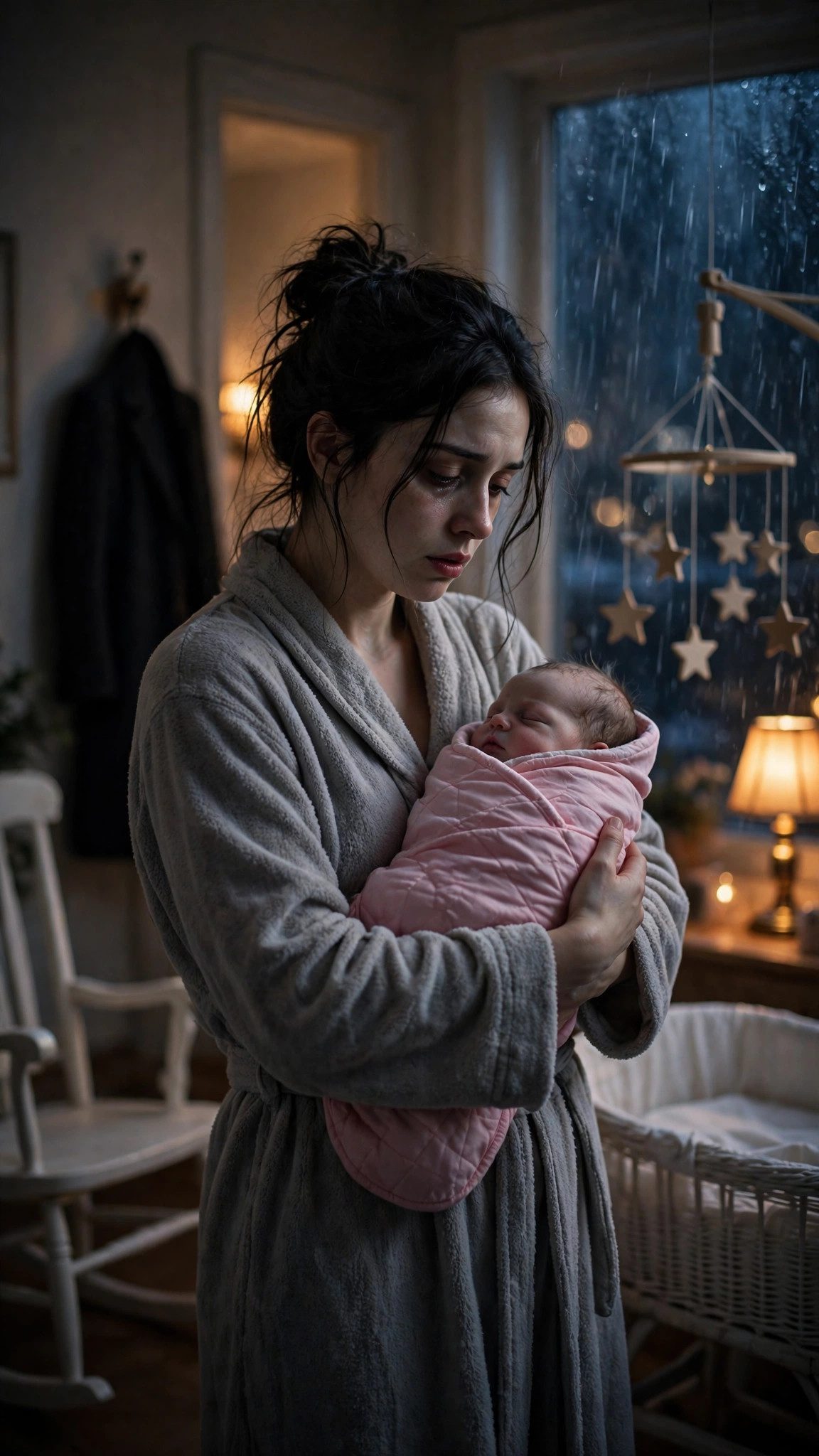
Roman Moretti had not wanted to go to Laya Crane's birthday dinner.
That was the part he would remember later, when he was standing in the empty nursery with the folded paper in his hands — that he had not even wanted to go. He had stood in the nursery doorway buttoning his coat, and he had felt Aaron's eyes on him, and he had felt Sophie sleeping in her bassinet, and some part of him, some small, buried part that still remembered how to be a decent man, had whispered, stay. Stay home. Stay with them. Nothing at that restaurant matters more than this room.
He had gone anyway. Because Laya had called him three times that afternoon, and because she had said, "You promised," in that soft, wounded voice she used when she wanted something, and because he had told himself that one dinner would not hurt anyone, and because he was a coward in the particular way that powerful men are cowards — not afraid of other men, but afraid of disappointing a woman who smiled at him the way Laya smiled at him.
The Drake Hotel restaurant was everything the house on Lake Drive was not. Loud. Bright. Full of people who wanted something from him. The private dining room smelled of expensive wine and fresh flowers, and there were twenty people at the long table, all of them smiling, all of them watching him, and at the head of the table, in a red dress that left nothing to the imagination, sat Laya Crane, glowing like a candle in a dark room.
"Roman," she had said, rising to kiss his cheek, her perfume wrapping around him like smoke. "You came. I was afraid you wouldn't."
"I promised," he had said, and even as he said it, he had thought of Aaron standing in the nursery doorway, saying, "You promised me, too." He had pushed the thought away. He was good at pushing thoughts away. He had been doing it for years.
Dinner had been endless. Course after course. Toast after toast. Laya's father, Charles Crane, a silver-haired real-estate developer with a smile that never reached his eyes, had raised his glass to his daughter and said, "To Laya. The brightest light in this city." And then Laya had stood, and she had raised her own glass, and she had looked straight at Roman, and she had said, "To the man who makes all of this possible. To Roman. To the future."
The whole room had cheered. Someone had shouted, "To the future Mrs. Moretti!" and everyone had laughed, and Laya had laughed too, and she had looked at Roman with those bright, hungry eyes, and he had laughed along with them, because that was what you did at a party like that. You laughed. You raised your glass. You pretended the joke was a joke.
But it was not a joke. He knew that, even then, in the back of his mind, in the place where he kept the truths he did not want to look at. Laya did not want to be his mistress. She wanted to be his wife. She wanted the house on Lake Drive. She wanted the name. She wanted everything Aaron had, and she wanted Roman to give it to her, and she had been patient about it for months, waiting for him to choose.
After dinner, she had pulled him aside, into the hallway outside the private dining room, where the light was low and the music from the bar was a distant throb.
"Roman," she had said, and her voice was soft, and her hand was on his arm, and her eyes were shining. "I need to tell you something."
"What is it?"
"I've been thinking about us. About our future. My father has been talking to his lawyers. He says the divorce can be handled quietly. No scandal. No mess. Aaron will be taken care of — a settlement, a house, whatever she wants. And then you and I can stop hiding. We can be together properly. In the open. The way we should have been all along."
He had stared at her. The hallway had seemed to tilt, very slightly, the way a room tilts when you have had too much to drink.
"Laya," he had said. "I'm married. I have a wife. I have a daughter who is six days old."
"I know," she had said, and she had stepped closer, and her perfume had filled his head. "And I know you love them. I'm not asking you to stop loving them. I'm asking you to be honest about what you want. You want me, Roman. You've wanted me for months. Everyone can see it. The only person who won't admit it is you."
She had been right, and that was the worst part. He had wanted her. Not the way he wanted Aaron — not with the deep, quiet love of a man who has built a life with someone — but with the sharp, hungry wanting of a man who has been told no too many times and has started to believe that what he cannot have is the only thing worth having.
But standing in that hallway, with Laya's hand on his arm and her eyes on his face, he had thought of Aaron. Not the Aaron of the last few months, tired and quiet and always watching him with those knowing eyes. The Aaron of the gala, standing by the chocolate fountain in a borrowed black dress, telling him about the little boy with the tonsils and the plastic dinosaurs. The Aaron who had laughed through her tears in the delivery room and said, "She has your eyes."
"I need to go home," he had said.
Laya's hand had tightened on his arm. "Roman—"
"I need to go home," he had said again, and he had pulled away from her, and he had walked out of the Drake into the November rain, and he had driven home through the dark streets of Milwaukee with the windshield wipers beating and his head full of wine and guilt and the sound of that toast — to the future Mrs. Moretti — ringing in his ears like a bell.
He had told himself, on the drive, that he would fix it. He would go home, and he would wake Aaron up, and he would tell her the truth — all of it, finally — and he would beg her to forgive him, and he would end it with Laya, and he would be the man he had promised to be in the rocking chair on that first night.
He had told himself all of that. And then he had turned into the driveway, and he had seen the dark house, and the open front door, and he had known, before he even got out of the car, that he was too late.
He stood in the empty nursery for a long time after he read the note. He did not cry. He did not shout. He did not throw anything. He stood very still, holding the folded paper in his hands, and he listened to the mobile turning, and the stars knocking together, and the rain on the roof, and he thought about the last six days — about the rocking chair, about the bottles at three in the morning, about the way Sophie's tiny hand had curled around his finger — and he understood that he had thrown all of it away for a dinner, for a toast, for a woman who wanted his name.
Then he did what he had always done when something went wrong. He reached for his phone, and he called his men, and he gave orders.
"Find my wife," he said to Salvatore Voss, his consigliere, who answered on the first ring, the way he always did, no matter the hour. "Find my daughter. I want every road out of Milwaukee watched. I want the airports. I want the bus stations. I want the train station. I want every man we have on the street tonight, and I want them to understand that this is not business. This is my family. If anyone so much as sees her, I want to know within the minute."
"Boss," Salvatore said, and his voice was careful, the voice of a man who has worked for the Moretti family for forty years and has seen everything. "Boss, listen to me. She left because you gave her a reason to leave. If you send men after her like she's a shipment that went missing, you'll lose her forever."
"She took my daughter," Roman said, and his voice cracked on the words, and he hated himself for it.
"She took her daughter," Salvatore said, gently. "And she took her because she was afraid. If you want her back, you need to give her a reason to come home. Not men on the roads. A reason."
Roman stood in the dark hallway with the phone pressed to his ear, and he looked at the empty nursery, and he thought about what Salvatore had said, and he knew the old man was right. He had spent his whole life solving problems with men and money and threats. But this was not a problem he could solve that way. This was a woman who had loved him, and a baby who needed him, and the only way to get them back was to become a man worth coming home to.
But first, he had to find them. And to find them, he had to understand why they had left. So he did something he had never done before. He sat down in the nursery, in the white rocking chair, in the dark, and he thought — really thought — about the last six months, about Laya, about the phone calls and the dinners and the parties, about the way Aaron had gone quiet, about the way she had stopped asking him where he was going, and he began, slowly and painfully, to see the shape of what had happened to his life.
He had not just cheated on his wife. He had abandoned her, piece by piece, month by month, until there was nothing left of the man she had married. And on the sixth night of his daughter's life, he had walked out the door to celebrate another woman's birthday, and his wife had finally, finally stopped waiting for him to come back.
He sat in the rocking chair until dawn, and when the sun came up over Milwaukee, gray and cold through the nursery window, he stood up, and he folded the note and put it in his pocket, and he went downstairs, and he began to do the only thing he knew how to do.
He started looking for the truth.
The first thing he did, when the sun came up, was drive to the Drake.
He did not bring his men. He did not bring Salvatore. He went alone, in the black SUV, through the gray morning streets, and he walked into the restaurant where he had spent the night before, and he asked for the manager, and he waited in the empty dining room with the chairs still stacked on the tables and the smell of last night's wine still in the air.
The manager was a nervous man named Ortiz, who had run the Drake's restaurant for twelve years and had seen enough of the Moretti family to know that when Roman Moretti asked a question, you answered it.
"Last night," Roman said. "The private dining room. Laya Crane's birthday. Someone from your staff called my wife."
Ortiz went pale. "Mr. Moretti, I don't know anything about—"
"Don't lie to me," Roman said, very quietly. "I'm not here to hurt anyone. I just need to know who it was, and what they said."
Ortiz swallowed. Then he nodded, and he went into the back, and a moment later he came out with a young woman in a waitress's uniform, her dark hair pulled back, her hands twisted together in front of her apron. She could not have been more than twenty-two. Her name tag said Maria.
"Mr. Moretti," she said, and her voice shook. "I'm sorry. I know I shouldn't have called her. But I was serving your table last night, and I heard what happened, and I kept thinking about your wife at home with a new baby, and I couldn't— I couldn't just stand there and say nothing."
"What did you hear?" Roman asked.
Maria looked at the floor. "Miss Crane stood up and raised her glass, and she said — she said, 'To the future.' And then Mr. Crane, her father, he stood up too, and he said, 'To the future Mrs. Moretti.' And everybody cheered. And then Miss Crane said the lawyers had already drawn up the papers, and that it was only a matter of time."
Roman stood very still. The dining room was quiet around him. Somewhere in the kitchen, a dishwasher hummed.
"Did I say anything?" he asked. "When they said that. Did I say anything?"
Maria hesitated. "You laughed, Mr. Moretti. You raised your glass with everyone else. You didn't correct them."
He closed his eyes. He had not corrected them. He had sat there and laughed and raised his glass, while his wife sat at home with their six-day-old daughter, waiting for a man who had promised to be home before nine.
"Thank you, Maria," he said. "You did the right thing. If anyone gives you trouble over this, you tell them Roman Moretti said you did the right thing."
He left the Drake and drove home, and when he got there, he went into the garage, and he saw what he should have seen hours earlier. The blue Honda was gone. Aaron's old car, the one she had driven in college, the one she had refused to sell because it had been her father's. She had taken the Honda, not the SUV. She had planned it. Someone had helped her plan it.
He went into the kitchen and opened the cupboard above the stove, and the coffee tin was there, but it was light in his hands, and when he opened it, it was empty. Forty-seven hundred dollars, gone. He stared at the empty tin for a long moment, and then he laughed — a short, broken sound that was not really a laugh at all.
She had been planning this. Not for weeks. Not for months. But she had known, somewhere in the back of her mind, that one day she might need to leave, and she had kept money in a coffee tin, and she had kept the Honda in the garage, and when the night came, she had been ready.
He put the tin back on the shelf, very carefully, the way a man handles something fragile. Then he went upstairs to the nursery, and he sat down in the white rocking chair, and he picked up his phone, and he called the one person he trusted to tell him the truth, even when the truth hurt.
"Salvatore," he said. "I need you to find out everything about Laya Crane. Not what she tells me. Everything. Her father. Her money. Who she talks to when she thinks no one is listening. I think I've been a fool, old friend. And I think it's time I found out exactly how much of a fool."