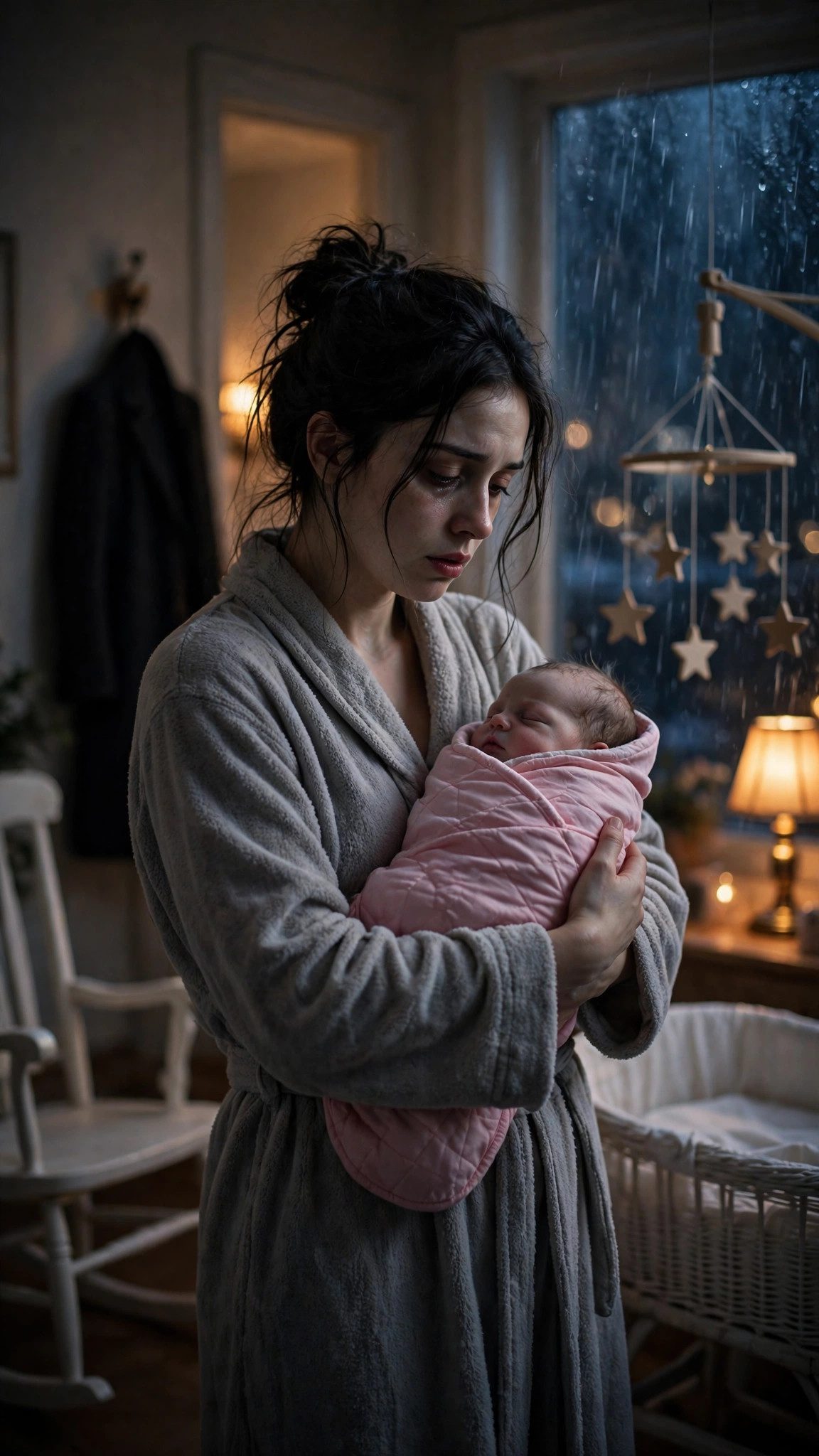
Three months after she left, on a cold morning in February, Aaron Moretti drove back to Milwaukee.
Sophie was three months old by then, and she had grown so much that the pink sleeper with the tiny rabbits no longer fit her, and her hair had come in dark and soft, like her father's, and her eyes were gray, like his too, and when she smiled — which she did often now, at the sound of her mother's voice, at the mobile above her bassinet, at the face of her uncle Ethan when he made his terrible jokes — her whole face lit up, and Aaron thought, she is going to be all right. Whatever happens next, she is going to be all right.
Ethan drove them. He did not ask if she was sure. He had stopped asking that weeks ago, when he had seen her reading Roman's letters for the third time, and he had understood that his sister had already decided. He just loaded the diaper bag into the trunk of his car, and he put Sophie's car seat in the back, and he drove south on Highway 41, past Oshkosh and Fond du Lac and West Bend, and he did not say a word until they crossed the city line, and then he said, "If he hurts you again, Aaron, you call me. Day or night. I don't care what he's done or what he's become. You call me."
"I will," she said. And she meant it. That was the difference now. She was not going back because she had nowhere else to go. She was going back because she had somewhere else to go — the cabin on Lake Mendota, with the fire in the stone fireplace and the wicker bassinet beside the wood stove — and she was choosing to come home anyway.
Roman was waiting for them in the driveway of a small house in a quiet neighborhood, a house Aaron had never seen before. It was not the house on Lake Drive. It was smaller, and plainer, and the paint on the shutters was a soft, ordinary blue, and there was a swing on the porch, and a garden in the front yard, covered in snow, waiting for spring.
He was standing in the driveway in his coat, with his hands in his pockets, and when Ethan's car pulled in, he did not move. He just stood there, watching, the way a man watches for something he is afraid to hope for.
Aaron got out of the car. She unbuckled Sophie from her car seat, and she held her daughter against her chest, and she walked across the driveway, through the snow, toward the man she had married, and she stopped three feet away from him, and she looked at him, and she said, "Show me."
So he showed her. He showed her the house — the kitchen with the big windows, the living room with the fireplace, the nursery upstairs, painted a soft, warm yellow, with a white crib and a white rocking chair and a mobile above the crib, little wooden stars and moons, the same mobile he had hung in the old nursery, the one he had taken down himself and carried here, piece by piece. He showed her the thermostat, set to exactly seventy-two degrees. He showed her the dresser, full of tiny clothes, folded with impossible neatness. He showed her the notebook on the changing table, with the feeding times written in his handwriting, in the same neat letters she used.
And then he showed her the last thing. A framed document, hanging on the wall of the nursery, beside the crib. It was a court order, stamped and signed, dissolving the Moretti family's criminal enterprises. Beneath it, a second document: the incorporation papers for a legitimate shipping company, Moretti Logistics, with audited books and a board of directors and not a single dollar that could not be explained.
"It's done," he said. "All of it. Castellano was convicted last week. Life in prison, no parole. Laya took a plea — fifteen years. Her father got ten. The docks are sold. The warehouses are sold. The trucking company is legitimate. I testified for three days, Aaron. I told them everything. And when it was over, Agent Reyes shook my hand, and he said, 'You're a free man, Mr. Moretti. Don't waste it.'"
Aaron looked at the documents on the wall. Then she looked at Sophie, asleep in her arms, her tiny fist curled against her cheek. Then she looked at Roman, standing in the doorway of the nursery, in a house she had never seen before, in a life she had never imagined, and she said, "There's one more thing I need."
"Anything," he said.
"I need you to promise me something. And I need you to mean it this time."
"Tell me."
"Promise me you'll be home before nine," she said. "Every night. Not most nights. Every night. Because Sophie deserves a father who comes home. And I deserve a husband who comes home. And if you can't promise that, then tell me now, and I'll go back to the cabin, and we'll be fine, because we're already fine. But if you can promise it — if you really mean it — then I'll stay."
Roman looked at her. He looked at his daughter. He looked at the nursery, with its yellow walls and its white rocking chair and its mobile turning slowly in the warm air. And he said, very quietly, "I promise. I'll be home before nine. Every night. For the rest of my life."
She believed him. Not because of the words — words were easy, and Roman had always been good with words — but because of everything else. Because of the letters. Because of the lists. Because of the court order on the wall and the legitimate shipping company and the three days of testimony and the small blue house with the swing on the porch. Because a man who had been the most feared mafia boss in Milwaukee had given it all up, not for power, not for money, but for a woman and a baby and a promise he had broken once and would never break again.
"Then we'll stay," she said.
He did not cry. He did not shout. He did not throw anything. He just stepped forward, very slowly, like a man approaching something fragile, and he put his arms around both of them — around Aaron and Sophie, his wife and his daughter, his whole world — and he held them, and the mobile turned, and the stars knocked together, and outside the nursery window, the snow fell softly over Milwaukee, covering the city in white, covering everything that had come before, and leaving only what was left.
In the spring, they renewed their vows in the garden of the small blue house, with Ethan standing beside them and Claire holding Sophie, who was six months old by then, and who wore a white dress with a pink ribbon, and who laughed when the wind blew the petals from the cherry tree across the yard. There were no photographers from the society pages. There were no glittering rooms full of glittering people. There were only the people who loved them, and a cake from the bakery on the corner, and a promise, spoken quietly, in the sunlight, by a man who had finally learned what a promise was for.
"I promise," Roman said, holding Aaron's hands, looking into her eyes, "to be home before nine. Every night. For the rest of my life."
And he was. Every night, without fail, the black SUV turned into the driveway of the small blue house before nine o'clock, and Roman Moretti came through the front door, and he hung up his coat, and he washed his hands, and he went upstairs to the nursery, and he picked up his daughter, and he held her against his chest, and he whispered, "I'm here, sweetheart. Daddy's home."
And Aaron, standing in the doorway of the nursery, watching them, would think about the night she had left — about the voicemail, about the rain, about the drive north in the dark — and she would think about how far they had come, from that night to this one, and she would understand something she had not understood before.
She could not make him choose them. That had always been true. But she could decide what she and Sophie deserved. And what they deserved was a man who came home before nine. And that was exactly what they had.
The first weeks back in Milwaukee were quieter than Aaron had expected. She had braced herself for whispers and stares, for the society pages and the questions, for the world she had left to come rushing back at her the moment she returned. But the world did not rush back. The world, it turned out, had moved on. Laya Crane's trial had been in the papers for a week, and then it was gone, replaced by other scandals, other names. Vincent Castellano's conviction had been a headline for a day. The Moretti family, which had once owned the city's attention the way it owned its docks, was now just a name people mentioned in the past tense, if they mentioned it at all.
Aaron went back to work at the hospital two days a week, the way she had before Sophie was born, and her colleagues welcomed her back without asking too many questions. Priya found her in the supply room on her first day back, and she put her arms around her, and she said, "You look like you again," and Aaron laughed, because she did feel like herself again. Not the woman who had waited by the phone. Not the woman who had driven north in the rain. Herself. A nurse, a mother, a wife — in that order, on most days, and in a different order on others, depending on who needed her most.
Priya came to dinner at the small blue house one Sunday, and she brought a casserole and a bottle of wine, and she sat on the porch swing with Aaron while Roman gave Sophie her bath upstairs, and she said, "Tell me the truth. Is he different? Really different?"
Aaron thought about it. She thought about the letters, and the lists, and the court order on the nursery wall. She thought about the way Roman came home every night before nine, without fail, and the way he washed his hands and went upstairs, and the way he held Sophie like she was made of glass and sunlight at the same time.
"He's trying," she said. "Every day. And trying is not the same as succeeding, but it's a lot more than I had before. And Priya — he chose us. When it cost him everything, he chose us. That's not nothing."
"No," Priya said. "That's not nothing. That's everything."
In May, Castellano's appeal was denied, and the news ran a short segment about it on the local station, and Roman watched it in the living room with Sophie asleep on his chest, and when it was over, he turned the television off, and he sat there in the quiet, and Aaron came downstairs with two cups of tea, and she sat beside him, and she said, "Are you all right?"
"I am," he said. "For the first time in my life, I think I actually am. I spent eight years being afraid — afraid of losing power, afraid of looking weak, afraid of Castellano, afraid of my own men. And now I have nothing to be afraid of losing, because the only things that matter are sitting right here, in this room, and nobody can take them from me. Not Castellano. Not Laya. Not anyone."
Sophie grew. She rolled over in June, on a blanket in the garden, while Aaron and Roman watched from the porch swing, holding hands like teenagers. She laughed for the first time in July, at the sound of her father's terrible singing in the bath, and Roman laughed too, and then he cried, just a little, because it was the first time he had heard his daughter laugh, and he understood, in that moment, everything he had almost lost.
In August, on Sophie's eight-month birthday, Roman came home at 8:47, as he did every night, and he found Aaron in the kitchen, making dinner, with Sophie in her high chair, banging a wooden spoon against the tray, and he stood in the doorway for a moment, watching them, and he thought about the night he had come home at 1:12 in the morning to an empty house, and he thought about the note on the changing table, and the four words that had changed his life.
You promised me, too.
He had promised. And this time, he was keeping it. Not because someone was watching. Not because someone had threatened him. But because he had finally understood what his wife had known all along: that a promise is not a sentence you say to get out of a room. It's a life you live, one night at a time, coming home before nine, every night, for the rest of your life.
On a November evening, one year to the day after Aaron had driven north in the rain, Roman came home at 8:52, and he found Aaron sitting in the nursery, rocking Sophie, who was nearly a year old now, and who had just learned to say her first word that morning.
"What was it?" he asked, kneeling beside the rocking chair. "What did she say?"
Aaron smiled, and her eyes were shining in the lamplight. "Mama," she said. "She said 'mama.' Clear as anything."
Roman laughed, and he leaned in, and he kissed the top of Sophie's dark head, and then he kissed Aaron, slow and unhurried, the way a man kisses a woman he has finally learned to deserve.
"She'll say 'dada' next," he said. "Just wait."
"She will," Aaron said. "She has plenty of time. We all do."
Outside the nursery window, the November rain was falling again, soft and steady against the glass, just as it had fallen a year ago. But inside the small blue house, the nursery was warm, and the mobile was turning, and the little wooden stars knocked together with a soft, hollow sound, and Aaron Moretti sat in the white rocking chair with her husband beside her and her daughter in her arms, and she thought about the night she had almost lost all of it, and she was glad — so glad — that she had been brave enough to leave, and brave enough to come back.
The End.
THE END