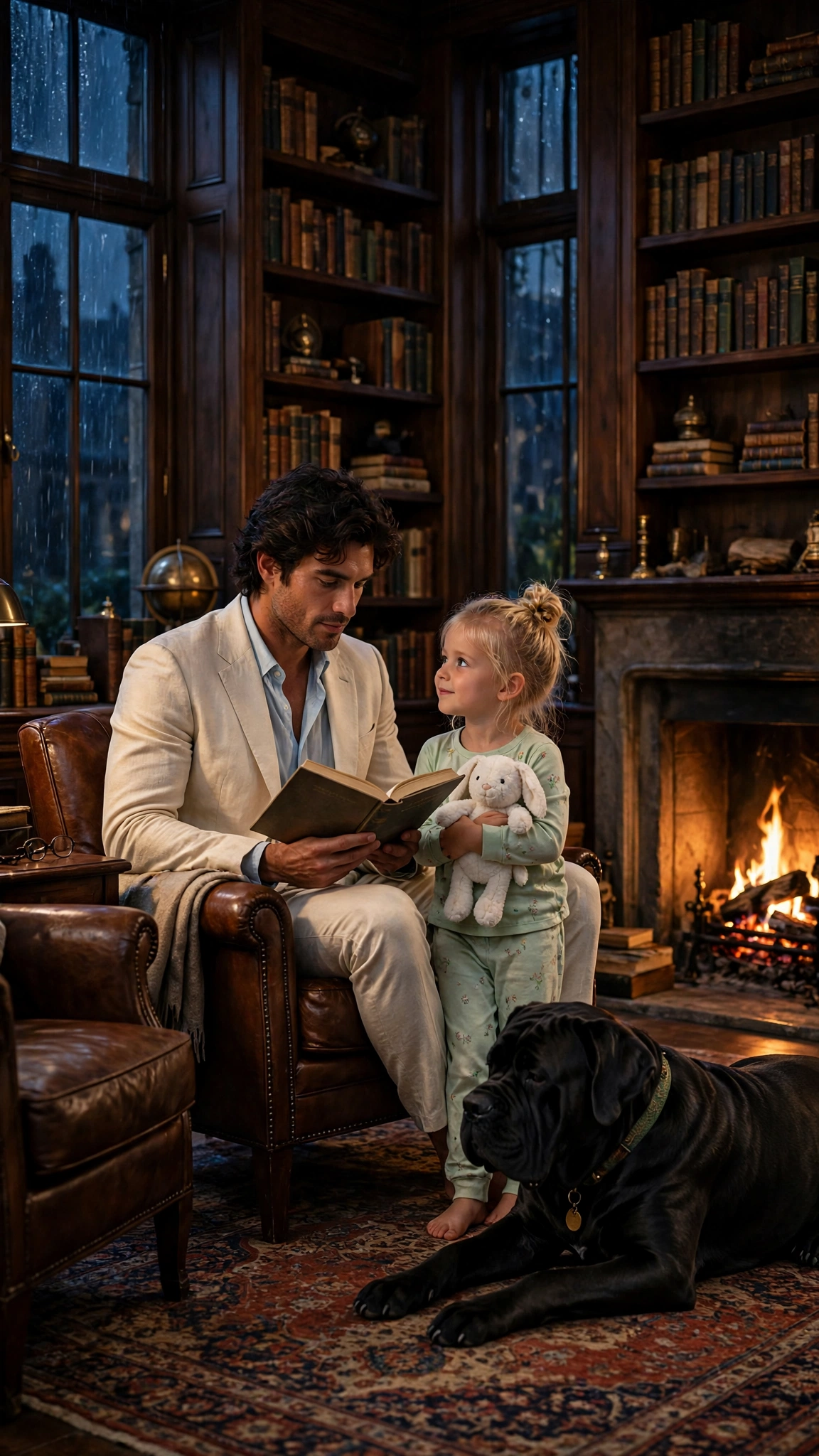
The next morning, the house woke up different.
Millie could feel it before she was even properly awake — the way you can feel a change in the weather before you open your eyes. The house was the same house, with the same rain on the windows and the same smell of Rosa's bread from the kitchen, but something in it had shifted, the way a room shifts when someone finally opens a window that has been shut for years.
King was still lying across her doorway. He lifted his great head when she stirred, and his tail moved once against the floor, and Millie, who had slept through the night for the first time in a month, sat up in bed and looked at him, and smiled — a real smile, small and sleepy, the first one Rosa had seen on her face in weeks.
"Good morning, King," Millie whispered. "Did you hear it last night?"
King's ears rose. He looked at the door, and then back at her, and Millie understood that he had heard it, and that he had stood guard, and that he would stand guard again tonight, and every night, because that was what he had been waiting for someone to ask him to do.
She slipped out of bed and went to him on her bare feet, in her green pyjamas, with the bunny in one arm, and she put her small arms around his great neck, and she pressed her cheek against his broad head, and King sighed, a deep, contented sigh, and closed his eyes.
Downstairs, Rosa was making breakfast, and when Millie came down with King beside her, Rosa took one look at the child's face and felt something loosen in her chest that had been tight for a month.
"You slept," Rosa said, and it was not a question.
Millie nodded, and she sat down at the kitchen table, and she ate her toast — all of it, for the first time in weeks — while King lay at her feet with his chin on her shoe, and Rosa watched them both, and thought about how strange it was that a dog could do in one night what a whole house full of grown people had failed to do in a month: make a frightened child feel safe.
After breakfast, Rosa took Millie into the garden, because the rain had stopped and the sun was out, pale and watery, and the roses were wet and bright. King went with them, walking beside Millie with his great head level with her shoulder, and Rosa walked behind them, her hands folded in her apron, watching the little girl and the dog move through the garden together, the way they had always moved, except that now they moved differently — closer together, slower, as if they had made a promise to each other in the dark and were keeping it in the daylight.
"Rosa," Millie said, as they walked past the fountain, "why does King stay with me? He is Papa's dog. Why does he follow me everywhere?"
Rosa thought about this for a moment. She had known King since he was a puppy, and she had watched him grow from a small black bundle into the biggest dog in the city, and she had seen the way he looked at Millie, and she thought she understood it better than anyone.
"Because he chose you, sweetheart," Rosa said gently. "Dogs choose their people, the way people choose their friends. Your papa bought King, and he fed him, and he trained him, but King chose you. He chose you the day he first saw you, when you were one year old and learning to walk, and you fell down in the garden, and he lay down beside you so you could pull yourself up on his back. Do you remember that?"
Millie shook her head. "I was too small."
"Yes," Rosa said. "But he remembers. Dogs remember everything. He remembers that you were small, and that you needed him, and he has been waiting ever since for someone to let him do his job."
Millie looked at King, who was sniffing at a rosebush, his great black body moving slowly through the wet grass, and she thought about that — about a dog who had been waiting for four years to be asked to guard her door — and she felt a small, warm feeling in her chest, the way you feel when someone tells you a secret you have always suspected but never quite believed.
"He looks lonely too," Millie said softly, echoing the words she had said to her father in the library. "That's why I asked for him, Rosa. Not just to protect me. Because he looks lonely too."
Rosa stopped walking. She looked at the little girl, and at the great black dog, and her eyes glistened, because she understood, suddenly and completely, what Millie had understood all along: that the dog was not just a guard, and the girl was not just a child to be protected. They were two lonely creatures in a big, quiet house, and they had found each other, the way lonely creatures sometimes do, without anyone having to arrange it.
"Yes, sweetheart," Rosa said quietly. "He does look lonely. And so did you. And now neither of you is alone anymore."
They walked on through the garden, past the lemon trees and the hedges, and Millie held King's collar in one hand and the bunny in the other, and Rosa walked behind them, and the sun came out properly for the first time in days, and the house on the hill glowed warm in the light, like a ship that had finally found its way home.
That afternoon, while Millie napped with King lying across her doorway, Lorenzo sat in his study with Enzo, and Enzo laid out what his men had found.
"The footprints belong to one man," Enzo said. "He comes through the gap in the hedge, the one by the old gate. He walks to the terrace, he smokes three cigarettes, he knocks three times on the library doors, and he leaves. He has been doing it for weeks, sir. Maybe a month. The older footprints are under the terrace, where the rain hasn't washed them away. He is careful. He never comes before midnight. He never stays longer than twenty minutes. He never takes anything. He only watches, and knocks, and leaves."
"Who sent him?" Lorenzo asked.
Enzo was silent for a moment. "We don't know yet, sir. But I have an idea. Three years ago, after Mrs. Moretti died, the Ferraro family went quiet. They have been quiet for three years. But in the last month, their men have been seen in the town — asking questions, watching the house, learning the routines. The Ferraros have always wanted the harbor road, sir. They have always wanted what you have. And they have always been patient."
Lorenzo nodded slowly. The Ferraro family. He had known them for twenty years. He had fought them, and made peace with them, and fought them again, and for three years, since Renata's death, there had been a kind of truce — not a peace, exactly, but a silence, the way two tired boxers lean on each other between rounds. And now, it seemed, the silence was over.
"They are testing the house," Lorenzo said. "They want to know if I am still watching. If the dog sleeps inside or outside. If the girl is guarded. They are learning the house the way a burglar learns a house — slowly, patiently, one knock at a time."
"Yes, sir," Enzo said. "That is what I think too."
Lorenzo looked out the window at the garden, where his daughter was walking with her dog and her bunny, and he felt a coldness spread through his chest that had nothing to do with the rain. Someone had been watching his house. Someone had been standing outside his daughter's window, night after night, knocking on his doors, testing his walls. And the only ones who had been watching back were a five-year-old girl who could not sleep, and a dog who had never been asked to guard her door.
"Then we will give them something to learn," Lorenzo said quietly. "From tonight, two men on the terrace, every night. I want the gap in the hedge fixed. I want the terrace doors fitted with a new lock. And I want the name of the man who knocks. Not the family. The man. I want to look him in the eye."
"Yes, sir," Enzo said, and he went to carry out his orders.
That evening, after supper, Lorenzo went to the library, and he did not bring a book. He sat in his leather armchair, in his cream suit, and he waited. King came with him, and lay down by the fireplace, and Lorenzo watched the fire burn, and listened to the rain begin again on the windows, and thought about his daughter upstairs, and about the dog, and about the man in the dark, and about the three years he had spent believing that strength meant never bending, never yielding, never admitting he was wrong.
He thought about Renata, too. He thought about the way she used to sit in this very library, in the evenings, with her feet tucked under her, reading, while he worked. He thought about the way she had laughed at him when he tried to be stern with the staff. He thought about the last thing she had ever said to him, on the night she died — something ordinary, something about milk for the baby, something he had forgotten for three years and then suddenly remembered, word for word, sitting in his study on a Wednesday afternoon.
"Don't forget to be soft with her, Lorenzo," Renata had said. "She is going to need you to be soft."
He had not been soft. He had been hard, and fast, and certain, and he had been wrong.
At nine o'clock, Rosa came to the library door with a cup of tea. She set it down on the small table beside Lorenzo's chair, and she stood there for a moment, and Lorenzo, who had never once asked Rosa for her opinion about anything, looked up at her and said, "Rosa. The bunny. Where did it come from?"
Rosa looked at him for a long moment. She had known this man for twenty years. She had watched him grieve, and work, and build his walls. She had never once seen him ask about his daughter's toy.
"Your wife bought it, sir," Rosa said quietly. "Before Millie was born. She bought it in a little shop in the town, and she kept it in a drawer, wrapped in tissue paper, with a card that said, 'For my little bird, when she is old enough.' I gave it to Millie on the first anniversary, sir. I thought — I thought she should have something of her mother's to hold, for the nights when she could not sleep."
Lorenzo was silent for a long time. Then he said, very softly, "Thank you, Rosa. Thank you for keeping it safe. And thank you for staying. I have never said that to you, and I should have said it years ago."
Rosa looked at him, and her eyes glistened, and she nodded once, slowly, the way she had nodded a hundred times before — at the top of a staircase, at the edge of a garden, at the beginning of something brave.
"You are welcome, sir," she said, and she turned and went back to the kitchen, and Lorenzo sat alone in the library, listening to the rain, and thinking about his wife, and his daughter, and his dog, and about the fact that the people who had kept his family together for three years had never once been the men with guns at the gates.
They had been a housekeeper, and a little girl, and a dog.
At eleven o'clock, the clock on the mantelpiece struck the hour. The fire burned low. The rain drummed on the windows. And in the library, in the dark, Lorenzo Moretti sat in his cream suit and waited for the knocking to come.
Upstairs, in her room, Millie lay in her bed with the bunny under her chin, listening to the rain, and to the soft breathing of the great black dog across her doorway, and she felt, for the first time in a month, something she had almost forgotten how to feel.
Safe.
And downstairs, in the library, her father sat in the dark, waiting, and thinking about the man who knocked three times every night, and about what he would say to him when they finally met.