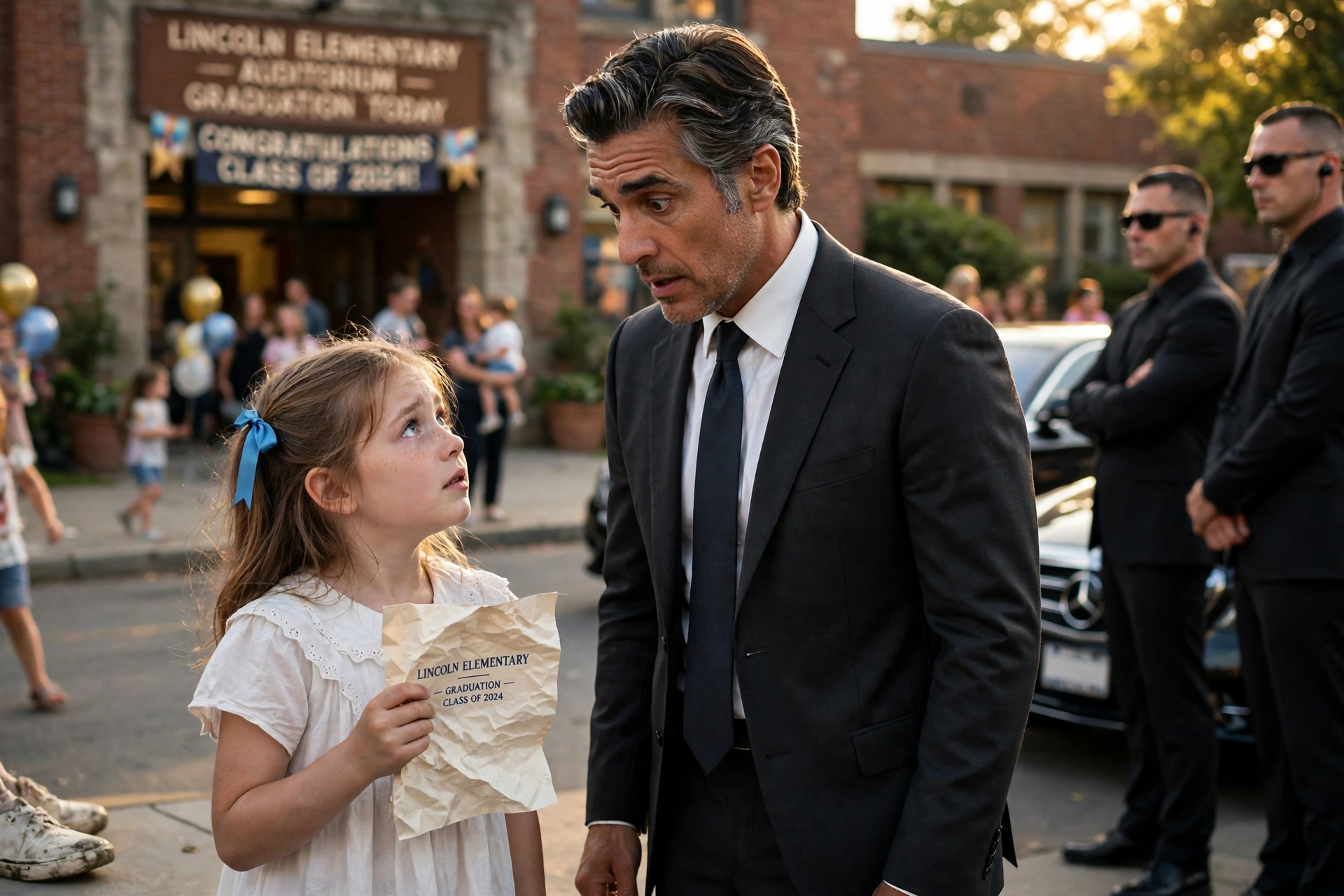
The autumn concert arrived on a evening when the air smelled of rain and woodsmoke, and the auditorium at Lincoln Elementary was warm with lights and with the particular excitement that only school concerts create: children in clean shirts, parents with cameras, teachers with clipboards, and a stage that seemed, to the children waiting in the wings, both very small and impossibly large.
Sophie was nervous in a way she had not been at her graduation ceremony. At graduation, she had been nervous about an empty chair. At the concert, she was nervous about singing, about remembering words, about standing in front of people and being heard when her voice shook. Mrs. Alvarez had chosen her for a short solo, not because Sophie was the loudest singer, but because Sophie sang with a clarity that made people listen, even when she was quiet.
June was in the front row, with Aunt May beside her, and Luca was in the third row, on the left, because Sophie had saved him a chair again, and because some traditions, once they begin honestly, are worth keeping. This time, Luca did not arrive in a black Mercedes with bodyguards. He arrived on foot, in a dark suit that was a little less formal than before, carrying a small bouquet of daisies, because Sophie had once liked daisies and because Luca had learned that consistency can be a kind of love, even when it is expressed in flowers.
Before the concert began, Anton Reyes made one last attempt to turn the evening into something else. He did not come inside. He sent a reporter, a young man with a notebook and a camera, who approached Aunt May in the lobby and asked if Sophie would be willing to say a few words about Harbor Point, about her father, about Mr. Moretti, for a story about "the little girl who changed a shipping empire." Aunt May, who had dealt with reporters before and who had no patience for them when they approached children, said no, firmly and politely, and then she found Luca and told him what had happened, not to alarm him, but so he would know.
Luca found the reporter in the lobby, and he did not threaten him, and he did not try to buy him off, which was, for Luca, a measure of how much he had changed. He said, simply and clearly, "This is a school concert, not a press conference. Sophie is seven. She is here to sing. Her family has already told their story, in their own words, in a public record, and they do not owe anyone a performance of their grief tonight. If you want to write about Harbor Point, write about the learning center, and about the jobs that were saved, and about a grandmother who kept a deed for seven years because she loved her family. Do not write about a child singing."
The reporter, who had expected either a threat or a bribe, looked surprised, and then he nodded, and he put his notebook away, and he stayed for the concert as an audience member, not as a hunter. Luca did not know if the reporter would keep his word, but he knew he had done the right thing by saying it out loud, in front of Aunt May, where it could not be denied later.
Inside, the concert began. Second graders sang two songs, just as Sophie had once predicted second graders would, and the audience applauded, and laughed, and wiped their eyes, as audiences at school concerts always do. Then Mrs. Alvarez introduced Sophie, and Sophie walked to the front of the stage, her white dress clean, her blue ribbon bright, her scuffed shoes replaced by newer ones that June had bought for the occasion, though Sophie had insisted on keeping the old ones at home, because, she said, they had been with her when Luca had first clapped for her, and she did not want to throw away something that had been part of a good day.
Sophie looked out at the audience, and for a moment her courage wavered. She saw June, smiling encouragement. She saw Aunt May, nodding. She saw Luca, in the third row on the left, holding daisies, clapping already, softly, as if to say, "I am here, and I am not going anywhere." And then she began to sing.
Her voice was small at first, and then it grew, not loud, but clear, and the song she sang was about a house by the water, and about people who come home after a long time away, and about chairs that are saved for people who are loved. It was not a famous song. Mrs. Alvarez had chosen it because its words were simple and its melody was kind, and because Sophie sang it as if she believed every word, which, in a way, she did.
Halfway through the song, June reached for Aunt May's hand, and Aunt May reached for June's, and Luca, in his chair, felt tears come to his eyes, not because the song was sad, but because it was true. He thought of Daniel Bell, who had never heard his daughter sing, and of Laura Bell, who had died last winter, and of Victor Moretti, who had missed his own son's ceremony, and of all the chairs in all the auditoriums that had been left empty by pride, or by fear, or by business, or by death. And he thought of Sophie, who had saved a chair and had, by that small, brave act, changed the shape of all their lives.
When Sophie finished, the applause was not polite. It was loud, and long, and full, and Sophie beamed, and she looked directly at Luca, and at June, and at Aunt May, and she knew, in the way children know important things without needing them explained, that she was not alone in that room.
After the concert, in the lobby, with families milling around and with teachers trying to keep order, June asked Luca to come to the blue house for tea, one more time, with Aunt May present, as always. Luca agreed, and they walked through the cool evening air, Sophie skipping a little ahead, then coming back to walk beside June, then skipping ahead again, as children do when they are happy and tired at the same time.
At the blue house, June went to her bedroom and returned with something she had not shown Luca before: a letter, sealed, addressed in Daniel's handwriting to "My daughter, when she is old enough to understand." June had kept this letter even longer than the deed, because it was not a legal document. It was a father's letter to a child he would never meet, written in the weeks before he died, when he already suspected that his work at Harbor Point might be dangerous, and when he wanted his daughter to know, above all, that he had loved her, and that he had believed the world could be made fairer by careful people who asked honest questions.
June handed the letter to Sophie, not to Luca, because it belonged to Sophie, and Sophie held it carefully, as if it were made of glass, and then she handed it to June and asked June to read it aloud, because some letters are too important to read alone the first time.
June read, her voice steady, though her hands shook a little. Daniel wrote that he did not know what the future would hold, that he hoped Sophie would grow up in a house full of books and songs, that he hoped she would have people who showed up for her, not just people who promised to show up, and that if she ever met someone powerful who had done something wrong, she should judge that person not by what his father had done, but by what he did when he learned the truth.
When June finished, there was silence in the kitchen, a silence that was not awkward, but full, like a room after a song has ended and before anyone wants to break the feeling by speaking.
Sophie looked at Luca, and she said, "Mr. Luca, my daddy said to judge you by what you do when you learn the truth. You gave back the land, and you helped Nana, and you came to hear me sing. I think my daddy would say you did the right thing."
Luca, who had faced down rival shippers and port authorities and his own board, found that he could not speak for a moment, because a seven-year-old's judgment, offered simply and without flattery, was heavier and more precious than any business victory he had ever won.
June then did something Luca had not expected. She took a small key from her pocket, a key to the tin box, and she placed it on the table, not as a gift to Luca, but as a symbol. "Mr. Moretti," she said, "this box no longer needs to be kept closed. The deed is in a public record now. The letter belongs to Sophie. The box itself can hold something else now, perhaps photographs, perhaps daisies, perhaps whatever Sophie wants to keep safe. You are not Sophie's father, and you will never replace Daniel or Laura, and we would not ask you to. But you are, if you want to be, a friend of this family, who is welcome at our table, with Aunt May present, for as long as you continue to show up honestly. That is not a small thing, Mr. Moretti. That is a family, chosen, not just born."
Luca nodded, and he accepted the invitation the way one accepts something sacred: quietly, and with gratitude, and without trying to make it larger than it was.
In the months that followed, the story did not end with a grand gesture, but with a series of small, faithful ones. Luca continued to visit, supervised and welcome. June's health stabilized, with good days and tired days, but with more good days than tired ones. Aunt May continued to run the blue house with order and love. Sophie continued to go to school, to sing, to read, to ask careful questions, and to save chairs, not just for Luca, but for anyone who needed a place to sit and to be seen.
The Harbor Point learning center grew, slowly, into a place where children from dockworker families could read and learn, and where a plaque, small and respectful, remembered Daniel Bell, not as a victim, but as a careful man who had believed paper could protect people, and who had been right, in the end, because paper, kept in a tin box by a grandmother who loved her family, had finally done what Daniel had hoped it would do: it had told the truth, and the truth, once told honestly, had made room for a new kind of family to form.
On the first anniversary of the school ceremony, Sophie, June, Aunt May, and Luca returned to Lincoln Elementary, not for a ceremony, but for a quiet visit, to thank Mrs. Alvarez and to leave a bouquet of daisies on the stage. Sophie stood in the third row, on the left, and pointed to the chair where Luca had once sat, and she said, "That was the chair I saved, Nana. And look, it is still here, and we are still here, and that is a good story, isn't it?"
June put her arm around Sophie, and Aunt May smiled, and Luca, standing a little behind them, with daisies in his hands, said, "Yes, Sophie. That is a very good story. And the best part is, it is not finished yet. It is just beginning, with people who show up, and who tell the truth, and who save chairs for each other, even when it is hard."
Sophie laughed, and June laughed, and the afternoon light came through the auditorium windows, warm and golden, and for a moment, in that ordinary school, with its banners and its small chairs, it felt as if all the empty chairs in all their lives had finally been filled, not by pretending, but by choosing, day after day, to come back, to listen, to make amends, and to clap loudly for a child who had asked, once, for forty-five minutes, and had received, in return, a lifetime of people who would not leave her sitting alone.
Years later, Sophie would still remember that autumn concert, not because she sang perfectly, but because she sang honestly, and because the people who loved her were sitting where she could see them, clapping loudly, just as she had asked. She would remember that a chair, once saved for a stranger, can become a place where a family gathers, and that the bravest thing a child can do is not to pretend that everything is fine, but to ask, clearly and kindly, for someone to show up, and then to give that person a chance to prove that showing up can change everything.