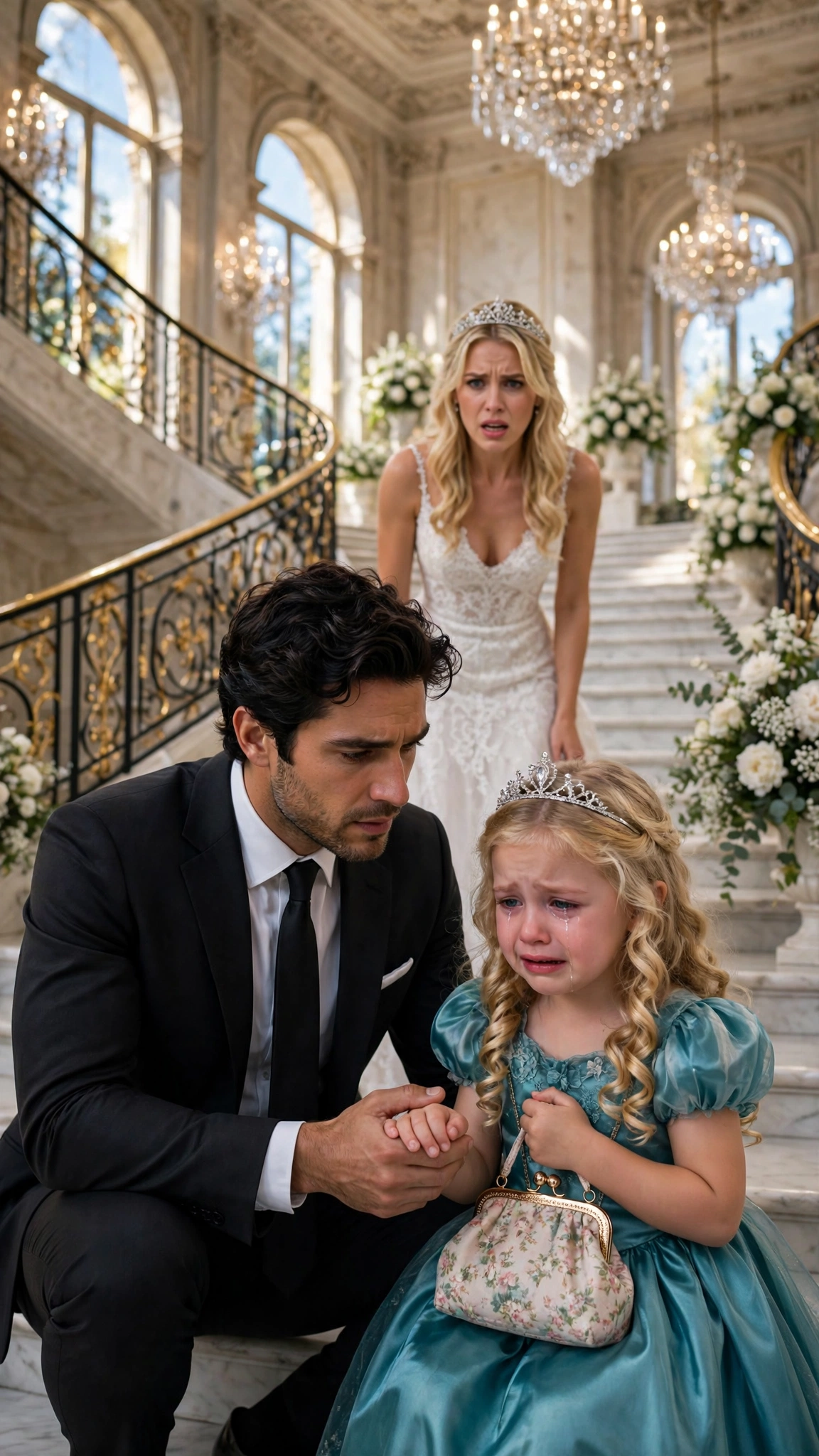
The cruelty did not stop. It grew, the way a small crack in a wall grows when water gets into it — slowly, quietly, and then suddenly the whole wall is coming down.
Two weeks before the wedding, Victoria began to change the house. She ordered new curtains for the nursery — heavy, dark curtains, "to help Lily sleep better." She had the rocking chair removed — the chair where Isabella used to read to Lily, the chair Lily had sat in a hundred times with her mother's arm around her — because, Victoria said, "it takes up too much space, and it is old."
Lily came home from school one afternoon and found the chair gone. She stood in the doorway of the nursery, staring at the empty corner, and her lower lip trembled, and she said, very quietly, "Where is Mommy's chair?"
"It was old," Victoria said, from behind her. "We threw it away."
Lily turned around. Victoria was standing in the hallway, her arms crossed, her eyes cool.
"You threw it away?" Lily whispered.
"Don't be dramatic, Lily. It was a chair. We will buy a new one."
Lily did not answer. She walked into the nursery, and she sat down on the floor in the empty corner, and she stayed there until Carlo found her an hour later, still sitting, still staring at the space where the chair had been.
That was the first crack. The second came three days later.
Lily had been playing in the garden, chasing butterflies in her teal dress, her silver tiara catching the sun, her mother's floral handbag bouncing on her arm, and she had come inside with dirt on her cream shoes and a smudge of earth on her cheek. Victoria was in the hallway, talking on the phone, and when she saw Lily, her face tightened.
"Look at you," Victoria said, her voice sharp. "You are filthy. A Moretti daughter does not run around in the dirt like a street child."
"I was only playing," Lily said.
"Playing," Victoria repeated, and she reached out and gripped Lily's arm — not hard enough to leave a mark that anyone would see, but hard enough that Lily gasped, hard enough that her small fingers curled into fists. "Go to your room. Now. And do not come out until I say so."
Lily went. She went to her room, and Victoria followed her, and Victoria closed the door, and Lily heard the sound she would never forget for the rest of her life: the soft, deliberate click of a key turning in a lock.
She was locked in.
She stood in the middle of the nursery, her heart pounding, her breath coming fast, and she tried the door. It did not open. She knocked. No one came. She called for Carlo, but Carlo was at his office, and the house was quiet, and the only sound was the ticking of the clock on the nursery wall.
She sat down on her bed. She pulled her knees to her chest. She held her stuffed rabbit — the one her mother had sewn for her — tight against her heart, and she held her mother's floral handbag in her other hand, and she waited. She waited for an hour. Then two. The sun moved across the nursery floor, and the room grew dim, and Lily's stomach growled, and her throat was dry, and she began to cry — not loudly, because she had learned not to cry loudly, but quietly, the tears running down her cheeks and soaking into the rabbit's fur.
When Carlo came to the house that evening, he found the nursery door locked. He knocked. He called Lily's name. He heard a small, muffled voice say, "Carlo?"
"I'm here, princess. I'm here."
Carlo went to find Victoria, who was in the sitting room, reading a wedding magazine, her face calm, her diamond ring catching the light.
"Victoria," Carlo said, his voice shaking. "The nursery door is locked. Lily is inside."
"She needed to learn," Victoria said, without looking up. "She was filthy. She needs to understand that there are consequences."
"She is five years old," Carlo said. "She was playing in the garden. Unlock the door."
Victoria looked up then, and her eyes were cold, and her voice was very quiet, and she said, "Carlo. You are the lawyer. You do not give me orders in my own house."
"This is not your house yet," Carlo said, and his voice was shaking, but he did not back down. "And that child is not yours to punish."
They stood there, the old friend and the fiancée, staring at each other across the sitting room, and for a moment Carlo thought Victoria might strike him. But Victoria only smiled — the smile that did not reach her eyes — and she stood up, and she walked to the nursery, and she unlocked the door, and she said, "There. Happy now?"
Lily came out of the nursery slowly, her eyes red, her cheeks streaked with tears, her stuffed rabbit clutched to her chest and her mother's handbag on her arm. She ran to Carlo and buried her face in his jacket.
Victoria watched them, and her expression was unreadable, and then she turned and walked away, her heels clicking on the marble floor, and Carlo held Lily tight and thought, This cannot go on. This cannot go on.
But it did go on. It went on, because Daniel was busy, and because Lily was quiet, and because Carlo was afraid — afraid of losing his friend, afraid that if he spoke too soon, Victoria would find a way to make him disappear from the house, and then there would be no one left in the house who loved Lily at all.
The third crack came a week before the wedding, and it was the one that broke something in Lily that could not be put back together.
Victoria found Lily in the nursery, drawing. Lily had a new picture — her family again, the tall man, the small girl, the woman with yellow wings, and now, beside them, a small house with a red door, and a garden full of flowers. She was concentrating very hard, her tongue caught between her teeth, her crayon moving carefully across the paper.
"What are you drawing?" Victoria asked.
Lily held it up, shyly proud. "Our family. And our house. See? The red door is for Mommy, so she can find her way home."
Victoria looked at the drawing. She was silent for a long moment. Then she said, very quietly, "Lily. Come here."
Lily went to her. Victoria knelt down, so that their faces were close, and her voice was low, and her eyes were cold, and she said the words that Lily would carry with her to the rehearsal, and beyond:
"Listen to me, little girl. When your father marries me, things are going to change. You are not going to be the center of this house anymore. You are not going to be your daddy's little girl anymore. Do you understand?"
Lily stared at her. Her mouth opened. No sound came out.
"Your father loves me now," Victoria said. "He loves me more. And when we are married, you are going to a school. A school far away. A school where little girls learn to behave. And you will not come home for a very long time."
"But —" Lily whispered.
"No," Victoria said. "No buts. And if you tell your father what I said, I will tell him that you lied. And he will believe me, because I am going to be his wife, and you are only a child. Do you understand?"
Lily nodded. She nodded because she was five, and because she was terrified, and because the woman in front of her was beautiful and cold and absolutely certain, and Lily did not know how to fight someone who was absolutely certain.
Victoria stood up. She smoothed her skirt. She smiled. "Good girl," she said. "Now go and wash your hands. You have crayon on your fingers."
Lily went to wash her hands. She stood at the bathroom sink, the water running over her small fingers, and she looked at herself in the mirror, and she saw a little girl with blonde curls and a silver tiara and blue eyes, and she thought, I am not going to be Daddy's little girl anymore. And the thought was so big, and so heavy, that she had to sit down on the bathroom floor, because her legs would not hold her up.
That night, she did something she had never done before. She did not go to Carlo. She did not hide. She waited until the house was quiet, until Victoria was in the sitting room with her wedding magazines, until her father was in his study, and then she crept down the hallway in her nightdress, her bare feet silent on the marble floor, her mother's floral handbag on her arm, and she went to Victoria's study.
She did not know what she was looking for. She only knew that Victoria had a secret — that beautiful, cold women always have secrets — and that if she could find the secret, she could stop what was coming.
The study door was open. The desk drawer was not locked. Lily opened it, her small hands shaking, and inside, under a stack of wedding magazines, she found the letter.
It was from a boarding school in Switzerland. It was addressed to Victoria. It spoke of "the Moretti child" and "firm guidance" and "distance from certain influences." It spoke of a start date — September, two weeks after the wedding — and a fee, and a uniform, and a rule: no visits for the first six months.
Lily could not read all the words. She was five, and the letter was written in grown-up language. But she could read her name — or rather, she could read "the Moretti child," and she could read "September," and she could read the name of the school, and she understood, in the wordless way that children understand, that this letter was the thing Victoria had been hiding, and that it was the thing that would take her away.
She folded the letter very carefully. She opened her mother's floral handbag — the little purse with the pink roses, the purse that had been her mother's, the purse that was the safest place in the whole world — and she put the letter inside it, beside the photograph of her mother holding her as a baby, beside the folded note her mother had written for her before she died. She closed the gold clasp. She held the bag tight to her chest.
She went back to the nursery. She put the bag on the pillow beside her, the way she always did, and she lay down, and she pulled her blanket up to her chin, and she thought about the letter, and about the school far away, and about the woman with the cold eyes, and she made a promise to herself, in the wordless way children make promises:
I will not let her take me away. I will hold on to Mommy's bag, and I will not let go. And when Daddy asks me, I will tell him the truth.
She fell asleep with one hand on the gold clasp, and she dreamed of her mother — of a woman with wings, drawn in yellow crayon, smiling down at her from a sky full of early stars — and in the dream, her mother said, "Be brave, my little girl. Be brave, and hold on tight."
When Lily woke, the sun was coming through the nursery windows, and the house was quiet, and the rehearsal was tomorrow, and the letter was safe in her mother's bag, and for the first time in a year, Lily was not only afraid.
She was also, in a small and furious way, ready.
The next morning, Lily went to find Carlo in the garden. He was sitting on the bench under the old oak tree, reading the newspaper, a cup of coffee in his hand, and she climbed up beside him without a word, and she put her mother's floral handbag in her lap, and she looked at the photograph inside it — her mother holding her as a baby, smiling down at her as if the whole world had just begun — and she said, very quietly, "Carlo, is Mommy watching me?"
Carlo put down his newspaper. "Yes, princess. I believe she is."
"Even when I am scared?"
"Especially when you are scared," Carlo said. "That is when mothers watch the hardest."
Lily nodded. She closed the handbag, and she held it tight, and she looked at the house — at the tall windows, and the marble steps, and the door to Victoria's study — and she said, "I found something, Carlo. In Miss Victoria's desk. A letter. I put it in Mommy's bag, so she couldn't take it back."
Carlo went very still. "What kind of letter, princess?"
"A letter about a school," Lily said. "Far away. I can't read all the words. But I know it is bad. I know it is the reason she wants my bag."
Carlo looked at the little girl beside him — at her blonde curls, and her silver tiara, and her small fierce face — and he felt something in his chest tighten, because he understood, in that moment, that this five-year-old girl had done what no grown-up in the house had been brave enough to do. She had found the truth, and she had hidden it somewhere safe, and she was waiting for the right moment to show it to her father.
"Keep it safe," Carlo said softly. "Keep it in Mommy's bag, and do not let anyone take it from you. Not anyone. Do you understand?"
"I understand," Lily said. And she held the bag a little tighter, and she did not let go.