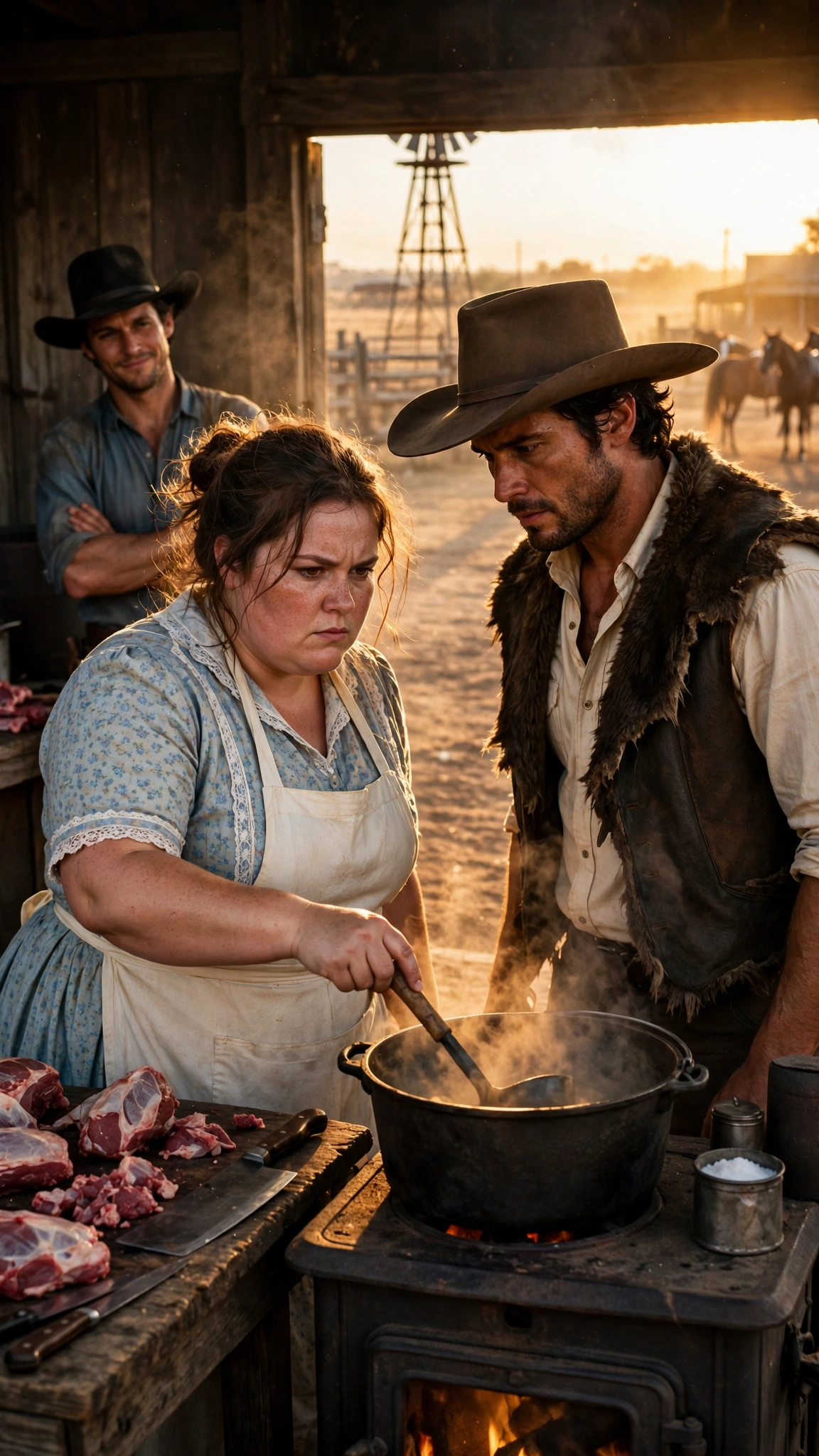
The sun was low over the Bar R Ranch, and it turned the dust in the yard to gold.
Abigail Thornton stood beside the rough wooden butcher's table and looked at the meat laid out on it, and she did not look away. Ribs. Steaks. Shoulder cuts, dark red and raw, laid out in rows on the scarred boards. A cleaver rested beside them, and the knives were lined up the way she had lined them up herself that morning, handles even, blades clean. The windmill turned slow behind the cookhouse. Horses stamped in the pens. Thirty cowboys stood around the yard in a loose ring, and the smell of dust and horse sweat and hot iron hung in the air, and every one of those men was watching her.
Caleb Reynolds stood across the table from her. He was tall enough that the sun struck the brim of his brown hat and threw his face into shadow, and the shadow made his eyes harder to read, which was the point. He wore the shaggy dark-brown leather-and-fur vest over his cream work shirt, and his hands were scarred from rope and wire, and he did not raise his voice. He did not have to. He pointed one finger at the meat on the table, and his voice cut across the yard like a whip crack.
"GOAT MEAT? For thirty cowboys?"
Behind him, several of the cowboys exchanged smiles. Not laughs — they knew better than to laugh outright at Caleb Reynolds — but smiles, the kind men wear when they are sure of how a thing is going to end. Eli nudged Sam with his elbow. Dutch looked at the sky. Somebody near the back of the ring made a small sound in his throat, the sound of a man swallowing a joke.
Abigail did not move. She stood completely still, her hands at her sides, her cream apron already dusted with flour from the morning's bread, and she stared back at him with restrained anger. Her brown hair was pinned up in its loose bun, coming undone at the edges the way it always did by late afternoon, and the light-blue floral dress she wore had white lace at the collar that Martha had starched that morning. She was a big woman, and she had spent the whole of her twenty-nine years being told, in one way or another, that a big woman ought to take up less room. She had stopped listening to that a long time ago. She put her hands on the edge of the butcher's table and gripped it, and her fingers tensed against the wood, and her eyes dropped — just for a moment — to the meat. Then they rose, slowly, to meet his.
"Give me until sundown," she said.
Her voice was firm. It was controlled. It did not shake, and she was proud of that, because her knees were shaking under the dress where nobody could see them, and her heart was beating so hard she was sure the men nearest the table could hear it. But her voice did not shake.
Caleb leaned toward her, just slightly, studying her face with cold suspicion. His jaw tightened. Behind him, Wyatt Granger stood with his arms folded and a smug smile on his face, the black hat pulled low over his eyes, and the smile said everything Wyatt ever said without opening his mouth: this will not work, and I will be here to watch it fail. The ranch hands fell silent. Even the horses seemed to go quiet. The windmill turned. The sun dropped another finger's width toward the horizon.
"One chance," Caleb said. His voice was low, and it was a command, and it was also — if she was hearing it right, and she thought she was — the thinnest thread of a question. "One chance."
She nodded once. She did not trust herself to speak again.
Inside the dusty cookhouse, the afternoon went on. Abigail stirred the heavy cast-iron pot over the wood-burning stove, and the steam rose around her face, and she added the dried spices one pinch at a time — cumin, chile, wild garlic — moving with skill and quiet confidence, the way her mother had taught her when she was a girl standing on a stool in a kitchen half the size of this one. The pot was full of goat ribs and shoulder, browned hard first in the pan, then laid into the water with onions, and the smell coming off it was already good, already promising, and she let herself believe, for one minute, that it might be enough.
Through the open doorway, Wyatt watched her. She felt his eyes on her back the way you feel a draught on the back of your neck, and she did not turn around. She kept stirring. She counted her breaths. She thought about the dough rising under its cloth, and the beans soaking in the bucket, and the cornbread she would bake in the skillet when the time came, and she did not think about Wyatt Granger at all, which was a lie, because she thought about nothing else.
When the pot was settled and the fire banked down to a steady glow, she wiped her hands on her apron, picked up the wooden water bucket, and stepped outside for water.
Wyatt moved the moment she was gone.
He slipped into the cookhouse quiet as smoke, his eyes darting toward the doorway, and his hand went to the small metal salt container that stood beside the steaming pot. His fingers closed around it. He lifted it. He tilted it over the pot, and the salt began to fall —
A hand closed around his wrist like a trap.
Caleb had come up behind him without a sound, and he stood there now with his face inches from Wyatt's, and his grip did not loosen, and his eyes were ice. Wyatt froze. The salt container hung in the air between them, harmless now, and the pot steamed on underneath, untouched.
"Don't." The word came out deep and chilling, and it carried more threat in that one syllable than most men could put into a whole speech.
And then Abigail came back.
She came through the doorway carrying the wooden water bucket, heavy and sloshing, and she stopped dead. She saw Wyatt's guilty face. She saw Caleb standing beside the untouched cooking pot with his hand locked around Wyatt's wrist. She saw the salt container, still whole, still in Wyatt's hand, and she understood all of it in a single heartbeat — what Wyatt had meant to do, and what Caleb had done instead.
Caleb slowly released Wyatt's wrist. He did not look at Wyatt again. He turned toward Abigail, and their eyes met across the steam, and for a moment neither of them said anything at all. Then Caleb lifted one hand to the brim of his brown hat, and he gave her a small, silent tip of it — a gesture so slight that a man standing ten feet away might have missed it entirely — and Abigail stood there in the doorway with the bucket in her hands and the steam drifting between them, and she did not know what to think. She did not know what any of it meant. She only knew that her heart was beating too fast, and that the pot was safe, and that sundown was coming.
That was how it began.
—
Two weeks earlier, the cookhouse had belonged to Silas Boone, and Silas Boone had been cooking for the Bar R for eleven years, and on a Tuesday morning in early April he had set his ladle down on the table, looked at his own hands — swollen at the knuckles, stiff as old leather — and told Caleb Reynolds that he was done.
"My hands won't do it no more, boss," Silas had said. He was seventy-three years old, and he had cooked through drought and fever and two bank panics, and he said it the way a man says a thing he has already made his peace with. "I can barely hold a knife. I near dropped the pot yesterday. Somebody's going to get hurt, and it won't be me. I'm going to my daughter's place in Waco, and I'm going to sit on her porch, and I am never going to lift anything heavier than a coffee cup for the rest of my natural life."
Caleb had argued. Caleb had offered more money. Caleb had offered a boy to do the lifting. Silas had shaken his head, packed his one canvas bag, and ridden out on the mule the next morning, and the cookhouse had stood empty for exactly one day before the whole ranch felt it. Thirty men cannot be fed on good intentions. The beans went unsoaked. The bread went unbaked. Dutch tried his hand at the stove and produced a pot of something the men refused to name, and Pete burned the coffee so badly that Eli poured it out behind the bunkhouse and pretended it had never happened.
Caleb needed a cook. He needed one before the spring roundup, which was three weeks away, and he needed one who would stay, and the trouble was that nobody wanted the job. The pay was twelve dollars a month and keep, which was fair money, but the work was brutal — up before dawn, asleep after dark, thirty hungry men three times a day, and no rest on Sunday — and the cookhouse had a reputation. The last two cooks before Silas had both quit within a month. The men said the work drove them off. Wyatt Granger said nothing at all, which was its own kind of statement, and the men who knew Wyatt understood what it meant: Wyatt had made the cookhouse his territory, and a cook who would not bend to Wyatt did not last long on the Bar R.
Abigail Thornton heard about the empty cookhouse from Martha, who heard it from the storekeeper's wife, who heard it from Pete when he came in for lamp oil and complained for twenty minutes about Dutch's cooking. She heard it, and she said nothing, and she went on kneading the bread dough on the cabin table, and she thought about the number forty-seven.
Forty-seven dollars. That was what she owed the ranch store. Flour, salt, coffee, lamp oil — and, last winter, the medicine for Martha's cough, the bitter brown bottle from the doctor in town that cost eleven dollars and kept Martha alive through January. Abigail had paid a little here and a little there, in eggs and in mending and in loaves of bread, but the number would not go down fast enough, and the storekeeper, Mr. Hargrove, was a patient man but not a bottomless one, and he had begun to look at her in the way that meant the patience was running out.
She had been a widow for a year. Thomas Thornton had been a top hand on the Bar R, the best roper in the county, and he had died the previous spring in a stampede — a young steer had turned under his horse on a wet slope, and the horse had gone down, and Thomas had gone down with it, and by the time the men reached him there was nothing to be done. Caleb Reynolds himself had carried Thomas's hat back to the cabin. He had stood in the doorway with his own hat in his hands, and he had said, "I'm sorry, Mrs. Thornton," in a voice that sounded like it cost him something, and then he had gone, and Abigail had buried her husband on the hill behind the cabin, under a wooden cross that she had carved herself, and she had stayed.
She stayed because there was nowhere else to go. She stayed because Martha was there, and Martha's knees were bad, and somebody had to look after the old woman. She stayed because the cabin was hers, and the garden was hers, and the grave on the hill was hers, and because leaving would have felt like losing Thomas a second time. So she stayed, and she took in mending, and she baked bread for the bunkhouse when the men asked, and she kept the cabin clean and the garden weeded, and she owed the store forty-seven dollars, and every morning she woke up and did it again.
On the third morning after Silas left, Caleb Reynolds rode up to the cabin.
She saw him coming from the kitchen window — the brown hat, the fur vest, the tall horse picking its way along the rutted track — and her hands went still in the dough. Martha was in the back room, asleep. Abigail wiped her hands on her apron, untied it, retied it — a nervous habit — and went to the door.
"Mrs. Thornton," Caleb said. He took his hat off. He did not come inside. He stood on the step, and he looked at her the way a man looks at a problem he has been turning over in his head for three days and has not yet solved.
"Mr. Reynolds," she said.
"I need a cook," he said. "Silas is gone. The roundup is in three weeks. Thirty men, three meals a day, and I have got Dutch burning coffee and Pete burning everything else. I need somebody who can cook, and I need somebody who will stay."
She waited. She knew what was coming, and she was afraid of it, and she wanted it anyway, and both of those things were true at the same time.
"I'll wipe your store debt," he said, "if you last the season. And I'll pay the twelve a month on top of it. But I won't lie to you, Mrs. Thornton. It is hard work, and the men are rough, and the cookhouse is no place for a woman who can't stand her ground."
Abigail looked at him for a long moment. She thought about the forty-seven dollars. She thought about Martha's medicine. She thought about Thomas, who had loved this ranch and died on it, and about the grave on the hill, and about the way the men at the store looked at her when she came in to buy flour on credit — the way they looked at a woman who had no husband and no money and nothing but a cabin and a garden and a dead man's name.
Then she thought about the kitchen. She thought about her mother's hands, and the smell of cumin, and the way a pot of stew could make a room feel like a home. She thought about the fact that she had been cooking for hungry men since she was fourteen years old, and that she was good at it, and that nobody on this ranch knew it yet.
"I can stand my ground, Mr. Reynolds," she said.
He studied her face for a moment longer, the way he had studied it in the yard two weeks later, with that same cold suspicion — and then he nodded once, and he put his hat back on, and he said, "Be at the cookhouse at dawn on Monday. And Mrs. Thornton — bring your own knives."
He rode away. She stood in the doorway until he was out of sight, and then she went back inside, and she finished the bread, and she did not tell Martha until supper. Martha listened, and she said nothing for a long time, and then she said, "Your mother would have taken that job too," and she went back to her mending, and Abigail knew that was as close to a blessing as she was going to get.
On Monday morning, at dawn, Abigail Thornton walked into the cookhouse of the Bar R Ranch with her mother's recipe book wrapped in oilcloth under her arm, and her own knives in a canvas roll, and her chin up. The yard was still dark. The windmill turned slow against a sky the color of cold ash. Somewhere in the pens, a horse stamped. She lit the stove, and she put the coffee on, and she began.
Two weeks later, the sun was low over the Bar R, and the dust in the yard had turned to gold, and Caleb Reynolds stood across the butcher's table from her and pointed at the goat meat and said, "GOAT MEAT? For thirty cowboys?"
And Abigail Thornton gripped the edge of the table, and she looked him in the eye, and she said, "Give me until sundown."