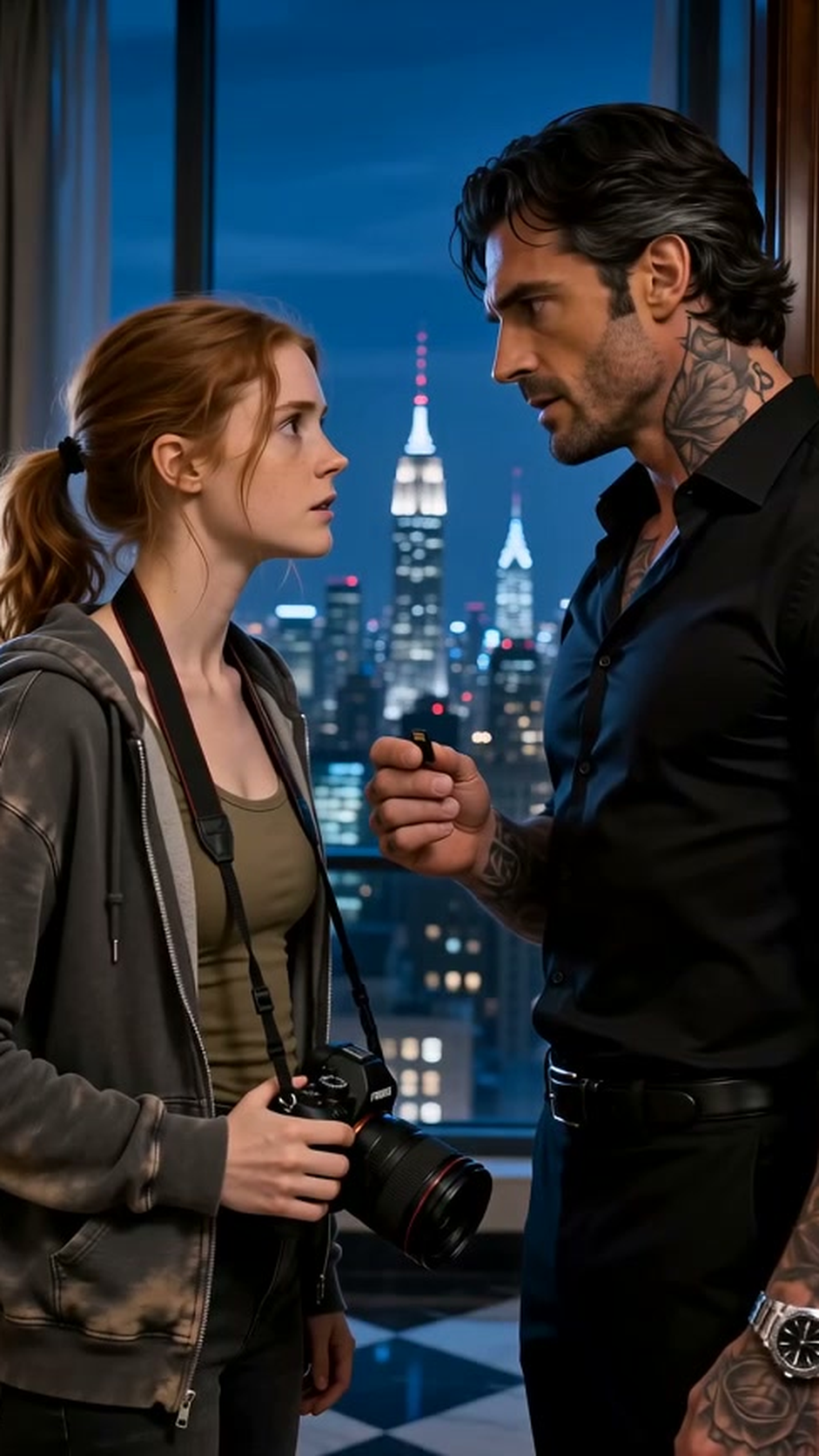
"Now," said Salvatore Kane, in her ransacked studio, at midnight, with all the patience of a man who has never once been refused a room, "give me Eddie's card, and this ends like a family matter."
Lily Carr sat at her own worktable with her camera between them like a centerpiece, and she did the bravest thing she had ever done with her hands, which was fold them, still and visible, in her lap.
"No," she said. "First you explain it to me. All of it. I'm the one who carried it up fourteen floors past your men, Mr. Kane. I'm the one your story is about now—planted girl, Castellano plant, whatever version wins. If I'm going to be the story, I get to hear it from the author." She kept her eyes on his face and her voice in the level register of every interview she'd ever coaxed out of a reluctant subject. "Why? That's the only question I actually have. You had everything. His trust. His father's name. Why?"
What she knew—and what Sal, in his vanity, had never once in sixty-eight years learned—was that nobody can resist a lens and a question at the same time. A lens alone makes men careful. A question alone makes them clever. But the two together make them authors, and authors cannot help themselves: they correct the record.
"You want to know why," Sal said at last, almost gently. "Because the family was dying of caution, child. Because my nephew—my brother's son, God keep him—has the instincts of a bank. Routes surrendered because the margin displeased him. Wars declined because the arithmetic was untidy. In my father's time the Kanes took. In my brother's time we held. In Damian's time we file reports." His hand—the watch hand—turned over on the table, palm up, a man showing you an old scar. "I sold him nothing that mattered. Schedules. A warehouse the feds were welcome to. And in exchange the Castellanos were going to let this family eat for another generation, under management that understood the times. I wasn't betraying the family, Lily. I was saving it from its heir."
"And Eddie Rusk?" she asked softly.
"Eddie Rusk was a clerk who forgot his place." The warmth went out of the room like a candle pinched. "He watched the watch—his own pathetic little joke, he said it to my face once, laughing, and I laughed with him and went home and arranged it. He was supposed to bring his suspicions to me, as family does. Instead he made his little film for the king. So the king's man got what clerks get."
"And the toast?" she said. "At the Table. In front of forty men. Your own nephew. Say it plainly, Mr. Kane. For the record."
Marco made a small sound. Sal silenced him with two fingers, without looking, the way you quiet a dog.
"You want it plainly." Sal leaned back in her broken chair and looked at her with something almost like respect. "Plainly, then. I arranged him a statesman's death. He would have stood. He would have toasted his house. He would have sat down among his peers with his dignity entirely intact, and been gone before the fish course, and half the men in that room would have wept at the funeral of a lion and voted—gratefully—for the steady hand that poured. It was a mercy, as these things go. I have seen the other kind. I chose him the kind one." He folded his hands. "And you—some waitress of a photographer, some nobody the agency sent—picked his death up off a carpet and carried it to him in your fingers, and now I am to be a villain in a story told by a girl in a torn-up room." His voice stayed soft, and that was the worst of it, the genuine grief in it. "Give me the card, Lily. Let an old man at least arrange the ending of his own—"
Marco's phone rang.
It rang in his jacket, shrill and ordinary, and Marco—who had faced down Rocco Bell's entire profession without blinking—went white to the lips as he fumbled it out and read the screen. In the same second, Sal's own phone began to buzz against the tabletop where he'd laid it, face down, at the start of the interview. And buzz again. And again.
In Lily's ear, small as a thought, Nadia's voice said: "They have it. All five families. Emilio's man just stood up in the Meridian library and walked out to make this call. It's over, Lily. Come home."
Sal was looking at the phones. He was looking at Marco, whose face was a confession all by itself. And then, slowly, the old man's gaze traveled—as Lily had known, in her bones, in her father's religion, that it would—from the phones, to her, and down, at last, to the camera sitting dark and patient between them on the scarred table.
"The whole time," he said. It wasn't a question.
"From the moment you sat down," Lily said. "The toast. Eddie. The warehouse. 'A statesman's death.' Five families just heard you say it, Mr. Kane—in your own voice, in a room you walked into of your own free will, explaining yourself to the planted girl." She stood up, slowly, because her knees had opinions, and she put the original card on the table between them and slid it toward him with one finger—the little black wafer, the whole burning center of it—and watched him stare at it like a man watching his own coffin being carried past. "Take it. It's a copy of nothing. Nadia made three copies before you ever left the hotel—you knew that, you watched her hands. The card was never the evidence. You were. You just needed a room quiet enough to confess in."
The studio door came open.
It did not come open the way doors open in raids. It opened the way it had opened at the start of all of this—inward, unhurried, on a man too big for the frame of it—except that this time the man in the doorway was pale as paper under one arm strapped to his chest, with Rocco Bell behind him and Dani behind Rocco and a tide of quiet professionals behind them, and Damian Kane looked past his uncle, past Marco, past the ruin of the room, and found Lily, and his whole face changed in a way that forty years of control could not stop and did not try to.
Marco's hand went into his jacket. He got it perhaps an inch toward the light before he understood what he was looking at—understood the phones, the door, the arithmetic of a finished war—and then, to Lily's astonishment, it was Sal who stopped him. Sal, who raised two fingers, the way he had by the sideboard, the way he had an hour ago in this room, and quieted his last soldier like a dog.
"Enough," Salvatore Kane said. "It's finished, Marco. Put your face back on. We'll be photographed leaving, and the Kanes—" something crossed his face that in another man would have been a smile and in him was a scar closing, "—the Kanes leave a room like gentlemen."
He rose. He straightened the cuffs of his overcoat, one fold, exact. At the door he stopped, and looked back at Lily one final time, and there was no hatred in it, which somehow was the saddest part of the entire war.
"Your father," he said. "The journalist. The one who ran toward things." Her blood stopped. "I read the papers in those days, child. I knew the byline. The apple—" he shook his head, once, almost admiring, "—the apple fell straight down."
Then he went out into the stairwell with his head high, between Rocco's men, and the building exhaled around them all.
The council sat at noon, twelve hours early, because five families had spent the night watching an old man confess in a photographer's studio and none of them saw any reason to wait for breakfast. Lily wasn't in the room. She would spend the rest of her life being fine with that. But Nadia was, with the files, and Emilio Castellano was, with the little blue book his own pharmacist kept, and Isabella was—sitting at her uncle's right hand in black this time, not red, while the Castellano house formally disowned its captain Vito, who was discovered, by dawn, to have taken a sudden and permanent interest in the olive harvest in Calabria.
The sentences, when they came down, were old-fashioned: names struck from the family rolls, offices emptied, fortunes disgorged into the common fund. Salvatore Kane was given a house above the sea in Sicily, a garden, a guard who was called a companion, and the rest of his natural life to contemplate the difference. Marco Delgado got a colder coast and a longer silence. The shooter from the Table—the mezzanine man, whose name turned out to be the least interesting thing about him—lived, and talked, and took his deal, and the story of the planted girl died in every library and bar where it had been born, killed not by denial but by evidence, which is the only way stories like that ever truly die.
And on the following Thursday, in a gallery in Chelsea with her name on the door in letters she kept having to re-read, Lily Carr opened her first solo exhibition.
She had called it One Second.
There were portraits of the city in it—doormen and senators, brides and bartenders, all the strangers she'd ever stopped for—and at the center of the main wall, printed six feet high, hung the skyline frame: the whole glittering miracle of Manhattan through the lounge glass, and at its edge, faint as a ghost in a double exposure, the reflection of a man with a phone raised, watching her. Most of the reviews called it a meditation on surveillance. Lily let them. She knew what it was. It was the second before her life changed, and she had taken it herself, by reflex, looking the wrong way—which was, when you thought about it, how every important photograph in history had ever been taken.
Jess came, unharmed and furious about the fuss, and ate eleven canapés and interrogated the foundation's director about the catering budget. Isabella Castellano came in jeans, with her hair up and no one presenting her, and stood in front of the skyline frame for a long time, and then commissioned a portrait—"Not the dress," she said. "The eyes. Like you do." Priya from the Meridian came, and wept discreetly into a napkin about the overtime.
And Damian Kane came at nine, when the room was thinning, in a dark suit with both sleeves occupied and the last of the bruising gone yellow at his throat, and he did a slow circuit of the walls like a man reading a book in a language he was teaching himself, and stopped, finally, beside her, in front of the big frame.
"The foundation's board approved your contract this morning," he said. "Photographer-in-residence. Two years. Your rate, your terms, your name on the work. Nadia has the papers. She made me promise to tell you the hazard clause was her idea."
"Tell Nadia the hazard clause is why I'm signing."
"I'll tell her you negotiated." He produced, from his inside pocket, a small envelope, and held it out with the air of a man returning something borrowed. "And this is yours. It was never evidence. Not this part."
Inside the envelope was a memory card. She knew it before she touched it—Eddie's card, the original, the little black wafer that had crossed a corridor and a war. That night, in her studio, with Jess asleep in the spare room Damian's people had guarded for a week and the new lock—the Kane-grade lock, installed without asking, which she had decided, after exactly one day of pretending to mind, not to mind—Lily slid it into her reader with hands that shook only a little.
One file. Not eleven. One.
It was a still frame from the Meridian's own corridor system, camera six, time-stamped 23:02—the hotel's record of the moment before its own six-minute amnesia: a penthouse door standing open, a big tattooed man filling it with an expression caught halfway between fury and fate, and in front of him a girl in a charcoal hoodie with a camera on her hip, holding up something small and black between two fingers, like a white flag. Like an offering. Like the first page of something.
"He kept it," she said that Saturday, in the suite—she had come up to sign the papers, and stayed for coffee, and neither of them had remarked on the staying. "Nadia. She saved one frame that wasn't evidence."
"She saved the frame that was the point." Damian stood at the wall of glass with the city doing its miracle below, in daylight now, in a world that had gone back to pretending it was ordinary. "Do you know what everyone told me to expect, that whole day? The foundation, my uncle, the Castellanos—one word, from all of them. I was to expect someone beautiful and glamorous at my door at eleven o'clock. It was practically in the contract." He turned, and the late light caught the side of his face that the video had left in shadow, and there was nothing guarded in it at all. "And the door opened, and there you were. Hoodie. Camera. My entire death held up between two fingers and a spine like a flagpole. I have been a careful man all my life, Lily. I've stopped arguing with the evidence. The evidence says the woman I was waiting for was the one standing in front of me the whole time."
Her eyes were doing something she refused to dignify with a name. She raised the camera out of pure self-defense.
"Find the second after," she said, a little thickly. "That's what my father always said. Don't take the picture everyone else is taking."
"And what is the second after, Miss Carr?"
She looked at him through the lens—the most powerful man she knew, standing in the wreckage of his old life with his heart, for once, exactly where his face could see it—and Lily Carr pressed the shutter on Damian Kane, laughing, for the first time in the whole long story, out loud.
"This," she said. "This is the second after."
***
Somewhere across the river, in a green-doored apartment in Brooklyn, a non-renewal letter still hung on a refrigerator for exactly one more day, until a photographer with a new contract, a new lock, and a story she'd never be able to tell came home and took it down, and put a photograph in its place: a doorway, a city, a girl with a flag in her fingers, and a man just beginning—just barely, just audibly—to laugh.
THE END