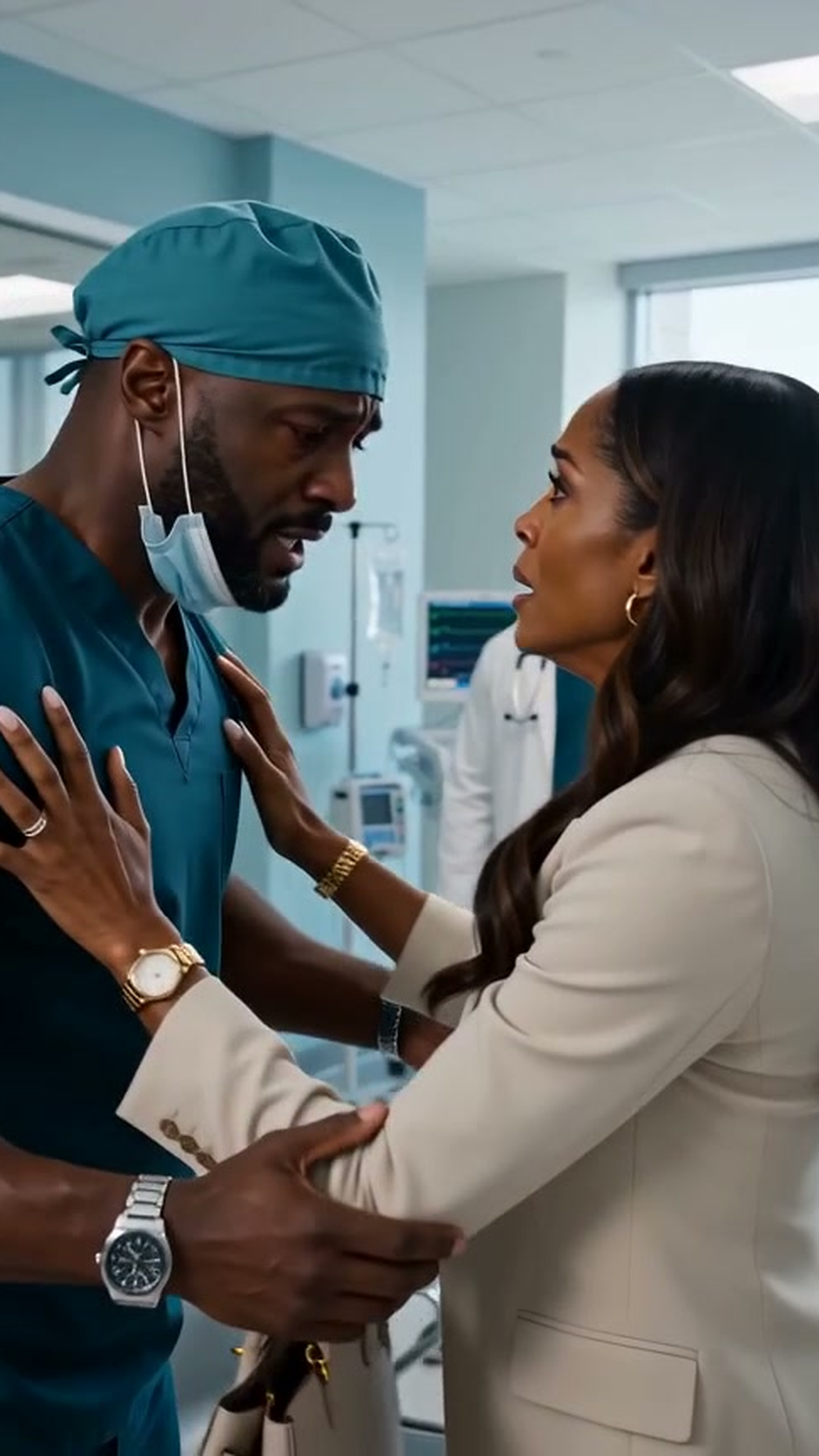
The board room had eleven chairs, and Marcus had counted them so many times in imagination that walking in felt like arriving at a place he'd already lived.
He had not expected to walk in with his wife's hand in his.
Naomi had refused, with a serenity that ended all discussion, to wait in the corridor. "I have been in the corridor for six weeks," she said, in the elevator, straightening his scrub top with both hands the way she used to straighten his tie. "I'm done with corridors, Marcus." Whitaker, arriving at a run with her briefcase and her composure in separate hands, took one look at the two of them — and at Denise Brooks, standing behind them with her folder — and made the fastest decision of her career. "The board can hear a family statement before it convenes formally," she said. "It's discretionary and it's unusual and I will trade every favor I own for it. Mrs. Brooks, when I nod — you talk. Tell them exactly what you'd tell a judge. Tell them the truth in your own words."
The board filed in — surgeons, an administrator, a radiologist with a tablet, the chief of surgery with his jaw set like a man bracing for weather — and the chairman, Dr. Osei, seventy years old and famously immovable, opened the sealed file and said the formal words, and the room went through the timeline in the language of pressure readings and imaging sequences. Three bleeds. Two controlled. The third — the radiologist put the images up on the wall screen, six weeks of strangers' scrutiny frozen in gray light — a defect so deep in the architecture of the boy's chest that it looked, even enlarged, even knowing, like nothing at all.
"Undetectable antemortem under trauma conditions," the radiologist said. "I've consulted two institutions. The word both used was *inevitable*."
"Dr. Bennett," the chairman said, "the committee notes — unusually — that this review was convened at your own request."
"Yes, sir."
"Why?" It was not in the script; Naomi could tell by the way Whitaker's pen stopped. Dr. Osei leaned forward over the sealed file with his reading glasses low on his nose, and his voice, when it came, was not the voice of an institution. It was the voice of an old surgeon. "In forty years I have read reviews requested by families, by insurers, by this hospital's counsel, and — twice — by men who had something to hide and hoped to be caught somewhere smaller. I have never once read one requested by a surgeon against himself on a case with no complainant. Dr. Bennett, the floor would like to understand what you wanted from us."
The room looked at Marcus. Naomi felt his hand tighten once around hers under the table, and then steady.
"I wanted to know if I killed him," he said.
Nobody wrote anything down.
"I have run that night maybe ten thousand times. I know what the experts say, I know what the imaging says, and none of it reaches the place the question lives. I needed people whose job is not to comfort me to weigh my hands — because if I did it, if there's a second I could have bought that boy with a different choice, then I owe his mother that truth and I owe this hospital my license, and I'll hand both over in this room. And if I didn't—" His voice thinned, and he made it continue anyway. "If I didn't, I need to hear it from somebody whose word is heavier than mine, because mine isn't working. I can't sleep in my house, sir. I can't sit at my own table. I requested this review because I am trying to find out whether I'm fit to be believed — by a jury of the only people qualified to say. That's what I wanted from you."
Dr. Osei regarded him for a long moment. Then he took off his glasses, folded them with great precision, and said something that Whitaker later claimed she would deny under oath if quoted, because chairmen of peer review boards do not say such things inside the record:
"For what it is not worth, Doctor — the fact that you are sitting in that chair, asking that question, is data too. And this committee does not ignore data."
"You understand that the preliminary finding—"
Whitaker nodded.
Denise Brooks stood up.
She was not a tall woman, and she was not a practiced speaker, and her hands shook so hard on the folder that the papers inside it whispered. But she had buried a son and fixed, with her own hands and a borrowed surgeon, a porch rail her boy had promised to fix, and there are credentials no board can issue and none can take away.
"My name is Denise Brooks," she said. "Jaylen Brooks was my son. He was seventeen. He liked his eggs scrambled hard and he was going to be an engineer and he is dead, and I have come here to tell you about Dr. Bennett, because I understand you may be deciding something about him today, and I am the only person in this room who was *owed* something by that night, so I figure my account ought to be in the record."
The room was very still.
"He told me himself. Sat right down. He didn't send a nurse or a chaplain, he came with his hat in his hands and he told me my baby was gone, and he answered every question I asked, including the ones that were just screaming with words on them. Then, when the funeral home talked money, it turned out it was handled. I didn't know by who. I run a register at the Dollar General and I clean offices at night, and my son got a stone with his name spelled right and flowers, and it was *handled*, and I found out from my cousin who works in billing at the funeral home that the man who handled it was the surgeon. And every Thursday since — every Thursday, rain or not — that man has come to my house and fixed my porch rail and my gutter and the step my mother broke her hip on in 2019, and he sits and he lets me talk about Jaylen until I run out, and when I run out he says *tell me the one about the science fair again*, and I have never — " Her voice went, but her chin didn't. "I have never once heard that man make an excuse. Not one. Not to me, who he could have made a hundred to. So whatever your papers say — my paper says this. My son died of something God hid in his chest. He did not die of Dr. Bennett. And if you take that man's license, you will not be punishing him for my boy. You'll be punishing every boy who comes after, for a flaw in the making of the first one."
She sat down, abruptly, as if her legs had filed their own verdict, and Naomi — who had known this woman for less than an hour — reached across Marcus without thinking and took Denise Brooks's hand, and held it through everything that followed.
It was not a long deliberation. The board was out for nineteen minutes. When they returned, the chairman read the finding in the flat, formal cadence of institutional mercy: no negligence; no deviation from the standard of care; the death of Jaylen Brooks attributable to a congenital defect incompatible with survival of the injuries sustained; the committee's additional commendation — and here Dr. Osei looked up from the page, directly at Marcus, and the formality cracked just slightly — "for the surgeon's conduct toward the family, which this institution will not detail in a public finding, but which it does not wish to leave unmentioned either."
Whitaker closed her eyes like a woman whose parachute had opened. The chief of surgery exhaled six weeks in one breath.
Marcus sat perfectly still with his hands flat on the table, and Naomi watched the verdict land on him and keep landing, the way rain keeps landing after the roof stops leaking — because clearance, she understood, was not the same thing as forgiveness, and the man who had requested his own judgment had never actually wanted to be *acquitted*. He had wanted to be *weighed*. It was the wanting that was the wound.
In the corridor afterward, in the returning noise of the hospital — trolleys, voices, a monitor beeping its ordinary beep — Denise hugged him, hard, the way you hug a fence post you're determined to keep standing, and said, "Thursday. The gutter on the north side. And bring her," with a nod at Naomi that was half order, half adoption. "She's got the right hands for holding things."
Then she was gone, into the elevator, with her folder against her chest.
For a moment neither of them moved. The corridor went on being a corridor around them — a porter with a mop, a resident laughing once at something at the far end, the ordinary machinery of the hospital resuming its shift as if a man's whole life had not just been weighed in a room with eleven chairs. Naomi looked down at their joined hands, his surgeon's fingers still locked around hers hard enough to leave marks, and loosened them one by one, gently, the way you unclench something that has held on too long to know it is allowed to stop.
David was waiting by the nurses' station with the lunch bag.
He had carried it through the whole afternoon — through the corridor confrontation, the elevator, the hearing's long hour, all of it — this crumpled brown paper bag with a ruined pie in it, held first like evidence and then like an infant and finally, unmistakably, like a relay baton he had been appointed to deliver. He held it out to Naomi with both hands and the air of a man returning a hostage.
"I picked it up off the floor," he said. "The sandwich survived, somehow. The pie did not. I—" He stopped, and the composure that had carried him through six weeks of corridors abandoned him all at once, and David Carter, who had cried in front of her that morning out of guilt, cried now out of something perilously close to joy. "I made him a bet in medical school. Did he ever tell you? I bet him fifty dollars he'd be married and divorced by thirty-five, because nobody could live with a man that incapable of asking for help." He wiped his face with the flat of his hand, unembarrassed, in front of the whole station. "I have never been so glad to lose fifty dollars in my life. Don't let him carry anything alone again, Naomi. He will try. It's a reflex, like breathing. It's your job to stand in the doorway with the bag."
"I intend to," Naomi said, and took the bag, and found — because the day was not finished dismantling her — that the little folded note was on top, smoothed flat by somebody's careful hands. David's, probably. Or a nurse's. The whole hospital, handling her love letter like a fallen flag.
*You don't have to take care of everyone. Let me have a turn.*
"He read it?" she asked.
"Three times," David said. "Standing right where you're standing. Then he folded it like it was made of glass and went in to face the board."
"Whitaker." Marcus stopped the lawyer at the station, and his voice was hoarse and his eyes were on his wife. "The fund. I want Naomi's name on it as co-founder, and I want it announced properly — not buried in a newsletter."
Naomi frowned. "What fund?"
Whitaker looked at Marcus with the exhausted tenderness of a woman watching a client finally do the only healthy thing available to him. "Ah," she said. "He hasn't told you about the fund."
And Marcus Bennett — cleared, commended, and forty pounds lighter in the soul than he had been at breakfast — took his wife's hand in a hospital corridor for the second time that day, and said the sentence that six weeks earlier would have cost him everything he was afraid of:
"There's one more thing I never told you. Come home, and I'll tell you all of it — every last thing — in our own kitchen, where I should have told you the first night."