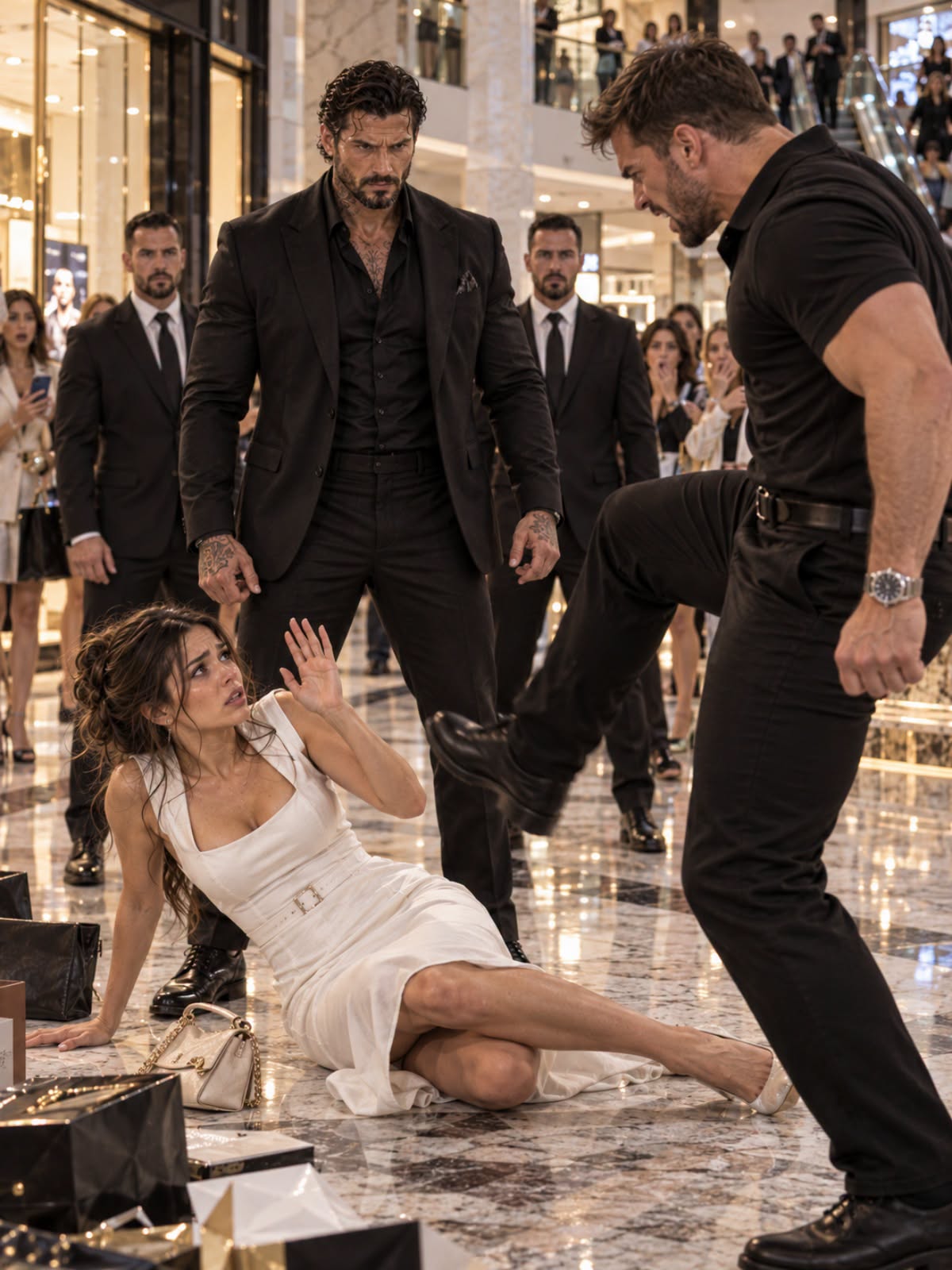
The last thing Trevor saw of me before security arrived was me standing.
I want that written down, because the camera footage tells a different story — a woman's knee folding under a kick, her body hitting polished marble, a coffee cup exploding brown across the floor like something from a crime scene. But the footage doesn't show what happened after, when the room tilted and the pain arrived in a white wave and I heard Roman's voice cut through the noise, flat and cold as a blade being drawn, saying, "Touch her again."
Trevor never touched me again.
That's the part I want written down.
The emergency clinic smelled like industrial disinfectant and old coffee, and I hated every second of the fluorescent lights humming over my head. Roman sat beside the exam table with his hands folded, platinum wedding band catching the light, tattooed fingers still, and he watched the doctor's hands the way other people watch approaching weather — calculating, certain it would turn bad.
The doctor — young, efficient, already a little afraid — wrapped the blood pressure cuff around my arm and said, "Let's start with—"
"Walking?" Roman said.
The doctor blinked. "Excuse me?"
"Walking," Roman said. "Tonight. Will she walk."
This was how Roman handled fear. Other people fidgeted or cried or called someone to talk them through it. Roman turned it into a briefing.
"She can walk with support," the doctor said carefully. "Limited tonight. She needs to stay off—"
"Permanent damage?"
"Highly unlikely."
"Pain?"
"Moderate, I'd say. Manageable with—"
"Medication?"
"I can prescribe something—"
"I'll take the details of that in a moment." Roman's eyes never left the doctor. "Brace?"
"A stabilizing brace for the knee. Several days, at least."
The doctor glanced at me, then back at Roman, then said with the exhausted courage of a man who had clearly dealt with worse patients and worse fathers-to-be, "She can answer too."
"Apparently I'm still conscious," I said.
"I noticed," the doctor said, and smiled at me — a small, conspiratorial smile that said we're in this together — and for the first time since my knee folded under Trevor's shoe, something in my chest loosened.
Roman's mouth twitched. Almost a smile. Almost.
The X-ray came back clean — no fracture. The doctor pressed his fingers along the curve of my knee and calf with gentle precision, and I learned the anatomy of what Trevor had done: deep bruising, a swelling knee, a minor ligament strain, the kind of damage that heals if you respect it and festers if you don't. "Ice. Elevation. The brace for several days," the doctor said. "Call if the swelling gets worse."
"I should've broken his leg," Roman said on the drive home, the city sliding past the tinted windows in ribbons of light.
"We've been over this."
"His wrist."
"No."
"Two fingers?"
"Roman."
"One finger."
I laughed — a short, surprised sound that hurt my ribs more than my leg — and then I looked at him and realized he was entirely serious. He was genuinely sitting there calculating which bone to take as an offering to the universe for what had happened to me.
That is the thing nobody tells you about Roman Vale. He terrifies rooms. I have watched board members go pale when he goes quiet. I have watched men twice his size find urgent reasons to be somewhere else. But he has never once raised his voice at me. Never. His calm is terrifying to everyone except the one person it was built for, and I have decided, over two years of marriage, that this is my greatest accomplishment in life — bigger than anything else, because it was never the loud thing that mattered. It was the fact that he chose not to be loud with me.
Home smelled like the expensive candles I buy and the rain that had started somewhere over the hills. Arthur helped me to the couch — gently, like I was something expensive — and Roman stood in the middle of the living room with his hands in his pockets, looking at me the way he'd looked at the doctor: calculating, certain something would turn bad.
"You could have let Arthur stop him earlier," he said.
"I wanted to handle it."
"You were on the floor."
"I got up."
"He assaulted you."
"I know."
A pause. The rain whispered against the windows.
"That's not what's actually bothering you," I said.
He didn't answer. His jaw worked. Roman Vale, who could reduce a hostile board to silence with a look, stood in our living room unable to form the sentence.
"I'll say it for you," I said. "It bothers you that you couldn't control it. That for thirty seconds you weren't there, and something happened to me, and there was nothing — no money, no security, no phone call — that could have changed it. Power protected you for so long that the things you can't control feel like failures."
"Come here," he said, and his voice had dropped to something rough underneath the calm.
I stood — carefully, brace and all — and crossed the room to him. He folded me against his chest with the precise gentleness of a man handling a bomb, and I felt his heartbeat through his shirt, fast, too fast for Roman, who was never too fast for anything.
"You arrived," I said into his shoulder.
"Too late."
"You arrived before the second time."
"You have unreasonable standards."
"For you? Always." I pulled back just enough to see his face. "Roman. I spent most of my life without bodyguards. I walked home from the diner at two in the morning through streets where the lights were broken. I don't want to become someone who thinks safety means never standing alone."
He looked at me for a long moment — that flat, unreadable stare that made strong men nervous — and then something in him gave, the way ice gives in the first warm hour.
"You gave me something Trevor never did," he said quietly.
"What?"
"Choice."
The word sat between us like a hand on a table — offered, not taken.
Roman entered my life on a Tuesday at table twelve.
Black coffee, no sugar. Eggs over medium. Toast burned slightly — not ruined, just past golden, the way people who've eaten in diners their whole lives like it because it reminds them of their mother's kitchen. I remember because I have the kind of memory that files things away: the way some people remember birthdays, I remember orders.
He was cold coffee and a complaint. "This is cold," he said when I set it down, and I said, "You ordered it five minutes ago, it was hot when I—" and he looked at me with the five-second stare that I would later learn had ended careers, and I finished the sentence anyway because I was twenty-four and stupid and I refused pity.
The second day was worse. The coffee sat untouched while he talked to someone on the phone in a voice so low I could only catch the rhythm of it, and when he finally drank it, he said, "Cold again."
"Then learn to make your own," I said.
Another five-second stare. Longer this time. The armed men three tables behind him — I had noticed them, of course; I wasn't blind, they were just furniture, like the jukebox and the pie case — shifted slightly.
Roman left a hundred-dollar bill on a fifteen-dollar check.
I chased him to the sidewalk. The bell over the door was still jingling when I caught up to him.
"You forgot this."
"I didn't."
"You paid fifteen dollars."
"I know."
"Then this is ridiculous."
"Keep it."
"No."
"You refuse money?"
"I refuse pity."
The next day, the tip was exactly twenty percent. To the penny. I respected that more than the hundred dollars — the hundred was a power move, and I knew it, and he knew I knew it. The twenty percent was an apology, and that took more.
Months of ordinary talk followed. The weather. Books — he read everything, crime novels and history and, once, a poetry collection he claimed was "research." Terrible music — we agreed on this one easily, his taste being, in my professional opinion as a woman who worked in a diner with a jukebox, criminally bad. He never asked about my two jobs. I never asked about the men three tables behind him. We had an unspoken agreement that the space between table twelve and the counter was a country with its own laws, and neither of us would invade the other.
What he didn't see — what Trevor never saw — was what the rest of my life looked like. Trevor left that winter. He left with the kind of casual cruelty that's worse than the loud kind: he just stopped trying. Stopped calling. Stopped pretending the waitress with the college degree she couldn't afford to use was worth the effort. I missed three shifts at the diner in the weeks after, sitting in my apartment staring at the wall, and then I lost the apartment — the eviction notice taped to my door like a verdict — and I understood, finally, what it meant to be completely alone in a city that did not care.
The diner's landlord announced redevelopment that same spring. Condos, probably. Something glass and soulless. Maria Velasquez — my coworker, single mother, the only person in that kitchen who knew I was running on four hours of sleep and spite — squeezed my hand and said, "We survive. We always survive."
The new owner called a meeting. A man in a suit that cost more than our entire year's tips stood in front of the grill and said the lease had expired and the building was being sold, and I remember the grease smell and the way Maria's hand went white around the dish towel, and I said — because someone had to — "You're evicting us?"
"The lease expired."
"People work here."
"People work everywhere."
I recognized the voice before the face. It was table twelve. It was five-second stares and exactly twenty percent.
I hated him for three days. A clean, righteous hatred, the kind that feels good going down. And then I learned — from the new manager, from the other servers, in the way news travels through a diner kitchen like a gas leak — that he had offered every single employee a job at his other properties. Better pay. Real benefits. The kind of package people cry about in break rooms.
Everyone took it except me.
He called me into what used to be the manager's office, and he looked annoyed in a way I'd never seen — the five-second stare was gone, replaced by something almost human — and he said, "Why did you refuse."
"Because you didn't ask me," I said. "You announced. You decided. That's what people like you do — you decide, and the rest of us get to be grateful."
"People like me."
"People with buildings."
He laughed. It startled both of us, I think. The laugh of a man who hadn't done it in a while.
That was the beginning of the friendship, and then — slowly, the way weather changes and you only notice when you need a coat — it was more. He told me, one night in his car after the dinner rush, the truth about his family: that they'd built their power through violence decades earlier, that the name Vale carried history he didn't choose, that he operated in the narrow space where the law and loyalty weren't always the same thing. He said it flatly, without self-pity, watching the road.
I almost walked away. I had my hand on the door handle.
"If you need to," he said, "you should."
That's when I trusted him. Not the confession — the permission. He gave me the door and didn't block it.
Trevor came back that month, the way exes do when they smell happiness like sharks smell blood. He begged forgiveness. He cried. He swore he'd changed. And then, within a week, the cruelty returned — the small cruelties, the ones he thought didn't count: correcting me in front of friends, "forgetting" to pick me up, the way his voice changed when he was tired.
Roman never said a word against him. He just showed me, day after day, what it looked like to be treated like someone whose choices mattered. And one night, lying awake in my new apartment — the one Roman had helped me find, not given me, never given me, because he understood the difference — I finally saw it. Trevor wasn't offering me a life. He was offering me a cage with better furniture.
I was choosing. That was the whole of it. I was choosing.
City hall. Four witnesses — Maria cried; Arthur pretended not to. Blue dress, because white felt like a lie and I was done with lies. Roman forgot his vows — he'd assumed they were optional, which I have teased him about for two years and will tease him about until we are old — and the judge said, "You may kiss the bride," and he did, carefully, like I was something he'd waited a long time to be allowed to touch.
I woke to Arthur's voice in the hallway, low and urgent, and the particular quality of light that meant morning had arrived without asking my permission.
Arthur stood in the doorway holding his tablet the way bomb technicians hold questionable packages.
"We have a problem," he said.
Roman was already up, already dressed, already calm — Roman had a setting for mornings that involved other people's emergencies, and it was prepared. "Show me."
Arthur handed over the tablet. Roman read. His face didn't change. It never changed, which is how you knew it was bad.
"How bad," I said.
"The mall video passed ten million views overnight," Arthur said.
I stared at him. "Ten — that's not possible, it was just — last night—"
"The internet moves fast when it's angry." Arthur swiped. Headlines filled the screen, ugly and bright:
LAWYER KICKS WOMAN IN LUXURY MALL—THEN HER HUSBAND ARRIVES
PARTNER AT BRADFORD & KELLER CAUGHT THREATENING EX-GIRLFRIEND
WHO IS SADI VALE?
"Who is Sadi Vale," I repeated. "That's a headline now."
"They found old photos," Arthur said. "High school yearbook. The diner uniform — someone from the neighborhood posted it. Your driver's license photo. The eviction notice." He paused. "Trevor's social media. Old posts."
Roman took the tablet and set it face-down on the table with the careful precision of a man disarming something.
"No intimidation," he said.
"I wasn't going to intimidate anyone," Arthur said.
Arthur coughed. Arthur studied the wall with great interest.
Roman's phone rang. He answered on the second ring, listened for thirty seconds, said "Understood," and hung up.
"Trevor's firm suspended him," he said. "Bradford & Keller issued a statement. Internal review, effective immediately. No mention of me by name."
"You asked for privacy," I said. It wasn't a question.
"I asked for privacy," he confirmed. "For you. The firm agreed — they're terrified enough of the publicity without adding my name to it."
I sat with that. Ten million views. Headlines. My face — my high school face, my diner face, my worst year — passed around by strangers.
Three years ago, I fantasized about this. I would lie awake in the apartment with the eviction notice on the door and imagine Trevor losing everything — the firm, the reputation, the smug certainty. I rehearsed it like a prayer. Let him know what it feels like.
"And now?" Roman said quietly, reading my face the way he read everything.
"Now it feels…" I searched for the word. "Small."
"Small."
"Revenge occupied space when Trevor still mattered. It was a room I kept furnished in my head. But he's — " I gestured at the tablet, at the headlines, at all of it. "He's just a man who kicked a woman in a mall. The room's empty now. I don't want to live in it anymore."
Roman looked at me for a long moment, and then he did something he almost never did in front of Arthur: he came and sat beside me and took my hand, the brace on my knee between us like a small white flag.
The gate intercom buzzed.
Arthur checked his phone. His eyebrows went up — Arthur's version of a gasp. "Chloe Mercer is at the gate."
Roman's expression flattened. "No."
"Let her in," I said.
"No."
"Roman."
"She tried to stop him." I stood, carefully. "She contradicted him in front of the police."
"You're doing the control thing."
"I am protecting you."
"Choice."
A pause. The rain had stopped; the morning was doing that clean, bright thing it does after.
"Five minutes," he said.
"Ten."
"Seven."
"Fine."
Chloe Mercer arrived transformed, and I almost didn't recognize her.
I'd seen her before — at Trevor's side in photographs, at charity events in the society pages, always polished to a high shine: the hair, the makeup, the kind of dress that said I belong here. The woman who stepped through our door wore jeans and a sweater. No makeup. Her hair pulled back like she hadn't had the energy for anything else.
She was holding an envelope. Both hands. The way you hold something that might detonate.
"I ended the engagement," she said. No preamble. No hello. "I should have done it before yesterday."
"You didn't know," I said.
"I knew enough." Her voice was steady, but her hands weren't. "Trevor gets angry."
Something in my chest recognized the rhythm of those three words — the careful neutrality of them, the way you say it when you're testing whether the person across from you will flinch or nod.
"He never hit me," Chloe said quickly.
"Throws things?" I asked.
"Sometimes."
"Blocks doorways?"
"Yes."
"Checks your phone?" A nod. "Explains afterward that you made him angry?"
Tears now, silent, tracking down the un-made-up face. "Yes."
I sat down on the couch and patted the cushion beside me, and she came — carefully, like a stray — and I thought: different woman. Same architecture. The same house built on the same foundation, and I knew every room in it because I'd lived there once.
"Why are you here, Chloe?"
She held out the envelope. "Because yesterday, watching him kick you, I realized — " Her voice broke. "I realized it was never going to be different. It was only ever going to be a matter of time."
Roman took the envelope. Arthur was already moving, already in motion the way security men are when something shifts from social to operational. Roman opened it.
Bank statements. Client files. Payment records. Handwritten names in a neat, unfamiliar hand.
Arthur leaned over Roman's shoulder. "Run these companies," Roman said quietly, and Arthur was already photographing pages with his phone, already sending.
One name repeated. Northstar Consulting. Monthly transfers, regular as a heartbeat.
And then a name I knew. Maria Velasquez.
I went very still. "What does it say about Maria?"
Roman's eyes scanned the page. "Immigration dispute. Trevor represented her. Pro bono — 'for free.'" He looked up. "Twenty-eight thousand dollars moved out of her settlement account."
"Maria didn't have twenty-eight thousand dollars," I said. My voice sounded far away. "Maria had — she had the diner, and her kids, and a landlord who — she didn't have—"
"More names," Arthur said, flipping pages. "All modest incomes. Legal aid referrals, mostly. Settlements — small ones, a few thousand here and there — and then money leaving the accounts after the cases closed."
Roman went very cold. I knew that cold. It was the cold from the mall, the cold that had made Trevor take a step backward.
"He's stealing settlement funds," Roman said.
"You're sure?" I asked.
"Not yet." A pause. "Arthur. Northstar is a mailbox. Beneficial owner hidden through two LLCs." Another pause. "Have legal trace it. Quietly."
"Already on it," Arthur said, and left the room with his phone to his ear.
Silence. Chloe sat with her hands twisted in her lap, crying quietly, and I put my arm around her shoulders and felt her shake — the particular shaking of a woman who has just burned her old life down and hasn't decided what to build in its place.
"What do we do?" Chloe whispered.
Roman looked at me.
Not at Arthur. Not at Chloe. At me.
And I understood, with a clarity that felt like the morning light through the windows, what he was doing. This was mine. The choice was mine. He would burn the world down or he would call the lawyers or he would do nothing at all — whatever I decided, he would make it happen. But the deciding was mine.
Yesterday, Trevor had been exposed in public — ten million people watching him kick a woman in a mall. Today was going to expose what he did in private — the quiet thefts, the small accounts, the women who trusted him because he wore a suit and said I'll help you for free.
And I realized, sitting there with Chloe's tears on my shoulder and Roman's eyes on mine, that I didn't need Roman to destroy Trevor.
Trevor had been destroying himself for years. Methodically. Patiently. Stealing from the people who trusted him most, one settlement at a time, building a collapse so thorough that no one would need to push him.
All I'd ever done was stop protecting him from the truth.
"We call the police," I said. "And the state bar."
Chloe looked up. Roman nodded once — the smallest movement, a king receiving orders.
And somewhere across the city, in an office that was already emptying his name off the door, Trevor had no idea that the woman he'd kicked in a mall was about to become the least of his problems.