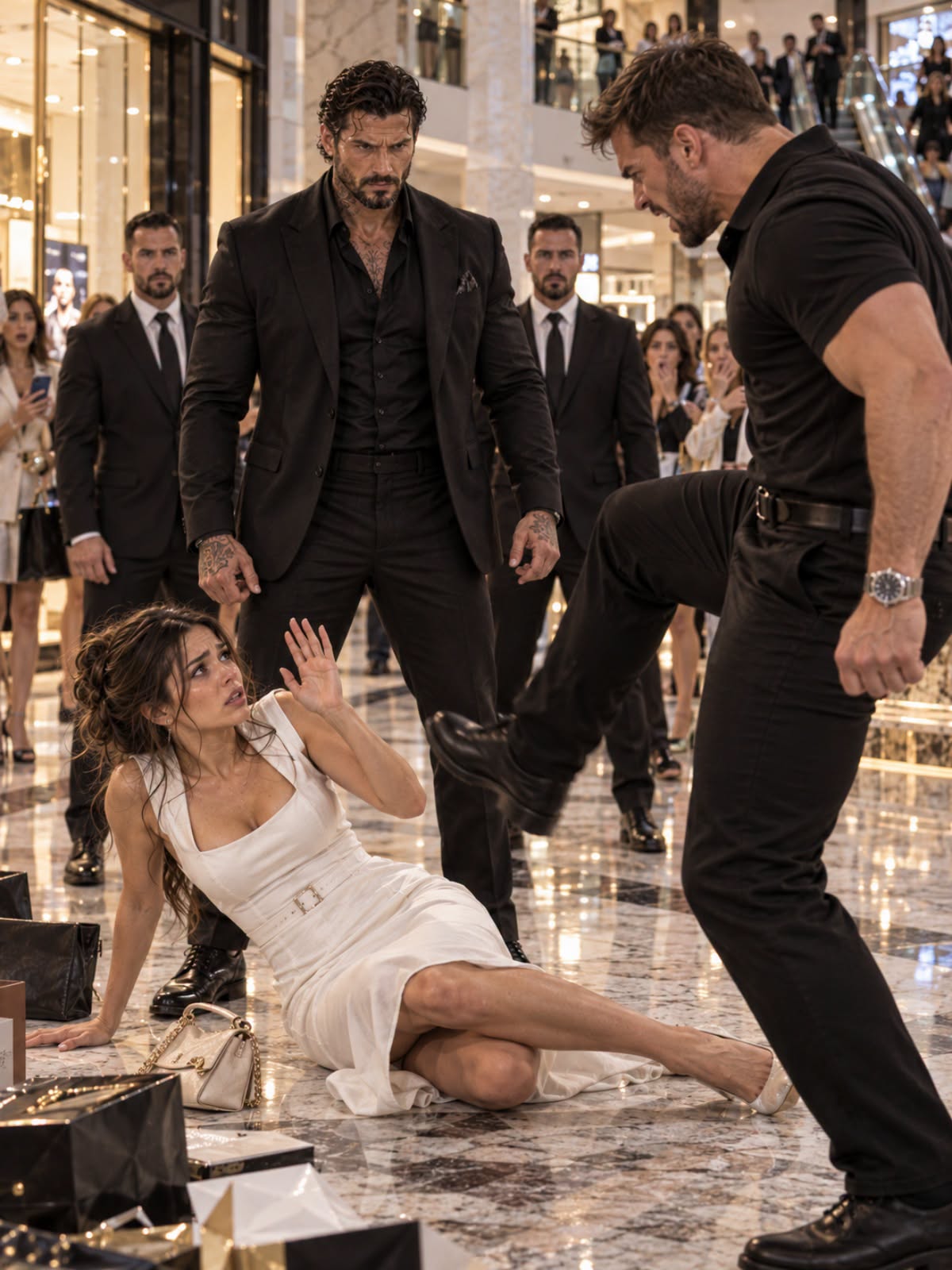
The morning she went back, Sadi woke before the alarm and lay still in the dark, listening to Roman breathe. Five years. Five years since a man's boot had caught her ribs on the cold marble of the Galleria and the entire city had watched it happen on a phone screen. She could still feel it sometimes — not the pain, which had faded into a ghost she only noticed on rainy days, but the floor. The specific, humiliating cold of the floor against her cheek.
She didn't wake Roman. He had a board call at seven and she had no intention of telling him where she was going until it was too late for him to stop her — exactly the kind of reasoning that had kept them married for five years.
Twenty feet behind her, the entire way across the parking garage and through the Galleria's side entrance, walked Arthur.
This, too, was part of the marriage.
They'd had the fight — the real one, not a spat — about three years ago, when she went to the farmers' market alone and he found out via a security camera instead of from her.
"I was buying tomatoes," she'd said. "Not smuggling diamonds."
"You are worth more than my buildings," he'd said, terrifyingly calm, the way he was about everything that actually frightened him. "You don't get to be casual about it."
"And you don't get to assign me a bodyguard like I'm luggage."
"I'm not transformed into an optimist, Sadi. I compromised."
The compromise, after two days of cold war that had genuinely alarmed the housekeeper, was this: Arthur would follow her at a distance of twenty feet. No closer, no conversation unless she initiated, and he was to be — Sadi's exact word — "invisible." Arthur, a former special forces man the size of a door, being invisible was the funniest thing Sadi had ever heard, and she told him so weekly.
"Marriage means tolerating each other's irrational habits," Roman had declared, as if reciting a law.
"You invented that rule," she'd accused.
"Yes," he'd admitted, without shame. "I admit it."
"That's not how rules work."
"It is now."
She'd allowed Arthur. Roman had allowed her to stop texting him her location every hour. Everyone was furious and nobody was dead, which by their standards was peace.
The boutique was almost unchanged. Glass displays, low warm light, the same cedarwood scent that had once made her feel like an intruder in a temple. Different staff — the girl from that day was long gone, probably fired or promoted, Sadi never asked. She stepped inside and stood on the exact square of tile where she'd fallen.
And it hit her — a full-body physical memory, faster than thought: cold seeping through her blouse, Trevor's voice rising sharp in the chandeliered quiet, her knee striking tile, dropped phones ringing on marble, strangers' hands doing nothing — and then Roman's hand, appearing at the edge of her vision like it had been there all along.
She braced for sadness. It didn't come.
She smiled. Genuinely, involuntarily, the way you smile at a scar you forgot to hate.
"Can I help you?" asked the saleswoman.
Sadi turned. "Yes." She pointed at the cufflink case. "Those."
The woman opened the glass. "A gift?"
"My husband keeps pretending he dislikes them."
The saleswoman's eyebrows rose a fraction. "Then why buy more?"
"Marriage is complicated."
She chose a different pair from the rhodium ones he'd worn all these years — black onyx, square-cut, still understated, still exactly the kind of thing a man like Roman would pretend not to want. She paid without trying them on herself, which was the entire point, and slid the small box into her bag.
Near the entrance, a young woman was standing in front of the handbag display. Mid-twenties. Cheap coat, worn shoes, the particular posture of someone trying to take up less space than physics requires. Sadi knew that posture the way you know a language you grew up speaking.
A sales associate drifted toward the girl — smiling, but with the kind of smile that had a camera behind it. "Can I help you?"
"I'm just looking."
The girl lingered. Her shoulders pulled inward, old instincts, old shame, the whole private arithmetic of a woman who has already decided she doesn't belong here and is waiting for the room to confirm it. Sadi recognized it so completely it felt like being looked at in a mirror from ten years ago.
Sadi walked over. "That bag is beautiful."
The girl startled. "Sorry?"
"The brown one." Sadi nodded at the display. "I've been staring at it too."
The associate's expression shifted — suspicion dissolving into professional warmth now that a paying customer was part of the tableau. Sadi hated that. She hated that she'd ever been the girl on the wrong side of that arithmetic, and she hated that the girl knew it.
"I'm waiting for a job interview upstairs," the girl said, a little defensively, a little proud. "I came early because I didn't want to be late."
"Smart," Sadi said.
"Do you work around here?"
"Not exactly." Sadi reached into her bag. "I run a nonprofit."
"What kind?"
"Legal advocacy." A nervous laugh escaped the girl. "I might need that if this interview goes badly."
"Hopefully not." Sadi handed her a card. "Keep it anyway."
The girl read it. Her eyes widened. "Sadi Vale?"
"Unfortunately."
"You're the woman from that video."
"Long time ago."
"My mom showed me."
"Why?"
"She was leaving my stepdad." The girl's voice softened at the edges. "She said watching you stand up after that guy kicked you made her realize she could leave."
Sadi's mouth opened. Nothing came out. Five years of conferences and galas had taught her to absorb applause like weather. This was different. This was a stranger in a cheap coat in a boutique Sadi had once bled in, telling her that getting up off a cold floor had been enough.
"Is she okay?" Sadi managed.
"Yeah." The girl smiled — a real one, the first of the conversation. "She's really okay."
Something lodged in Sadi's throat. She swallowed it. "Tell her I said hi."
"I will."
The girl left for her interview, shoulders a fraction straighter than before. Sadi stood motionless among the handbags for a full minute.
"You okay?" Arthur said from twenty feet away, closer than twenty feet, because of course he was.
"Yes."
"Need Roman?"
"Always," Sadi said, and meant it in a way she didn't bother explaining.
She was home before sunset. The house — their house, though she'd never once called it a mansion to his face — sat quiet in the late light. She found Roman in his study, the one room she'd been forbidden to redecorate, which still smelled of leather and his particular arrogance.
He looked up over reading glasses he would deny needing until the day he died.
"You're wearing the old cufflinks," she said.
"They happened to be available."
"You've worn them twelve times this year."
"You count?"
"Yes."
"Disturbing."
"Close your eyes."
"No."
"Roman."
"I know you."
"Close them."
He obeyed — reluctantly, dramatically, like a man disarming a bomb — and she placed the new box in his palm.
"What is this?"
"Anniversary gift."
"Our anniversary isn't today."
"Mall anniversary."
"You commemorate being assaulted?"
"I commemorate meeting the version of you who learned not to commit felonies for me."
"I was already learning."
"Slowly."
He opened the box. The onyx cufflinks caught the lamplight, dark and gleaming.
"I like the other pair," he said.
Sadi gasped, theatrically. "You admitted it."
"I said no such thing."
"You absolutely did."
"Unrecorded conversation."
"I have witnesses." She raised her voice. "Arthur!"
From the hallway, without missing a beat: "I heard nothing."
Roman looked smug. Sadi stared at the hallway.
"Cowards," she declared. "Both of you. Cowards."
Dinner was on the terrace. Roman had cooked — successfully, mostly: the salmon was edible and nothing had caught fire. Five years of marriage had not made him a chef. It had made him a man willing to stand in a kitchen in an apron, because even aprons, he'd decided, were beneath comment.
Second Chance was in four cities now. Maria Velasquez directed the victim advocacy arm with a competence that had made Sadi cry exactly once, at the ribbon cutting, in front of forty people, which Roman still brought up whenever she called him the emotional one.
Chloe Mercer had remarried — a gentle schoolteacher named Daniel who was visibly terrified of Roman and visibly devoted to Chloe, and Roman had shaken his hand at the wedding and said, very quietly, "She deserves gentleness. So does she know you'll give it," which Daniel had repeated to Sadi later with the air of a man quoting scripture.
Trevor had never returned to law. He worked at a nonprofit — housing advocacy, unglamorous, real. He sent one letter a year to Second Chance, addressed to the organization, never to Sadi. He was sober. He was employed. He was, by all accounts, a different man than the one who'd raised a boot in a jewelry boutique. Sadi wished him well from a distance, the way you wish good weather on a country you never plan to visit again.
Victor Marchetti was serving a long federal sentence. The details didn't matter. What mattered was the silence where his name used to be.
Roman's old criminal partners were gone — not literally, Sadi always clarified, because Roman's face did a specific thing when people assumed literally. They were gone through sales and prosecutions and retirements and the slow, unglamorous distance that legitimate money buys. Vale International was, by every measure Sadi cared about, boring. Magazines praised his transformation. He pretended to hate the word transformation. Sadi told him regularly that boring was his greatest victory, and watched him try not to look pleased.
After dinner, Roman stood with his hand in his pocket in a way she recognized.
"What did you buy?" she asked.
"Nothing."
"That means something expensive."
He pulled out a folded paper, soft with age, and set it on the table between them. She unfolded it.
It was a photocopy of the diner receipt. Table twelve. Black coffee, eggs, toast. A twenty percent tip — the first tip she'd ever accepted from him, back when she'd been a waitress and he'd been a man she was determined not to need.
"You kept this?" she said.
"Yes."
"Why?"
He looked, for the first time all evening, genuinely embarrassed. "I don't know."
"Liar."
He sighed. "You returned the hundred dollars."
"So?"
"Nobody returned money to me." She laughed — a short, surprised sound. "That's depressing."
"It fascinated me."
She leaned forward. "You fell in love because I rejected your tip?"
"No."
"When, then?"
He considered, turning his wine glass slowly. "Gradually."
"That is not romantic."
"I've never pretended otherwise."
"Try."
He looked at the city lights, then at her — and the terrifying calm gave way to something rawer. "I loved you before I understood what the feeling required," he said quietly. "I thought protecting you meant removing every danger."
Her throat tightened. "And now?"
"You taught me it meant standing near enough to help and far enough to let you choose." Her eyes filled. She didn't hide it. "That was better."
"I practiced," she said, and reached her hand across the table, and he took it.
Later, alone for a moment while he took a call he couldn't refuse, Sadi stood in the living room and looked at the shelves.
Five years ago, the shelves in Roman's penthouse had been empty — curated, dead. Now they held photographs. Her mother, young and laughing, in a frame Sadi had carried through three apartments. Roman's old friends, the ones who'd survived the transition, grinning around a fishing boat. Maria at the first Second Chance opening, scissors in hand, mid-laugh. Chloe at a picnic, head thrown back. Their city hall wedding day — small, private, perfect. Sadi at a conference podium last spring, Roman in the front row — not center stage, not controlling anything, just watching, the way he'd learned to do.
And beside the photographs, in a small open box: the rhodium cufflinks. The original pair. She'd bought them as a joke, half-expecting them to vanish into his dresser. Instead he wore them at every important speech and claimed it was coincidence — and she let him lie, because some lies are love letters in disguise.
"Do you know what that woman at the mall told me today?" she said when he came back out.
"What woman?"
She told him. About the girl, the cheap coat, the handbag display. About the mother leaving the stepfather. About getting up off a floor and it being, impossibly, enough.
He listened the way he listened to everything that mattered — completely still, eyes on her face.
When she finished, he looked away.
"What?"
"Nothing."
"You're doing the emotional thing."
"I don't do emotional things."
"You're literally tearing up."
"Wind."
"We're indoors."
"Air conditioning."
She laughed — and then, because the night was honest and the wine was good and they'd earned the question, she asked it.
"Worth it?" she said.
"What?"
"The video." She held his gaze. "All of it."
He considered — the humiliation, the pain, the headlines, the investigation, the years of being that woman to strangers. "No," he said, and she felt a jolt of surprise. "I wouldn't tell someone they need to suffer because something good might come afterward."
She nodded slowly.
"But since it happened—" She squeezed his hand. "I chose what to do with it."
"That sounds like you."
They stayed on the terrace until the city lights outshone the sky. Finally he stood.
"Ready?"
"For what?"
"Bed."
"It's nine-thirty."
"I have a meeting at six."
"You're becoming old."
"So are you."
She gasped, scandalized, and stood so fast her chair scraped. "Terrible strategic decision."
He chased her inside, and she was laughing — actually laughing, the deep unguarded kind — as they left the terrace lights burning behind them.
Trevor, five years earlier, had believed the worst thing that could happen to her was being left poor and alone. He had misunderstood everything.
Poverty had never been her shame. Surviving it had built muscles that money couldn't buy — the muscle that had gotten her off a cold marble floor, the muscle that had built a legal project in four cities, the muscle that had looked at the most feared man in the city and refused, on day one, to be impressed by his money.
Trevor hadn't ruined her. He had hurt her. There was a difference, and the difference was everything.
And Roman hadn't saved her. He had loved her. There was a difference there too, and it was the whole story.
Her happiest moment wasn't Roman stepping in front of her. It wasn't Trevor facing consequences. It wasn't the house, or the name on a building, or the applause at conferences.
It was years later, on an ordinary night like this one, when Roman walked into their bedroom wearing the ridiculous new onyx cufflinks — with pajama pants.
"What are you doing?" she demanded.
"You said you wanted me to wear them."
"With a suit."
"You failed to specify."
She burst out laughing. There were no bodyguards in the room, no enemies, no cameras, no crowd — just a husband making himself ridiculous because he knew she'd laugh.
"Perfect," she said.
"I look absurd."
"Completely."
He put his arms around her, and the city continued without them, and she rested her head against his chest, listening to his heart.
She had once believed a happy ending meant being untouchable. She knew better now. Nobody is untouchable. People disappoint you. They leave. They lie, they betray, they threaten, they knock you down.
A happy ending is not never falling. It's knowing who you are when you stand back up.
Five years earlier, she had risen from cold marble. Trevor had seen the poor woman he'd abandoned. Roman had known better — he'd seen the woman who had survived him before anyone powerful arrived. And eventually, standing in boutiques and boardrooms and kitchens and bedrooms, choosing and choosing and choosing — Sadi had known it too.
The ending that mattered was never marrying the most feared man in the city.
It was the woman everyone underestimated finally stopping underestimating herself.
The End