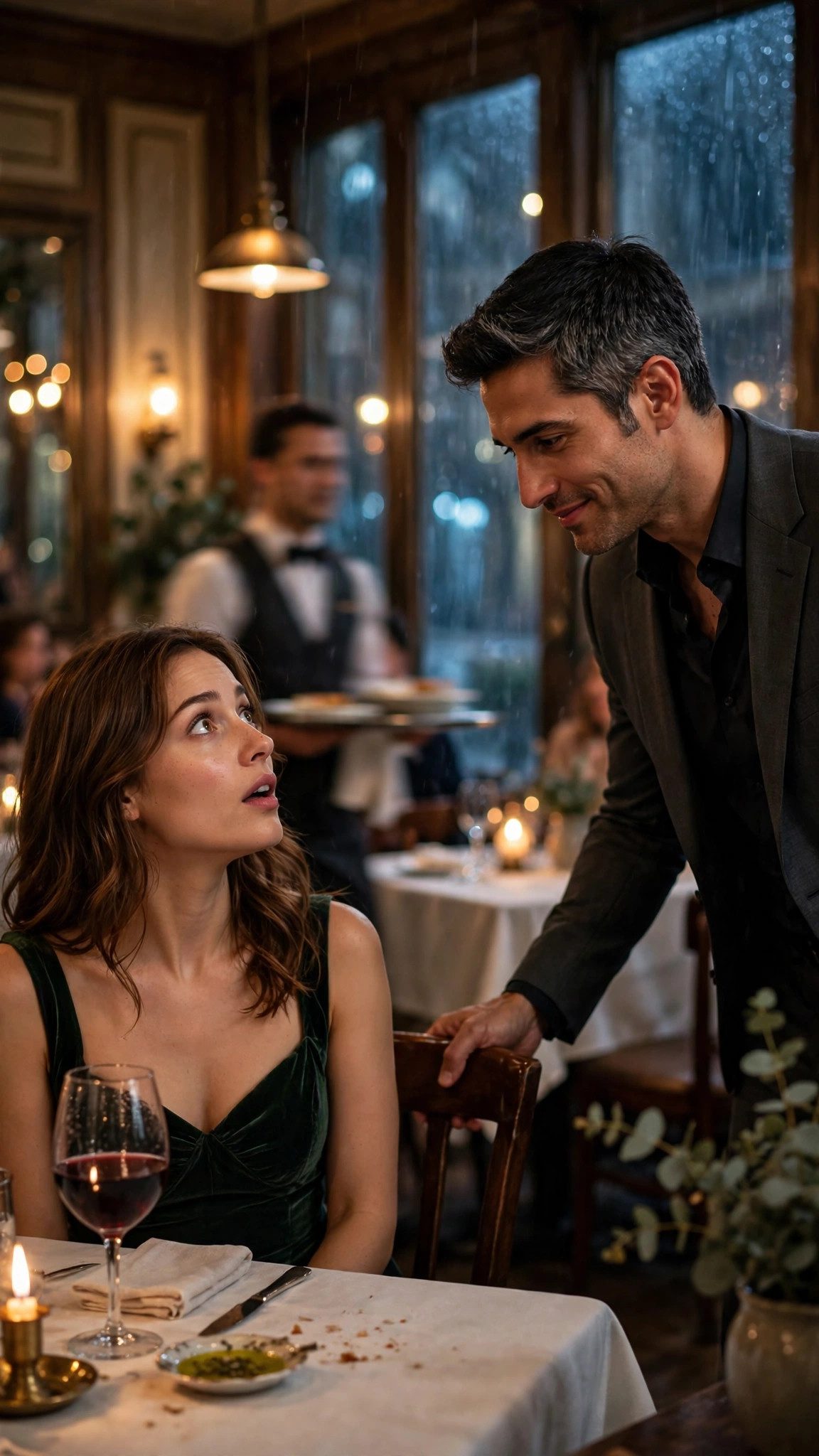
"It looks like we're both being stood up," I said, because joking was easier than admitting how humiliated I felt sitting alone on a Friday night.
The man across the room looked up from his phone. He had been sitting alone at a corner table for twenty minutes, a glass of red wine untouched in front of him, a dark suit that fit him the way expensive things fit people who never had to think about money. His hair was black with gray at the temples. His eyes were the color of a winter lake, and when they settled on me, I felt like the whole restaurant had gone quiet.
"Ryan," he said, extending his hand and nodding toward the empty chair across from me. "Mind if I take that seat? Better than eating alone, right?"
"My name is Emma," I said. "And I said sure. Because who says no to a stranger in New York City?"
Only it wasn't New York City. It was Rochester, on a rainy Friday in March, in a little Italian place on East Avenue called The Copper Lantern, and I was sitting at a table for two with one empty chair and a glass of wine I had ordered to give my hands something to do. My blind date was forty minutes late. His name was Kevin, he was the cousin of a girl I worked with, and he had texted me exactly once since I sat down: running late, sorry, order without me. Then nothing. No second text. No call. Just the rain on the windows and the waiter circling my table with the polite, pitying patience of a man who has seen this exact scene a hundred times.
So when the stranger across the room stood up and walked toward me, I did not say no. I said sure. Because who says no to a stranger when the alternative is sitting alone for another hour, watching the door, pretending she is not being stood up?
He sat down, and the first thing I noticed was that he did not look at his phone again. He put it face down on the table and forgot about it, and in my experience, that was the rarest thing a man could do. He asked me what I did. I told him I worked at Meadowbrook Senior Care, that I coordinated care for the memory unit, that I spent my days with people who were slowly losing their yesterdays and my job was to make their todays gentle. He listened. He really listened, the way almost nobody listens, his eyes on my face, his wine still untouched, and when I stopped talking he asked me another question, and then another, and before I knew it two hours had gone by.
He made me laugh. I had not laughed like that in months. Not since the budget meetings started at Meadowbrook, not since the board began talking about cuts in the careful, bloodless language of people who have never watched a woman with Alzheimer's cry because she cannot remember her daughter's name. He told me nothing about himself, or almost nothing. He said he was in freight and construction. He said he had grown up in Rochester. He said his mother still lived in the house he had grown up in and still cooked enough food for twelve people every Sunday. He had a way of speaking that made ordinary sentences sound like they mattered. When the waiter brought the check, he took it before I could reach for it.
"You don't have to do that," I said.
"I know," he said. "I wanted to."
He walked me to my car in the rain. He did not try to hold my hand. He did not try to kiss me. He held his umbrella over both of us and asked me if my car was reliable, and when I said it was a ten-year-old Honda with a heater that only worked on Tuesdays, he laughed, a real laugh, low and surprised, and said I should let him know if it ever stranded me.
"Text me when you get home," he said at my car door. "So I know you got there safe."
No guy had ever done that for me before. Least of all a guy who looked like THAT.
I drove home through the rain with the heater rattling and my phone on the passenger seat, and I kept glancing at it, waiting for it to light up, and then I realized I had not given him my number.
The heater rattled the way it always did when it rained, a thin, metallic shiver that came and went with the windshield wipers. I had meant to get it fixed for two winters now. I had meant to do a lot of things. Get the heater fixed. Paint the bathroom. Call Daniel back, just once, to see how Chicago was treating him. But life at Meadowbrook had a way of filling every spare hour, and by the time I got home most nights, all I wanted was tea and quiet and my own bed. I drove past the closed shops on Park Avenue, past the bakery below my apartment with its windows dark, past the little park where the mothers walked their babies in the morning, and I thought about how small my life had become. Work. Home. Work. Home. And now, suddenly, a stranger with winter-lake eyes, and two hours that felt like the beginning of something I did not have a name for yet. He had not asked for it. He had told me to text him, but he had never given me a number to text. I laughed at myself all the way up Park Avenue. Of course. A beautiful stranger buys you dinner, walks you to your car, tells you to text when you get home, and never gives you his number. That was Rochester. That was my life.
Priya had set the date up the week before, cornering me by the copier with her phone already in her hand. "Kevin is nice, Emma. Kevin is normal. Kevin sells insurance and he has all his own teeth and he has never once been arrested, which in this city is practically a royal pedigree." I had laughed, and I had said yes, because Priya was right about one thing: I had not been on a date in over a year. My last boyfriend had been Daniel, a history teacher who had moved to Chicago for a job and asked me to come with him, and I had said no, because Meadowbrook was here, and my mother was here, and the people who needed me were here, and Daniel had gone anyway, and we had tried long-distance for three months before it quietly fell apart, the way long-distance things do, with fewer and fewer calls and no big fight to mark the end of it.
So I had bought a new dress for Kevin. A dark green one, on sale, that made my eyes look greener than they were. I had done my hair. I had arrived at The Copper Lantern ten minutes early, which was a mistake, because it meant I had ten extra minutes to sit there and watch the door and wonder if I had made a mistake. The waiter had brought bread and water. I had ordered a glass of wine. I had checked my phone eleven times. Kevin had texted once, at 7:04, running late, sorry, order without me. At 7:40, I had ordered the salmon, because I was hungry, and because sitting alone in a restaurant with no food in front of you is worse than sitting alone with food. At 7:55, the waiter had come by and asked, very gently, if my guest was still coming. I had said, "I don't think so," and he had nodded, and he had not said a word, and somehow that kindness was worse than pity would have been.
And then, at the red light on Goodman Street, my phone buzzed.
Drive safe, Emma.
I stared at it. He had my number. I had never given it to him, and he had my number, and I should have been frightened, and some small, cold part of me was, but a larger part of me was sitting at that red light in the rain, smiling like an idiot, because he had thought of everything.
I texted back: Home in ten. Thank you for dinner, Ryan.
His reply came before the light turned green. It was my pleasure. Sleep well.
I drove the rest of the way home thinking about his eyes. There was something about them that would not leave me alone, something that tugged at the back of my mind like a word on the tip of my tongue. I had seen those eyes before. I was sure of it. Not in Rochester. Somewhere smaller. Somewhere with lake light and the smell of coffee. But every time I reached for the memory, it slipped away, and by the time I pulled into the driveway of the little house I rented over the bakery on Park Avenue, I had convinced myself I was imagining it. A man with gray at his temples and winter-lake eyes was not the kind of man you forgot meeting. If I had met him before, I would remember.
That was what I told myself. It was a lie, and I would not know it was a lie until much later, when the memory came back whole and knocked the breath out of me.
My name is Emma Hart. I am twenty-seven years old. I was born in Rochester, in the same hospital where I now sometimes sit with the families of my patients, and I have lived here my whole life except for two years at a nursing school in Syracuse and one summer I spent with my aunt June in Canandaigua, a summer I almost never think about, a summer I had folded away so neatly that I had forgotten it was even there.
I work at Meadowbrook Senior Care, a low brick building on the edge of the city with a garden out back that the residents' families planted one spring and nobody has ever let die. I am a care coordinator for the memory unit, which means I am the person who sits with a daughter while her mother asks her, for the fourth time in an hour, who she is. It means I know which resident likes her tea with two sugars and which one will only eat if you put the fork in her left hand. It means I come home most nights with my heart full and my feet sore and my clothes smelling faintly of lavender and disinfectant, and I would not trade it for anything.
For three months, my supervisor and I had been fighting. Her name is Louise Carter. She is seventy-four years old, a director at the facility, with silver hair she wears in a knot and a spine made of iron and a laugh that could fill a room. The board wanted to cut the memory-care program. They called it "restructuring." They called it "efficiency." What it meant was fewer nurses, fewer hours, and twelve families who would have to find somewhere else for the people they loved most in the world. Louise and I had been fighting it for months. We had written letters. We had gone to meetings. We had stayed late and come in early and made charts and gathered signatures, and every week the board found a new reason to delay the vote, which was their way of telling us the answer without having to say it out loud.
Jobs were coming up, rough and full of pitfalls. That was what Louise said the day the board announced the first round of layoffs in the kitchen staff, and she said it the way she said everything, like a woman who had survived worse and intended to survive this too. "Jobs are coming up, Emma," she said, tapping her pen against the table. "Rough and full of pitfalls. But we do not quit on our people."
My friend Priya, who worked the front desk, had set up the blind date because she was tired of watching me eat lunch alone in the break room. "You need a life, Emma," she had said. "You need a man who is not a budget spreadsheet." Kevin was her cousin. Kevin sold insurance. Kevin was, according to Priya, "nice, normal, and employed," which in Rochester in March felt like a reasonable standard. Kevin had stood me up. And a stranger named Ryan had taken his chair.
When I got home that Friday night, I kicked off my shoes, made tea, and stood at my kitchen window watching the rain come down on Park Avenue. I kept thinking about the way he had listened to me. About the way he had said my name, like it was something worth saying carefully. About the way he had held the umbrella so that I stayed dry and he got wet, and had not seemed to notice or care.
I went to bed telling myself it was one dinner. One strange, wonderful dinner with a man whose last name I did not know and whose number I did not have, a man who had somehow gotten my number without asking. One dinner. That was all.
I was wrong. It was the beginning of everything.
It was much later that night, or maybe it was just before I fell asleep, when the memory finally came back. I was brushing my teeth, half asleep, the bathroom light too bright, and suddenly I was not in my bathroom at all. I was in a café in a small town I never thought I would visit again, a lakeside café with blue-checked tablecloths and the smell of coffee and rain, and a man was sitting across from me, and his eyes were the color of a winter lake, and he was leaning forward with his hands flat on the table, and he was saying, in a voice so quiet it was almost gentle, "Give me one reason why I shouldn't kill you."
My toothbrush clattered into the sink. I stood there with toothpaste on my chin and my heart hammering against my ribs, staring at my own face in the mirror, and the memory kept coming, piece by piece, unstoppable now that the door was open. The café. The lake. The two men at the next table. The words I had overheard and should never have heard. And the man across from me, the same man, the same eyes, asking me why he should let me live.
I had met Ryan before. I had met him two years ago, in Canandaigua, in a café with blue-checked tablecloths. And he had asked me why he should not kill me.
And I had answered him. And he had let me walk away.
That was the moment I understood that Friday night had not been an accident at all.