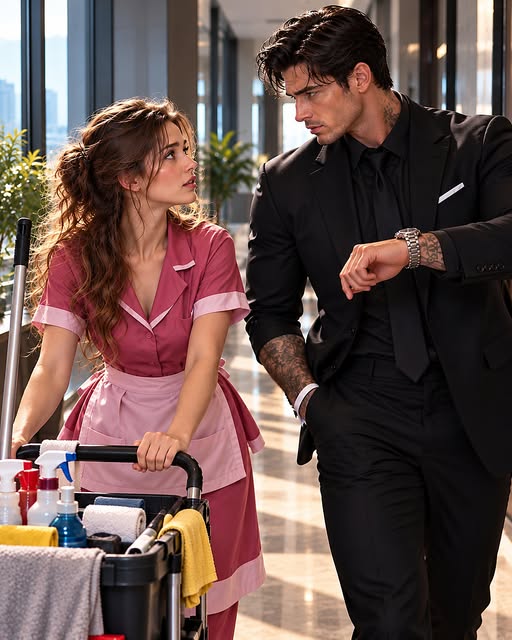
"My grandfather built this company from a single shipping warehouse," Julian said. He had moved to the window, and he spoke to the city below us as much as to me. "Augustus Vale. He trusted exactly two things in this world: work, and family. When he died, he put his controlling shares into a trust — and he put a condition in the trust that everyone in my family has been laughing about at dinners for nine years."
"What condition?" I asked.
"That the heir be legally married by midnight on the night before his thirty-ninth birthday." He turned around. "I turn thirty-nine at midnight, Lena."
"That's insane," I said.
"That's Augustus." Something almost like affection crossed his face and was gone. "He married my grandmother against his own family's wishes — a seamstress from the docks, with nothing. Forty-one years. He used to say a man who can't persuade one good person to stand beside him has no business commanding thousands to stand behind him. The clause was his way of reaching out of the grave and forcing his heir to have a life." He looked at the empty chairs around the table. "My family treats it as a joke because treating it seriously would mean admitting none of them would pass the test."
"And your cousin would?"
"Nate isn't married either. He doesn't need to be." Julian's voice went flat. "The clause only binds the heir. If I fail it, the shares fall to him free and clear — no conditions, no tests, no seamstress required. Nate has never worked a day in this company. He has, however, spent the last year having lunch with Cross Industries. Tonight I learned the sale price includes a chairmanship for him and a very large number with his name on it. He's been counting down to my birthday like a man waiting for a train he intends to rob."
The clock read 11:50.
"And if you're not married?"
"Then the controlling shares pass to the next Vale in line." His jaw tightened. "My cousin, Nathaniel. Nate has already signed a letter of intent — I found out tonight, on that phone call, forty minutes after my own lawyers confirmed it — to sell Vale Group to Cross Industries the moment he takes control. Their merger team has a plan. It starts with breaking the company into pieces. It ends with eleven thousand people losing their jobs, including—" he glanced at my uniform, my cart, the badge on my chest "—every cleaner, porter, cook, and night guard this company employs. People like you get cut first. You always do."
My mouth had gone dry. "The woman tonight. Vivienne."
"Vivienne Cross." Something bleak moved across his face. "Her family has been circling this company for two years. The engagement the magazines loved so much was her father's idea of a merger with better photographs. I ended it in April, when I found the drafts of the breakup plan on her laptop — with my name already in it as a consultant. A face for the sale." He exhaled. "Tonight she came to watch me sign the final Cross partnership papers, because she and Nate both believed the marriage clause made me desperate enough to come back to her. That phone call was my counsel telling me the trustees have moved their verification meeting to tomorrow morning — Nate's doing. He wants the clock verified as expired before anyone can think too hard."
"So marry someone," I said. "You must know a hundred women who'd—"
"I know a hundred women who were sent to me by people who want something," he said. "Nate's lawyers will challenge any marriage I make tonight. They'll call it a sham in front of the trustees, and they'll be looking for a bride with a price tag in her past — someone who can be bought twice. Do you understand? The bride has to be someone no one planted. Someone who was never part of this world." His eyes held mine. "Someone who, when six hundred thousand dollars is put in front of her, asks only for her mother's sake and nothing for herself. There is exactly one person in this building tonight who fits that description, Lena. You're on your knees scrubbing my carpet."
I looked at the clock. 11:51.
"You're asking me to save eleven thousand jobs," I said.
"I'm asking you to marry a stranger for a great deal of money, with a lawyer about to challenge it and a cousin about to make your life very public." He didn't dress it up. I respected that more than the money. "I won't lie to you about what it will be. But I will keep every term you set. Your mother comes first. I said it and I'll sign it."
"Nine minutes," I said.
"Nine minutes."
I thought about my mother asleep in the Bronx with the pink envelopes beside her bed. I thought about eleven thousand people, and the woman in diamonds, and the fact that in nine years of laughing at the clause at family dinners, not one person Julian Vale trusted had simply stood by him.
"Call your lawyer," I said. "And the license says Morales. M-O-R-A-L-E-S. If you're going to marry me, spell it right."
"Wait." He crossed the room in three strides — not to stop me, but to be close enough that what he said next couldn't be overheard by any door. "Before the lawyers come in, you should hear the rest, because there will be no time after. The trustees verify the marriage tomorrow. Nate will file a challenge — Margaret estimates within days. He'll say I bought a bride. He'll hire people to look at your life, your mother, your debts. If the trustees find the marriage isn't genuine, the clause fails anyway and everything I just told you happens, one week later instead of tonight."
"Then why risk it on the truth being ugly?" I asked.
"Because the truth is the only version that survives him." His eyes were steady. "I'll need us to live as husband and wife — publicly, and in my home, where the trustees' people will look. Separate rooms. Your own space. Every boundary yours. The money is yours regardless of how the challenge ends — that, too, I'll put in writing. And when it's over, if you want out, you walk out with every cent and my signature on whatever you ask." He paused. "I'm not asking you to love me, Lena. I'm asking you to stand next to me where they can see you, and not flinch."
I thought about the pink envelopes. I thought about Vivienne Cross, who had everything and had chosen to spend her evening grinding a stranger's face into a carpet for sport. I thought about what it would mean for my mother to be the scandal in a rich man's courtroom — and then I thought about her rationing her heart pills one morning at a time because a nurse had told her to stretch them.
"You'll put the six hundred thousand in writing," I said. "Not for me. Held for my mother's care. If I never touch a cent of it for myself, your cousin will look very stupid calling me bought."
For the first time in the whole insane conversation, Julian Vale looked at me the way men in his world looked at a move they hadn't seen coming. "Consider it done," he said.
What happened next happened the way money makes things happen — in a blur of doors opening before he touched them. Julian's counsel, a gray-haired woman named Margaret Sloane who arrived in four minutes flat with a briefcase and the calm of a bomb technician, spread papers across the boardroom table. The marriage license had been applied for three days earlier — "a contingency," Julian said, not quite meeting my eyes, "my grandfather's clause concentrates the mind" — and a retired judge named Harold Brennan, who owed Augustus Vale a forty-year-old debt and answered his phone at 11:52 in a dressing gown, was already on a video line, smiling like this was the most fun he'd had since the bench.
"Prenuptial agreement," Margaret said, sliding a document toward me. "Standard protections, both directions—"
"No." I pushed it back. She blinked. Julian watched me. "He doesn't get to buy insurance against me in the same hour he asks me to trust him. And I don't want any either. If this is fake, paper won't make it real, and if it's real, I don't need it." I looked at Julian. "One page. My condition, written in. My mother. That's all."
Margaret looked at Julian. Julian looked at me for a long moment, and then he did something I didn't expect: he picked up a pen, struck through the prenup with a single line, and wrote my condition in longhand in the margin of the marriage agreement himself — *The wife's mother comes first. Always. No permission required.* — and signed his name beneath it with eight minutes of my old life left on the clock.
"Miss Morales." Judge Brennan's voice crackled kindly through the speaker. "Do you understand what you're agreeing to?"
I thought about the crackers in the vending machine. About stairs my mother couldn't climb. About a woman in diamonds learning that the cleaner had a name.
"I understand," I said.
"Julian Augustus Vale, do you take this woman—"
"I do." At 11:56. Without hesitation. It unnerved me how steady he sounded.
"Lena Rosa Morales, do you take this man—"
My mother's middle name is Rosa; they use it at the clinic; I hadn't known it was on my employee file, and hearing it in that marble room at 11:57 P.M. nearly undid me. I swallowed.
"I do."
"Then by the authority vested in me—" Judge Brennan beamed "—and with fifty-eight seconds to spare on what I believe is a personal record — I pronounce you husband and wife."
Julian took my hand — to shake it, formally, like a deal closing — and instead held it a moment longer than a deal required. His thumb brushed my knuckles once, over skin roughened by bleach and work. My wedding ring was the plain gold band Margaret produced from her briefcase, sized for someone else, a little loose. It spun when my hand trembled.
"Filed," Margaret said at 12:03 A.M., as the timestamp confirmation came through. "Legally married before midnight. The clause is satisfied." She gathered her papers, paused, and looked at the two of us — the billionaire and the cleaner, standing among the executive chairs in a room that still smelled faintly of my cleaning spray. "Congratulations," she said, in the tone of a woman placing a bet she couldn't explain.
While Margaret spread her papers, Julian touched my elbow. "Your mother," he said quietly. "You should be the one to tell her. Not the television."
I called her from the boardroom window, forty-one floors above the city, with a billionaire pretending very hard to study a contract so I could pretend I had privacy.
She answered on the fourth ring, thick with sleep. "Mija? Is it the landlord?"
"No, Mama." My voice did something unreliable. "It's me. Something happened at work tonight. A man — the owner — he needed help, and I helped him, and—" I looked at Julian, who was suddenly, completely, a stranger I had promised to marry. "Mama, I got married."
Silence. Then, in the voice she'd used when I was nine and caught doing something dangerous: "Lena Rosa Morales, you put him on the phone."
I put him on the phone.
I don't know everything my mother said to Julian Vale in the next ninety seconds — her voice was too low, and some of it was in Spanish — but I know his spine straightened, and I know he said, twice, "Yes, ma'am," and once, very quietly, "I give you my word," and that when he handed the phone back his ears were slightly red.
"She says—" he cleared his throat "—she says if I make you cry, she will come up here personally, heart condition or not, and deal with me."
"She will," I said. "She absolutely will."
"Good." He almost smiled. "Then she's exactly as advertised."
The door closed behind her. The clock read 12:04 — an ordinary time now, harmless. Julian was looking at me like a man who'd stepped off a cliff and was still processing the part where he hadn't fallen.
"There's a car downstairs," he said. "It will take you home. And Lena—" he stopped. Started again, awkward for the first time. "Thank you."
"Don't thank me yet," I said. "You haven't met my mother."
I rode down forty-one floors in an elevator with mirrored walls, married, wearing a loose gold ring and a cleaner's uniform, holding my spray bottle like an idiot because I'd never set it down. Outside the tower, the driver — a quiet man named Owen — held the door of a black car. And across the plaza, half-hidden by a column, a photographer lowered a long lens, looked at the picture he'd just taken of the billionaire's midnight bride leaving through the staff entrance, and smiled at his luck.
By morning, half of New York would know my name.