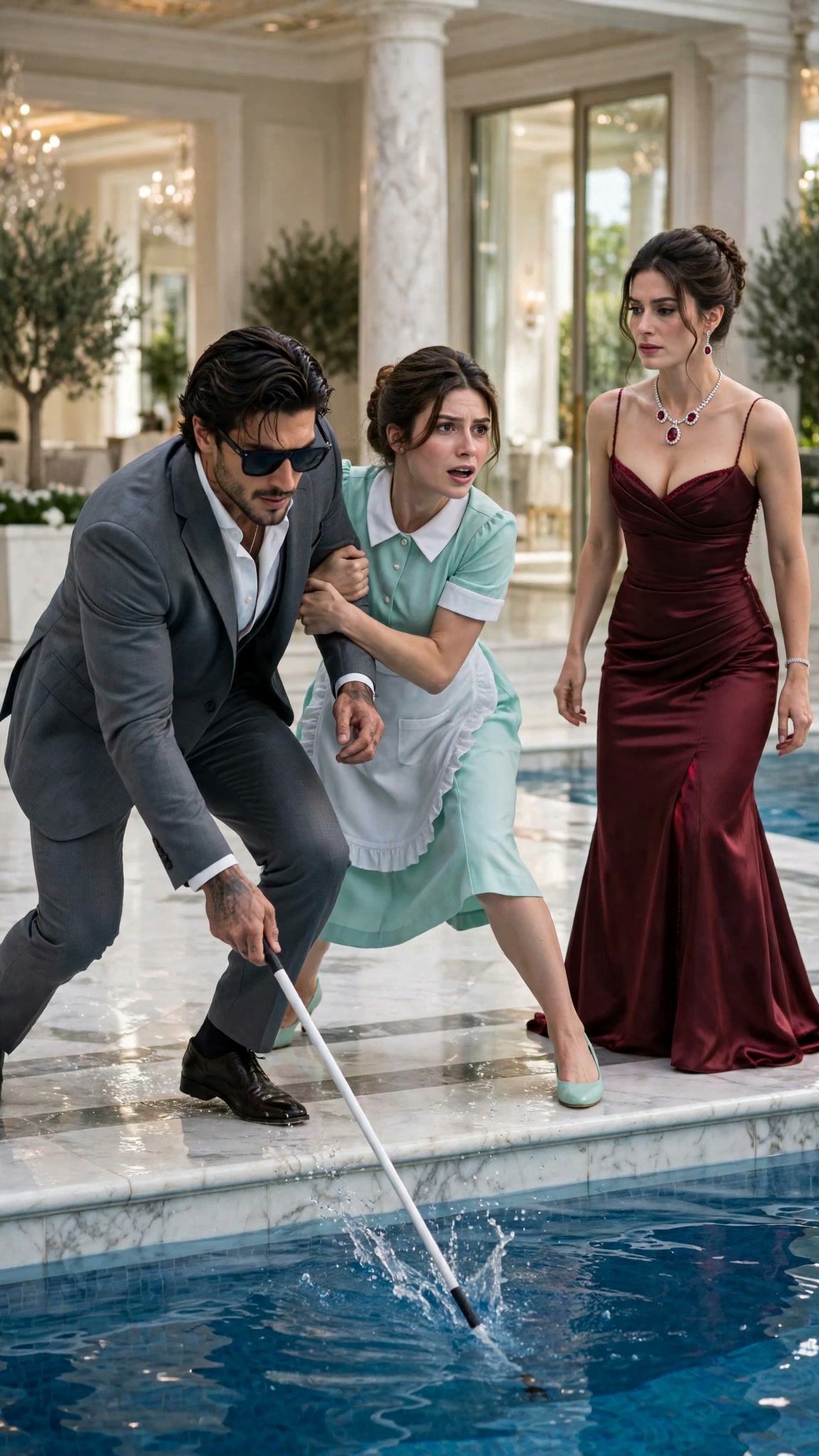
Ethan Cole chose the meeting place himself: the observation deck of the Blackwood Tower, forty stories above the city Daniel's grandfather had started buying one bankrupt parcel at a time.
He arrived at eight with his golden composure freshly pressed, and he smiled at the empty deck, the two glasses, the bottle Daniel had left pointedly unopened.
"No recorders," he reminded.
"Gregory," Daniel said, without looking up from the skyline, "tell Mr. Cole about the recorders."
Shaw stepped out of the service doorway with Rachel beside him, and Rachel set her phone on the parapet between the two men, screen up, the recording light burning its small red eye. "This conversation is being documented by counsel," she said, "and Mr. Cole is free to leave at any time and take his offer with him. Those were never his terms to set. He confused himself with someone whose terms matter."
Ethan looked at the phone for a long moment. Then he laughed — genuinely, it seemed, the laugh of a man watching his own price fall in real time. "You know what, Daniel? She's worth ten of Clara. I never understood why you married the wrong—" He stopped. He poured his own water. He began again, in the tone of a man reading a statement he has rehearsed in an elevator. "Julian Cross approached Clara last autumn. Not me — Clara. He knew about the marriage. Everyone in this city knows about your marriage; it was the favorite story at every dinner none of you invited me to. The rich blind king, the beautiful queen, the castle on the headland Cross has been trying to buy since before your accident. He offered her a door out: sell the estate through a shell, be a rich widow in all but paperwork, thirty percent of a very large number. She brought me in to run the property side. I built Cole Meridian. I recruited Voss — forgive me, Clara recruited Voss, through her little dinners for Rachel's staff. She's better at this than I am, Daniel. I hope you appreciate that, now that it's aimed at you."
"The signature," Rachel said.
"Voss's clone approved the transfer. The signature image came off your own executed contracts — the firm had a hundred samples. The plan after completion was the guardianship. With the house gone and the money offshore, Clara petitions, Dr. Fenn testifies, you're declared incompetent in your own interest—" He shrugged. "A private facility. Good doctors. Heavy quiet. Men like you sign things in places like that, Daniel. Men like you sign anything, eventually, to make the quiet stop."
Daniel had been very still. "And the pool?"
For the first time, Ethan Cole's composure cost him something visible. "The pool was Cross's impatience. Friday kept not arriving. His people decided you needed to be… resolved… before the hearing gave you a platform. Clara ordered a scare. I want that on your recording, Rachel — she ordered a scare, an accident, a broken shoulder, a reason for Fenn to say the house was unsafe for you." He looked at Daniel. "The cut cane and the deep end were not her design. They weren't mine either. Cross doesn't tell his instruments everything. It's why we live so long, and why we hang separately when it ends."
"You'll say all of this in a statement," Rachel said. "Tomorrow. With prosecutors."
"I'll say all of it," Ethan agreed, "the day my immunity is signed, and not a syllable before. Until then—" he rose, straightened his cuffs, and looked out over the city he had tried to steal one promise at a time "—consider tonight a preview. A trailer, Daniel. I understand you like those."
He walked out between Shaw and the service door like a man leaving a theater, and the red light on Rachel's phone burned on, and Daniel stood at the parapet of his own tower until the recording had enough of the wind.
"Will it hold?" he asked.
"The injunction hearing is at ten," Rachel said. "With what we already have — the cane, the footage, the keycard log, Voss's statement, the examiner's report — the injunction holds, Daniel. The sale is dead. What Ethan adds tomorrow is not a shield. It's a sword. For Clara. For Cross." She picked up the phone and ended the recording. "Get some sleep. Tomorrow I have to save your house in front of a judge while your wife tells the court you're insane. I intend to enjoy it, and enjoyment requires rest."
At dawn he found Anna already awake, standing at the drained pool with a mug of tea going cold in her hands, watching the light come up over the headland.
"You don't have to be in the courtroom," he said. "Your statement is sworn. Rachel says that's enough."
"Statements don't get cross-examined about hair buns and lockers." Anna handed him the mug, because his hands were doing the thing they did when he thought no one was watching. "She'll call me the scheming maid again, in front of everyone. I'd rather be in the room when she says it. People who say things about me tend to do it more carefully when I'm looking at them."
"You've been looking at people carefully for both of us for a year," Daniel said. "Let me return the service today."
She straightened his tie — an old gesture, from the blind months, when a man's hands could not be trusted with silk — and then, realizing what she had done, and that he could see her realize it, she left her hands where they were for one second longer than duty required.
"Win," she said. "Then we'll talk about whose service is whose."
The courtroom was full by nine.
Clara arrived in cream, with her attorney and Dr. Fenn — a soft, silver, sorrowful man who carried his bought opinion like a hymn book. Her petition was heard alongside the injunction, because the judge, a woman of sixty with no visible interest in anyone's feelings, had decided that the two matters were one animal and she intended to see it whole.
Dr. Fenn testified first. Daniel's injury. The known phenomena. Patients who believed, with shining sincerity, that lost function had returned. The danger of humoring the delusion; the tragedies on record. He was gentle, he was credentialed, he was — in the strictest sense of the word — plausible, and Daniel watched members of the press gallery nod along, and felt the story of the gala begin to tilt under him like a floor.
Then Rachel stood up, and called his physicians.
All three of them. The specialists Clara had invoked on the terrace — "the doctors said the damage was permanent" — filed into the witness box one after another, and said, under oath, with charts: that Daniel Blackwood's retinal recovery had been documented since February. That it had been gradual, measured, and entirely real. That his cognition had been assessed repeatedly and had never, at any point, been impaired. That the only deception in the medical record was the patient's own: he had asked his doctors to keep his recovery confidential, as was his legal right, because — the eldest of them said, looking directly at Clara — "he told me he was afraid. He would not say of whom."
Clara's attorney argued desperation. The judge read the examiner's report on the cloned device. She read Voss's statement. She read the keycard log, and the security timeline, and she looked for a long time at a photograph of a white cane's rubber tip, cut neatly three-quarters through, entered as Exhibit One.
"The injunction is granted," she said at last. "The transfer is frozen in its entirety, and the escrow is impounded pending criminal investigation. As to the guardianship petition—" and here she looked at Clara over her glasses with an expression that Daniel would treasure for the rest of his life "—the court finds that the petitioner has rather a great deal of explaining to do, and very little standing to do it. Petition denied. We are adjourned."
Outside, on the courthouse steps, in a tide of cameras, Clara did not stop. That was the thing nobody who knew her had ever credited: Clara Blackwood, cornered, indicted by evidence in front of the whole county, did not stop. She walked down the steps with her cream suit immaculate and her face set like a queen's, and she was smiling — smiling — when the prosecutor's investigators met Daniel at the bottom and told him, in front of everyone, that Peter Voss had been arrested at his home that morning and Ethan Cole had presented himself at the district attorney's office at noon, with counsel, asking to cooperate.
By evening, it was on every screen in the city: the blind husband who could see, the wife, the lover, the headland, the pool.
Clara came back to the house at six, under the court-approved window the judge had granted her — one hour, escorted, to collect her personal belongings. Shaw walked the perimeter. Two officers waited at the gate. Her attorney waited in the car. And Clara, who had never once in her marriage asked permission for anything, asked to see the terrace.
"One minute," Daniel said. "Shaw stays."
The pool was still drained. It would be drained until Daniel ordered otherwise; the blue basin in the evening light looked like a held note. Clara stood where she had stood on Tuesday morning, by the glass door, and looked down at the empty deep end, and for the first time since he had known her, Daniel saw his wife's face without an audience in it.
"I never wanted you dead," she said.
"No," Daniel said. "You wanted me gone. Dead was just the version your partners preferred."
"I wanted—" Her voice broke, genuinely broke, and she hated it; he watched her hate it. "You have no idea what it was like. At the beginning you loved me. Then you built and built and the house got bigger and I got… ornamental. And after the accident I was a nurse. A nurse with a diamond. Thirty percent, Daniel. He offered me thirty percent and a life where I was a person again. Ethan was—" She laughed once. "Ethan was a door I could see."
"The ring," Daniel said. "You sold the ring I had made with a sapphire hidden in it so I would always know the real one. You sold it for what — a year of your allowance? You wore a copy into our bed."
"I sold it because it was the only thing in this house that was mine to sell!" The queen came back up fighting, all at once, magnificent and doomed. "And I would do half of it again — the sale, the petition, Fenn, all of it — do you hear me? I would do it again rather than die a nurse in a castle. The pool was not mine. The pool I never—"
"The pool," Shaw said from the doorway, in the tone of a man closing a book, "is why the officers at the gate have a warrant, Mrs. Blackwood. Conspiracy doesn't ask who held the blade. It asks who paid for the knife."
She looked at Daniel then — past the officers who had come onto the terrace, past her attorney calling her name from the drive — and what she said, she said clearly, into the record of two body cameras and the memory of everyone present, like a woman spending her last coin on the only revenge left to her.
"You think it began with me? The guardianship papers were drawn up last spring, Daniel. Before your accident. Before the brakes. Ask Rachel who drafted them. Ask your precious lawyer whose idea it was — to have you declared incompetent while you could still see."
They took her down the drive in the last of the light, and the cameras at the gate went off like a string of small, white explosions.
Daniel stood on the terrace with the empty pool below him and the evening coming down, and Anna came and stood beside him — not close, not far, in the exact place where she had stood on Tuesday with her arms locked around his life.
"Is it true?" she asked. "About the papers. About Rachel."
"I don't know," Daniel said honestly. "I know Clara would burn the world on her way out of it, and she just threw the match at the one person who saved this house." He looked at the drained blue basin, at the place where the water would go. "Tomorrow I ask Rachel. And tomorrow—" a long breath, the first unguarded one in days "—tomorrow, we fill the pool."