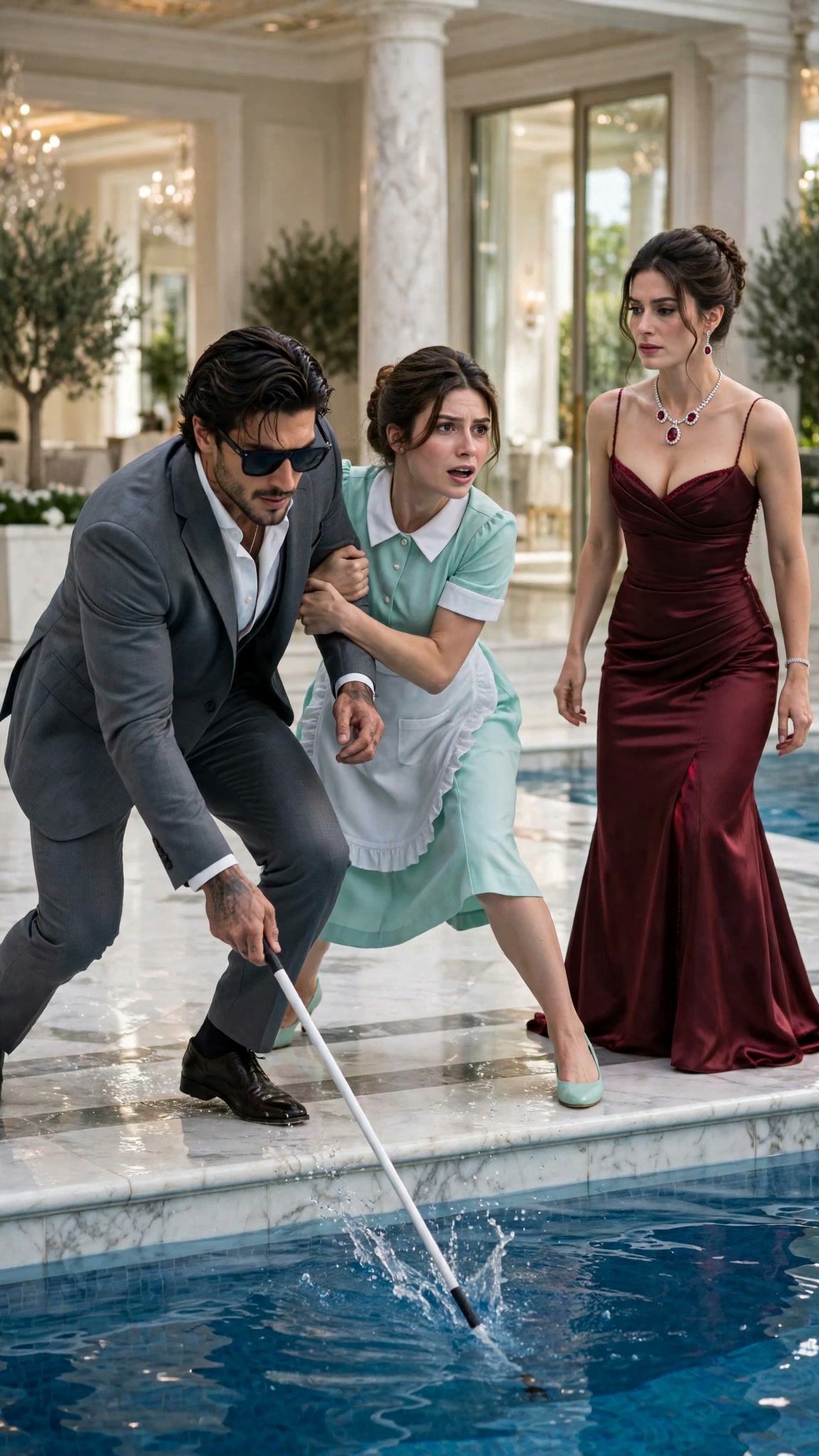
The pool filled on a Thursday, and by the weekend the terrace belonged to the living again.
Daniel had the railing rebuilt higher, in steel, by a firm that did not know his name or his story — some things he wanted done by strangers. On the first evening, he walked the terrace alone at dusk and ran one hand along the new rail the way he once had with a cane, out of an irony he permitted himself exactly once. The water below was full and darkening and ordinary. That was the miracle he had stopped expecting: ordinary water, in an ordinary evening, in a house that was finally telling him the truth.
The law finished its work the way the law does — slowly, then all at once, then in headlines.
Clara pleaded in October: fraud, forgery, conspiracy. Nine years, her counsel announced to the cameras, in exchange for her testimony against the men who had escalated her betrayal into attempted murder — a distinction the judge accepted and Daniel, reading the coverage over breakfast, found he could accept too. She had wanted him gone. Other men had wanted him dead. The law, for once, had measured the difference precisely, and he discovered that precision was enough; he did not need to hate her at full strength anymore, and the letting go of it felt like setting down something he had been carrying in a hand he needed for other things.
Ethan Cole left the state under the terms of his cooperation, golden no longer, into a small life in a city where nobody knew his name at dinner. Peter Voss pleaded in November and wept in court, and Rachel sent Daniel the transcript with one line highlighted, in which Voss said he was sorry to Miss Reed — the only sentence in two hundred pages, Daniel thought, that had cost its speaker anything real.
And Julian Cross was indicted in December, on a gray morning when his own board was voting to remove him before the agents had finished their coffee. The resort died with his signature authority. The headland — the last undeveloped mile of coast in the county, the prize the whole bloody chess game had been played for — stayed exactly what it had been for three generations of Blackwoods: too stubborn to sell.
Daniel made certain of it in the spring.
He signed the estate into a coastal conservancy trust, in his grandfather's name, in Rachel's office, on a morning so bright it came through the blinds in bars. The land could never be sold now — not by a wife, not by a forged signature, not by Daniel himself in some future weakness. The house would stand as it stood, the pool behind it, the foundation in the east wing, and the family in the west, and no pen guided by any hand would ever move it again.
He read every line aloud before he signed. All forty-one pages. Rachel bore it with the expression of a woman witnessing a sacrament she had helped design. And when he reached the witness line, he looked up at Anna, who had come as the estate's manager and his, and held out the pen.
"You cleaned this house for eleven months," he said. "You know where everything in it is buried. Witness it."
She signed her name under his, in the firm hand of a woman who had signed statements, contracts, and one famous retainer, and the Blackwood estate passed out of the reach of thieves forever, in a room full of sunlight, with nobody pretending anything.
In May, Daniel made a mistake of exactly the kind he had sworn off, and Anna caught him at it within the week, because she read the foundation's filings the way she read everything: completely, and with a fingertip on the line.
"You've endowed a scholarship," she said, at breakfast, with the document beside her plate. "For paramedics retraining after wrongful dismissal. Through the foundation. Anonymously, except it isn't anonymous, because the fund's paperwork crosses my desk — I am, you may recall, the estate manager."
"The Reed Fund has a certain ring to it," Daniel said.
"The Reed Fund has a certain debt to it. I told you: no strings. A scholarship with my name on it is a string the size of a mooring rope, Daniel. Every paramedic in the county will know whose—" she stopped, because he was smiling into his coffee with the expression of a man who has been caught on purpose, and understood, a beat late, that he had been. "You wanted me to find it."
"I wanted you to argue," he admitted. "You only ever say the truest things when you're arguing. It's your native language. I was lonely for it." He set the cup down. "The fund stands, because there are women sitting in laundries right now who were framed by smaller people, and you are the proof it can end differently. But the name comes off. It'll be the Terrace Fund. For the place where a woman with a bucket's worth of courage—" he stopped, and corrected himself, because she was watching "—where a paramedic refused to let go of a man's arm."
"The Terrace Fund," Anna said, after a moment. "Anonymous. And the first award goes to one of the nurses from my hospital — the ones who filed. Not me. Never me."
"Never you," Daniel agreed. "You I intend to compensate in entirely unprofessional ways, outside working hours, in strict accordance with your contract."
"Clause nine," Anna said. "I drafted that too."
"I know," he said. "I read every line. Aloud."
Her license came home in April.
The board's letter was three paragraphs long, and it used the word reinstated, and the word apology did not appear in it, which Anna said was fine — she had never needed paper to know what she was. She took the ambulance shifts two days a week, Tuesdays and Fridays, and came home the first evening in her old uniform with her hair coming down and stood in the kitchen doorway while Mrs. Dalton — who had believed the worst for exactly one day and spent the rest of the year making amends in soup — burst into tears into a handkerchief the size of a flag.
"I'm not crying," Mrs. Dalton announced, crying. "It's the onions."
"There aren't any onions," Shaw said, from the doorway, in the tone of a man reading weather, and then he cleared his throat and held out his hand to Anna like a soldier. "Welcome back, Miss Reed."
"Thank you, Gregory." She shook it solemnly. "The house still standing?"
"Nobody's fallen in the pool all year," Shaw said. "We're very proud."
The cane stood in a glass case by the study door. Daniel had had it mounted — the white shaft, the sunglasses retired beside it, and the cut rubber tip exactly as it was, three-quarters severed, the blade's patience preserved under glass like an insect in amber. The plaque beneath it, in his own hand, read: FOR THE DAY I STOPPED PRETENDING. Visitors assumed it was a memorial to his blindness. Staff knew better. Anna passed it every morning on her way to the east wing, and some mornings she saluted it, which Daniel pretended, with his fully recovered sight, not to see.
In late May, Daniel drove the coast road again.
He had not driven since the accident — fourteen months of passengers and drivers and, for eight of them, the dark. The car was new; the old one was evidence, then scrap, then a line in a court file. Anna sat beside him without being asked, in the passenger seat, with her hands folded in her lap and her eyes on the road in the professional way of a woman who has arrived at a thousand scenes other drivers didn't.
The descent above the marina came down out of the hills in three long curves. Daniel took them slowly, both hands where they belonged, feeling the brake pedal answer him — firm, honest, immediate — the way it should have answered on a night of rain fourteen months before. Halfway down, his hands began, very slightly, to shake. He did not hide it. That was new, too.
"You can pull over," Anna said quietly. "There's no grade for this."
"I know. That's why I'm finishing it." He drove them down out of the curves and onto the flat coast road, with the water on their left going silver in the afternoon, and let out a breath he had been holding, in one form or another, since a hospital corridor. "For a long time I thought the worst thing they took was my sight. It wasn't. Sight came back by itself, like weather. The worst thing they took was this — the ordinary machinery of a life. Driving to the coast. Reading a menu. Signing my name without wondering whose it would become." He glanced at her, briefly, the way drivers may. "I'm taking the machinery back. All of it. Piece by piece."
"You drive better than half the men I've scraped off this road," Anna said, which from her was a sonnet, and he laughed all the rest of the way home.
He asked her on the terrace, in June, at the hour when the pool takes the whole sky.
He had planned it the way he planned everything that mattered — badly, repeatedly, and with Rachel's unsolicited advice rejected in full. There was no speech that survived contact with the evening. There was only the water, and the new steel railing, and Anna coming out of the glass doors with two glasses of the lemonade she made too strong on purpose, and Daniel Blackwood — who had spied on his own marriage for eight months because it was easier than asking a single honest question — deciding, for the second time in his life, to simply say the true thing with his voice.
"The first ring I ever gave a woman had a stone hidden in it," he said. "A test, built in. So I'd always know. I've been thinking about what that says about the man who designed it — that even his love came with a tripwire. I'm done with tripwires, Anna." He took the box from his pocket. The ring inside was new, and the sapphire was not hidden beneath the diamond this time. It sat beside it, in the open, where anyone could see it, exactly as blue as the water. "Nothing underneath. Nothing held back. Everything I mean, I'll say in the open, and when I can't, you'll know it isn't worth hearing. Marry me. Not for the house — the house can't even be sold anymore, I checked with my lawyer. Marry the difficult man. The hours are terrible and the cook is deplorable and the employer has a documented history of lying about major medical conditions."
Anna looked at the ring for a long moment. Then she looked at him, and the whole year's weather was in her face — the terrace, the cell, the ballroom, the garden, the pen.
"You rehearsed that," she said.
"Fourteen times. In the study. Shaw timed me."
"Then Shaw can be best man." She held out her hand — the left one, the ring hand, steady as the morning she had hauled him back from eight feet of water. "Yes, Daniel. On my terms, which are in the contract, which you signed."
The wedding was small, because everything true in that house had learned to be small: the garden, twenty chairs, the quartet from the gala — who sent, with their contract, a note saying they had always wanted to play the second half of that evening. Rachel stood with Anna, in navy, and cried once, efficiently, during the vows, and denied it for the rest of her life. Shaw walked Anna down the garden path in his one good suit, with the bearing of a man escorting royalty through a minefield, and gave her away with a firmness that suggested he would be checking references on the groom for years to come.
And afterward, in the blue hour, the bride and groom walked the terrace together — past the steel railing, past the place where a white cane had once struck the marble and slid toward the deep end, past the water that had once been emptied of everything and filled again.
Anna took his hand at the pool's edge, where the light trembled on the surface exactly as it had on the worst morning of his life, and turned it into the best one.
"Careful, darling," she said.
And this time, she was holding his hand.