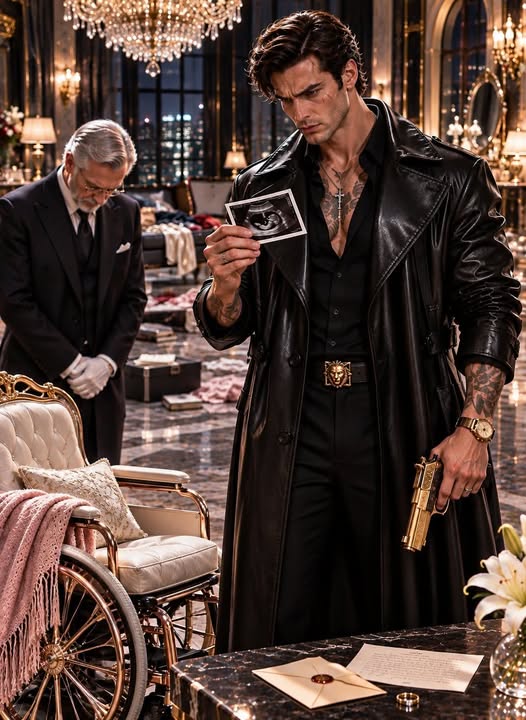
Marcus delivered the recording the next morning in a plain envelope, hand-carried to the clinic's front desk with the ceremony of a man defusing ordnance: a USB drive, a printed transcript, and a note in his own square capitals. *FULL FILE, UNEDITED. CHECKSUM ON REVERSE. M.*
I read the transcript first, because paper felt like something I could survive, and I got exactly as far as the first page.
There it was in black and white, Marcus's capitals marching down the margin with timestamps. 14:02 — Mrs. Vale's medical appointment confirmed via foundation calendar. 14:31 — C. Rowan enters office. 14:44 — *If you don't love your wife, Adrian, why are you still married to her?* I read my husband's answer on paper, in a hospital-quiet room, with the lake-gray light coming through the blinds, and I put the page face-down on the tray table with a hand that was not steady, and I did not turn it over again. A transcript can be misread as easily as a doorway; I knew that, and knowing it didn't help. Words on paper are just the skeleton. I needed the thing itself — the pauses, the temperature, the part of the sentence I had fled from. I needed to know if there *was* a part of the sentence I had fled from, because if there wasn't, the laptop was going to finish what the hallway started.
So I spent the day the way I'd spent the first weeks in rehab: negotiating with a machine. I catalogued the drive's weight. I rehearsed verdicts. I told Lena absolutely nothing, which told Lena everything, and she responded by bringing soup at six and soup again at nine and not once looking at the laptop, which in Lena's personal system of ethics constituted a heroic act of restraint.
"For when the patient is ready," she said, setting the second bowl down, "the gym is open."
At midnight, the patient was ready.
I held out for eleven hours.
I told myself it was dignity. I told myself it was the hematoma — stress was forbidden, the doctor had used the phrase *strict rest* as if it were law. I ate Lena's soup and played chess badly and lost, and at midnight, in the dark of that kind little room, I put the laptop on the tray table and plugged in the drive.
The office camera looked down from a corner. I saw the desk, the slice of room I had glimpsed through the door gap — and I saw, with a stranger's terrible clarity, the whole stage I had only ever had a keyhole view of.
Celeste, arriving with a folder. Celeste, setting her phone face-down on the desk — no. Face-*up*. Screen lit. Whatever else she was doing in that room, she had wanted a witness of her own choosing. (Marcus's investigators would confirm within the week that the phone had been live-streaming audio to a number registered to Celeste's cousin; she had wanted Adrian's voice saying certain words, out of context, for use in a family argument about the foundation's future. She had been building a file. She had, investigators believed, been building it for months.)
On the screen, Celeste smiled her syrup smile. "If you don't love your wife, Adrian, why are you still married to her?"
And I saw what the door had hidden from me. Adrian wasn't looking at her. He was looking at the photograph on his desk — me, in the garden, laughing, in a frame Rosa had given us — with the expression of a man being read his own obituary by a fool. "Because she saved you?" Celeste pressed. "You stay because she saved your life?"
"I owe her my life, not my love—" Adrian said, and my whole body flinched, and then he *kept talking*, and the door and the hallway and my breaking heart had stolen every word of it:
"—is that really the story you've been telling my father's old friends, Celeste? Because I've heard it at three dinners now, in your exact phrasing, and I want you to hear how it ends. I didn't marry my wife out of debt. Debts I pay in money. I married her because she's the only person on this earth who ever looked at me and saw a man instead of a weapon — and if I owe her anything, it's thanks, every morning, on my knees, that she was standing on that pavement and I wasn't." On the recording, he stood. He came around the desk. His voice went down into the register that had ended arguments across three states. "The foundation audit starts Monday. Your access to this house ends today. And if you ever again say my wife's name in the shape of a bargain, Celeste, there won't be a family treaty in the world thick enough to stand between you and the consequences. Are we finished?"
*That* was when she lunged.
On the recording you could see it plainly, with hindsight's x-ray: her eyes flicked — not at him. At the door. At the thin bright line beneath it, where a wheelchair's shadow cut the light. She knew. She had known the whole time — she'd seen my appointment come through the foundation's medical calendar that morning, five weeks and four days, and she had timed her little performance the way other people time trains.
She stepped into him, arms around his neck, and Adrian — whose hands came up, whose hands *started* to set her back the way you handle something contaminated — froze for one half-second of pure political calculation, forty years of alliance between the families in the balance of a shove, and that half-second, through a door gap, from a hallway, had looked exactly like surrender.
Then he stepped back, removed her arms like gloves, and said, "Get out of my house."
And then — this was the part that undid me, at midnight, with the laptop hot against my blanket — he didn't follow her. He stood in the middle of his office for a full minute, alone, looking at the door. And he said, to the empty room, to the door, to me and not to me, in a voice I had heard exactly twice in six years, both times in the dark:
"God, let her never learn to doubt it. Everything I have is just… everything she has."
He picked up the garden photograph and stood there holding it like a man holding a hand.
I watched it four times.
Then I did the thing I'd been refusing to do since the driveway: I grieved correctly, for the right reasons. Not because my marriage was a lie — because it wasn't, and I'd nearly buried it alive on ninety seconds and a keyhole. Because he'd let that woman poison the air of our house for months with her insinuations at dinners while I'd smiled and passed the wine. Because the half-second of calculation existed. Because *I* existed in a world where another woman could stand close enough to my husband to weaponize his stillness.
I watched the embrace nine times before I could look at it steadily, the way you press on a bruise to map its borders. Each time, the same evidence assembled itself a little differently: his hands rising — not to hold, to *handle*, the way you take hold of something that has been thrust at you and must not be dropped in company; his weight shifting back even as hers came forward; the exact frame where his eyes went to the door. And under the video, Marcus had filed the rest of the architecture: a screenshot of the foundation calendar with an access stamp at 09:12 that morning — *C. Rowan viewed appointment: Vale, G. — OB intake, Dr. Patel, 11:30* — four hours before she sat down in that office and asked her syrup questions to a live microphone. She had known there was a baby before Adrian did. She had known there was a *door* before I ever reached it. The performance had been staged for an audience of one, in a wheelchair, in a hallway, and the cruelty of its craftsmanship took my breath away more completely than the words ever had.
Lena watched it with me the last time, arms folded, saying nothing until the screen went dark. Then she delivered the verdict of a woman who has supervised a thousand recoveries and knows a viable limb when she sees one.
"The marriage isn't the injury, Gia. The injury is that he kept a snake in the house because the treaty said so, and you nearly paid for the treaty. That's fixable. Bones knit. Snakes, however—" she nodded at the frozen frame of Celeste's smile, "—snakes have to actually be thrown out of the house. By him. In writing. That's your physical therapy plan. Make him do the reps."
Love, it turned out, had survived the tape. Trust was going to be a longer rehabilitation. I knew about rehabilitation. It begins with telling the truth about what's broken.
In the morning I called the number Marcus had left — not Adrian's. Marcus answered on the first ring, which suggested a number of things about how the Vale organization was currently spending its time.
"Tell him I watched it," I said. "Tell him the words are… Tell him I know what he said. All of it."
A pause, careful as footsteps. "And will you see him, Mrs. Vale?"
"Tell him there's a difference between a debt and a choice, and he made his choice standing still for half a second while another woman hung on him like a coat. Tell him that's the part we have to talk about. Not the sentence. The *stillness*. Tell him—" My voice threatened me; I disciplined it. "Tell him the baby is strong, and that when I'm ready to talk, *I'll* send for him. I'm not his obligation, Marcus. If I come back to that house, it will be because I chose it. Not because he owes it. That's the whole point of me. It's always been the whole point of me."
"I'll tell him exactly that," Marcus said, and I heard, absurdly, something like respect settle into his voice. "Word for word."
He did. I know he did, because that afternoon the watchers across the street changed — not removed; I hadn't asked for that, and Adrian was done pretending my wishes were the only variable; the baby had changed the mathematics for both of us — but doubled, professionalized, and rotated with the quiet rhythm of a protective detail on a head of state. And a box arrived: my prenatal vitamins in the good brand, my blanket from the reading chair, folded with a care that had Rosa's fingerprints all over it, and on top, the garden photograph from his desk in its frame.
No note. There didn't need to be. He'd said it to a door.
Marcus carried the answer to the mansion in the small hours and found his employer exactly where the watchers had reported: in the bedroom that wasn't his anymore, in the reading chair that wasn't built for him, with the soul record turning and the garden photograph in his hand.
"She watched it, sir. All of it. She knows what you said."
Adrian closed his eyes. For a moment the room held nothing but the record's soft crackle. "And the rest of her message?"
"Word for word, she said you'd know it wasn't the sentence. It was the stillness." Marcus, who had delivered casualty reports with less care, set the words down gently. "She said the baby's strong. She said she'll send for you when she's ready. And she said if she comes back to this house, it'll be because she chose it."
"Then we wait to be sent for," Adrian said, and stood, and did a thing Marcus had never seen in eleven years of service: he put the garden photograph back in its place on the desk, squared it precisely, and left the room without giving a single order — a general dismissed by his own decision, walking out of the headquarters of his own war.
What none of us knew — what Marcus would piece together later from a cousin's phone, a sold secret, and a terrified rideshare dispatcher — was that Celeste Rowan, expelled and audited and watching forty years of family position burn, had made one final transaction before she left Chicago.
The Kade family had been waiting six years for Adrian Vale to have something he couldn't protect from inside his fortress.
She told them where it was sleeping.