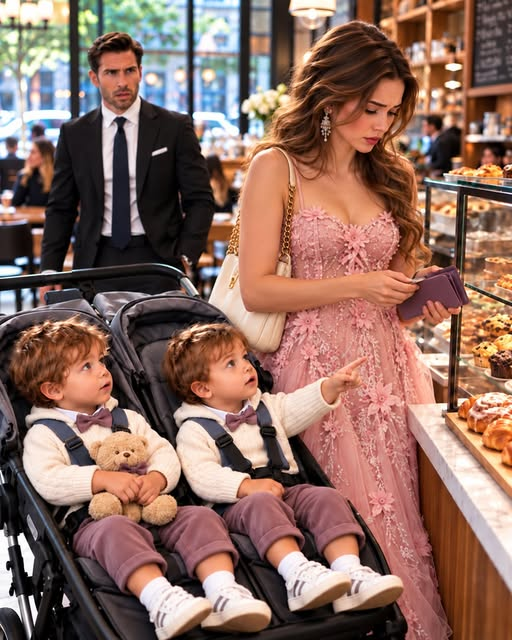
Nathan Harrison had closed billion-dollar deals in Dubai, New York, and London without blinking.
In the United States, people called him the King of Concrete. Wherever Nathan Harrison signed his name, luxury towers appeared. Shopping centers rose out of empty lots. Exclusive gated communities sprang up where nothing but luxury SUVs rolled through guarded entrances, and his signature was the thing that made it happen — thirty-eight years old, dark brown hair going silver nowhere, a face that had learned, over a decade of negotiation, to give away nothing at all.
He had not planned to be on Chicago's North Side that Friday afternoon. A site meeting had run long — a Harrison tower going up six blocks away, all glass and rebar and arguments about load-bearing steel — and when it finally broke, his driver was stuck in traffic on the far side of a jackknifed truck. Nathan did what he almost never did anymore. He walked.
The bakery was small and old and entirely beneath his notice, the kind of place his world paved over. Russo's, said the hand-painted sign. A bell over the door. He went in for coffee because the place smelled like cinnamon and warm butter, and because for one unguarded second he was not the King of Concrete. He was just a man who had skipped lunch.
He was standing near the pastry case, half turned toward the register, when he heard the coins.
Not the bright ring of a card reader. Coins. The small, careful music of change being counted out onto a counter, one piece at a time, by someone who could not afford to be wrong.
Nathan looked up.
Emma Parker stood at the register with her back half-turned to him, and the world went very quiet.
Five years. He had not seen her in five years — not since the week the lawyers finished with them — and his first thought, absurd and traitorous, was that she was still the most beautiful woman he had ever failed. Her long brown hair was pulled back in a simple ponytail. She wore inexpensive clothes, a plain sweater, a coat that had been good once. There was exhaustion in her eyes that no amount of sleep seemed likely to fix. She looked nothing like the woman who had once moved through charity galas at his side in designer gowns while the cameras flashed.
She looked like a mother who had learned how to survive alone.
Beside her stood two little boys. Identical. About four years old, with Emma's eyes and dark, unruly curls, dressed in matching sweaters and trousers gone soft at the knees. One of them — the bolder one, chin up — was staring through the glass of the display case at a tray of cinnamon rolls the way other men Nathan knew stared at waterfront property. As if they were treasure. As if they were the whole point of the world.
The other boy, quieter, stood a half-step closer to his mother's side, hugging a spiral notebook to his chest. Even from where Nathan stood, he could see the drawings on the cover page: planets, rockets, a child's careful solar system in crayon.
Nathan did not move. He was not sure he could.
The quieter boy tugged, very gently, at nothing at all, and whispered — but a small bakery is an honest place, and whispers carry.
"Mom," the boy said, "if there's not enough money, I don't need any bread."
Something in Nathan's chest simply stopped.
Emma smiled. It was the same smile he remembered from a hundred mornings in a kitchen that no longer existed — stubborn, unbending dignity dressed up as gentleness — and it undid him completely.
"There's enough, sweetheart," she said. "We just have to count carefully."
She went back to the coins. Nickel. Dime. Quarter. Her fingers were quick and unembarrassed. The boys watched the small pile the way congregations watch altars. Behind the counter, Mr. Russo — a broad, silver-haired man of about sixty-five, with flour on his apron and the face of someone who had decided long ago what kind of person he intended to be — packed their bread into a paper bag with the gravity of a man handling something sacred.
Then, quietly, without comment, Russo slipped two extra pastries into the bag.
"Go ahead and take them," he said. "Friday special."
Emma's head came up. "No, Mr. Russo, I can't."
"You'll hurt my feelings if you refuse."
A beat of silence. Her pride and her arithmetic fought it out in her face, and Nathan, watching, remembered that he had once been the richest thing in her life and she had never once taken anything from him she hadn't earned.
The boys cheered softly, the way children do when they understand that cheering too loudly might break the spell. Emma closed her eyes for one second — gratitude and humiliation in a single breath — and nodded.
"Thank you, Mr. Russo," she said, with more formality than the moment needed, because formality was a kind of armor.
"Friday," he said, and shrugged, flour and all, "is Friday."
Nathan watched her gather her sons the way she did everything, efficiently and without fuss. The notebook went under Noah's arm. The paper bag went into a tote worn thin at the straps. Ethan took her free hand; Noah took the hem of her coat, not because he needed holding up but because it was where his hand lived. She had a system. She had had five years to build it, in a life with no slack in it anywhere, and it ran beautifully, and it broke Nathan's heart in a place he had genuinely believed was load-bearing concrete.
He thought of her at twenty-six, in the emerald dress, at the Children's Hospital gala — the irony of the memory physically hurt — laughing with a glass of champagne she never finished, because Emma at a party was always halfway through three conversations about other people's work, other people's kids, other people's science fairs. She had been a teacher then, too. She had been a teacher when he married her, glowing with it, and he had loved that she was unimpressed by his money, right up until his money started being the only language he spoke at home.
The ponytail. The plain sweater. The counted coins. None of it had diminished her. That was the unbearable part. She had not fallen. She had been left — no. He corrected himself with the precision of a man auditing his own ruin. She had left, because leaving had been the only door he hadn't blocked with a tower.
Nathan stepped backward before she could turn around.
He did it without deciding to. One step, then another, the bell over the door mercifully silent because he caught it with his shoulder, and then he was outside on the sidewalk in the mild Friday light with his heart pounding as if he had just lost everything.
He stood there while his car found him. He stood there while the driver, well trained, said nothing at all. Through the bakery window, small and already far away, he could see the top of Emma's head bent over the counter, and two dark curls, and the paper bag.
Four years old, he thought. The boys were four years old.
He did the arithmetic all the way downtown, and the arithmetic did not care how much money he had. It just kept arriving at the same place.
That night he sat in his glass-walled office on the forty-first floor, overlooking a downtown Chicago that glittered like something he owned, which in no small part he did. He had tried to work. There were contracts on his desk that represented nine figures, and the words had swum and reassembled themselves into a small pile of coins on a bakery counter until he gave up and stood at the glass like a man in an aquarium of his own success.
The divorce had been five years ago. The twins — if they were twins, if the identical faces meant what identical faces meant — were four.
Born, at the latest, seven or eight months after the papers were final.
He remembered the week the marriage ended with terrible clarity, because his memory, traitor that it was, kept the deal and discarded the wife. A merger week. Three time zones in four days. Emma had put the papers in front of him at the kitchen island at midnight, between a term sheet and a soil report, and said — he could hear it now, which he could not have done then — *I can't keep being married to a man I have to make an appointment with, Nathan.* And he had said *not this week,* and signed, eventually, the way he signed everything that week: fast, trusting the lawyers, thinking there would be a later in which to fight for her properly.
There had been no later. There had been a finalized decree, and her maiden name restored like a country regaining independence, and silence so complete he had eventually filed it under dignity. Hers. She was proud; she would not beg; fine. He had told himself that story for five years, and it had held, right up until a small boy in a bakery whispered that he didn't need any bread.
His phone was in his hand for a long time before he used it. Marcus Webb had been his executive assistant for nine years. Marcus had been there for the wedding. Marcus had been there, in the outer office, for the end of it too.
Marcus answered on the second ring. "Nathan."
"I need information on Emma Parker."
There was a long silence. It was not an empty silence. It was the silence of a man deciding how much of what he knew he was allowed to say.
"Nathan…" Marcus said at last, carefully.
"Just tell me."
"Tell you what, exactly?"
"Everything," Nathan said. "Start with the boys."
The report arrived the next morning, in a plain folder, carried up by Marcus himself and set down on Nathan's desk with the care of a man delivering something explosive. Marcus did not sit. Marcus did not stay.
Nathan read it standing up.
Emma Parker. Thirty-one. Middle-school science teacher, Chicago's South Side. Address, a walk-up apartment. Employer, a public school with a leaking roof he could have replaced out of the petty cash of his conscience.
And then the page he had known, since the bakery, would be there.
Two children. Twin boys. Ethan and Noah. Age four.
Ethan: the elder by six minutes, bold, devoted — per the preschool's notes, which Marcus had somehow obtained — to cinnamon rolls and any machinery with wheels. Noah: quieter, artistic, a notebook of planets and rockets that went everywhere he did. Mild asthma. Both boys born at thirty-two weeks.
Born seven months after the divorce was final.
Nathan read that line four times. Seven months after. Which meant — he had to sit down to finish the math, and he was a man who had priced out a two-billion-dollar tower in his head on an airplane — seven months after meant she had been pregnant when the ink dried. It meant that two weeks, three weeks, a month after he signed his name to the end of his marriage without reading the weather in her face, Emma Parker had learned she was carrying his sons, and she had picked up the telephone exactly zero times.
He requested everything. Addresses. Employment records. School information. Financial history. It came through the day in tranches, the way bad news comes in hospitals, and he read all of it with the city going gold below him and none of it registering as anything but her name, her name, her name.
Emma took two buses to work every morning. Two. An hour and twenty minutes each way, in the dark half the year, to teach other people's children about volcanoes in a classroom whose science lab had been condemned before her students were born.
And at the bottom of the financial summary, in the same flat typeface as everything else, was the figure the whole report had been walking toward.
The twins' premature birth — the emergency delivery at thirty-two weeks, the weeks in the neonatal unit, the follow-up care, Noah's lungs — had left Emma Parker, after insurance, with a medical debt of nearly one hundred and twenty thousand dollars. She had been paying it down for four years, in monthly installments small enough to fit between rent and groceries, and at the rate she could afford, the report noted with an accountant's neutrality, she would be paying it until the boys were in high school.
One hundred and twenty thousand dollars.
Nathan Harrison had spent more than that on a watch. He had spent more than that, twice over, on the dinner where he'd signed the Meridian preliminary papers. Somewhere across the city, the mother of his sons counted coins onto a bakery counter so her boys could have bread, and owed a hospital one hundred and twenty thousand dollars for the crime of bringing them into the world seven months after he had signed her away without a fight.
He sat in the glass office long after the lights of the city came on, with the folder open and the number in front of him, and it was the first number in his entire life that he could not make smaller by looking at it.