The legal machinery took my mother fourteen months to finish grinding, and I will not pretend I enjoyed all of it.
Victoria Calloway was charged in the spring — fraud, forgery, and charitable theft, in counts Martin read to me off the indictment with the air of a man defusing something he was not entirely sure was disarmed. Eleanor Voss, in exchange for her ledgers and her testimony, received a cooperation agreement and the kind of public disgrace that doesn't require a prison to be complete. She moved to Arizona. She sent Naomi a letter, once, which Naomi read alone and never showed me, and answered — because Naomi is Naomi — with a single line that she did show me, because it made her laugh on a hard day: "I accept your apology. I do not accept that it was clerical."
My mother never apologized. I should record that plainly. She pled to a reduced set of charges on the advice of three law firms, received a sentence the newspapers called lenient and she called persecution, and went to serve it with her chin at the altitude it had cruised at her whole life. She refused my visits for the first year. That is her right, and I have learned — slowly, the way you learn everything true — that my forgiveness and her repentance are two separate countries, and I cannot annex hers.
The foundation took longer to heal than the headlines did. The forensic team stayed. Every diverted dollar we could trace, we traced; the Calloway family — meaning, in the end, me — restored the four point seven million to the foundation out of the estate, plus the interest, plus a penalty I insisted on naming publicly in the annual report, because a foundation that cannot say the word theft in its own report has learned nothing. Judge Reyes chaired the interim board.
And in the fall, the board did the smartest thing it had done in thirty years. It offered the directorship of the literacy and science programs to Naomi Vance.
She made them wait three weeks. She read the foundation's entire charter — the original one, my father's — with a pencil. She negotiated: her salary at the published scale, not a dollar of Calloway generosity; the science grants doubled; her classroom position held for one year while she built the program; and an ethics clause with her own name handwritten in the margin: no officer of this foundation, ever again, answers to a single signature.
"Your father wrote a good charter," she told me, signing it at Frank's bakery, because she said some contracts should only be signed in honest rooms. "He just trusted the wrong reader."
As for me — I learned to be a father the way you learn a language in middle age: badly at first, with an accent, in public.
There were Saturday planetariums. There were Wednesday science questions by telephone, at bath time, while I stood in my silent forty-first-floor office shouting distance from no one, answering why the sky was blue in installments as Theo demanded longer and longer explanations and Eli audited my facts against the notebook. There was a school science fair where I, Preston Calloway, who had negotiated with sovereign wealth funds, stood beside a volcano made of papier-mâché and was more nervous than I have ever been in a boardroom — because Theo had appointed me Assistant Sky Boss, probationary, and a man does not fail his probation in front of a volcano.
There was a night in November when Eli spiked a fever of a hundred and three and Naomi called me — called me, at two in the morning, first, before anyone — and I drove through a sleet storm with a pediatrician on speakerphone and arrived to find her in the hallway of the hospital where my sons had been born without me, and she put her forehead against my shoulder in the corridor and said, "I hate that I still know how to do this alone," and I said, "You don't have to prove that anymore," and we sat on either side of a small bed until the fever broke at dawn.
Theo, informed that I had stayed all night, promoted me. Assistant Sky Boss, no longer probationary.
Ordinary fatherhood, I discovered, is ninety percent logistics and ten percent being climbed on.
I learned the school run. I learned that Theo cannot find his left shoe as a matter of constitutional principle, and that Eli requires his socks without the toe seam that "argues." I learned to pack lunches under supervision — Naomi audited the first eleven — and to braid nothing, because there was nothing to braid, but to stand ready with the emergency hairbrush for Theo's cowlick, which had its own foreign policy. I learned parent-teacher night, where I sat in a chair built for a seven-year-old, in a two-thousand-dollar suit I have since given away, and listened to a tired, kind teacher tell me that my sons were "advanced in curiosity and behind in sitting," a diagnosis I recognized as hereditary.
I fixed a leaking sink in Naomi's kitchen with a wrench and a video call to Gerald, who knows everything. I assembled a bookshelf and only had to disassemble it twice. I attended a school play in which Eli played the Sun — a starring role, method-acted, with research — and Theo played a tree with one line, which he delivered with the eyebrow and brought down the house. I sat between Mrs. Alvarez and Frank in the third row, and I laughed until I cried at a tree, and no one in that auditorium knew or cared who Preston Calloway was, and it was one of the finest evenings of my life.
And I learned the hardest skill of all, which was leaving. Every visit ended. Every Saturday had a last page. A hundred times that autumn I stood in Naomi's doorway with my coat on and my sons hanging off my arms like fruit, and I went home to my silent apartment and did not call, did not text, did not engineer an excuse — because she had set the terms like treaty law, and the whole architecture of the new world was that her terms held even when they cost me. Especially when they cost me. A Calloway who can be trusted is a Calloway whose no is boring. I practiced being boring at the highest level.
In January, Naomi decided it was time.
She had thought about it the way she thought about everything — thoroughly, and with a pencil. "They already know," she said. "Children know the shape of a thing long before they know its name. Eli asked Mrs. Alvarez why Mr. Calloway cries at the telescope. Theo told his teacher his dad is 'far away being sorry.' We are the only people in their lives still using the wrong words, and I won't teach them that the truth is something adults hide."
We told them on a Sunday, at her kitchen table, with cocoa, because Naomi said no child should ever receive enormous news without cocoa. She did most of the talking. She told them that a long time ago, before they were born, she and I had been married; that some things had gone wrong and some people had done wrong things; that I had not known about them — that sentence she said very slowly and clearly, looking at me, and I understood she was giving my sons my innocence as a gift, one she had fought her own heart for — and that when I found out, I came as fast as I could, and that I would keep coming.
Theo considered. Theo always considers; it is his jurisprudence.
"So you ARE the dad," he said.
"Yes," I said. My voice did something unreliable. "I am. I'm sorry it took me so long to get here, Theo."
"You got here," said Theo, with the Calloway eyebrow at full elevation, "before Saturn. Eli said Saturn takes twenty-nine years. You're faster than Saturn."
Eli had not spoken. Eli was turning his mug in slow circles, watching me with those enormous dark eyes — my eyes, Naomi's patience.
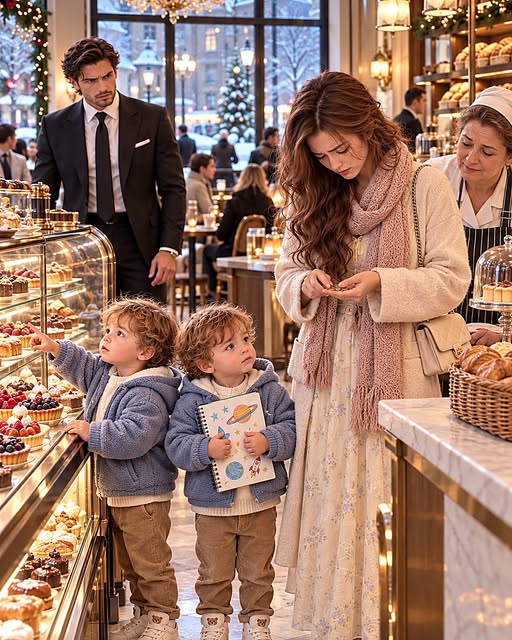
"Dad," he said, experimentally, like a scientist testing a hypothesis, and then he climbed down from his chair and came around the table and put his arms around my neck with the planet notebook still in one hand, so that it pressed against my back like a small, battered shield. "Okay," he said. "You can be in the notebook now. Under D. For Dad. I already wrote the page. I was just waiting to see."
He had written it months ago. There is a heading, STAR EXPERTS WE KNOW, and there is another page, in letters an inch tall, that simply says DAD — PENDING, and the date underneath is the date of the planetarium.
I did not cry in front of my sons that day. I want that recorded too, because a man should get credit where credit is due. I cried in the car, at the curb, for ten full minutes, and Gerald — who has driven Calloways for twenty years and seen everything — said absolutely nothing, and then, at a red light, reached back without looking and offered me a handkerchief the size of a flag.
In March, the boys turned five, and I attended their birthday for the first time — as Dad, a title two months old and still warm from the notebook.
I asked Naomi's permission for the telescope, because asking was the religion now. She considered the four-hundred-dollar question with her pencil face on, and delivered her ruling: joint gift. From both of us. Because a telescope from a guilty billionaire is a transaction, she said, but a telescope from your parents is a telescope. Theo received a star atlas and a question journal with a lock, which he informed me was for "secrets and also Saturn." Frank baked a cake in the shape of a croissant, because Frank contains multitudes. Mrs. Alvarez cried. The boys blew out five candles each — ten candles, because twins — and Theo announced his wish out loud, wishes being, in his jurisprudence, enforceable contracts: "I wish Dad comes to ALL the birthdays. Even the ones before." A small silence followed, in which four adults looked at the table. "He means retroactively," Eli explained, kindly, to the room. "We've discussed it. It's not possible, but it's the wish."
"I'll come to all the ones from now," I said. "Every one. That's not a wish, that's a schedule."
"Put it in the notebook?" Eli asked.
"Put it in the notebook."
He wrote it in his wobbly inch-high letters, under DAD — APPROVED, and dated it, and I understood that my sons were building the record my mother's office had tried to burn: a file that no one would ever be able to bury, because it was written in pencil, in love, and in triplicate — one copy in a battered notebook, and two copies running around a kitchen in sock feet, shouting about Saturn.
That night, Naomi walked me to her door. The boys were asleep. The hallway smelled of cocoa and crayons.
"Preston," she said. "I have a condition. For whatever this is becoming."
"Name it."
"Slowly." She leaned against the doorframe, tired and amused and entirely herself. "We were married in a cathedral the first time, with four hundred people and a string quartet, and it was worth approximately nothing. This time, if there is a this time, we do it at the speed of trust. You don't propose to me in a ballroom. You don't propose to me because a crisis ended. You propose to me — if you do — on an ordinary day, when nothing is burning, because ordinary days are the whole marriage. The rest is catering."
"I can do ordinary," I said.
"You are historically terrible at ordinary," she said, "but you are a gifted student." And she kissed my cheek — the first time she had touched me voluntarily in six years — and closed the door gently, like punctuation.
I stood in the hallway for a moment, listening to the apartment settle — a small cough from the boys' room, the refrigerator's hum, the tick of the radiator I had bled twice that winter and now maintained like a parish priest. Then I went down the stairs and out into the cold, past the door where a process server had once taped my mother's elegant trap, and I walked the four streets to my empty rental with my hands in my pockets and my cheek still warm.
Ordinary. A man can build an empire on deals and still have to learn ordinary at the kitchen table of his life, one bled radiator at a time. I had been a gifted student before, in classrooms that mattered far less. I intended — with a fervor I had once reserved for acquisitions — to graduate.