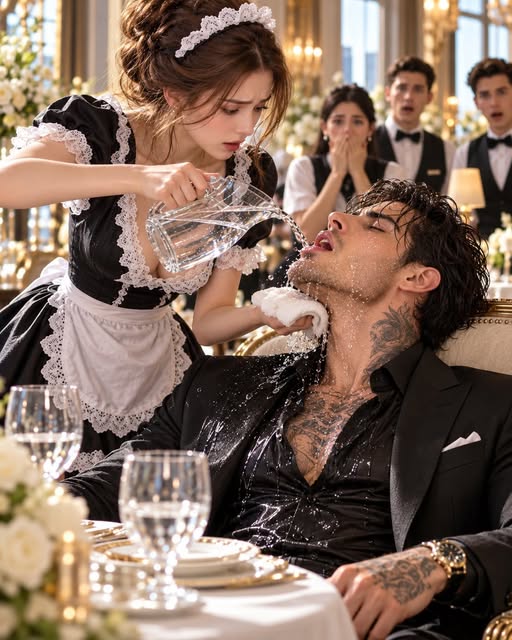
At 9:17 p.m. on a Friday night, I was the only waitress at Harborlight brave enough to walk toward table four, where Boston's most feared mafia boss was slowly dying in front of a dining room full of people who were pretending not to see it.
Dominic Romano's lips were turning blue. His hands had gone rigid on the white tablecloth, his fingers clawing at the linen like it was the only thing holding him upright. A thin line of blood was dripping from his nose onto the cuff of his black suit. His wine glass stood untouched beside a plate of food he had never raised to his mouth, and every instinct I had — every instinct I had earned sitting beside my mother's hospital bed for eleven months, watching monitors and learning what it looks like when a body starts to fail — told me that the man in the corner booth had minutes, not hours.
My name is Chloe Henderson. I am twenty-six years old, and until that night I was nobody. A waitress with an overdue rent notice taped to her fridge, a stack of my dead mother's medical bills beside her bed, and exactly one marketable skill: I could carry four plates at once and smile at men who spent more on a bottle of wine than I earned in a week.
Harborlight was that kind of restaurant. Old money, quiet money, money that did not like to be looked at directly. Our manager, Richard, ran the floor like a man defusing bombs. He knew every regular's name, every allergy, every scandal, and he made sure the staff understood the first rule of the house: the guests were scenery's audience, and we were the scenery. Invisible. Silent. Replaceable.
That evening, before service, Richard had gathered the servers by the kitchen doors with a look on his face I had never seen before. He was sweating through his collar.
"Nobody goes near table four tonight unless I say so," he said. "Nobody. Is that understood?"
I glanced past him toward the corner booth. A man sat alone in it, broad-shouldered, dark-haired, in a black suit cut so well it looked poured on. Dominic Romano. Thirty-nine years old. The name people in this city lowered their voices to say. He controlled the shipping docks, two casinos, a private security empire, and a criminal organization that made senators nervous. Newspapers called him the King of the Boston waterfront. The other waitresses called him something simpler, under their breath: the man you never, ever bother.
"Don't bother Mr. Romano, Chloe," Richard said, catching me looking. "He doesn't want some waitress interrupting his dinner. He values his privacy."
"I wasn't going to—"
"See that you don't." He smoothed his tie with a hand that was not quite steady. "Table four serves itself tonight."
I nodded and went back to my section, and for twenty minutes everything was ordinary. I refilled water glasses. I smiled at a couple celebrating an anniversary. I carried a tray past the corner booth twice and both times Dominic Romano sat exactly as he had the first time — still, composed, one hand resting near his wine, a man alone in a crowded room like the eye of a storm.
Then, on my third pass, I saw his shoulders stiffen.
It was small. Anyone else would have missed it. But I had watched my mother die by inches for the better part of a year, and I knew what a body looks like in the first seconds it stops obeying. His fingers tightened on the tablecloth. His jaw locked. His chest rose once, hard, and then barely rose at all, and when the candlelight caught his face, his lips had gone the color of a bruise.
Something was wrong. Something was very wrong. I'd seen similar signs while caring for my mother during her final illness — the shallow panic of lungs that can't pull air, the blue creeping in at the edges. Dominic Romano was suffocating at his own table, in silence, in a room full of people who had been ordered not to look.
"Someone call an ambulance!" I shouted.
The dining room went dead quiet. Richard was at my elbow before the words had finished echoing, his fingers digging into my arm hard enough to bruise.
"Chloe. Stop making a scene. Right now."
I pulled free. "He can't breathe!"
Then I ran. I don't remember deciding to run. I remember the sound of my own shoes on the hardwood, Rosa the hostess gasping at the podium, sixty heads turning at last. I reached table four and dropped to my knees beside the booth, and Dominic's eyes found me — dark, terrified, furious at his own helplessness. He tried to speak. Nothing came out but a thin, wet rattle.
I already had my phone out. I told the dispatcher the address, the age of the patient, the symptoms, as calmly as I could while my hands shook. Then I stayed exactly where I was, on my knees on the floor of a restaurant where I was supposed to be invisible, following the dispatcher's instructions and talking to a dying man like he was the only person in the world.
"Help is coming," I whispered. "Please stay with me. Just stay with me."
His hand trembled against the table. I took it and held on. And for one second — one second I will remember for the rest of my life — the most feared man in Boston looked at me like he was afraid, and squeezed my hand like I was the rope and he was going over the cliff.
Then the door crashed open and two enormous bodyguards came through the dining room like a weather event. One of them seized my shoulder and hauled me half to my feet.
"What did you do to him?"
I stared up at him. "I'm trying to help him! Let go of me—"
His grip tightened hard enough to hurt. "What did you—"
Dominic lifted one trembling hand off the table. It cost him everything he had. His voice was barely a breath, but in that silent dining room, everyone heard it.
"She… helped."
The bodyguard released me so fast I stumbled. The paramedics came in ninety seconds later with a stretcher and calm, competent hands, and they took Dominic Romano away into the Boston night with his oxygen mask fogging and his eyes still fixed on me until the doors closed between us.
I stood in the middle of the dining room shaking, in my uniform, with a dying man's blood on my sleeve, and I actually believed — God help me — that I had done the right thing.
The next morning, Richard called me into his office before service. My apron was folded inside a plastic bag on his desk.
"You're fired."
I stared at him. "What?"
"You embarrassed this restaurant in front of its most important clientele." He wouldn't meet my eyes. He kept looking at the bag. "You created a spectacle."
"He was dying, Richard."
"You caused a scene that is now in the newspapers."
"I called an ambulance. That's all I did. I called an ambulance and held his hand."
"And now everyone is talking about it." He slid the bag across the desk. "Get your things. Don't come back."
I walked home in the rain, crying so hard I had to stop twice. I had exactly eighty-three dollars in my savings account. My rent was three weeks overdue. My mother's medical bills were stacked beside my bed in a pile I had organized by color of envelope, because organizing them was the only control I had over them. And now I had no job, no income, and no idea what I had done wrong except refuse to watch a man die.
Over the next week, I applied to seventeen restaurants. Seventeen. I have the list still, written on the back of a grocery receipt. Not one of them offered me a job. Some never called back. Others went warm and friendly right up until the moment I said my name, and then something in their voices closed like a door. On the ninth day, a bartender I knew from a place in Southie finally told me the truth, lowering his voice like it was contagious.
"Richard's been calling around, Chloe. Told everyone you're unstable. Said you attacked a guest. Nobody's going to touch you while he's saying it."
I had saved a man's life. And somehow, I was being punished for it — methodically, by a man who had grabbed my arm and begged me, with his eyes, to let it happen.
Then, on a rainy Thursday evening, three black SUVs rolled to a stop outside my apartment building.
I watched through my window as men in dark suits stepped out into the rain with the unhurried precision of people who own whatever street they're standing on. My stomach dropped into my shoes. A knock came at my door — three raps, patient, inevitable.
When I opened it, I recognized the bodyguard from the restaurant. The one who had grabbed my shoulder. The one who had accused me. He looked, of all things, uncomfortable.
"Miss Henderson," he said. "Mr. Romano would like to speak with you. And—" He cleared his throat. "I owe you an apology."
Then he stepped aside, and there stood Dominic Romano.
Alive. On my landing. In a charcoal-gray suit with the rain beading on his shoulders, looking at me with those dark, unreadable eyes, like a man who had rehearsed this and still wasn't sure of it.
"May I come in, Chloe?"
I could barely speak. "Um. Yes. Of course."
He entered my tiny apartment alone; the bodyguards stayed outside. I saw the room suddenly the way he must see it: peeling paint, thrift-store furniture, the stack of unpaid bills on the kitchen table with the red FINAL NOTICE stamps. Heat flooded my face.
"Would you like coffee?" I asked, because it was the only sentence my brain produced.
He looked almost surprised. "Yes. Thank you."
I made instant coffee. In a chipped mug. The kind of thing a billionaire mafia boss had probably not touched in twenty years. He accepted it with both hands and without a flicker of complaint, and then he reached into his jacket, took out a thick envelope, set it on my table, and pushed it toward me.
"Fifty thousand dollars."
I stared at it. "What?"
"For saving my life."
Slowly, I pushed it back. "I didn't save your life for money."
Something crossed his face. "You lost your job because of that night. You have debts. Your landlord—" He stopped himself, and I understood with a chill that Dominic Romano had looked into my life the way he looked into everything: completely.
"I know I need it," I said. "That doesn't mean you owe me fifty thousand dollars."
"Then why refuse it?"
I met his eyes. "Because I would have helped you even if you didn't have a dollar to your name. You were dying. That's the whole reason. It doesn't get a price tag."
For a long moment, he didn't speak. He studied me like I was a language he had once known and forgotten. Then the warmth went out of his eyes, and he leaned forward, and his voice dropped.
"Chloe. I didn't come here just to thank you."
My heart started to hammer. "What do you mean?"
"Someone tried to poison me that night." He said it flatly, like a man reporting weather he'd already survived. "The doctors confirmed it. What happened at that table was not an accident, and it was not my heart. It was put in my wine by someone who wanted me dead before dessert."
I couldn't breathe properly. "Poison?"
"And someone at that restaurant made sure the one person who saved me lost her job for it. Made sure no one in this city would hire her. Made sure she looked crazy." He watched my face as the pieces fell. "Whoever wanted me dead knows you were the one who kept me alive. Your face was in the papers, Chloe. Your name. They know exactly who you are."
"Why would that matter?" My voice came out smaller than I wanted. "I'm nobody. I'm a waitress."
"Because you are the only witness who saw my table that night. Because you are the loose end." He glanced at the rain-streaked window, at the black shapes of the SUVs below, and then he looked straight into my eyes, and the last of the distance in him burned off. "I don't think you're safe here anymore. Pack a bag, Chloe. You're coming with me — tonight."