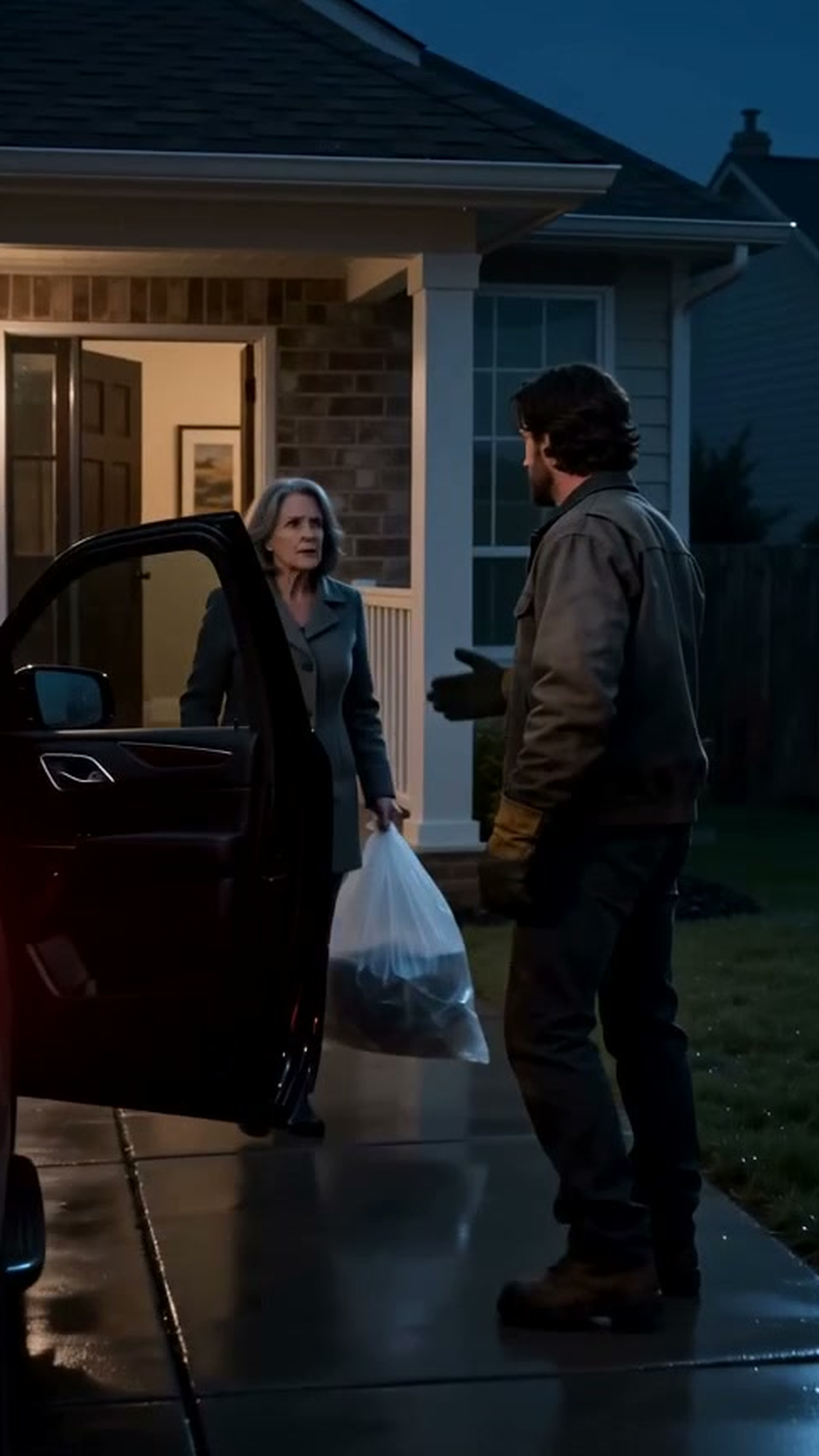
I didn't sleep after the glovebox.
I lay beside my husband in the dark and listened to him breathe and did the arithmetic of my marriage the way I'd once done the arithmetic of a call: what's the timeline, who knows what, what's the worst version of this that is still possible.
By Thursday morning I had decided on the worst version, because the worst version was the only one that explained the phone.
I called the insurance company from the parking lot of Lily's school, with the engine running and the rain from last night's storm still beading on the windshield. I used the policy number from the letter. I said I was Laura Bennett, that the mail had come to my house, and that I wanted to confirm the coverage on a policy I couldn't remember signing.
The agent was cheerful. The agent was helpful. The agent destroyed my life in under four minutes, in the tone of a woman reading out a grocery list.
Yes, Mrs. Bennett, a term policy, issued six weeks ago. Insured: Laura Marie Bennett. Face value: two million dollars. Beneficiary: Mark A. Bennett, one hundred percent. And yes, the homeowners' policy on the Katy address had been amended the same week — structure and contents coverage nearly doubled. And yes, there was a rider — she paused to check — a rider covering accidental death, which paid double.
"Did I—" I had to stop and start again. "Did I sign for any of this?"
"Your signature is on file, ma'am."
"And the premiums? Who's been paying the premiums?"
There was a soft clatter of keys, the mundane soundtrack of my own dismantling. "Bank draft, ma'am. Monthly. The account on file ends in 4417."
Mark's business account. The Bennett Builders account — the one with the failing loans, the one I'd been told not to worry about, the one that had been quietly bleeding money for two years while my husband paid, out of it, six hundred dollars a month to keep my death insured and current. I asked her for the dates again, slowly, and wrote them on the back of a school parking pass with a hand that had gone very steady, the way hands do when the mind steps back and lets the training drive. Six weeks. The policy was six weeks old. The rider was six weeks old. The doubled house was six weeks old. Six weeks ago Mark had come home from a meeting with his accountant — I remembered the meeting, I'd made him a plate and kept it warm — and kissed the top of my head at the kitchen island and said, "We're going to be fine, Laura. I'm putting some things in place." Things. He had put things in place. I was one of the things.
"Ma'am?" the agent said, gently, into my silence. "Is there anything else I can help you with today?"
"Yes," I said. "If anything ever happens to me — if a claim is ever filed on this policy — I want it noted on the record, right now, that the insured called on this date and stated she did not knowingly sign for it, and that she is afraid." I heard how it sounded. I said it anyway. "Can you note that?"
A pause, longer this time, and when she came back her voice had lost the grocery-list music entirely. "I've noted it, Mrs. Bennett," she said. "There's a reference number for the note. Do you have a pen?"
I already had the pen. I had the pen out before I'd finished saying the words, because some part of me had known since the envelope that Tuesday was never going to be the only thing I had to survive — there would also be the version of the story where I didn't, and in that version this reference number, read aloud in my own recorded voice, was the only sentence of it I would get to write myself.
I have never signed anything. My signature is on file the way my marriage was on file: as a thing that existed on paper, in a drawer, in a life that turned out to have a second set of books.
I sat in that parking lot for a long time. Then I did what seven years of dispatch trains into a person: I started a log. I photographed the letter. I photographed the glovebox phone, dead now, its screen black — I'd let it die on purpose, because a charged phone is a phone that can ring, and I needed Mark exactly as relaxed as he'd been on Wednesday night, turning me around the kitchen by my waist.
Thursday afternoon I drove to the Harris County dispatch center for the first time in two years, with a box of kolaches and a story about missing everybody, and I sat beside Dana Whitfield — my old training partner, my maid of honor, the godmother of my child — while she worked a console, and during a lull I said, very quietly, "If I ever call you from the road and I sound strange, I need you to treat it like a call. Not like a friend. Like a call."
Dana didn't ask a single question. That's the thing about dispatchers. She just said, "Copy," the way she'd said it ten thousand times, and reached over and squeezed my wrist once, hard.
Thursday night I cooked Mark's favorite dinner in the kitchen of the doubled house — pot roast, the three-hour kind, the kind that fills the rooms with a smell like safety — and I watched my husband eat it with appetite and tell me about sprinkler systems and soil compaction, and I did the thing that still, in my worst 3 a.m. audits, I cannot quite forgive or quite regret: I studied him for the man I'd married, the way you press on a bruise to find out how deep it goes. He was in there. That was the unbearable part. He passed Lily the rolls the way he always had, two fingers under the basket. He asked about her spelling test. He laughed once, genuinely, at something on the news. And all the while some schedule was ticking in him like a second pulse, and twice — twice — I caught his eyes moving past me to the hallway, to the thermostat on the wall beside the kitchen door, with the brief, assessing glance of a man checking a gauge. A thermostat. He kept checking the thermostat the way other men check a door they've locked, and I ate my pot roast and smiled and noted it in the log I kept in my head, in the column I had started, by then, to think of as evidence for a trial I prayed nightly would never have a date.
Friday morning, before the attorney, I did the banking. I want it in this record that I did the banking — that whatever else that week was, it was also a woman at a credit-union counter on her lunch break, opening a safe-deposit box in her own name with cash from three years of skimmed grocery money I will not apologize for. Into the box went the original insurance letter, the photographs printed at the drugstore kiosk like vacation pictures, and a sealed envelope with a one-page account in my handwriting: dates, times, the policy number, the reference number from my recorded call, the location of the second phone. On the outside of the envelope I wrote: FOR DANA WHITFIELD OR ATTY. RUIZ — OPEN IF I CAN'T. The young man who walked me to the vault asked if everything was all right, and I said, "It will be," with total sincerity, because I had just made the first thing that week that Mark Bennett could not amend, forge, double, or burn.
On Friday I went one step further, because fear that only sits in your chest is useless. I took my lunch hour and sat in the office of a family attorney named Ruiz two blocks from the courthouse, and I paid her cash retainer out of the grocery money, and I told her everything: the letter, the policy, the second phone, the message. Tuesday. After that, we're free.
Ruiz was quiet for a moment. Then she said, "Laura, I want you to hear me. If he's planning something financial — fraud — a paper trail protects you. If he's planning something else—" She stopped. We both looked at the word neither of us wanted to say, hanging in the air of her small office. "You don't go back into a situation your gut has already left. Do you understand me? Your daughter is eight. You follow your gut."
"I know," I said. "I'm not leaving him yet. If I run now, he knows I know, and I lose the only advantage I have."
"Which is?"
"He thinks I'm still the woman who threw that letter away."
It was true, and it wasn't noble. It was terror wearing the mask of strategy. Every night that week I cooked dinner in the kitchen of a house that a stranger had valued at double, for a man who had valued me at two million, and I smiled, and I asked about the Harper Group, and I watched my husband's face for the lie to slip — and it never did, not once, and that was the most frightening thing of all. The man was good. The man had been practicing.
He had been practicing for a long time.
Saturday, Mark took Lily to soccer, and I had ninety minutes and a house that no longer felt like mine, and I spent them in his home office.
I was looking for the policy's paperwork and found the loan instead — the 2023 Bennett Builders development loan, the one that had gone bad in Conroe, filed in a folder Mark had labeled, in his square hand, TAXES. Evelyn's signature was on the guarantor page. I know Evelyn's handwriting the way you know a face: eleven years of birthday cards, of recipe cards in a box on her counter, of tall slanted letters with a flourish on the capital E that she learned in a Texas schoolroom in 1973. The signature on the loan had her name. It did not have her hand. The letters were cramped, the E sealed shut like a fist, and on the line beneath — the witness line — sat Mark's own initials, small and hurried, as if even he had wanted to get off that page quickly.
I photographed it from three angles. I put the folder back at the exact slant I'd found it. And I stood in my husband's office doorway understanding that the arithmetic had a second column: whatever Mark was planning, his mother was standing in it up to her knees — as his victim or his partner, I couldn't yet tell, and I have never been more frightened by the limits of my own training, because dispatchers are taught that the caller is usually one thing. Life, I was learning, lets a person be both.
Sunday we went to Evelyn's for dinner, the way we had every Sunday of my marriage, and that was the day Lily changed.
She wouldn't go into Evelyn's kitchen. Lily, who had been stealing Evelyn's dinner rolls off the cooling rack since she was four, stood in the hallway of her grandmother's house with her backpack clutched to her chest — she'd insisted on bringing it, insisted on the stuffed fox too — and when Evelyn called her in to help with the biscuits, my daughter shook her head so hard her braids rattled.
"Evelyn," I said lightly, "she's been clingy all week. Phase, probably."
"Children sense things," Evelyn said. She was looking not at Lily but at Mark, and her face had something on it I had never seen directed at her son: not pride, not indulgence. Assessment. The way you look at a dog you're no longer sure of. "Don't they, Mark."
"She's fine, Mom." Mark's smile didn't move his eyes. "She's been having nightmares. About the house, of all things. Says the house is going to be loud." He laughed, and looked at me, and held the look one beat too long. "Kids."
That night, in our driveway, with Lily asleep in the back seat and the porch light burning over the door of our doubled, insured house, Mark leaned across the console and tucked a strand of hair behind my ear with a tenderness that made my skin crawl.
"Tuesday morning," he said, "after you drop me at the airport, just go straight home and rest, okay? You've been running yourself ragged. I'll text you when I land. Put the heat on — it's supposed to turn cold. Just go home, and rest."
He held my gaze. He smiled. And I understood that he had just given me my instructions for the day he intended to kill me — and that he expected me to follow them, all the way home, all the way to the thermostat, like a good wife turning up the heat against the cold.