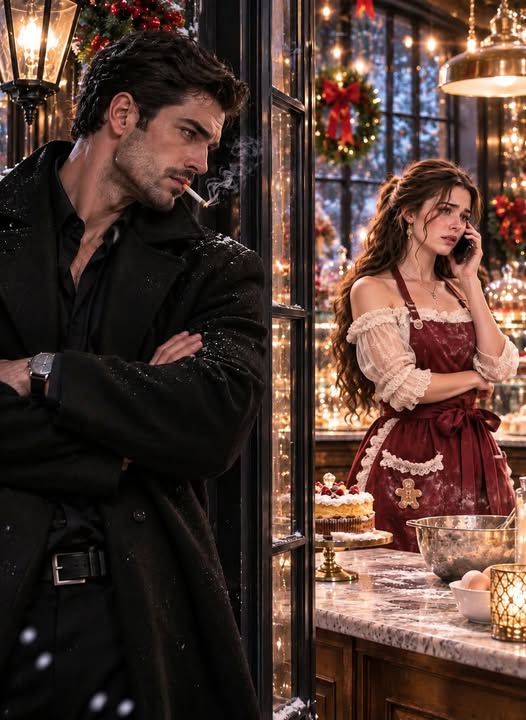
Nico's question, when it came at nine the next morning, was not the one I expected.
I arrived at Winter & Rye on Christmas Eve in falling snow, braced for spreadsheets and a shuttered shop. Instead I found the ovens already warming, Marco unloading crates of oranges and pine branches, and Nico Vale standing in the middle of my bakery in shirtsleeves, reading a list.
"For eleven years," he said, without preamble, "my family's foundation has held a Christmas Eve dinner. It began with my grandmother. Two hundred guests — foster children, shelter families, the people this city seats in its emptiest chairs." He looked up. "The hotel that hosted it lost its kitchen to a burst pipe on Monday. So it will be here. Tonight. And I am asking you to run it."
"Me?" I said. "Mr. Vale, I've never run an event in my life. I'm the girl with the notebook."
"You are the manager of this bakery," he said. "And the only person in this building I trust with food." He folded the list once. "You will be paid for the event separately. Maya and the staff have already agreed — at double rate, before you ask. Say yes, Clara."
I thought about my empty apartment. I thought about the tart in my fridge and the pajamas in a gift bag by my door and my mother's voice saying narrow seats.
"Yes," I said. "Yes. Let's feed two hundred people."
We worked like a small army all day. Maya arrived with bells actually tied to her shoes. The ovens never cooled. By five o'clock the bakery had been transformed — long tables where the cases had been, candles in jars, oranges studded with cloves, a tree in the window that Marco produced from somewhere and pretended he hadn't carried in personally, because apparently terrifying men have dignity to protect.
And the cake — my Christmas cake, the one with the sugared village — stood at the center of the dessert table, because Nico had found it in the display case and simply said, "That one stays."
At six, the first guests arrived, stamping snow off their boots, and the room filled with the specific, beautiful chaos of children who have been told there is cake.
I had run a bakery counter for three years, but I had never run a room like that, and I will tell you honestly: for the first ten minutes I was terrified. Two hundred people. Foster kids who'd been promised, in writing, a Christmas dinner with cake. Shelter families who arrived in the careful, apologetic way of people who have been moved along from too many doorways. Grandmothers. Teenagers pretending not to care and caring enormously.
Then the food started moving, and terror turned into choreography. Maya on the door with a list and a smile like a sunrise. Paige's rolls — no, Paige wasn't there yet; it was Luis from the morning shift on rolls, and old Mr. Abernathy — no relation to my neighbor, though Boston is a small town wearing a big coat — carving the hams with the concentration of a surgeon. And Nico Vale, the most feared man in Boston, in his shirtsleeves, carrying a tureen of soup to a table of eight-year-olds with the grave focus of a man defusing something, because a small boy in a too-big sweater had looked at the tureen, looked at Nico's face, and announced to the table at large: "That's the soup man. He looks scary but the soup is safe. I checked."
"You checked," Nico said.
"I watched you taste it," the boy said. "If it was poison you'd be dead. You're not dead. It's safe."
Something happened to Nico's face then that I had never seen on it — not the glacier, not the sea under the glacier, but a plain, helpless, human crack down the middle of it, there and gone. "Sound reasoning," he said gravely, and ladled the soup like it was communion.
A girl of about ten with braids like ropes followed me through three refills of cocoa before she finally asked, in the tone of a journalist, "Are you the cake lady?"
"I suppose I am," I said.
"My foster mom said this dinner is put on by a foundation." She pronounced it like a spell. "Is the foundation a person?"
"The foundation is a family that lost somebody," I said, because Nico had told me that much over the list that morning — his grandmother started it, the year she arrived, with eleven guests and a borrowed hall. "And the somebody believed nobody should sit alone at Christmas. So now there's soup. And cake."
"Good," the girl said, with enormous satisfaction, and took her cocoa back to her table, where she reported to a jury of other children: "The cake lady says the foundation is real."
I laughed until my eyes watered, alone by the ovens, and then I went and checked the dessert table for the fourth time — the tarts, the trifles, the rows of shining eclairs — and at the center, in the place of honor I'd chosen at five o'clock: my cake. White icing. Sugared cranberries. The little village, with its tiny lampposts and its dusting of sugar snow. I had made it for a family photograph I wasn't allowed in. It was feeding two hundred people instead. There was a lesson in that so large I couldn't look at it directly, so I looked at the cake, and I was still looking at it when the smallest guest of the evening — Ana, four years old, all curls and exhaustion — climbed me like a tree and fell asleep on my shoulder with her fist in my apron strings.
It was at half past six, with a little girl named Ana asleep against my shoulder and powdered sugar on my sleeve, that the bell over the door rang in its polite register, and my mother walked in.
The Aspen flight had been grounded by the storm; that much I learned later. What I learned in the moment was that Vivian Holloway did not cancel Christmas for weather — she relocated it. She had taken a private room at the Beacon Hill hotel across the street, summoned my family like staff, and then — because fate has a sense of humor that borders on cruelty — her pastry order had fallen through, and someone had told her that the little bakery across the street had the best Christmas table in Boston this year.
So she sent my mother to fetch it. And Vivian, curious about the place everyone at her party was suddenly discussing, came herself, in diamonds and impatience, with Paige trailing behind looking like a hostage in a cashmere coat.
My mother saw me across the room — me, with a sleeping child on my shoulder and a serving spoon in my hand — and her face did something complicated.
"Clara," she said. "There you are. We need the almond tarts, and the large cake, the one in the window, and whatever else you can box quickly. Vivian's dinner is at seven and the hotel's pastry chef has simply vanished, it's a crisis—"
"Mom." I kept my voice low. Ana slept on. "That cake is promised. Everything on that table is promised. Two hundred people are eating here tonight."
"Don't be selfish, Clara, not tonight. Vivian is waiting." She glanced around the room — at the foster kids in their donated coats, at the shelter families, at the tree, at me — and I watched her decide that all of it was somehow less real than a hotel dining room. "This is very sweet, sweetheart, but the Holloways are important. Paige's engagement announcement is tonight. Please don't make a scene about dessert."
"I'm not making a scene," I said. "I'm working. This is my bakery tonight. The answer is no."
Vivian Holloway had drifted closer, the way weather drifts in. She was sixty, silver-haired, flawless, with the serene cruelty of a woman who has never once been refused cake. Her eyes traveled over me — slowly, completely, in the way I had been looked at my whole life, the measuring look — and she smiled the smile I knew from every photograph I'd ever been cropped out of.
"Ah," she said pleasantly. "You must be the other daughter." She turned to my mother. "Lorraine, you didn't mention she works here. How fortunate — she can pack the boxes herself." Then, to me, with the warmth of a woman addressing a coat rack: "The large white cake, dear. And do try not to touch the icing with your fingers. We've had quite enough improvisation this evening."
The room didn't go silent the way it had for Nico. Worse — it went ordinary. People kept eating. A child laughed. My mother's eyes dropped to the floor, and Paige's face was a mask of horror she was too well-trained to act on, and I understood with a clarity that burned like swallowing ice: this was the whole thing. This was every Christmas. Not hatred. Just this — the assumption, flowing downhill forever, that I would be the one to step aside, pack the box, carry the chairs out of my own photograph.
My hand was shaking around the serving spoon.
"Mrs. Holloway." My voice came out quiet, and then, to my own astonishment, steady. "That cake was promised to the little girl asleep on my shoulder before it was promised to anyone. She has waited a year for a Christmas somebody meant. So no. I won't pack it. I won't pack any of it. This dinner is not your pantry, and I am not—" I had to stop and breathe. "I am not the other daughter. I am Clara Bennett. I manage this bakery. And you are welcome to buy a ticket to our New Year's gala like everyone else."
"Lorraine," Vivian said, in the tone of a woman noting a stain, "control your—"
"She isn't required to."
Nico's voice. From the doorway to the tasting room, where he stood with a crate of candles in his hands and Marco behind him, and I swear the candles were shaking, just slightly, because Nico Vale's hands were not entirely steady, and his hands were never unsteady.
"Mrs. Holloway." He set the crate down with care. "What a coincidence of venue. My office spoke with your family's bank this morning — a courtesy call, about the Holloway Group's credit line, which my holding company acquired last month." He straightened his cuffs. "I had planned to discuss the renewal after the holidays. Generously." The gray eyes came up. "I find my generosity is very responsive to how my manager is spoken to in her own shop."
Vivian Holloway's face changed the way a building changes when the lights go out floor by floor.
"Mr. Vale," she said. "I had no idea the girl was— I mean, I didn't realize—"
"That she was under my protection?" he said. "You do now. Lorraine." My mother flinched as he addressed her, gentle as a blade. "Your daughter made you an almond tart. Three layers. She told me so in my car last night, while I drove her home from the job her own family would have let her lose." He let that sit. "She is the finest baker in this city and the only person at this address whose opinion of her I require. The cake stays."
Then he did something I will remember on my deathbed. He took the serving spoon from my shaking hand — carefully, around Ana's sleeping head — and he held out his hand to my mother.
"There is an empty chair at the long table," he said. "It has been empty all evening, because its owner was working. Sit down, Mrs. Bennett. Eat something your daughter made. It is, I am told, your favorite."
My mother looked at the chair. She looked at me. And for the first time in my life, I watched Lorraine Bennett not know what she was worth in a room.
She sat down. Slowly. Like the chair might refuse her.
Paige came and stood beside me, out of Vivian's orbit for the first time all evening, and whispered, "Clara. I'm so sorry. For Aspen. For all of it. I knew, and I just— I'm so sorry," and I put my free arm around my little sister, and Ana slept through all of it, breathing warm against my neck, while Vivian Holloway made a phone call in the corner in a voice like a shutter coming down.
It should have been a perfect night. It nearly was.
At nine, as the last families were bundling into coats and Marco was handing out oranges like a general distributing medals, his phone buzzed. He read it, looked at Nico, and said one sentence that pulled the warmth out of the room by the roots.
"Julian Cross posted bail an hour ago."