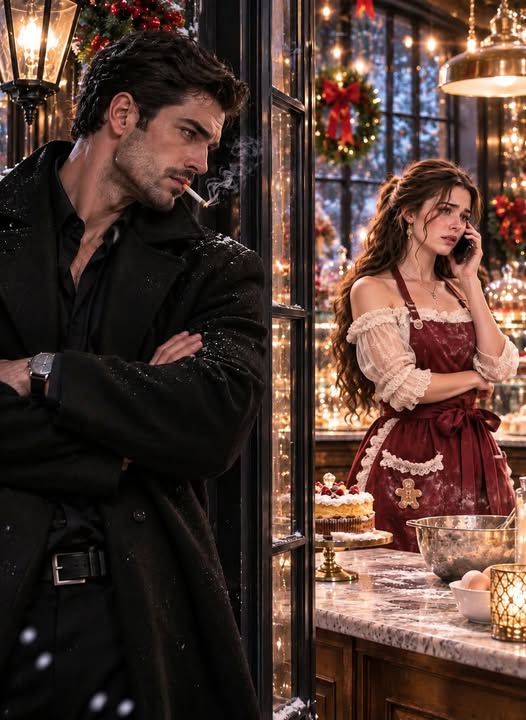
One year later, on the twenty-third of December, I stood behind the counter of Winter & Rye at 9:17 p.m. and looked out at my whole life, arranged in front of me like the sugared village on a cake.
The bakery had a line to the door — it usually did now, ever since a newspaper called us "the little bakery that burned and fed Boston anyway" and a food magazine used the phrase "the plum pastry worth crossing a blizzard for," which Nico had framed, to my endless teasing, in the office. My name was on the ownership papers in the drawer and on the small brass plaque by the register: C. BENNETT, PARTNER. My hand had healed to a pale map of lines I no longer hid. Maya ran the front of house like a benevolent air-traffic controller, with bells on her shoes that nobody had the heart to regulate.
My mother arrived at four in the afternoon — not summoned, not fetching, but arriving, with her tart in a carrier and an apron of her own folded over her arm, which she put on in my kitchen with the air of a woman enlisting. "Where do you want me?" she said. Lorraine Bennett, who had once uninvited me from Christmas over a seating chart, stood in my kitchen and asked for a job. I put her on the cranberry sauce, where she could do the least structural damage, and when the rush peaked she was out on the floor refilling cocoa for a table of foster children with her hair coming down and her good pearls still on, and a small boy in a too-big sweater — a year older now, and back for his second Christmas with us, because his foster mother had written to the foundation to request "the same bakery, the one with the soup man" — studied her with the gravity of a building inspector and announced, "You're new. Are you safe?"
"I'm the cake lady's mother," my mother said, and I watched her decide to make it true in public. "I am learning to be safe."
"She tastes everything first," the boy informed her. "That's the rule. So the soup man knows."
"Then I'll taste everything twice," my mother said gravely, and did, and laughed with her mouth full like a girl, and I had to go into the walk-in and stand among the cream for a moment, holding the door, being twenty-eight and six years old at the same time.
That was the thing about the year. It hadn't given me a different family. It had given me back the same one, repaired at the seams like a good coat — my father gone from the story, yes, but my mother relearning her own kitchen; my sister standing between me and every camera now instead of behind it; Grant, of all people, keeping the foundation's books for free because, he said, it was the first ledger he'd ever balanced that he was proud of. Even Vivian had thawed to the temperature of very expensive ice.
And Nico moved through all of it the way weather moves through a harbor — changing the pressure of every room, impossible to ignore — except that now he did it in the open, at my side, in the light, tasting the soup first.
Thirteen days straight, I had worked — my choice this time, my schedule, my bakery — because the twenty-third was our second Christmas Eve dinner, and this year we had two hundred and forty guests coming, and a second location opening in the spring that the papers were already calling "Vale's bakery empire," a phrase that made Nico look physically pained and me laugh every single time.
Dinner — the first one, with no curtain — had happened in February. He had answered every question. Every one. Some of the answers were hard, and one of them made me quiet for two whole days, and on the third day I had gone to the bakery at four in the morning and baked until my head cleared, and then I had called him and said, "I don't need you to be a different man than the one who came through that window. I need you to be that man on purpose, forever" — and Nico Vale, who does not beg, had said, "Clara Bennett, that is the only prayer I know how to answer," and we had been, since then, exactly what we were: inevitable, and careful, and happy in a way that still surprised me on ordinary Tuesdays.
Now the last customers were drifting out into the snow with their boxes, and the long tables were being set for tomorrow, and at 9:17 — the hour my life had once ended — my phone lit up on the counter.
"Mom," I answered, smiling. "Hi."
"Clara, sweetheart." No bright charity voice this time; just my mother, a year older and considerably more honest. "I'm confirming tomorrow. Your father— well. I've made the tart. Three layers. Mine's still lopsided, so don't set it near the window where people can compare." A pause, warm as an oven door opening. "Paige and Grant are bringing the chairs from the hall at noon. Grant measured the van. Twice. And Clara — I saved you the head of the table. Unless you'd rather—"
"I'd rather earn it arguing with you every year until we're ninety," I said. "Head of the table is fine, Mom."
"You'll wear the red dress?" she asked. "The one from the magazine photograph? You looked—" She stopped herself, and I heard her choose the true words over the arranged ones. "You looked like yourself in that photograph. That's why it was a good photograph. Wear the red dress."
"I'll wear the red dress."
I hung up and stood in the warm, cinnamon dark of the kitchen with tears in my eyes for exactly ten seconds — happy ones, which no longer required apology — and that was when I heard, from the doorway of the tasting room, a sound I had not heard in a year.
The velvet curtain, moving.
Nico stood there in an immaculate black suit, exactly as he had the first time — and entirely different, because now I knew the man inside it, and he was smiling in a way he reserved, I had learned, for a congregation of one.
"You can't keep doing that," I said. "One of these days you'll give Marco a heart condition."
"Marco is at the door turning away a food critic," Nico said. "We have approximately four minutes of privacy, which is, historically, all I have ever needed to change your life." He came toward me through my bakery — his bakery, our bakery — and stopped, and took from his coat pocket not a phone this time, but a small white bakery box. Ours. The kind we tied with string.
"Nico—"
"Open it."
Inside the box, on a bed of tissue, sat a plum pastry — sour-first, sweet-late, my recipe, the one that had finally, this autumn, made him close his eyes at the counter and say, "There she is. That's her. That's my grandmother," in a voice I'd had to pretend not to hear shake. And nestled against the pastry, in a twist of the tissue, was a ring. Platinum. One dark red stone, the color of plums, the color of the curtain.
"Sixteen Fridays I sat behind that curtain like a coward with a reservation," Nico said. "Then one Christmas I came through a window like a maniac with a sandwich board. My courtship technique is not consistent, Clara, but my intentions have been embarrassingly clear since the espresso went cold on the sixteenth Friday." He took the ring from the box with those still, careful hands — which were, I noted with a full heart, not entirely steady. "You wished, in this room, for one person who would notice if your chair was empty. I am asking to spend the rest of my life as that person — formally, publicly, in every photograph, at the head of every table, in the chair next to yours. Which will never be empty. That is the whole proposal. The rest is paperwork, and you may negotiate all of it."
"Is this a merger, Mr. Vale?" I managed, crying and laughing in the middle of my own bakery. "Because my partner taught me to negotiate."
"Everything is negotiable except the answer," he said. "And the answer, I should warn you, I have already heard. You said it in February. You said it in a hospital. You said it signing your name next to mine. You've been saying it all year, Clara. Say it once more, so it's in the minutes."
"Yes," I said. "Yes. In the minutes, in the papers, in the photographs — yes."
He slid the ring onto my finger, over the pale map of the burn, and it fit the way true things fit, and he kissed me in the kitchen of Winter & Rye with the ovens ticking as they cooled and the snow coming down over Beacon Hill like a blessing that had finally learned our address.
Marco, returning at midnight to lock up, found us still there — Nico asleep in the tasting room chair with his jacket folded under his head like a field soldier, me with the ledgers, closing out the year of my life. Marco looked at the ring, looked at his sleeping employer, and produced from his coat a bottle of something Italian and older than my marriage prospects had been.
"For the minutes," he said, and poured three glasses, and woke Nico with the care of a man defusing his own bomb, and the three of us drank to the bakery in the dark — to the foundation, to the ghost of a grandmother who started all of it with eleven guests and a borrowed hall, to burnt things that come back. "My grandmother," Nico said, raising his glass to the green lamp, "would have fed you all and sent the bill to God." Then he looked at me sideways, gray eyes soft in the lamplight. "She would also have said I took too long behind that curtain."
"She'd have been right," I said, and Marco — Marco actually laughed, out loud, a sound so rare that Nico and I both stared, "and I am putting that in the minutes too."
The next day we fed two hundred and forty people.
My mother sat in the room I was actually in, and ate her own lopsided tart beside mine, and did not compare them aloud, which for Lorraine Bennett is a form of poetry. Paige and Grant ran the cocoa station, and Grant — who now measured vans and washed dishes and called me "boss" with genuine respect — took the family photograph himself this year, on a timer, so that no one had to stand outside it. Vivian Holloway sent a hamper and a card with a sentence in it that I choose to believe was an apology; her family's credit line, I am told, was renewed on generous terms, with one new condition involving courtesy.
At the head of the long table, in the chair with the red cushion that Maya had embroidered with a plum when no one was looking, sat me — flour on my cheek, ring on my hand, my husband-to-be on my right and my mother on my left, in a room so full of noise and steam and candlelight that you could hardly hear the storm when it came, late, politely, as if even the weather had learned to knock.
I looked down the whole long table — two hundred and forty chairs, and mine, and his — and I thought about the girl who had once whispered to an empty room: just one person. Just one person who would notice if my chair was empty.
Every chair was full.
And in the photograph — the one that ran in the paper on New Year's Day, the one my mother framed, the one where the Mafia boss of Boston is laughing with his head back and his arm around the baker — I am not cropped, or hidden, or standing behind anyone.
I am at the head of the table, in the red dress, exactly where I belong.
THE END