My daughter was born on a Tuesday in May, at St. Brigid's Hospital, three floors below the room where her grandmother had fought her way back to life — because my mother was there for it. That is the first fact, and to me it is still the most miraculous one. The final procedure in November had succeeded beyond the surgical team's careful optimism; by spring, Margaret Hart was walking the hospital corridors under her own power, terrorizing the physical therapists, and on the morning of my labor she installed herself in the waiting room like a general taking a hill, informing the Varenna security detail, the nurses, and at one point a bishop who had come to visit another patient entirely, that her granddaughter was arriving and standards would be maintained.
She was right about the granddaughter, as she was right about most things. Seven pounds, two ounces. A full head of dark hair. Luca's eyes — I saw them open for the first time on his face across the delivery room and watched a man who had stared down councils, gunmen, and his own uncle look at three kilograms of newborn and come completely, helplessly undone.
"She's so small," he kept saying. "Evelyn. She's so small. How is she — look at her hands. Her hands are—"
"Functional," the midwife said dryly, "like her mother's."
We named her Isabella, for Luca's grandmother, whose ring I wore — and Rosa, for the nurse of thirty years before who had kept, in a shoebox in her closet, the duplicate records that Beatrice had quietly told us corroborated Calloway's ledger to the letter. Isabella Rosa Varenna. There were men in that hospital waiting room — board members, attorneys, the old guard of a hundred-year-old empire — who wept openly when Enzo came out and announced her name and weight, and I choose to believe it was not only because the succession of the Varenna family had just been secured in a pink blanket. It was because every person in that room had lived, in some way, inside Silvio's lie, and the small furious person in my arms was the living proof that it had failed.
She was christened in October, in the small stone chapel on the estate where Varenna children had been christened for a hundred years, and if that building had ever held a more dangerous congregation I would like to hear about it: the entire council in their best black, my mother in the front pew in a hat like a battleship, and the new heir of the family asleep through the entire ceremony with the serene indifference of a person who has already won every war she will ever need to.
It was afterward, over coffee and cake in the garden room, that Luca made the announcement about the godfather, and I watched old Mrs. Antoniou set down her cup with great care, the way you handle something that might be about to become interesting.
"Security through knowledge," Luca said, when the room had finished reacting. "Adriano knows exactly what a Silvio looks like from the inside — the patience, the paper, the smile. If, God forbid, another one ever rises in this family, I want the man standing beside my daughter to be the one who can smell it at fifty paces." He looked at his cousin. "He also knows what it costs to stay silent. Don't you, Adriano."
"Every day," Adriano said, and held his goddaughter — awkwardly, terrified, perfectly — while the photographer immortalized the moment Silvio's son pledged his life to the child whose existence his father had spent twelve years and a fortune trying to prevent.
Beatrice, who had come as a guest and stayed as family, looked at the photograph over the photographer's shoulder and said, "Put that one in the archive. In a hundred years they'll think we staged it."
"We did," said my mother. "That's what a family is. Staging the truth until it holds."
A lie that had governed a family for twelve years had been defeated, in the end, by two pink lines on a plastic stick.
Dr. Henry Calloway did not live to meet her, and I have made my peace with the complexity of grieving him. He recovered from the fire slowly and then declined, all at once, in February — but not before he had signed everything, sworn everything, and recorded six hours of testimony in a Portland hospital room with a federal stenographer at the foot of his bed. He died knowing the truth was out of his hands and into the world's, which his lawyer told us was the first peaceful expression anyone had seen on his face in years. Luca paid for his funeral and attended it, alone, standing at the back — not forgiveness, he told me, but acknowledgment: the man had lit the fuse and then, at the end, at terrible cost, had shown them where the bomb was. The family does not speak his name kindly. But it speaks it accurately, which in the Varenna family is its own form of respect.
Silvio was convicted in the spring, on counts that took the clerk four minutes to read aloud. He will be a very old man before he sees Boston Harbor again, if he ever does. Adriano testified. I want that known. He sat in a federal courtroom and described his father's safe, his father's handwriting, his father's twelve-year project, in a steady voice, while Silvio looked at the table. When it was over, Adriano went back to work at the ports — where the crews, who had despised him in October as the heir of a fraud, had by spring begun to call him *the one who declined*, which in dock language is apparently a title of enormous respect. He is Isabella's godfather. Luca's decision, announced at the christening to a room that gasped exactly the way dining rooms are not supposed to, and defended with the immortal words: "The job of a godfather is to protect my daughter from men like his father. Who knows the breed better?"
We married again in June, properly, in the garden of the Varenna house, with my mother walking me down an aisle of white roses on the arm of — at her insistence, and nobody argued — Enzo. Luca asked her permission first, formally, in her kitchen, like a suitor from another century; she made him sit through tea and an interrogation about his intentions that left two of his security men, listening in the hallway, visibly shaken. "You may marry my daughter," she concluded at last. "You already have, technically, but I gather we're doing it properly this time, and I approve of properly. Also—" and she leaned forward, this woman who had been dying when he first sent for me "—thank you. For my life. It's been useful. I intend to spend the rest of it being a grandmother, which I understand is a position of great power."
"You have no idea," said the most feared man in Boston, with feeling.
That morning, before the garden filled with guests, I found Luca in the study in his shirtsleeves, with the original folder open on the desk — Calloway's cream letterhead, the Boston General laboratory report, the referral note that had waited twelve years to be read. I thought he was going to burn it, the way he had burned our contract. Instead he took a sheet of the family's heavy writing paper and wrote, in his own hand, in the deliberate script he used for documents that mattered:
*Read by Luca Varenna, aged thirty-five, in the year his daughter was born. The summary is a lie, bought and paid for. The laboratory report is the truth. Whoever holds this file: read every page, question every summary, and never let anyone — doctor, uncle, or king — tell you what you are. — L.V.*
He folded the note inside the folder, closed it, and put it not in the locked drawer, where it had spent twelve years, but on the open shelf of the family archive, between his grandfather's war letters and his father's harbor ledgers, where any Varenna who ever went looking for the truth of things would find it in the ordinary light of day.
"Not a secret anymore," he said. "A record. There is a difference. Secrets are how Silvios happen." He turned and looked at me standing in the doorway in my dressing gown, with the hairdresser due in an hour and his daughter asleep down the hall. "First entry in her education. She will read it when she is old enough to understand what it cost."
"And until then?"
"Until then," he said, "she grows up in a house where page two is always read aloud." He came around the desk and took my hands. "Come on. We have a wedding to attend. Apparently I asked properly this time, and the bride said yes, and my mother-in-law has opinions about the seating plan that have already defeated two generals."
At the wedding dinner — twenty-four seats, forty candles, the harbor spread out below in the dusk exactly as it had been that first night — I sat beside my husband at the head of the table, in a dress the color of candlelight, with our daughter asleep in a bassinet between my chair and my mother's. Course followed course. Toasts were made. Old Mrs. Antoniou, who had watched Silvio draw a gun in that very room, raised her glass to Isabella Rosa and said, "To the heir they tried to erase," and the whole table drank, and I looked down the long candlelit expanse of Varenna men and women, allies and attorneys and judges, all of them raising their glasses to my daughter, and I thought about the night I had run from a dinner like this one with everyone's eyes on my back and a secret burning a hole through me.
Luca's hand found mine on the table. Not for the cameras. There were no cameras. "What are you thinking?" he asked, low.
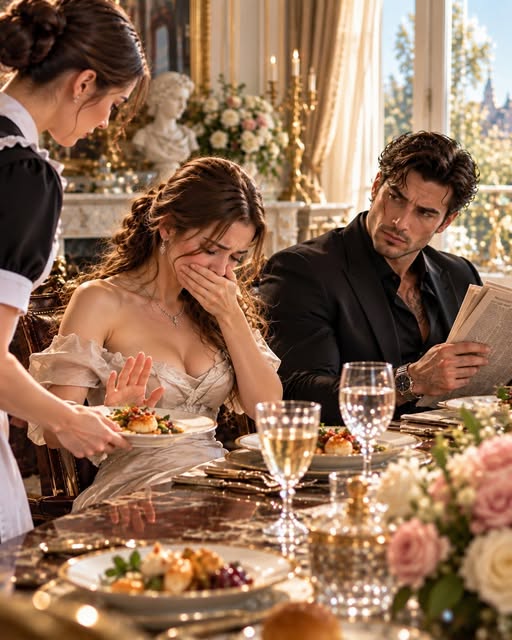
"I was thinking about the first dinner," I said. "The seafood. The bathroom floor. I thought my life was ending."
"No," he said. "It was beginning. It just had terrible manners about it." He looked down at the bassinet, at the small, sleeping, ruinously powerful face of Isabella Rosa Varenna, and then at me, and something in his expression — something quiet, and settled, and entirely unlike the carved-stone face he wore for councils — made my throat close.
"Twelve years," he said, "I believed I was a dead end. A family that stopped at me." His thumb moved over my knuckles, over his grandmother's emeralds, over the plain gold band from the contract that I had refused, in the end, to take off — because it was ours too, because all of it was ours. "And the entire time, the future of this family was just… waiting. For a woman brave enough to sit on a bathroom floor, look at two pink lines, and decide to tell a frightening man the truth."
"I was terrified," I said.
"I know," said my husband. "You told me anyway. That's what brave means. The rest of them—" his eyes went briefly, without malice, down the table of powerful men "—have been telling me what I wanted to hear since I was twenty-three. You are the only person alive who has only ever told me the truth."
Below us, Boston glittered, indifferent and beautiful, the way it had on the night everything began. Above the harbor, above the house, above twenty-four seats and forty candles, my daughter slept the sleep of a person for whom the world had been made safe at great expense and greater love — an heir with a father who had taken a bullet for her before she had a name, a mother who had run toward the truth with her hand over her heart, a grandmother who had refused to die before meeting her, and a family that had learned, at last and at cost, the most expensive lesson in the Varenna ledger:
That a dynasty is not kept alive by signatures, protocols, and lies in locked drawers.
It is kept alive by the truth, told out loud, in a room full of powerful men, by someone who loves you enough to say it.
And by two pink lines.
The end.