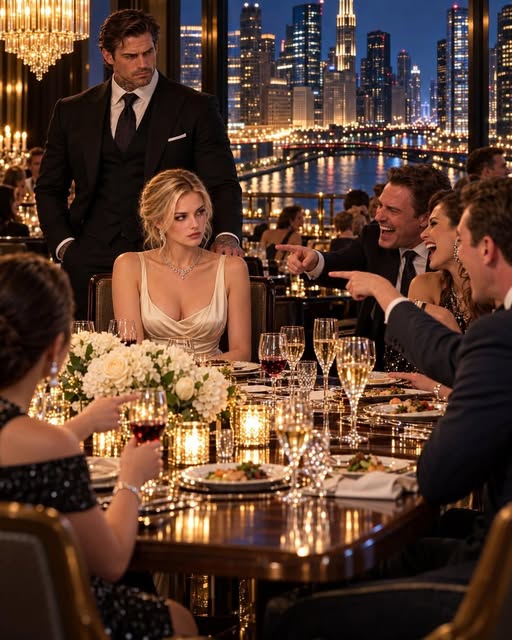
What did I do in Europe?
I set my glass down in its ring of condensation and considered how much truth that table could hold. All of it, I decided. I was done being edited.
"I fixed broken contracts," I said. "For people who could not afford to lose them."
Lorenzo made a sound. Vittorio raised one finger, and the sound died.
"For ten years I worked in maritime trade arbitration," I said. "Milan first, then Geneva, then Florence and Zurich. When a shipment of steel sat rotting in a port in Genoa because two companies had signed an agreement that didn't say who owned the rain — I was the person they called. When insurers and shipping lines and importers wanted to spend five years in court, they called me first, and I read their contracts the way surgeons read X-rays, and I told them where the fracture was." I looked around the table, slowly, at twelve men who had spent twenty minutes discussing my jewelry. "I was very good at it. In Geneva they didn't use my name in the settlements. They used my initials. S.L. Sophie Laurent. That was my name before it was Moretti."
The silence changed temperature.
Because Vittorio Bellini had gone completely still.
"Laurent," he repeated.
"Yes."
"In the spring of 2019," he said, "my family's fleet was seized in a dispute over a fuel surcharge clause. Three ships. Forty-one million dollars. Our own lawyers told us to settle and bleed. And then a memorandum arrived — eleven pages, unsigned except for initials — that took the other side's contract apart line by line and found the one paragraph that ended the matter in our favor in nineteen days." He was looking at me the way men look at paintings they once owned and lost. "My lawyers in Geneva swore the author was a retired judge. A ghost. I have wondered for six years who wrote it."
I picked up my wine. "The ghost charged by the hour, signore. Your family paid the invoice in nine days. I remember, because it was the fastest any client ever paid me, and I bought a coat."
"Tell me one," Vittorio said. "A case. Not the names — I know better than to ask a professional for names. The shape of it."
So I told him about Genoa, while the table listened and the Barolo went around, about a steel shipment and a monsoon and two companies whose contract had never once said who owned the rain. "Thirty-eight clauses about price," I said. "Eleven about insurance. Not one sentence about weather, in a contract to move forty thousand tons of steel through the Indian Ocean in September. Each side's lawyers had copied the other's draft for so long that the gap had become traditional. It was like a hole worn in a church step — everyone stepped over it because everyone always had."
"And you?" Vittorio said.
"I made them buy the rain," I said. "One sentence. Eleven words. The party whose vessel, whose risk — priced into the freight, shared by formula, so there would never be anything worth lying about. It took one afternoon. The dispute had been running for two years." I shrugged. "Most contract failures are not wicked, signore. They are tired. Men negotiate the numbers until midnight and leave the machinery to whoever is still awake. That is why the machinery matters. That is where the money actually lives — and where it dies."
Delgado, down the table, had begun, quietly, to take notes. On what, I was not sure — the new agreement had not started yet — but I recognized the motion. It is the motion of a man who has just discovered a whole floor of his own house that he never knew existed.
Lorenzo leaned toward his neighbor with a stage whisper meant to carry. "A talented hobby," he said in Italian. "Like the piano."
"Your hobby is spending," Vittorio said, without looking at him, in the same language. "Sit in your chair and be grateful one of you at this table has a trade."
It was the second time that evening that a Bellini had treated me like a professional, and my husband was sitting close enough to count. Dante registered it — I saw it cross his face like weather. Good, I thought. Let it rain on him a little. He had spent four years dry.
Down the table, Rocco was staring at me with his mouth open. Frank Delgado, my husband's lawyer, the man who had called the agreement on the table clean, was staring at the leather folder as if it had begun to tick.
"You saved this family forty-one million dollars," Vittorio said, "and my son has spent the evening explaining handbags to you."
"It is a common mistake," I said. "He is not the first man to make it. He is only the first to make it in front of his father."
Vittorio laughed again, and then he did the thing that rearranged the entire evening. He took the leather folder, closed it, and slid it — not to Dante, not to his own attorneys — down the table to me.
"Then nobody signs anything tonight," he said. "Mrs. Moretti will read the agreement. All of it. When she is finished, we will meet again, and we will discuss a contract that says who pays when my wine is late." He rose, and the whole table rose with him, and he came around to my chair and took my hand and bowed over it with the formality of an older and more dangerous century. "Your husband," he said, "is a fortunate man. I am not certain he knows the amount of his fortune. But I begin to."
Lorenzo did not bow. Lorenzo stood at his father's shoulder with his face arranged into something that wanted to be contempt and kept slipping into fury, and I memorized it the way I memorized clauses, because I had been in this profession long enough to know that a humiliated man with power is not an ended problem. He is a scheduled one.
In the car, the silence had a weight, like snow on a roof.
Dante drove himself — he had sent the driver home, which he only did when he wanted no witnesses. The river went past on our left, black and hammered silver. I waited. I had learned that in arguments with Dante, the first to speak usually lost; he was a negotiator the way wolves are gardeners.
"You humiliated me in my own restaurant," he said at last.
"I answered an insult in my own defense. In your restaurant. At your table. While you were laughing."
"I was not laughing at you."
"Dante." I turned in my seat. "I have spent ten years listening to men in rooms exactly like that one, and I am going to tell you what I heard, since apparently it needs translating after all. I heard Lorenzo Bellini call your wife a decorated fool for twenty minutes. I heard twelve men decide it was acceptable. And I heard my husband — the man who put a diamond necklace on me tonight like a label on a bottle — decide that the price of the Bellinis' shipping routes was me, sitting there, taking it." My voice did not rise. It did the opposite, and he knew me well enough to understand what that meant. "You didn't laugh at the joke, Dante. You paid with me."
He drove two more blocks before he spoke, and when he did, the command was gone out of his voice, and what was left was worse: honesty.
"If that agreement fails, I lose the import business inside of two years. The restaurants follow. Then the territory — the Castellanos are already counting my warehouses like teeth. My father built this family out of a dock and a debt, and he died with men still calling him a smuggler. Everything I have done for fifteen years has been to make the name Moretti mean something that lasts." His hands tightened on the wheel. "Tonight I told myself that one dinner was a fair price. That you would understand the arithmetic."
"I understand arithmetic better than anyone you know," I said. "That's the entire problem. You never did the arithmetic on me."
We didn't speak again that night. He slept — if he slept — in the room he used when shipments came in at 4 a.m., and I lay in our bed wearing the silence of the penthouse like a second necklace. I did not cry. Instead, I did what I had always done when a thing was broken: I began, methodically, to read the situation for flaws. My marriage had a liability problem too. Neither of us had established who pays when love arrives late, or short, or damaged. I had signed that agreement without reading it either. It was not a comforting professional conclusion.
I thought about the night I met him, because bad nights send you back to first ones, looking for the clause you missed.
The children's hospital gala, eight months after I came home from Europe with two suitcases and a burned career. I was there because Claire's Chicago cousin sat on the board and had begged me to fill a seat at a table of donors. Dante Moretti was the evening's underwriter — the name on the program, the man the room organized itself around. He asked me to dance during the auction intermission. He danced the way he did everything then: correctly, and without revealing anything.
"You've been watching the auctioneer for an hour," he said, "like he's a witness you're cross-examining."
"He's skipping the reserve prices on the signed lots," I said. "Three lots have sold under reserve. Somebody's charity is leaking."
He looked at the stage. He looked back at me. "Who are you?"
"A guest," I said. "Nobody's."
It was the truest thing I had ever said and the least examined. He laughed — the real laugh, the one I would hear again years later over a corrected contract — and said, "In my experience, the somebodies are the ones who say that." And still, he never asked. Not that night, not on the tenth date, not at the wedding we had in a garden in Lake Forest with ninety guests and a string quartet. He knew I had lived in Europe. He knew I read contracts at breakfast the way other people read horoscopes, because I had caught an error in our own caterer's agreement and saved him four thousand dollars and he had toasted me for it, delighted — a party trick, a charming eccentricity of his beautiful wife. He had never once asked what I had been, over there, before I was his.
And I had let him. That was the exhibit I kept returning to, lying in the dark. I had been so tired of rooms that went quiet when S.L.'s reputation entered them first. A man who didn't know felt like a room with the lights off — restful, private, safe. I had confused being unknown with being known by the only person whose knowledge I actually wanted. It is the oldest error in my profession: I had mistaken the absence of a clause for the presence of protection.
In the agreement of my marriage, nothing at all had been established. Not who pays. Not who asks. Not who reads.
Well. I was reading now.
At eight the next morning, a courier brought a leather folder to the penthouse. Inside was the full Bellini–Moretti import agreement — three hundred and twelve pages, with Vittorio's card paper-clipped to the first page.
On the card, in a hand like iron filings, he had written: *Read it the way you read mine in 2019. — V.B.*
Dante stood in the kitchen doorway with coffee he wasn't drinking, watching me open it. I took out the red pen I had carried in every bag I owned since Geneva — the pen of S.L., the ghost, the retired judge — and uncapped it.
"Three days," I said. "Maybe four. Don't hover."
"Sophie—"
"You wanted this contract handled," I said, and turned the first page. "Let me handle it."