The telephone kept ringing.
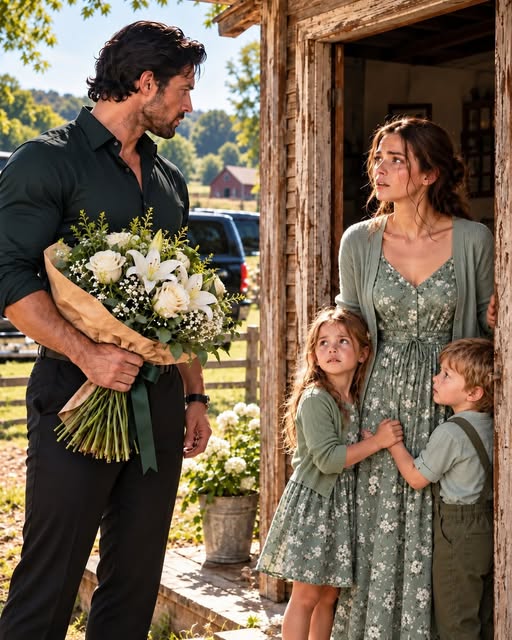
Daniel stood motionless on my porch, waiting for an answer to the question I had spent eight years hoping I'd never have to hear.
“Is she mine?”
I looked at the kitchen window.
Violet had disappeared from view. Ben's little green toy tractor sat abandoned on the windowsill, exactly where he'd left it that morning.
A toy tractor.
A glass of lemonade.
A child asking an innocent question.
Such ordinary things, and yet the entire life I'd built suddenly felt as fragile as the glass Daniel was holding.
“I can't talk about this right now,” I whispered.
“Emily, please.”
“Not in front of my children.”
He looked toward the door, and a terrible realization seemed to cross his face.
He had spent nine years believing I was somewhere beyond his reach, perhaps happily remarried, perhaps forgetting him a little more each year.
He had never considered the possibility that his own future might have been growing up in a farmhouse without him.
But I wasn't prepared to give him an answer simply because he'd finally decided to ask the question.
“I'll call you,” I said.
“You don't have my number.”
He reached into his pocket and pulled out a business card.
Even after nine years, he still carried those expensive white cards with his name embossed in dark lettering.
Daniel Whitmore. Chairman and Chief Executive Officer. Whitmore Holdings.
I remembered the first time he'd handed me one as a joke.
We'd been twenty-three, standing in line at a coffee shop in Boston. He had told me that if I ever needed anything, I could contact his office.
I'd laughed and written my number on the back.
He'd called me before I even reached the sidewalk.
That had been the man I'd fallen in love with.
Not the billionaire.
Not the heir to a fortune.
Just Daniel.
Now I took his card with trembling fingers.
“I'll be in town,” he said. “The inn on Main Street.”
“Fine.”
“I won't come back unless you ask me.”
That promise mattered.
Not because I trusted it yet, but because he hadn't tried to cross the threshold after I told him to leave.
He placed the lemonade glass on the porch railing, collected the fallen flowers, and carefully set the bouquet beside the door.
Then he stepped backward.
“I know I don't deserve anything from you,” he said. “But if there's something I need to know, please don't let my mistakes hurt them.”
I looked at him.
“Your mistakes already have.”
He absorbed the words without argument.
Then he turned toward the gravel driveway.
I watched him walk away.
He paused beside the dark pickup, glanced once toward the farmhouse, and continued down the drive toward the rental car he'd parked beyond the gate.
I stood there until he disappeared from sight.
Only then did I close the door.
And only then did my knees begin to shake.
“Mommy?”
Violet stood near the kitchen entrance.
Ben was beside her, clutching his stuffed rabbit.
“Did the sad man leave?” he asked.
“Yes, baby.”
“Is he coming back?”
“I don't know.”
Violet studied me.
“Are you crying?”
I touched my face.
My cheeks were wet.
I hadn't even realized it.
“Just a little.”
She walked toward me and wrapped her arms around my waist.
“You can have my good blanket tonight,” she offered.
That nearly undid me.
My daughter had inherited my mother's kindness and Daniel's dark, thoughtful eyes.
Sometimes looking at her felt like looking at everything I'd lost and everything I'd been given, all at once.
I hugged her tightly.
“Thank you, sweetheart.”
But when I finally got the children settled with their afternoon snack, I went upstairs and opened the old cedar chest at the foot of my bed.
Inside, beneath winter sweaters and a stack of birthday cards, was a photograph from another lifetime.
Daniel and I were standing beneath the chandeliers of the Whitmore mansion.
He was wearing a tuxedo.
I was wearing a simple ivory wedding dress.
He had one hand against my cheek, and I was smiling so widely my eyes had nearly disappeared.
On the back, he'd written:
No matter how big this world gets, you will always be my home.
I sat on the edge of the bed.
And suddenly, I was twenty-five again.
Nine years earlier, the Whitmore mansion had smelled of fresh roses and polished wood.
It was a magnificent house in Connecticut, with forty-two rooms, a marble entrance hall, a sweeping staircase, and gardens maintained by a staff of twelve.
I never felt entirely comfortable there.
I'd grown up in a modest Pennsylvania neighborhood where my mother clipped grocery coupons and my father worked double shifts at a machine shop.
In our house, people washed their own dishes.
At the Whitmore mansion, people quietly appeared to take away your empty glass before you realized you'd finished drinking.
Daniel used to laugh when I insisted on making my own breakfast.
“You married into a very ridiculous family,” he'd say.
“I married you.”
He'd kiss my forehead.
“Then God help you.”
For the first three years of our marriage, he was everything I could have wanted.
He remembered anniversaries.
He sent me handwritten notes.
He attended my father's funeral and stood beside me when I could barely remain upright.
He bought me expensive things I never asked for, but he also stopped beside the road whenever he saw wildflowers because he knew I'd love them.
I believed our marriage was stronger than the difference between our worlds.
I was wrong.
The change began when Daniel's father, Robert Whitmore, suffered a stroke.
Robert had founded Whitmore Holdings decades earlier and built it into a company worth billions.
He was difficult, demanding, and sometimes frighteningly direct.
But he had always treated me with kindness.
“You're the only person in this house who tells my son when he's being an idiot,” he told me once. “That makes you valuable.”
After his stroke, Daniel became acting chairman.
Overnight, my husband transformed into a man who slept four hours a night and spoke to lawyers more often than he spoke to me.
His mother, Judith Whitmore, seemed delighted by the change.
Judith had never liked me.
She was the kind of woman who could insult someone while making it sound like concern.
At our wedding rehearsal dinner, she'd smiled and told me, “I hope you understand, Emily, that marrying into this family requires a certain level of sophistication.”
I smiled back.
“And I hope you understand that marrying Daniel doesn't require your approval.”
She never forgave me for that.
For years, she'd made little remarks about my clothes, my manners, and my family.
But after Robert's stroke, those remarks became something darker.
She began asking questions about my access to the Whitmore Family Foundation.
I had volunteered to organize some of the foundation's charitable records because the accounting office had fallen behind after a staffing change.
The foundation provided grants to rural schools, food banks, and medical clinics.
It was the one part of the family business that made me feel useful.
Daniel had encouraged me to help.
His mother hadn't.
“You're not an accountant,” she reminded me one afternoon.
“No, but I can organize invoices.”
“Sometimes enthusiasm is more dangerous than incompetence.”
I'd ignored her.
I should have paid closer attention.
The foundation's chief financial officer, Charles Mercer, was a polished, silver-haired man who had worked for the Whitmore family for nearly two decades.
Everyone trusted him.
Daniel trusted him.
Judith relied on him.
Robert had once described him as “a man who knows where every dollar is buried.”
At the time, I thought it was a compliment.
Three weeks before our marriage collapsed, I noticed something strange in the foundation's records.
A grant of $2.4 million had been transferred to an organization supposedly building medical facilities in rural Appalachia.
The organization had a legitimate-sounding name.
But when I called the number listed on the paperwork, it was disconnected.
I searched the state charity registry.
Nothing.
Then I compared the bank authorization records with the foundation's internal ledger.
The money had been transferred using an approval code associated with my temporary administrative account.
My account could organize documents.
It wasn't supposed to authorize payments.
I immediately called Charles Mercer.
He arrived at the office within twenty minutes.
“It's a reconciliation error,” he assured me.
“Then why does it show my approval code?”
“Software issue.”
“Shouldn't we tell Daniel?”
His smile vanished.
“Daniel has enough problems right now.”
“I think he'd want to know.”
Charles leaned forward.
“Emily, these systems are more complicated than you realize. Let the professionals handle it.”
I didn't like his tone.
That evening, I told Daniel about the transfer.
He was sitting at his desk, staring at a stack of quarterly earnings reports.
“Mercer says it's a technical error,” I explained.
Daniel rubbed his forehead.
“Then let him correct it.”
“But the authorization—”
“Emily, please.”
He looked exhausted.
“I've had three board members threaten to resign today. My father can barely speak. Can we discuss this tomorrow?”
I wanted to tell him that something felt wrong.
Instead, I kissed his forehead.
“Tomorrow,” I agreed.
Tomorrow never came.
Two days later, Daniel's mother accused me of stealing the money.
I still remembered every detail.
The sound of rain against the windows.
The silver tray of untouched coffee.
The heavy curtains in Daniel's study.
And Judith Whitmore standing beside the fireplace holding a thick folder.
Daniel was behind his desk.
Charles Mercer stood beside him.
Neither man would look at me.
“What's happening?” I asked.
Judith slowly opened the folder.
“We've discovered something very disappointing.”
She placed a bank statement on the desk.
My name appeared beside a transfer authorization.
Beneath it was what looked like my signature.
I stared at the paper.
“I didn't sign that.”
Judith sighed.
“Emily, please don't make this uglier.”
I looked at Daniel.
“What's going on?”
He finally raised his head.
“Did you transfer money from the foundation?”
“No.”
“Emily.”
“I said no.”
Charles stepped forward.
“The approval was processed through Mrs. Whitmore's account. The destination company is connected to a bank account created with information from her former address.”
My old Pennsylvania address.
The one I'd lived at before marrying Daniel.
I felt sick.
“That's impossible.”
Judith folded her hands.
“We understand you've had difficulty adjusting to our family's lifestyle.”
I stared at her.
“What does that have to do with anything?”
“Sometimes people who come from less fortunate circumstances develop unhealthy relationships with money.”
I turned toward Daniel.
“Are you hearing this?”
He looked away.
And that was the first moment I knew something terrible was happening.
Not because his mother had accused me.
But because my husband had stopped defending me.
“Daniel,” I whispered, “you know me.”
He didn't answer.
“You know I wouldn't steal.”
His jaw tightened.
“Then explain the records.”
“I can't explain documents someone forged!”
“Please lower your voice.”
I remember staring at him.
Not at Judith.
Not at Charles.
At my husband.
Because those four words were more devastating than the accusation itself.
Please lower your voice.
He wasn't asking whether I was innocent.
He was asking me not to embarrass him.
I stepped closer to his desk.
“Look at me.”
He did.
I could see that he was hurting.
I could also see that he had already made a decision.
“Tell me you believe me,” I said.
His silence lasted only a few seconds.
It felt like an eternity.
“Emily,” he finally said, “I don't know what to believe anymore.”
Something inside me broke.
Judith placed another document on the desk.
A separation agreement.
It offered a financial settlement in exchange for my agreement not to challenge the foundation's allegations or speak publicly about the matter.
I didn't even touch it.
“You planned this?”
Daniel looked at the papers.
“It's temporary. Until we understand what happened.”
“Then why is there a separation agreement?”
“Because we need distance.”
I remember laughing.
A terrible, disbelieving sound.
“Distance?”
“You can't stay here tonight.”
The words were so quiet that I almost didn't understand them.
“Excuse me?”
Daniel stood.
“Mother has arranged a car.”
I stepped backward.
“You're throwing me out?”
He looked miserable.
But he didn't correct me.
Outside, thunder shook the windows.
I remembered thinking that storms had never frightened me before.
Now I couldn't breathe.
“Daniel, please. We can investigate this together.”
“I can't do this right now.”
“I am your wife.”
He looked toward the floor.
“Not everything can be fixed by saying that.”
I stared at him.
Then I removed my wedding ring.
My fingers were shaking so badly I dropped it onto his desk.
The small diamond made a soft clicking sound against the polished wood.
It was the loudest sound in the room.
“If you let me walk out of this house tonight,” I whispered, “don't expect me to come running back when you decide I'm worth believing.”
Daniel didn't move.
Judith called for the housekeeper.
Ruth Bell appeared in the doorway.
She had worked for the Whitmore family longer than I'd been alive.
She looked at my face, then at the papers on the desk.
I saw understanding turn into horror.
“Mrs. Whitmore?” she whispered.
“Please help Emily pack,” Judith said.
Ruth's lips pressed together.
For a moment, I thought she might argue.
Instead, she took my hand.
“Come with me, dear.”
Upstairs, Ruth helped me fill the old blue suitcase.
Not the beautiful luggage Daniel had bought for our honeymoon.
The old one with the broken wheel.
I wanted something that belonged to the girl I had been before I became a Whitmore.
Ruth carefully folded my sweaters.
She didn't ask questions.
But when she placed my grandmother's photograph inside the suitcase, she whispered, “Don't sign anything tonight.”
I looked at her.
“Why?”
She glanced toward the hallway.
“Just promise me.”
I promised.
Before leaving, I walked downstairs one last time.
Daniel stood beside the front windows.
His hands were in his pockets.
I waited for him to turn around.
To stop me.
To say he loved me.
To tell me the marriage we'd built mattered more than a folder full of suspicious documents.
He didn't.
The security guard opened the front door.
Rain blew into the entrance hall.
I dragged my suitcase down the marble steps.
The broken wheel caught against the edge of the driveway.
I nearly fell.
And still, Daniel didn't come after me.
That night, I stayed in a motel thirty miles away.
I cried until morning.
Three weeks later, I discovered I was pregnant.
At first, I stared at the test in disbelief.
Then I sat on the bathroom floor and held it against my chest.
I had wanted a child for years.
Daniel and I had spoken about names, schools, and the kind of parents we wanted to become.
We'd imagined a little girl with my smile.
A little boy with his dark hair.
And now I was going to have a baby.
Alone.
I tried calling Daniel.
His private number went straight to voicemail.
I called his office.
His assistant told me he was unavailable.
I wrote a letter.
Then another.
I sent the ultrasound photograph in a padded envelope addressed directly to him.
Six weeks later, the envelope was returned.
Recipient unavailable.
When I called the mansion, Judith answered.
“Daniel doesn't wish to be disturbed,” she told me.
“Tell him I'm pregnant.”
There was silence.
Then she said, “Emily, inventing a child won't repair your reputation.”
I almost dropped the phone.
“I'm not inventing anything.”
“Daniel is moving forward. I suggest you do the same.”
She hung up.
I didn't know whether she ever told him.
I didn't know whether he chose to ignore me or whether someone was deliberately keeping us apart.
Eventually, I stopped trying.
I signed the divorce papers through an attorney, keeping only what I had brought into the marriage. I refused the settlement that required my silence.
Then I moved to Kentucky.
My grandmother had left me a small farmhouse outside Bell Hollow.
The roof leaked.
The kitchen cabinets were crooked.
The barn was nearly collapsing.
But it was mine.
And nobody could throw me out of it simply because they stopped believing in me.
I planted roses beside the porch.
I found work arranging flowers for a local funeral home.
I learned how to stretch twenty dollars into a week's worth of groceries.
When Violet was born, I held her against my chest and made a promise.
“You will never have to beg someone to love you.”
I kissed her tiny forehead.
“And you will never have to earn the right to feel safe in your own home.”
Eight years passed.
I built a small flower business called Second Bloom Farm.
I raised Violet.
Later, when my cousin Clara died unexpectedly, I took in her little boy, Ben, and eventually became his legal adoptive mother.
We became a family of three.
Not the family I'd imagined when I married Daniel.
But a family filled with laughter, muddy boots, pancake breakfasts, bedtime stories, and unconditional love.
For the first time in years, I was happy.
Then the anonymous envelope arrived.
And four days later, Daniel appeared on my porch.
I was still sitting on the edge of my bed when the telephone rang again.
This time, I answered.
“Second Bloom Farm. Emily speaking.”
There was a pause.
Then a man's voice said, “Mrs. Whitmore?”
My blood ran cold.
Nobody had called me that in nearly nine years.
“Who is this?”
“I'm calling regarding your property on Willow Creek Road.”
I stood.
“What about it?”
“My name is Andrew Price. I'm an attorney representing a commercial land acquisition group.”
I looked toward the window.
“What acquisition group?”
He hesitated.
Then he spoke the name I'd hoped never to hear again.
“Whitmore Holdings.”
My hand tightened around the telephone.
“That must be a mistake.”
“I'm afraid not. There appears to be an outstanding financial claim connected to the property.”
“What kind of claim?”
“A lien resulting from an unresolved corporate obligation.”
I felt the room tilt.
“I don't have any corporate obligations.”
“Mrs. Whitmore, our records indicate otherwise.”
Then he said something that brought the past rushing back in a single sickening wave.
“The obligation originated nine years ago, under your former married name.”
I slowly sat down.
“That's impossible.”
“The amount, including interest and administrative costs, now exceeds three million dollars.”
I couldn't speak.
The attorney continued.
“Unless this matter is resolved, the property may become subject to legal proceedings.”
I looked through the window at the porch.
At the roses.
At the place where my children had learned to walk.
At the little farmhouse that had saved my life.
And I understood something horrifying.
Someone wasn't simply trying to remind me of the past.
Someone was using the past to take away everything I'd built.
“Mr. Price,” I asked, forcing my voice to remain steady, “who authorized this claim?”
Paper rustled on the other end.
Then came the answer.
“The original claim was certified by Charles Mercer.”
I closed my eyes.
The same man.
The same accusation.
Nine years later, Charles Mercer was still coming after me.
But this time, I wasn't a frightened twenty-five-year-old standing alone in a mansion.
This time, I had two children to protect.
And I was not going to let anyone steal our home.