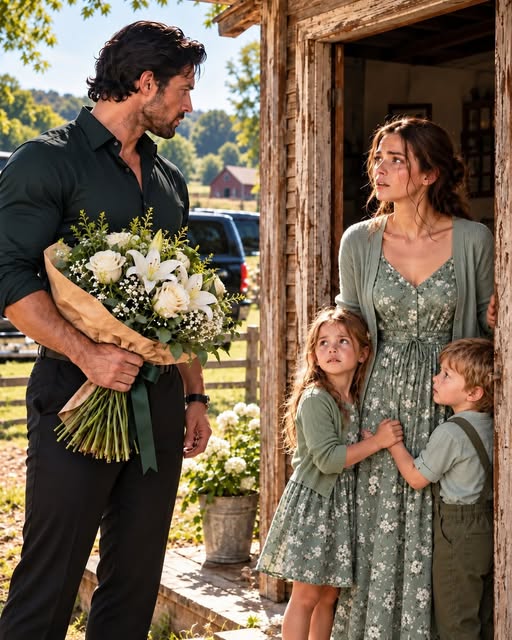
One year after Daniel Whitmore appeared on my porch holding white roses, I stood in the same doorway watching him teach our daughter how to change a bicycle tire.
The sun was setting over the Kentucky hills.
The fields glowed gold.
Violet was kneeling beside her bicycle, her long brown hair tied into a messy ponytail.
Ben sat nearby, wearing his favorite green overalls and supervising the entire operation with the seriousness of a five-year-old who believed he was in charge of everything.
Daniel had grease on his hands.
His expensive watch lay forgotten on the porch railing.
And when Violet accidentally dropped a wrench onto his foot, he hopped backward and let out a startled yelp.
Both children burst into laughter.
“Daddy, you're supposed to catch it!” Violet shouted.
“I'll remember that next time,” Daniel replied.
Ben shook his head.
“Daddy Daniel needs more practice.”
My heart warmed.
The name still surprised me sometimes.
Daddy Daniel.
Ben had invented it himself six months earlier.
He understood that Daniel was Violet's biological father, not his own. We'd spoken openly about Clara, the mother who had loved him first, and about the different ways families came together.
For a while, Ben had simply called Daniel “the flower man.”
Then he'd changed it to “Mr. Daniel.”
One evening, after Daniel read him three bedtime stories and helped him find his missing toy rabbit, Ben looked up and asked, “Can I call you Daddy Daniel?”
Daniel had glanced at me.
I told Ben the choice was his.
Daniel's voice trembled when he answered.
“I'd be very happy if you wanted to.”
Since then, the name had stayed.
And somehow, hearing it no longer made me afraid.
But our journey to that peaceful evening had been anything but easy.
There were weeks when I questioned every decision.
Days when old memories returned without warning.
Nights when I woke from dreams about the mansion and had to remind myself that the farmhouse belonged to me, that my children were safe, and that nobody could force us out.
Healing wasn't a straight road.
It was more like the winding dirt path behind our barn.
Sometimes beautiful.
Sometimes muddy.
Sometimes leading somewhere unexpected.
The legal investigation had continued for months.
Independent forensic accountants reconstructed the foundation transactions using banking records, electronic logs, company filings, and witness statements.
The findings confirmed what I'd known all along.
I had not stolen the $2.4 million.
The transfer had been part of a scheme involving concealed investment losses, false accounting entries, and businesses connected to Charles Mercer.
The original allegations against me were formally discredited.
The fraudulent claim against my farmhouse was withdrawn, and the relevant records were corrected.
Rebecca also helped me secure an agreement protecting my property from further claims arising from the fabricated debt.
I remembered the day she brought me the signed papers.
We were sitting at my kitchen table.
Violet was at school.
Ben was building a tower of wooden blocks on the living room floor.
Rebecca slid the documents toward me.
“It's over, Emily. At least the fight over this fabricated debt is.”
I looked at her.
“Really?”
She smiled.
“Really.”
I read the papers twice.
Then I started crying.
Not beautiful, delicate tears.
The kind of crying that comes from somewhere deep inside your chest.
The kind that makes breathing difficult.
The kind you don't know you've been holding back for nearly a decade.
Rebecca came around the table and hugged me.
“You did it.”
I shook my head.
“We did it.”
And that was the truth.
I hadn't survived because one billionaire finally decided to save me.
I'd survived because I learned how to stand up for myself.
Because Rebecca believed me.
Because my neighbors showed up.
Because Ruth Bell finally told the truth.
Because my children gave me reasons to get out of bed on days when I thought I couldn't.
And because somewhere along the way, I stopped believing that being abandoned meant I was unworthy of love.
Charles Mercer was eventually charged in connection with the financial misconduct and falsified records. Months later, he entered a guilty plea to several offenses and agreed to cooperate with investigators pursuing the remaining questions.
His consulting business collapsed.
The development company abandoned its disputed claim.
The county required additional reviews before proceeding with any large-scale commercial project along the creek.
Judith Whitmore also faced legal consequences for her involvement in the concealment and related false documentation.
She accepted a negotiated resolution involving a guilty plea to an obstruction-related offense, financial penalties, and restrictions on her involvement with the family foundation.
She lost her leadership position in the Whitmore family office.
For the first time in her life, her name could not protect her from accountability.
I didn't celebrate.
Not because I felt sorry for her.
But because watching someone face the consequences of their actions was different from wanting to see them suffer.
I didn't want Judith destroyed.
I wanted her to stop hurting people.
And most importantly, I wanted her to have no power over my children.
One afternoon, she sent me a letter.
It arrived in a plain white envelope.
Inside was a handwritten apology.
She admitted that she'd treated me unfairly because of my background.
She acknowledged that she had interfered with my attempts to contact Daniel.
She wrote that she regretted depriving Violet of the opportunity to know her father.
At the end, she asked whether she might eventually meet her granddaughter.
I read the letter three times.
Then I placed it in a drawer.
I didn't respond immediately.
Forgiveness wasn't something I owed on demand.
And being related to Violet didn't automatically give Judith the right to enter her life.
Daniel and I agreed that any future contact would depend on demonstrated change, professional guidance, and Violet's well-being.
For now, distance was the healthiest choice.
Daniel supported that decision without argument.
That mattered.
Because one of the greatest changes in him was that he no longer treated his mother's wishes as more important than everyone else's.
He had also changed his own life.
The board ultimately appointed a new permanent chairman of Whitmore Holdings.
Daniel remained a shareholder, but he gave up executive control and cooperated with the company's governance reforms.
For a while, he struggled.
He had spent his entire adult life believing that being powerful meant being successful.
That success meant controlling everything.
That his value depended on whether other people respected his name.
Without the title, he seemed almost lost.
One afternoon, we were sitting on the porch while the children played in the garden.
He looked toward the hills.
“I used to wake up every morning knowing exactly what I was supposed to do,” he said.
I glanced at him.
“And now?”
He smiled sadly.
“Now I have no idea.”
I handed him a glass of iced tea.
“Welcome to being human.”
He laughed.
A real laugh.
The kind I hadn't heard since we were young.
“I suppose I deserve that.”
I looked at him.
“Daniel, not knowing what comes next isn't failure.”
He considered the words.
“Then what is it?”
“Sometimes it's the beginning of finding out who you actually are.”
He looked toward Violet.
She was trying to convince Ben that worms were excellent garden helpers.
Ben was unconvinced.
Daniel smiled.
“I think I'm starting to figure that out.”
He rented a small house about twenty minutes from the farm.
Not a mansion.
Not a luxury estate.
Just a comfortable home with a kitchen that was always slightly messy and a backyard where Violet could practice riding her bicycle.
He still had considerable wealth.
But he stopped using it to solve every problem.
When my greenhouse needed repairs, he offered to pay for everything.
I refused.
Instead, he helped me compare contractors, carried lumber with Henry, and spent a Saturday replacing damaged shelves under the supervision of a builder who knew considerably more than he did.
He learned to distinguish compost from potting soil.
He learned that Ben preferred the crusts cut off his sandwiches.
He learned that Violet became quiet when she was disappointed and talkative when she was nervous.
He learned to arrive early for school events because the parking lot filled quickly.
He learned that a promise made to a child was not something that could be rescheduled by an assistant.
And once, he learned that lesson the hard way.
It happened during Violet's spring recital.
Daniel had promised to be there.
He had written the date on his calendar, talked about it for weeks, and even helped her practice her song.
But that afternoon, an urgent call from the investigators delayed him in Lexington.
He didn't arrive until the performance had ended.
Violet was devastated.
She tried to pretend she wasn't.
But when she got into my truck, she stared out the window and whispered, “I thought he was coming.”
My heart broke.
I wanted to call Daniel and tell him never to disappoint her again.
I wanted to protect her from every painful feeling he'd ever caused me.
But I knew I couldn't control the world.
I could only teach her how to live in it.
That evening, Daniel came to the farmhouse.
He didn't bring gifts.
He didn't make excuses.
He asked whether he could speak with Violet.
I sat nearby while they talked.
“I'm sorry I missed your performance,” he told her.
Violet looked at her shoes.
“You promised.”
“I know.”
“I kept looking for you.”
Daniel closed his eyes briefly.
Then he nodded.
“You had every reason to expect me.”
She wiped her cheek.
“Mommy came.”
“Yes.”
“And Grandma Martha came.”
“Yes.”
“And Ben waved even though he wasn't supposed to.”
Daniel smiled faintly.
“I wish I'd seen that.”
Violet looked up.
“Then why didn't you?”
He took a breath.
“Because I made a bad decision about my time. I should have planned better. And I should have called your mommy as soon as I realized I might be late.”
She thought about that.
“Are you going to miss everything?”
His face changed.
“No, sweetheart. But I can't promise I'll never make a mistake. I can promise I'll take my responsibilities to you seriously and tell you the truth.”
Violet stared at him for a long time.
Then she reached into her school bag.
She pulled out a program from the recital.
Across the front she'd written his name.
DADDY — RESERVED SEAT.
She handed it to him.
“I saved this.”
Daniel looked at it.
His eyes filled with tears.
“Thank you.”
“Next time,” Violet said firmly, “you need to come earlier.”
He nodded.
“You're right.”
There was no instant hug.
No dramatic reconciliation.
But when Daniel returned for her next school event, he arrived forty minutes early.
And Violet smiled when she spotted him.
That was how trust returned.
Not through expensive apologies.
Through ordinary, repeated acts of love.
The greatest change between Daniel and me happened slowly.
At first, we spoke only about the children.
School schedules.
Medical appointments.
Bedtimes.
Boundaries.
Then we began talking about the farm.
My business.
His plans.
The mistakes we'd made.
Some conversations were easy.
Others left us both crying.
We eventually began attending counseling together, first to learn how to co-parent and later to address the wounds our marriage had left behind.
I told him things I'd never been able to say nine years earlier.
I told him how humiliated I'd felt walking down the mansion steps in the rain.
How terrified I'd been during my pregnancy.
How lonely the hospital room had felt when Violet was born.
How difficult it had been to hear other children call for their fathers.
Daniel listened.
Sometimes he cried.
Sometimes he asked questions.
But he never told me to stop remembering.
And he never insisted that his own pain canceled mine.
He told me about the years after our divorce.
He'd thrown himself into work.
He had never remarried.
He'd dated occasionally, but never allowed anyone close enough to build a life with him.
He told me that on our wedding anniversary each year, he would find himself remembering the little church where we'd made our vows.
I didn't know what to say.
Part of me felt sad.
Another part felt angry.
Because he had spent those years with the freedom to miss me from a distance.
I had spent them raising our daughter.
“I loved you,” I told him one evening.
We were sitting beneath the maple tree.
The children were asleep.
“I loved you so much that I almost forgot who I was.”
Daniel looked down.
“I know.”
“And I can't ever do that again.”
He turned toward me.
“I wouldn't ask you to.”
I studied his face.
“Then what are you asking?”
He took a long breath.
“Nothing you're not ready to give.”
His voice trembled.
“I love you, Emily. I never really stopped. But I understand now that loving someone isn't the same as treating them well.”
I felt tears rise.
He continued.
“If all you ever want from me is to be a good father to Violet and a dependable person in Ben's life, I'll respect that.”
I looked at him.
“And if I never want to be your wife again?”
He swallowed.
“Then I'll still show up for the children. And I'll still be grateful you let me know them.”
That was the moment something inside me changed.
Not because he said he loved me.
I'd heard those words before.
But because he was finally willing to love me without demanding ownership of my future.
For the first time, I felt free to choose him.
Or not choose him.
And freedom made all the difference.
Several months later, I invited him to dinner.
Not because Violet asked.
Not because Ben wanted someone to help build his wooden train set.
Because I wanted Daniel there.
I made roast chicken with rosemary potatoes, the same meal I'd cooked for him on our first anniversary.
He recognized it immediately.
His eyes widened.
“Emily…”
I smiled nervously.
“Don't make too much of it. I had leftover rosemary.”
He laughed.
“Of course.”
After dinner, we walked into the garden.
The roses were blooming.
The air smelled of honeysuckle.
And for the first time in nearly ten years, I reached for his hand.
He stopped walking.
Looked down.
Then looked at me.
“Are you sure?”
I nodded.
“I'm sure I want to hold your hand.”
He smiled.
“That sounds like a good place to start.”
We began dating again.
Slowly.
Carefully.
Like two people learning each other for the first time.
Because in many ways, we were.
I was no longer the young woman who had believed love could survive anything without being protected.
Daniel was no longer the man who thought loyalty meant never questioning the people closest to him.
We had changed.
We had scars.
We had children who needed stability more than grand romantic gestures.
And we had a second chance neither of us wanted to waste.
One evening, almost two years after Daniel first arrived at the farmhouse, he took me back to the little church where we'd been married.
It was a quiet Sunday afternoon.
The building was empty.
The stained-glass windows painted soft colors across the wooden pews.
I looked around.
Everything seemed smaller than I remembered.
Daniel stood beside me.
“Do you remember what you said before we walked down the aisle?”
I laughed.
“I said your tie was crooked.”
He smiled.
“You did.”
“And you said it didn't matter because you'd be looking at me.”
His expression softened.
“I meant it.”
I turned toward him.
“I know.”
We stood in silence.
Then he reached into his pocket.
My breath caught.
But instead of producing an enormous diamond ring, he took out a small velvet box.
Inside was my original wedding ring.
The one I'd left on his desk nine years earlier.
I stared at it.
“You kept it?”
He nodded.
“Every day.”
My eyes filled with tears.
“Daniel…”
He didn't kneel.
He didn't try to turn the moment into a spectacle.
He simply held the box between us.
“I don't want to pretend the past didn't happen,” he said. “And I don't want you to feel obligated to take this back.”
I looked at the ring.
He continued.
“I was given your trust once, and I failed to protect it. If you ever decide you want to marry me again, I'll spend the rest of my life treating that choice with the respect it deserves.”
Tears slipped down my cheeks.
“And if I don't?”
He smiled gently.
“Then this ring stays a reminder of what I should never have taken for granted.”
I looked at the man standing before me.
Not the billionaire who'd once ordered me out of his mansion.
Not the frightened husband who'd believed a lie.
Not the stranger who'd appeared on my porch carrying flowers.
The man who had spent nearly two years showing up.
Who'd sat through parent-teacher conferences.
Who'd cleaned up spilled lemonade.
Who'd listened when I was angry.
Who'd respected me when I said no.
Who'd become a father through consistent love rather than a blood test.
And who'd learned that trust was not something he could buy.
I took the ring from the box.
Then I placed it in his palm.
He looked confused.
“Emily?”
I smiled through my tears.
“If we're going to do this again, I don't want to put the old marriage back on.”
His face changed.
I continued.
“I want to build a new one.”
For a moment, he couldn't speak.
Then he pulled me gently into his arms.
And I let him.
I rested my head against his chest.
His heartbeat was fast.
So was mine.
But for the first time in years, I wasn't afraid of what would happen when he let go.
Because I finally understood that my life would remain mine.
With or without him.
And choosing to share it was entirely different from depending on him to give it meaning.
We married six months later.
Not at the Whitmore mansion.
Not in a luxury hotel.
Not beneath chandeliers surrounded by important strangers.
We married in the garden beside our farmhouse.
The same garden where I'd planted roses during the loneliest year of my life.
Violet wore a sage-green dress and carried a small bouquet of white lilies.
Ben wore suspenders and proudly announced to everyone that he was “the official ring captain.”
Henry walked me down the short garden path.
Martha cried before the ceremony even began.
Rebecca stood beside me as my witness and closest friend.
Ruth Bell sat in the front row, holding a handkerchief and smiling through tears.
The guests were neighbors, friends, and people who had helped our family survive.
There were no photographers from society magazines.
No celebrities.
No enormous security detail.
Just the people who mattered.
Daniel stood beneath an arch covered in flowers.
When he saw me, his eyes filled with tears.
And when I reached him, he whispered, “You look beautiful.”
I smiled.
“You said that the first time.”
“I remember.”
“Then remember the rest.”
He nodded.
“Every word.”
We wrote our own vows.
Daniel spoke first.
“Emily, when I married you the first time, I promised to give you everything.”
He paused.
“I thought everything meant a beautiful home, financial security, and a life without worry.”
His voice trembled.
“I didn't understand that the most important things I could give you were trust, honesty, and the freedom to be yourself.”
Tears filled my eyes.
He continued.
“I cannot give you back the years we lost. But I can promise that I will never again let pride become more important than the truth.”
He looked toward Violet and Ben.
“And I promise both of our children that I will keep showing up, especially when life is difficult.”
Violet wiped her cheeks.
Ben leaned toward Henry and whispered loudly, “Is Daddy Daniel crying?”
Everyone laughed softly.
Daniel laughed through his tears.
“Yes, buddy. I am.”
When it was my turn, I looked at the man I'd once believed I would never trust again.
“Daniel, when I left your house nine years ago, I thought my life was over.”
My voice shook.
“But it wasn't.”
I glanced toward our children.
“It was the beginning of a life that taught me how strong I could be.”
Daniel nodded.
“I learned that love cannot survive without respect. That forgiveness cannot be demanded. And that trust must be earned through actions, not promises.”
I took his hand.
“I choose you today not because I need someone to save me.”
My eyes filled.
“But because you've learned how to stand beside me without trying to own the life I've built.”
He squeezed my fingers.
“And because after everything, I believe we can make something beautiful from what was broken.”
When the minister pronounced us husband and wife, Daniel kissed me gently.
Violet cheered.
Ben threw his flower petals into the air all at once.
Some landed in Daniel's hair.
Everybody laughed.
And I laughed too.
Not because the past had disappeared.
Not because our lives were suddenly perfect.
But because happiness no longer felt like something I had to earn by being loved by the right person.
It belonged to me.
It belonged to my children.
And now, by our own choice, we were sharing it with Daniel.
That evening, after the guests had left, I stood on the farmhouse porch in my simple ivory dress.
The sky was filled with stars.
Violet and Ben had fallen asleep upstairs, exhausted from dancing and eating too much wedding cake.
Daniel came outside carrying two glasses of lemonade.
I laughed.
“Lemonade?”
He smiled.
“It seemed appropriate.”
I accepted a glass.
We stood together in the quiet.
The same porch.
The same fields.
The same wooden doorway where he'd appeared two and a half years earlier.
I looked toward the steps.
“Do you remember the flowers you dropped?”
Daniel nodded.
“Every single one.”
“I was so angry with you.”
“I know.”
“And terrified.”
His expression softened.
“I know that now.”
I turned toward him.
“Do you know what frightened me most?”
He shook his head.
“That after nine years, I still remembered what loving you felt like.”
Daniel's eyes filled.
He set his glass down.
“Emily…”
I smiled.
“But I also knew that remembering love wasn't enough.”
He nodded.
“No.”
I stepped closer.
“You had to become someone I could trust with my life again.”
He touched my cheek.
“And you gave me the chance to try.”
I shook my head gently.
“You made the choice to change. That's yours.”
He smiled through his tears.
Then he wrapped his arms around me.
We stood there for a long time, listening to the summer insects and the quiet rustling of leaves.
Eventually, I looked through the open doorway.
On the wall beside the kitchen hung two photographs.
The first was our original wedding picture.
Young.
Hopeful.
Beautifully unaware of what life would bring.
Beside it was a photograph taken that very afternoon.
Daniel and me beneath the garden arch.
Violet smiling between us.
Ben standing proudly in front, holding his little wooden ring box.
Four people.
One family.
Not perfect.
Not untouched by pain.
But together.
And underneath the second photograph, Violet had placed a handwritten card.
I walked inside and read it again.
HOME IS WHERE PEOPLE COME BACK, TELL THE TRUTH, AND STAY.
My eyes filled with tears.
Daniel stepped beside me.
“She wrote that herself?”
I nodded.
“Yes.”
He looked at the words for a long time.
Then he whispered, “She's wiser than I was.”
I leaned against him.
“She has good teachers.”
He kissed my forehead.
Later that night, as we prepared to turn off the porch light, I noticed something beside the front door.
A fresh bouquet of white roses and lilies.
Wrapped in brown paper.
Tied with a dark green ribbon.
Just like the flowers Daniel had brought on the day he returned.
I looked at him.
“You remembered.”
He smiled.
“I wanted to get it right this time.”
I lifted the bouquet.
The flowers smelled sweet and fresh.
For a moment, I remembered the frightened woman who had stood in this doorway two and a half years earlier, shielding her children from a man she once loved.
I wished I could reach back through time and tell her something.
That she would survive.
That the truth would come out.
That her children would be safe.
That the home she'd built with her own hands would remain hers.
And that one day, she would understand that forgiving someone didn't mean forgetting what they had done.
It meant no longer allowing the past to control her future.
Daniel touched my hand.
“Are you happy, Emily?”
I looked around.
At the farmhouse.
At the pictures.
At the shoes our children had left beside the stairs.
At the man who had finally learned how to love without making promises he couldn't keep.
Then I looked into his eyes.
“Yes,” I whispered. “I really am.”
He smiled.
And together, we stepped inside.
I closed the wooden door.
Not because I was afraid of losing anything.
Not because I was trying to keep the world away.
But because everything that mattered was already home.
Nine years earlier, Daniel Whitmore had closed the door on me without listening to a word I said.
Two and a half years ago, he'd stood outside my farmhouse holding white flowers, desperate for a second chance.
And now I finally understood the difference between those two moments.
The first door had closed because someone else decided I wasn't worth believing.
The second had opened because I knew, beyond any doubt, that I was.
And this time, when Daniel reached for my hand, I took it.
Not because I couldn't live without him.
But because I knew I could.
And I chose to love him anyway.
THE END