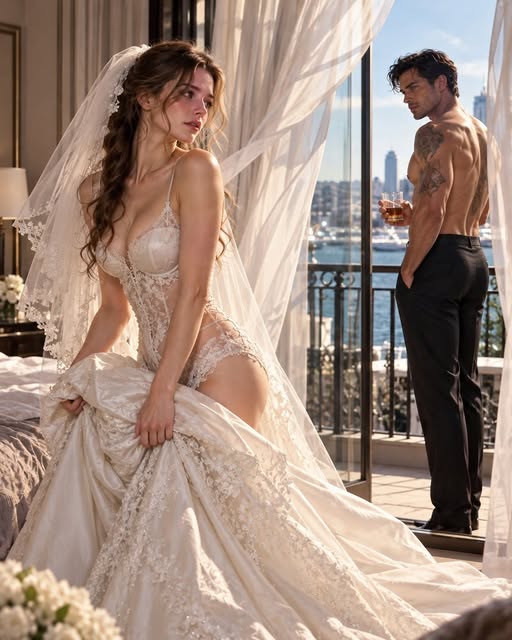
At 11:17 P.M. on my wedding night, my husband looked at me in my six-thousand-dollar wedding dress and said, "You mean nothing to me, Audrey."
We had been married for nine hours.
Graham Vale stood by the window of the master bedroom with a glass of bourbon in his hand, still wearing his wedding suit, his tie loosened, his dark hair untouched by the long day. Below us, Beacon Hill glowed through the tall windows of the brownstone he had restored down to the last brass hinge. The photographers were gone. The guests were gone. The string quartet, the flowers, the three hundred people who had watched Boston's most feared mafia boss slide a ring onto my finger — all of it was gone, and what was left was the contract underneath the ceremony.
"Take it off," he said.
I glanced down at the dress. "Excuse me?"
"The dress. The photographers are gone. You don't have to perform anymore."
I reached behind me, slowly unzipped the gown, and stepped out of it in my silk slip. I draped it over a chair like it was laundry. Six thousand dollars of Italian lace, folded over a chair in the dark.
Graham poured himself more bourbon. "This marriage changes nothing."
"How romantic."
He ignored that. "Your father's debt will be cleared on Monday. You'll have access to the household accounts. We'll attend the necessary events together. We sleep in separate bedrooms. We appear in public when the family requires it."
"And after eighteen months?"
"We divorce. Quietly."
Then he looked directly into my eyes, and I understood that everything before that moment had been rehearsal.
"No scandal. No sentimental misunderstandings. You mean nothing to me, Audrey."
I felt the words like a slap — not because they surprised me, but because some stupid, buried part of me had spent nine hours hoping the man who had held my hand at the altar without trembling might be something other than what everyone said he was.
I refused to cry in front of him.
"All right," I said.
His expression shifted. He hadn't expected agreement.
I picked up my dress. "Then you don't get to decide what I become while I'm here."
His jaw tightened. "I didn't buy you."
I looked at him over my shoulder. "My father owed your family three point eight million dollars. Your mother offered to erase it if I married you." I paused at the door. "You can call it whatever helps you sleep."
Then I walked into the second bedroom, closed the door, and locked it.
Only then did my hands start shaking.
Three months earlier, I had been living alone in Cambridge, in a one-bedroom apartment with a dying fern and a job I genuinely loved. I was a compliance consultant. Companies hired me to read the documents nobody else wanted to read — inspection logs, subcontractor chains, sign-off sheets, audit trails — and to find the one line in ten thousand that didn't belong there. I was very good at it. I had built a quiet, orderly life, and I guarded it the way other people guard fortunes.
Then my father's manufacturing company collapsed.
Lennox Manufacturing had stood for thirty-one years. It employed one hundred and seventeen people in South Boston, people who had come to my parents' Christmas parties, whose kids I had grown up with. One bad year, two lost contracts, and a loan structure that turned like a knife — and suddenly the company was underwater, the employees were facing the street, and my parents' house, the house I learned to ride a bicycle in front of, was ninety days from seizure.
And the largest outstanding loan on my father's books belonged to the Vale family.
That's when Charlotte Vale arrived at my apartment with an offer.
She was sixty-two, silver-haired, immaculate, and terrifying in the way only a woman who has buried a son and outlived a husband's empire can be terrifying. She sat in my kitchen, declined tea, and laid the terms out like cards.
Marry her son. Stay married for eighteen months. And the three point eight million would disappear — the company saved, the employees kept, the house kept.
There was a second reason, and she didn't hide it. Graham's grandfather had left voting shares in a trust, shares that could only be released to Graham if he was married — a relic of an old man's belief that a settled man was a trustworthy one. Without those shares, Graham's uncle Everett could force a breakup of the family's legitimate businesses — the shipping routes, the waterfront properties, the security companies — and sell them off piece by piece. With them, Graham could stop him.
"Why me?" I asked her. "He could marry anyone."
"Because you are in no position to refuse," she said, "and because you are not a fool." Then, when I asked the question I already knew the answer to — why a man like Graham Vale needed to marry a stranger at all — her face changed.
"Because my son refuses to marry anyone he loves."
I didn't understand that sentence until she told me about Miles.
Miles Vale, Graham's younger brother, had died four years earlier when a temporary platform collapsed at a waterfront construction site. He was twenty-six. He had gone down to the site that morning because a foreman had called in sick and Miles, who believed no Vale should ask men to stand anywhere he wouldn't stand himself, had gone to walk the platform in his place.
The subcontractor responsible for the platform's structural inspections was my father's company.
Graham had never forgiven him. In four years he had never spoken my father's name without it sounding like a verdict. And now, by his mother's design and my father's desperation, he had married the man's daughter.
I signed anyway. One hundred and seventeen families ate because I signed. That's what I told myself at the altar. That's what I told myself at 11:17 P.M., in a silk slip, in a locked bedroom, with my hands shaking too hard to undo my earrings.
The night after Charlotte's offer, I drove to South Boston and let myself into my father's factory with the key I'd had since I was nineteen.
The floor was dark and enormous and smelled of machine oil and cold steel. I walked it the way I had as a girl, between the presses my grandfather had bought on credit and my father had maintained like altarpieces, and I stopped at the shift board by the time clock — one hundred and seventeen names in my father's tall-looped handwriting, each with a start time, a station, a life arranged around both. R. Okafor, whose daughter was in pharmacy school. The Brennan brothers. Old Sam Whitaker, who had taught me to drive a forklift and sworn, on my life, never to tell.
My father found me there at midnight. He didn't ask what I was doing. He stood beside me and looked at the board the way men look at ships going down in paintings.
"Meridian pulled the Harborpoint subcontract payout again," he said at last. "If the Vale loan is called, this board comes down in ninety days. That's the whole of it, Audrey. There's no version where I save it by being clever."
"I know," I said.
"Then you know I'm not asking you to do what that woman's asking."
"I know that too." I put my hand flat against the board, over the names. "You never asked. That's why I can."
He was quiet a long time. "Your mother'll say I sold you."
"Mother will say a lot of things. Let the record show the seller." I took my hand down. "A careful man keeps records, Dad. So does his daughter."
The wedding was held three weeks later, in a ballroom so beautiful it felt like an insult.
Three hundred guests. Orchids flown in during a snowstorm. A string quartet, a seven-tier cake, and a receiving line of men who shook my hand while calculating what my marriage was worth to them. My mother cried through the entire ceremony — relief, mostly, though she would never have said so. My father stood beside her looking ten years older than he had in the spring, a man attending his own rescue like it was a funeral.
He had tried, once, to stop it. The morning Charlotte's offer arrived, he took my hands in the kitchen of the house that was about to be seized and said, "You don't have to do this, Audrey. Not for me."
"One hundred and seventeen families, Dad," I said. "It's not just for you."
He wept then, and I understood that everyone at my wedding would think I had sold myself, and that only I would ever know the exact price list — and that my father would have to live inside that arithmetic for the rest of his life.
Graham waited at the altar like a man at a closing. Not nervous. Not cold, exactly — sealed. When I reached him, his hand, taking mine, did not tremble at all, and I remember thinking that a man who could stand that steady either felt nothing or had buried what he felt so deep it would take an excavation to find it.
His uncle gave the toast.
Everett Vale was fifty-eight, silver at the temples, with the warm, avuncular smile of a man who has never once needed to raise his voice to ruin someone. He lifted his glass toward us and said, "To my nephew — who has always understood that in this family, duty comes before the heart." The room applauded. It sounded, to everyone else, like praise. I watched Graham's face over the rim of my glass and saw his jaw set, and understood that in the Vale family, even a toast was a move on a board.
We danced once, because the photographers required it. His hand rested at my waist, correct and distant as a business associate's. Halfway through the song, I heard a woman's voice behind us, not quite low enough: "That's the Lennox girl. Her father was the one whose company—"
Graham turned me, smoothly, mid-step, so that my back was to the voice and his body was between me and the rest of the sentence. He didn't look at me when he did it. He didn't acknowledge it. He finished the dance, thanked me as if I'd handed him a document, and walked away to shake the hands of men who feared him.
I filed the moment away — the first entry in a file I didn't yet know I was building. The file of everything Graham Vale did that contradicted everything Graham Vale said.
Our new life began the next morning, in the restored Beacon Hill brownstone. Graham took the third floor. I took the second. The staff moved between us like weather.
On my first morning, I found an eight-page household schedule on the kitchen counter — meals, staff rotations, security protocols, event calendar. At the bottom of the last page, in a hard, slanted hand, he'd written:
Thursday. Calder Museum fundraiser. Car at 6:40.
I picked up a pen. "How romantic," I wrote beneath it.
The next morning, a reply had appeared under mine, in the same slanted hand:
I'm trying not to overwhelm you.
I smiled despite myself. "Your concern is touching," I wrote back.
That evening: I have many hidden qualities.
I laughed — out loud, alone in that enormous kitchen — and then I went still, because it frightened me. It was the first time I had laughed since my wedding, and it had been caused by a man who had told me, in complete sincerity, that I meant nothing to him.
And then I began noticing things about Graham Vale that did not fit the verdict.
He knew the doorman's daughter was applying to colleges and asked, by name, how the essays were going. He tipped delivery drivers like he was apologizing to them. When he couldn't sleep — which was often — he cooked, alone, at two in the morning, and left the kitchen cleaner than he found it. He read history books at midnight in the library with his sleeves pushed up and a pencil behind his ear, and he looked, in those moments, less like a boss and more like a man standing guard over a grave only he could see.
And sometimes, when Graham thought I wasn't looking, he watched me with an expression that didn't resemble hatred at all.
Which left me wondering why the most feared mafia boss in Boston seemed to be fighting so hard against the possibility of caring about his own wife.